India and France are seeking to extend a partnership built over six decades—from scientific missions and launch technologies to human spaceflight, climate observation and private-sector collaboration. The opportunity is substantial, but turning diplomatic intent into strategic capability will depend on sustained programmes, clear division of work and meaningful pathways for industry and start-ups.
Chaitali Bag
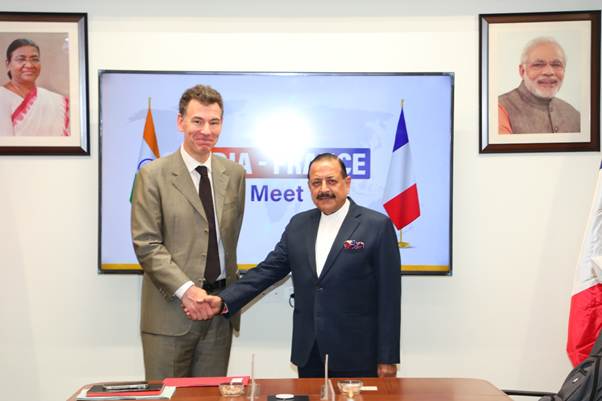
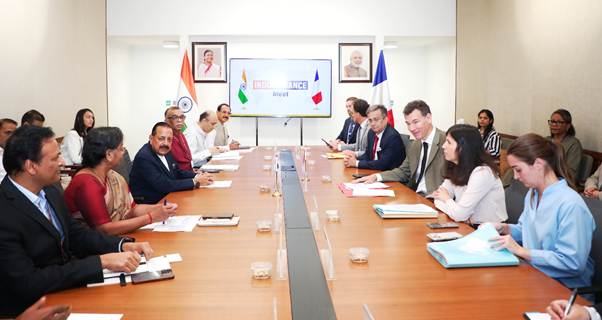
The meeting in New Delhi between India’s Science and Technology Minister of State, Dr. Jitendra Singh, and a French delegation led by Minister for Higher Education, Research and Space Philippe Baptiste, reflects a widening of the India–France space relationship. The agenda reached beyond government-to-government cooperation to include human spaceflight, microgravity research, start-ups, innovation, Earth observation and the wider scientific partnership.
The relationship has a long institutional memory. The supplied announcement traces it from sounding rocket experiments in the 1960s to joint satellite missions, launch-vehicle technologies and support for India’s Gaganyaan programme. Its next phase will be judged by whether that history can support a broader, more connected ecosystem—one that links agencies, laboratories, established aerospace firms, and newer companies in both countries.
A partnership with accumulated technical experience
India and France have worked together across several generations of space activity. The joint Megha-Tropiques and SARAL missions demonstrated cooperation in satellite development and Earth observation. The planned TRISHNA mission extends that record, with the two governments describing its realisation as progressing well.
These missions matter because they create more than a spacecraft. They require the partners to coordinate scientific objectives, instruments, engineering responsibilities, data use and operational planning. Repeated collaboration builds working relationships and technical familiarity that can make later projects easier to structure.
The announcement also refers to cooperation in launch-vehicle engine development. It does not specify the technologies or current status of that work, so its present contribution should not be overstated. Taken together, however, the historical examples show a partnership that has included both scientific missions and elements of launch technology—a wider base than cooperation confined to satellite launches or data exchange.
The key question is whether future programmes will deepen this technical interdependence. Joint missions can be valuable symbols, but their strategic and scientific return is greatest when both sides contribute capabilities, share the resulting knowledge and build follow-on work around what they learn.
Human spaceflight moves cooperation closer to the crew
The most consequential new area is human spaceflight. France is supporting India’s Gaganyaan programme, including supplying consumables and training flight surgeons. Indian and French teams have also begun discussions on microgravity research and parabolic flights.
This broadens cooperation from spacecraft and mission science to the human factors that shape crewed missions. Medical preparation, astronaut health, and microgravity research require specialist expertise and sustained coordination. Parabolic flights can provide short periods of reduced gravity for experiments and training, while broader microgravity research can help define scientific objectives for future missions.
The announcement describes discussions and areas of support; it does not announce a joint crewed mission or set out a detailed programme for astronaut participation. That distinction matters. Human spaceflight cooperation is technically demanding and requires carefully defined roles, safety standards, training arrangements and mission objectives. The present discussions are best understood as an opportunity to build practical cooperation step by step.
For India, collaboration with an experienced partner can deepen the scientific and medical dimensions of Gaganyaan. For France, engagement with India’s human-spaceflight programme creates scope for researchers and institutions to contribute to a major national effort. The value will depend on translating exchanges and discussions into defined experiments, training activities and durable research partnerships.
TRISHNA links space science to climate and water decisions
TRISHNA is presented as a flagship example of what the two countries can accomplish together. The announcement connects the mission with water-cycle applications and notes a planned event in Bengaluru on October 11 focused on the mission and its applications.
Earth-observation missions can strengthen environmental monitoring by providing systematic information about land and water systems. Their usefulness, however, depends on more than the satellite itself. Data must be calibrated, made accessible to researchers and public agencies, and translated into information that supports decisions. This is where scientific collaboration can have a direct public value: the partners can work not only on the mission, but also on how its observations are interpreted and used.
The announcement does not provide TRISHNA’s technical specifications, launch schedule or data-access arrangements. Its broader significance is therefore best framed around the cooperation it represents and the applications it is intended to support, rather than claims about specific outcomes that have not been detailed.
From agency partnership to industrial participation
A major change in India’s space sector is the growth of private companies following policy reforms. Dr. Singh cited more than 400 Indian space start-ups working across rocket development, satellite building and space applications. The next phase of India–France cooperation, he argued, should bring these companies into closer contact with government institutions and established industry.
That shift could make the partnership more dynamic. Start-ups may contribute specialised components, software, data services or new business models, while larger firms and public agencies can provide infrastructure, technical assurance and access to missions. Cross-border connections could help companies find research partners and customers and allow institutions to draw on a broader pool of expertise.
But ecosystem collaboration requires more than convening companies. It needs clear routes into programmes: procurement opportunities, joint research calls, test and validation access, intellectual-property arrangements and predictable rules for handling sensitive technologies and data. Without those mechanisms, start-ups may remain visible in strategy discussions but peripheral to the projects themselves.
The India–France Year of Innovation 2026 offers a platform to strengthen those links. Its impact will depend on whether it produces continuing programmes and commercial relationships, rather than a calendar of one-off events. Connecting research institutions and start-ups, as Baptiste welcomed, is a useful first step; sustained funding and pathways to deployment are what turn those connections into capability.
A wider science relationship strengthens the space agenda
The talks also covered biotechnology, digital sciences, ocean sciences and the Blue Economy, including India’s Deep Ocean Mission. These subjects may appear separate from space, but they share scientific and technological foundations: advanced sensors, data processing, robotics, materials, communications and environmental modelling.
Cooperation across these fields can expand the value of the bilateral relationship. Space-based observations can inform ocean and climate research; digital tools can help process large scientific datasets; and advances in materials or biotechnology may support demanding research environments. The announcement does not identify specific joint projects linking these domains. Still, it presents them as part of a broader scientific partnership supported by institutions such as CEFIPRA and Indo-French joint centres.
The advantage of this wider frame is that it can connect space activity to practical research needs on Earth. The challenge is governance: broad agendas need clear priorities, responsible institutions and defined outcomes if resources are to produce measurable results.
The measure of the next phase
The New Delhi discussions signal intent to expand a relationship with a substantial track record. The most promising areas are those where the two countries can build on existing work: TRISHNA and Earth observation; Gaganyaan-related medical and research cooperation; and structured links between research organisations, industry and start-ups.
The partnership’s next phase will require practical answers to several questions. Which projects will move from discussion to implementation? How will researchers and companies gain access to joint programmes? What arrangements will govern data, intellectual property and technology transfer? And how will each side sustain cooperation across changes in budgets, institutional priorities and mission timelines?
India and France have the advantage of decades of trust and a broad agenda for future work. The task now is to give that agenda shape: defined programmes, shared technical responsibilities and routes for new participants to contribute. If they do, the partnership can evolve from a history of successful missions into a more integrated space and innovation ecosystem—one that joins scientific discovery with industrial capability and public benefit.