Chaitali Bag
From indigenous warship construction and submarine collaboration to advanced naval technologies and international industrial engagement, India’s participation at Euronaval 2026 reflected the country’s growing ambition to become a major player in the global maritime defence ecosystem.
India’s presence at Euronaval 2026, held in Paris from 3–6 November 2026, was an important demonstration of the country’s evolving naval industrial capabilities and its ambition to strengthen its position in the international maritime defence market. More than a showcase of indigenous shipbuilding, India’s participation offered an opportunity to reinforce strategic partnerships, explore new avenues for defence exports, and engage international stakeholders on the changing technological and operational requirements of modern navies.
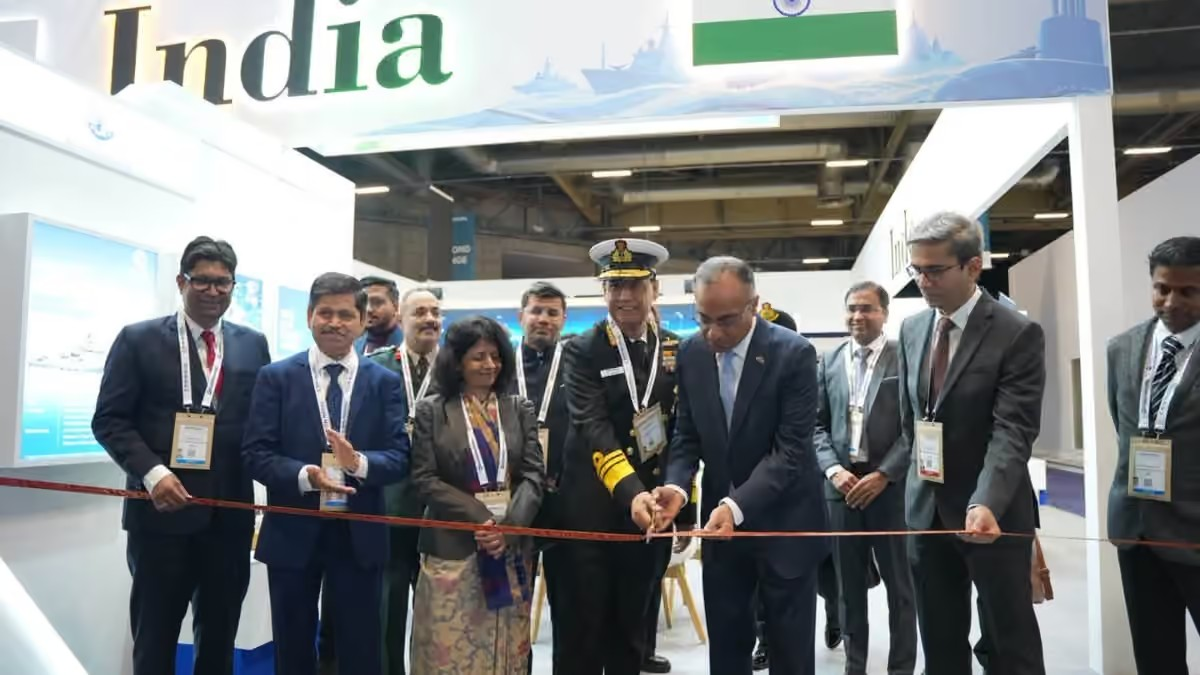
The inauguration of the India Pavilion by India’s Ambassador to France, H.E. Sanjeev Singla, in the presence of Vice Admiral Ajay Kochhar, Vice Chief of the Naval Staff, underlined the institutional importance attached to India’s participation. The pavilion brought together Indian defence shipyards and industry representatives, projecting the country’s growing capabilities in naval construction, submarine manufacturing and maritime technologies.
The larger significance of India’s participation lay in the convergence of three priorities: Aatmanirbhar Bharat, international defence-industrial cooperation and India’s emergence as a credible supplier of naval platforms and solutions.
The engagements of Garden Reach Shipbuilders & Engineers (GRSE), Hindustan Shipyard Limited (HSL) and Mazagon Dock Shipbuilders Limited (MDL) offered different but complementary perspectives on this ambition. While GRSE highlighted India’s indigenous warship-building expertise, HSL focused on evolving naval operational concepts and advanced systems integration, and MDL’s engagement with France’s Naval Group brought renewed attention to the strategic importance of submarine cooperation.
India’s naval industry takes centre stage
Against the backdrop of India’s expanding naval modernisation programme and growing emphasis on indigenous shipbuilding, GRSE’s participation at Euronaval was especially significant. Led by Cmde Vikas Kaushal, IN (Retd.), the delegation showcased the shipyard’s expertise in warships and specialised vessels while engaging with international naval delegations, maritime experts and defence industry representatives. The timing was compelling: just before the exhibition opened, India signed contracts worth ₹53,866.50 crore for eight Next Generation Corvettes, with GRSE building five and Goa Shipyard Limited three. Designed by the Indian Navy and constructed by Indian public-sector shipyards, the vessels mark an important advance in indigenous naval design and capability. These developments highlight India’s ambition to build a world-class shipbuilding base and give GRSE a strong platform to explore international partnerships and future export opportunities.
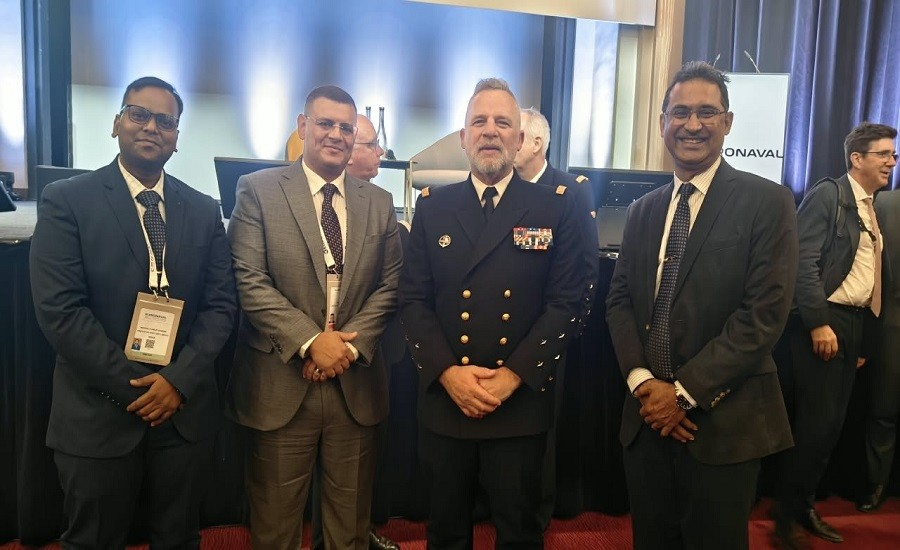
Hindustan Shipyard Limited (HSL) made a valuable contribution at Euronaval 2026, looking beyond ship construction to explore how naval capability evolves across a platform’s entire operational life. Led by R.V. Ramana, General Manager (Production), the HSL delegation engaged with international naval leaders, including Admiral Christophe Kluzel, Chief of Staff of the French Navy, exchanging perspectives on changing maritime requirements and developments in naval defence. HSL’s participation in the panel discussion, “Operating and Supporting Distributed and Hybrid Fleets,” was especially relevant, bringing into focus the forces shaping tomorrow’s fleets: intelligent human-machine teaming, in which technology strengthens awareness while people retain critical decision-making authority; risk-based sustainment that responds to equipment health and operating conditions rather than relying solely on fixed maintenance schedules; and the increasingly sophisticated integration of sensors, software, communications and weapons. Just as importantly, the discussion underscored that dependable lifecycle support—the ability to maintain, upgrade and sustain a platform over decades—is as essential as building it in the first place. These ideas reflect a major shift in how a modern warship’s effectiveness is measured: not simply by its size, propulsion or weapons, but by how seamlessly its systems, software and people work together. For Indian shipyards such as HSL, this opens an exciting and important path forward: combining strong platform construction with advanced systems integration, software resilience and long-term support can strengthen competitiveness in the international market and help deliver naval capabilities ready for the complex demands of the future.
India-France submarine cooperation: The strategic significance of MDL–Naval Group engagement
One of the most consequential industry engagements involving India at Euronaval 2026 was a meeting between Mazagon Dock Shipbuilders Limited (MDL) and France’s Naval Group. MDL Chairman and Managing Director Capt. Jagmohan met Naval Group Chairman and CEO Pierre Éric Pommellet to discuss the future of their long-standing submarine-building partnership.
The talks reportedly explored the possibility of a further submarine project for the Indian Navy, expanded participation by Indian manufacturers and suppliers, and maintenance and supply-chain support for the Kalvari-class fleet. No new construction contract or final financial agreement was announced, but the engagement signals a potentially important step for India’s underwater capabilities.
Building on Project 75
The partnership is grounded in Project 75, through which MDL built six Scorpène-design conventional submarines at its Mumbai facility, with technical assistance and technology transfer from Naval Group:
– INS Kalvari
– INS Khanderi
– INS Karanj
– INS Vela
– INS Vagir
– INS Vaghsheer
Project 75 gave Indian engineers, production teams and suppliers valuable experience in complex submarine construction, systems integration and specialised manufacturing. It also established an industrial foundation for future programmes.
The next phase of cooperation could build on that foundation, not only by considering additional submarines, but by strengthening domestic expertise, broadening Indian industry’s role and improving control over critical supply chains.
A broader focus on indigenisation and support
Submarine construction demands exceptional precision and specialised capabilities, from advanced materials and propulsion to acoustic management, sensors and combat systems. Greater involvement by Indian manufacturers could help develop expertise across these fields while reducing reliance on overseas suppliers.
Long-term support is equally vital. Submarines need specialised inspections, regular servicing and reliable access to critical spares. Discussions about Kalvari-class maintenance and supply-chain management point to a wider vision of cooperation that extends beyond construction to lifecycle support and fleet readiness.
For MDL, the partnership offers access to specialised expertise and a stronger platform for future programmes. For Naval Group, continued cooperation would deepen its role in India’s naval industrial ecosystem. The engagement also reflects the broader India–France strategic relationship, particularly in maritime security and defence manufacturing.
It is important to note that talks about a possible additional submarine programme do not confirm a new contract. Further negotiations, programme decisions and government approvals would be required before any project could move ahead.
Naval Group’s wider engagement with Indian shipyards
Naval Group’s engagement with India’s shipbuilding industry extended beyond Mazagon Dock Shipbuilders Limited (MDL), with the French company also hosting delegations from Goa Shipyard Limited, Cochin Shipyard Limited and Hindustan Shipyard Limited. Discussions explored naval defence technologies and potential cooperation, supported by presentations on submarines, naval drones, hybrid fleets and mine warfare, as well as meetings with Vice Admiral Ajay Kochhar and senior members of the Indian delegation. This broad outreach points to the potential for Indo-French naval cooperation across multiple shipyards and programmes, not just submarines. With India pursuing capabilities ranging from surface combatants and amphibious vessels to autonomous systems and mine-countermeasure technologies, partnerships can draw on the complementary strengths of its shipyards and French expertise. The key will be turning this interest into lasting domestic manufacturing skills and capacity, rather than partnerships focused mainly on procurement.
India’s first dedicated pavilion: An important step in international defence outreach
India’s debut with a dedicated national pavilion was one of the standout developments at Euronaval 2026. More than a symbolic presence, the pavilion showcased a growing institutional commitment to bringing Indian naval manufacturers and maritime technology companies to international markets.
Ahead of the exhibition, Euronaval General Commissioner Guillaume Merveilleux du Vignaux said around ten Indian companies were expected to attend, representing fields such as shipbuilding, electronics, sensors and software. The official exhibition directories offer a glimpse of that diversity, listing Indian firms including Altair Infrasec in the English catalogue, and Sipani Energy in the French edition. These entries, however, should not be taken as a complete record of the companies represented through the pavilion or wider Indian delegations.
The pavilion’s greatest promise lay in opening doors for smaller Indian businesses. By bringing them closer to international naval procurement authorities, shipbuilders, technology providers and potential partners, a coordinated national presence can help overcome a major challenge: reaching global decision-makers and demonstrating technical capabilities.
That opportunity matters for India’s defence industry. Alongside established public-sector shipyards, MSMEs, startups and specialist manufacturers will be vital to deepening domestic capability and indigenisation. Companies developing marine electronics, navigation and communication systems, sensors, autonomous technologies, propulsion components and specialised engineering solutions could also find a place in international supply chains.
Still, an exhibition debut is only the beginning. Converting visibility into lasting business will depend on sustained engagement, product certification, export compliance, reliable after-sales support and strong long-term partnerships.
Indo-French maritime cooperation: A strategic partnership with long-term potential
Euronaval’s engagements underscored the enduring importance of the India–France strategic partnership. France plays a significant role in India’s maritime security outlook, with a presence in the Indian Ocean and territories and military facilities across the wider Indo-Pacific. Both countries share a strong interest in keeping the region stable, open and secure.
Their defence cooperation already spans naval platforms, submarines, aerospace, advanced technologies and industrial manufacturing. A prominent example is the partnership between MDL and Naval Group, which shows how international collaboration can also build India’s domestic manufacturing capabilities.
The next phase offers an exciting opportunity to deepen that industrial partnership. Greater participation by Indian suppliers, advanced engineering, locally developed maintenance capabilities and cooperation on emerging maritime technologies could all help strengthen India’s naval ecosystem. Naval Group’s engagement with MDL, HSL, GSL and CSL points to potential collaboration across multiple sectors, including underwater autonomous systems, mine-countermeasure technologies, digital naval architectures and advanced sustainment.
For India, these partnerships are most valuable when they build lasting technological expertise and support a more self-reliant naval industry. For France, India is a compelling long-term partner, bringing substantial naval requirements, a strong manufacturing base and growing ambitions across the Indo-Pacific.