Staff Correspondent
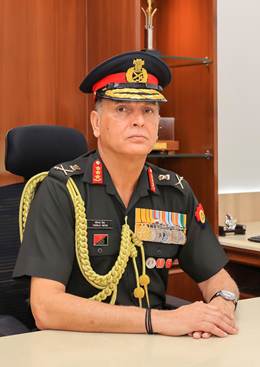
The appointment of Lieutenant General Dhiraj Seth, PVSM, UYSM, AVSM, as the Chief of the Army Staff with effect from the afternoon of 30 June 2026, marks a pivotal moment in the evolution of the Indian Army’s leadership and strategic outlook. This decision, taken against the backdrop of the retirement of General Upendra Dwivedi, PVSM, AVSM, signals continuity in professional excellence while also embodying the adaptive thrust that the Indian Army requires in an era defined by evolving threats, rapid technological change, and complex geopolitical dynamics. An examination of Lieutenant General Seth’s career, his operational commands, institutional responsibilities, contribution to capability development and strategic planning, and his professional military education illuminates why his elevation is consequential for the service’s present imperatives and future trajectory.
A career spanning nearly four decades, commencing with his commissioning into the Armoured Corps in December 1986 after graduating from the National Defence Academy, Khadakwasla, has endowed Lieutenant General Seth with a depth and breadth of experience across the principal domains of military professionalism. The Armoured Corps, historically central to India’s conventional deterrence and battlefield manoeuvre doctrine, inculcates a particular blend of tactical audacity, doctrinal rigour, and technical competence. Lieutenant General Seth’s early immersion in this arm of service and his ascent through its command echelons suggest a grounding in the operational art of combined-arms warfare; this background remains relevant as the Army retools its mechanised formations to meet contemporary requirements for mobility, precision engagement, and survivability in high-intensity conflict scenarios.
Command at every level in diverse operational environments is among the most salient features of Lieutenant General Seth’s record. Command of an Armoured Regiment in the Desert Sector conferred on him the demanding tasks of operating in harsh environmental conditions, managing logistics over expansive terrain, and integrating armoured manoeuvre within joint and combined arms contexts. Command of an Armoured Brigade in the Western Theatre further expanded his grasp of operational-level planning and employment of manoeuvre formations where doctrinal readiness and rapid force generation are imperative. His experience commanding a Counter-Insurgency Force in Jammu & Kashmir reflects another dimension of modern soldiering: the necessity to balance kinetic operations with intelligence-driven, population-centric approaches that require restraint, legal and ethical clarity, and close coordination with civil authorities.
As a Lieutenant General, Lieutenant General Seth’s command of the Sudarshan Chakra Corps, the Indian Army’s premier strike formation, further underscores his proficiency in leading formations constituted and trained for swift, high-tempo operations. The leadership of such a corps demands not only mastery of manoeuvre and deep-battle concepts but also nuanced judgment in escalation management, logistics for sustained offensive operations, and integration with air and electronic warfare assets. Subsequently serving as General Officer Commanding (GOC), Delhi Area, he assumed responsibilities that extended beyond conventional operational stewardship to encompass ceremonial duties, protection of strategic national assets, and the orchestration of high-visibility national and international military engagements. Such a posting cultivates diplomatic acumen, inter-agency coordination skills, and the capacity to represent the Army in the broader architecture of statecraft.
A distinctive and rare aspect of Lieutenant General Seth’s career is his command of two operational Army Commands upon elevation to Army Commander: first South Western Command and thereafter Southern Command, thus acquiring strategic oversight across divergent theatres for a cumulative period exceeding two and a half years. Commanding multiple Army Commands equips a leader with a panoramic understanding of force disposition, theatre-specific challenges, and the interrelationship of regional doctrines with national strategy. The South Western Command, with its traditional emphasis on high-intensity mechanised operations against a peer adversary, and the Southern Command, with its maritime interface and strategic outreach responsibilities, together have exposed him to both land-centric deterrence and cross-domain interoperability considerations. Such experience is invaluable in an era when jointness, theatre integration, and the synchronisation of land, air, maritime and space assets are central to credible deterrence and successful operations.
Beyond operational command, Lieutenant General Seth’s tenure in key staff and strategic appointments has significantly shaped his capacity to influence the Army’s trajectory. His involvement in operational planning, force management and capability development reflects an understanding that modern militaries must institutionalise processes that translate strategic intent into sustainable force structures and procurement decisions. The ability to synthesise strategic-level guidance with the granular realities of manpower, maintenance, training and logistics is a critical competency for a Chief of Army Staff charged with ensuring that the Army remains ready, modern and affordable. Lieutenant General Seth’s stewardship in these domains suggests he possesses the institutional experience to navigate the perennial tensions between present readiness and future transformatory investments.
Indeed, one of the most consequential aspects of his career—particularly relevant to his new role—is his contribution to force modernisation. Lieutenant General Seth has tenanted pivotal appointments in the Strategic Planning and Capability Development verticals at Army Headquarters, where the contours of long-term force structuring and the capability roadmap are determined. In contemporary defence planning, articulating priorities, aligning procurement with operational requirements, and calibrating indigenisation initiatives are tasks of profound strategic consequence. His role in shaping the Army’s modernisation trajectory implies an intimate familiarity with the technological, industrial, and doctrinal levers required to convert conceptual innovations into fielded capabilities. At a time when disruptive technologies—autonomy, artificial intelligence, precision strike systems, networked sensors, and advanced survivability measures—are reshaping the character of land warfare, this expertise enables the Army to respond intelligently to uncertainty while preserving core warfighting competencies.
Complementing his operational and institutional experience is Lieutenant General Seth’s consistent excellence in professional military education. His graduation from the Higher Command Course and the National Defence College, and attendance at the Command & Staff Course in Paris, signify both a commitment to intellectual rigour and exposure to diverse strategic perspectives. The National Defence College inculcates strategic thinking and provides a cross-services and inter-governmental forum for understanding national security in its fullest complexity. The international exposure afforded by the Command & Staff Course in Paris further broadens strategic outlook, fosters interoperability with friendly militaries, and facilitates an appreciation for differing doctrinal approaches and defence cultures. Such educational breadth, coupled with his record of high achievement in courses of instruction, indicates a leader who combines practical command experience with reflective scholarship, an essential combination for navigating the increasingly complex strategic environment.
The timing of Lieutenant General Seth’s appointment is especially salient in light of the myriad challenges the Indian Army confronts. These include a sustained need to deter and, if required, defeat a near-peer adversary along sensitive land borders; manage persistent low-intensity conflict and asymmetric threats; orchestrate disaster response and humanitarian assistance; and contribute to international peacekeeping and defence diplomacy. Simultaneously, the Army must transform structurally and technologically to remain relevant in future conflict milieus. Leadership that understands both the operational exigencies and the imperatives of capability development is therefore indispensable. Lieutenant General Seth’s career suggests that he is well positioned to pursue a balanced agenda that sustains current operational readiness while judiciously steering modernisation initiatives.
The handover from General Upendra Dwivedi, a distinguished soldier in his own right, to Lieutenant General Seth will be closely observed by domestic stakeholders and international partners alike. Continuity in professional competence and institutional stability is essential for signalling deterrent resolve and maintaining operational preparedness. It is equally vital for sustaining confidence among rank-and-file soldiers and among the defence industrial ecosystem. The appointment of a Chief who brings a balanced mix of operational acumen, strategic planning experience, and a modernisation-focused outlook thus serves both substantive and symbolic functions.
Lieutenant General Dhiraj Seth’s appointment as Chief of the Army Staff encapsulates a synthesis of operational depth, institutional leadership and strategic vision. His service record—spanning commanding roles in varied operational theatres, strategic oversight of multiple Army Commands, stewardship of capability development, and strong academic credentials—provides a robust foundation for addressing the Indian Army’s immediate and long-term challenges. As the Army navigates a complex security environment characterized by rapid technological change, multidimensional threats and heightened geopolitical competition, leadership that can harmonise present readiness with transformational initiatives will be indispensable. Lieutenant General Seth’s elevation offers the prospect of such leadership: one informed by practical experience, strategic foresight and a commitment to modernising the force while preserving its core combat capabilities and professional values. The coming years will test his capacity to translate vision into action, but the contours of his career to date suggest a leader well prepared for the task.