
By Kamal Shah
Introduction: The New Paradigm of Geoeconomics
For decades, global industrial strategy was dictated by a singular, unyielding metric: efficiency. The post-Cold War era of hyper-globalization championed the “Just-in-Time” (JIT) manufacturing model, minimizing inventory costs, dispersing supply chains across continents to capture cheap labour, and treating national borders as mere transactional speed bumps. However, the contemporary global landscape has shattered this illusion. Today, the world is shifting from efficiency to resilience, and traditional geopolitics has been fundamentally superseded by geoeconomics, the use of economic instruments to promote and defend national interests and produce beneficial geopolitical results.
The convergence of systemic geopolitical flashpoints—such as the protracted Russia-Ukraine conflict, escalating tensions in the Taiwan Strait, and the volatile West Asia crisis—has exposed the profound vulnerabilities of interconnected supply chains. Wars are no longer isolated battlefield engagements; they are total economic disruptions that trigger massive shocks in energy markets, food security, and manufacturing ecosystems.
For India, this shifting global order presents a fundamental existential question: Are we merely navigating disruption through reactive firefighting, or are we structurally positioning ourselves to lead as a trusted anchor in a reconfigured global order?
To answer this, India must critically evaluate the concepts of industrial resilience and the “war economy.” By blending technological innovation, financial mobilization, and strategic sovereign autonomy, India can transform its Defence Technological and Industrial Base (DTIB) from a position of import-dependence into a resilient, self-sustaining engine of national power.
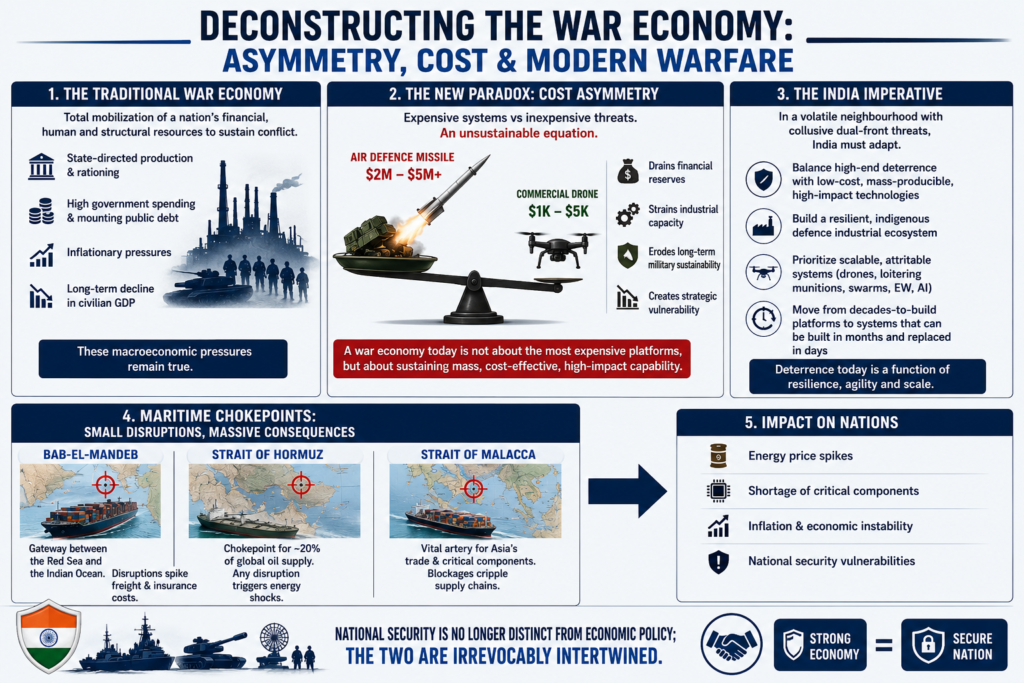
Deconstructing the War Economy: Asymmetry, Cost & Modern Warfare
The traditional concept of a war economy involves the total mobilization of a nation’s financial, human, and structural resources to sustain a conflict. Historically, this meant state-directed production, rationing, high government spending, mounting public debt, and inevitable inflationary pressures, often resulting in long-term declines in civilian GDP. While these macroeconomic pressures remain true, the nature of modern conflict has introduced a stark, destabilizing paradox: the disproportionate cost asymmetry of advanced military hardware against inexpensive, high-impact technologies.
In modern theatres of war, multi-million-dollar air defence missiles are routinely deployed to intercept commercial-off-the-shelf drones costing a few thousand dollars. This economic asymmetry drains the financial reserves and industrial capacities of even advanced nations. A war economy is no longer just about who can build the heaviest tank or the fastest fighter jet; it is about who can sustain mass production of cost-effective, attritable systems while maintaining the resilience to absorb macroeconomic shocks.
For India, situated in a highly volatile neighbourhood characterized by collusive dual-front threats, this cost asymmetry is a critical lesson. India cannot afford to rely solely on exquisitely expensive, imported legacy platforms that take decades to develop and minutes to destroy. The Indian defence ecosystem must pivot toward a model that balances high-end deterrence with low-cost, mass-producible, high-impact technologies.
Furthermore, as witnessed in recent global conflicts, disruptions at maritime chokepoints—such as the Bab-el-Mandeb, the Strait of Hormuz, or the Strait of Malacca—can instantly trigger energy shocks and blockages of critical components. National security, therefore, is no longer distinct from economic policy; the two are irrevocably intertwined.
Redefining Industrial Resilience: Beyond “Just-in-Time” to “Just-in-Case”
Industrial resilience is the capacity of a nation’s manufacturing sector to anticipate, absorb, adapt to, and recover from severe disruptions. Within the context of defence, it requires a profound shift in production and inventory models. The classic JIT model, which minimizes warehousing and holds zero buffer stock, is fatally flawed during a geoeconomic crisis. When a single choked shipping lane or a targeted sanction can halt the supply of a critical microchip or raw material, JIT rapidly transforms into “Too-Late.”
The defence technological and industrial base must transition to a “Just-in-Case” (JIC) philosophy. This involves:
- Strategic Stockpiling: Maintaining deep reserves of critical raw materials, rare earth elements, and sub-assemblies.
- Supply Chain Multi-Sourcing: Moving away from single-source dependencies, particularly from adversarial nations—toward a network of trusted, localized suppliers.
- Capability Agility: Moving away from rigid, long-term program management to a short-term, proactive anticipation model.
Manufacturers must be able to repurpose civilian assembly lines for military production during emergencies rapidly. This level of agility requires the defence ecosystem to abandon reactive logic and adopt predictive modelling, ensuring that industrial output can scale exponentially at a moment’s notice.
Industry 4.0: The Technological Imperative for Defence Autonomy
To achieve the mandate of producing “better, more, faster, and cheaper,” India’s DTIB must integrate Industry 4.0 technologies comprehensively. These digital innovations are not mere buzzwords; they are the architectural pillars of modern industrial resilience.
INDUSTRY 4.0 IN DEFENCE
| Digital Twins | Virtual prototyping & stress-testing assets |
| IoT & Sensors | Real-time supply chain tracking & health checks |
| Predictive AI | Anticipating maintenance before failures occur |
| Additive Mfg | On-demand 3D printing of spare parts in the field |
| Cobotics/Robots | Rapidly scaling production without labour bottlenecks. |
Digital Twins and the Internet of Things (IoT)
A Digital Twin is a dynamic, virtual replica of a physical asset, production line, or supply chain. By leveraging IoT sensors embedded throughout the industrial ecosystem, manufacturers can simulate stress scenarios, identify production bottlenecks before they occur, and optimize resource allocation in real time. In a war economy scenario, a digital twin allows planners to instantly simulate how a shortage of a specific imported alloy would affect an armoured vehicle’s delivery schedule, enabling them to test alternative components virtually.
Predictive Maintenance and Inventory Control
Traditional maintenance operates on a fixed schedule or a reactive basis (fixing things when they break). In a high-intensity conflict, equipment downtime can turn the tide of battle. Predictive maintenance uses artificial intelligence to analyse data from IoT sensors on military hardware and manufacturing machinery, predicting failures before they happen. This optimizes inventory control, ensuring spare parts are manufactured and deployed exactly when and where needed, reducing waste and maximizing operational readiness.
Additive Manufacturing and Cobotics
Additive manufacturing (3D printing) is a game-changer for industrial resilience. Instead of waiting months for specialized castings or forgings to arrive via a disrupted global supply chain, defence installations and factories can print critical spare parts on demand, directly from digital blueprints.
Concurrently, the integration of collaborative robots (cobotics) and advanced robotics ensures that manufacturing facilities can scale up production volumes during a crisis without being bottlenecked by human labor shortages or safety constraints.
The Indian Perspective: Challenges, Imperatives, and Strategic Vulnerabilities
India’s position in this reconfigured global order is unique, complex, and highly challenging. As the world’s largest importer of major arms historically, India faces distinct structural vulnerabilities that require urgent, calculated intervention.
The Macroeconomic Vulnerability: Energy and Commodity Shocks
India imports over 80% of its crude oil requirements. Any conflict in West Asia or along critical maritime trade routes immediately triggers energy shocks that reverberate across India’s macroeconomy. High oil prices widen the current account deficit, fuel domestic inflation, weaken the Indian Rupee, and deplete fiscal resources that would otherwise be allocated to capital acquisitions in defence. Therefore, India’s economic policy must treat energy security as a core pillar of national defence strategy.
The Legacy Dependency Dilemma
A significant portion of India’s legacy military hardware is of Russian/Soviet origin. The ongoing war in Ukraine has severely strained Russia’s own industrial capacity, leading to acute delays in the supply of critical spares, components, and life-extension kits to the Indian Armed Forces. This reality starkly illustrates the dangers of over-reliance on a single foreign nation for the sustainability of defence. It proves that sovereign autonomy cannot exist without industrial autonomy.
The Critical Materials Front
Modern defence hardware relies heavily on critical materials and rare earth elements (such as lithium, cobalt, titanium, and neodymium) required for everything from missile guidance systems to electric vehicle batteries for the military. Currently, China holds a near-monopoly over the processing and supply chains of these materials. For India to achieve genuine industrial resilience, it must secure access to these materials through strategic minilateral partnerships, domestic exploration, and aggressive recycling innovations.
From “Atmanirbhar Bharat” to Global Anchor: India’s Strategic Windows
Despite these challenges, India possesses a narrow but incredibly powerful window of opportunity. The global geopolitical realignment has forced Western democracies to pursue “friend-shoring” shifting supply chains away from authoritarian regimes to trusted, democratic nations. India is uniquely positioned to become a trusted anchor in these reconfigured global supply chains.
The Indian government’s clarion call for Atmanirbhar Bharat (Self-Reliant India) and Make in India must be elevated from import substitution to global export integration. India should not just aim to manufacture weapons for its own armed forces; it must aim to become an indispensable node in the global defence supply chain.
| Stage 1 | Import Substitution | Reduce foreign dependence |
| Stage 2 | Domestic Co-Development | JV partnerships (e.g., BrahMos) |
| Stage 3 | Global Supply Anchor | Export components to global DTIB |
Dual-Use Innovation Ecosystems
The distinction between civilian and military technology is rapidly blurring. Innovations in artificial intelligence, quantum computing, semiconductors, and green energy solutions are inherently dual-use. India must leverage its vibrant commercial technology sector, its thriving startup ecosystem, and its vast pool of engineering talent to feed into the defence sector. Initiatives like iDEX (Innovations for Defence Excellence) are positive steps, but they must be scaled up significantly to bridge the gap between deep-tech startups and production-ready defence manufacturing.
Materials and Energy Innovations
To counter its energy and material vulnerabilities, India must pioneer innovations in alternative energy and advanced materials. This includes accelerating the adoption of green hydrogen fuel cells in military logistics, investing in indigenous semiconductor fabrication facilities, and developing advanced composites to replace imported specialized steels and titanium alloys. By leading in sustainable industrial systems, India can insulate its defence base from external geopolitical shocks.
Financial Engineering: Mobilizing Public, Private, and Banking Levers
Building an agile, high-capacity, and technologically advanced defence industrial base requires astronomical capital. Government budgetary constraints mean that public funding alone cannot shoulder this burden. A resilient war economy model requires the coordinated mobilization of three primary financial levers: public capital, private equity, and the banking sector.
| Financial Lever | Primary Role in Defense Resilience |
| Public Financing | Long-term R&D, funding capital-intensive critical infrastructure, and providing initial seed capital for high-risk strategic projects. |
| Private Equity & Venture Capital | Infusing agility and speed into deep-tech defence startups, commercializing dual-use innovations, and scaling up mid-tier manufacturing capacity. |
| Banking Sector & Bond Markets | Providing structured project financing, working capital lines for defence MSMEs, and creating dedicated “Defence Bonds” to absorb public savings for national security infrastructure. |
To incentivize private and banking capital, the state must offer policy predictability. Long-term procurement guarantees, simplified defence acquisition procedures, and a clear regulatory framework for intellectual property rights are essential. By de-risking the defence sector for private capital, India can unlock massive investment into critical infrastructure, chip manufacturing, and aerospace ecosystems, creating a self-sustaining financial loop for national resilience.
Conclusion: Activating the Strategic Roadmap
The transition from a vulnerable, import-dependent defence model to a robust, highly resilient industrial war economy is not a choice for India; it is a strategic imperative. The lessons from global conflicts are clear: global power is maintained by those who control the intersections of technology, energy, and industrial capacity.
India stands at a historic crossroads. To seize this window and emerge as a leader in the reconfigured global order, the nation must execute a synchronized strategy:
- Accelerate the adoption of Industry 4.0 across its defence public sector undertakings (DPSUs) and private partners to master the mandate of producing better, more, faster, and cheaper.
- Ditch the vulnerabilities of the JIT model in favour of strategic stockpiling, dual-use technology integration, and resilient localized supply networks.
- Unleash the combined power of public, private, and banking finance to build an unassailable ecosystem of innovation and production capacity.
By transforming national security priorities into a structured blueprint for economic policy, India will not only safeguard its sovereignty against collusive threats. Still, it will also establish itself as an indispensable, trusted anchor of the global geoeconomic future.