
Cdr Rahul Verma (r)
There was a time when power liked to be seen. It arrived in tailored suits, on polished runways, inside armoured motorcades, or beneath the lights of high-level summits. It was loud, ceremonial, and unmistakably human. If the Devil wore Prada, he belonged to that world that’s elegant, intimidating, and confident enough to make presence itself part of the message. But as the global defence community gathers in Paris for Eurosatory 2026, another form of power is taking centre stage: airborne, distributed, intelligent, and increasingly autonomous.
That world has not disappeared. But it has been overtaken by another.
Today, military influence no longer depends only on mass, metal, and visibility. It depends on speed, data, autonomy, and the ability to influence outcomes without exposing the operator. If the Devil wore Prada once, he would fly drones now, not as a gimmick, but as a statement about how warfare, deterrence, surveillance, and dominance have changed.
Eurosatory 2026 captures this shift better than almost any other defence exhibition. The event is explicitly built around remote warfare, tactical drones (UAS), counter-UAS, ground robotics, air mobility, and multi-domain manoeuvre. In Paris this June, the message is crystal clear. The future battlefield is no longer organised around a single platform type, but around connected systems that sense, decide, and act faster than the adversary can respond.
The New Grammar of Power
The rise of drones has changed the grammar of military power.
For decades, the core logic of defence procurement was built around expensive, highly capable, manned platforms. Fighter aircraft, attack helicopters, armoured vehicles, and large naval assets defined the upper tier of national strength. Their value lay not only in what they could destroy but also in what they symbolized: reach, credibility, and state power. But drones have introduced a different logic, one based on persistence, dispersion, and affordability.
A drone can stay in the air longer than many manned platforms can remain on station. It can surveil without fatigue. It can be deployed in numbers. It can be replaced more easily than a legacy asset. Rheinmetall’s own production logic now reflects this. The company is ramping up to eight Skynex and Skyranger systems per week by 2027, a cadence that would have been unthinkable for a manned air-defence platform a decade ago. And, increasingly, it can do more than observe. It can target, coordinate, relay, deceive, and in some cases strike. That combination makes drones one of the most strategically disruptive technologies of the decade.
This is why the global defence conversation has moved so quickly from “Do we need drones?” to “How do we integrate them?” and “How do we defend against them?” The answer is never singular. The threat environment now spans tactical UAVs, loitering munitions, autonomous swarm concepts, commercial drones adapted for military use, and electronic warfare-enabled disruption. The challenge is not just aerial. It is systemic.
That systemic challenge is exactly what Eurosatory is leaning into. The show’s conference agenda includes tactical drones, UAS and counter-UAS, while the exhibition itself highlights helicopters and drones together in dedicated spaces for air-ground operations. That pairing matters. It reflects the fact that the future is not “drones instead of helicopters” or “autonomy instead of manned aviation.” It is a layered environment in which manned and unmanned systems increasingly coexist, cooperate, and compete for relevance.
The Democratization of Airpower
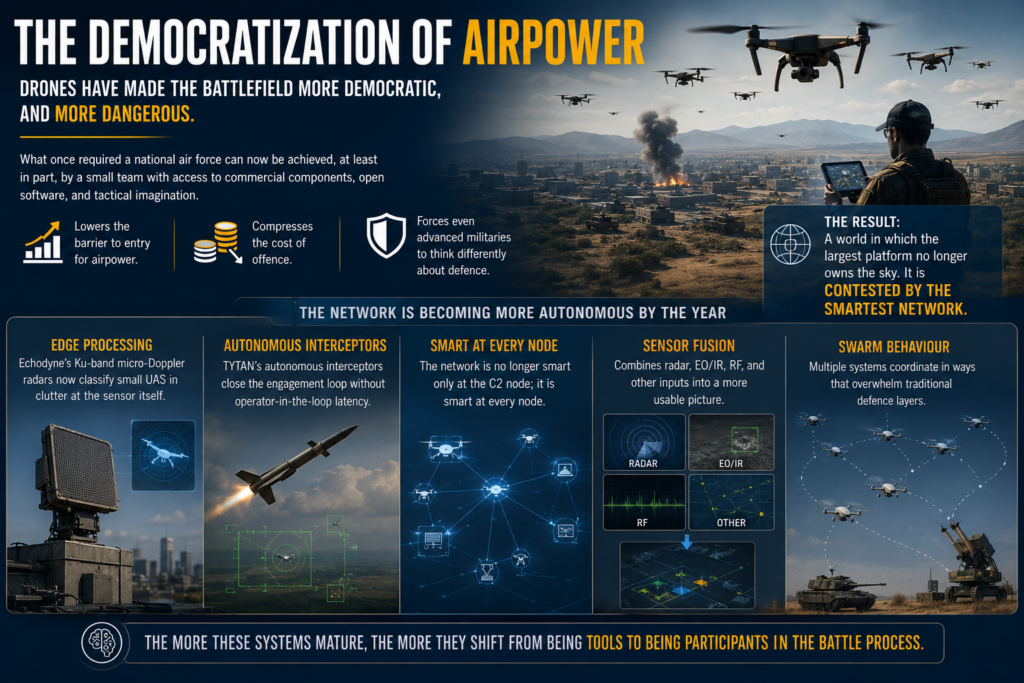
Drones have made the battlefield more democratic, and more dangerous.
What once required a national air force can now be achieved, at least in part, by a small team with access to commercial components, open software, and tactical imagination. This is why the drone age has such a destabilizing effect. It lowers the barrier to entry for airpower. It compresses the cost of offence. It forces even advanced militaries to think differently about defence.
The result is a world in which the largest platform no longer owns the sky. It is contested by the smartest network.
That network is becoming more autonomous by the year. Edge processing has moved from research promise to product reality; Echodyne’s Ku-band micro-Doppler radars now classify small UAS in clutter at the sensor itself, and TYTAN’s autonomous interceptors close the engagement loop without operator-in-the-loop latency. The network is no longer smart only at the C2 node; it is smart at every node. Sensor fusion is helping combine radar, electro-optical, infrared, RF, and other inputs into a more usable picture. Swarm behaviour enables multiple systems to coordinate in ways that overwhelm traditional defence layers. And the more these systems mature, the more they shift from being tools to being participants in the battle process.
Eurosatory 2026: From Ukraine and Gaza to Sindoor and the Gulf
On the show floor, this shift will be visible in named hardware rather than abstractions. Rheinmetall arrives in Paris in the middle of an industrial ramp that few in the sector can match, annual Skynex and Skyranger production climbing toward roughly 400 systems by 2027, with Italy already fielding the first NATO-operational Skynex battery in December 2025 and the Bundeswehr signalling demand for 500–600 Skyranger 30s.
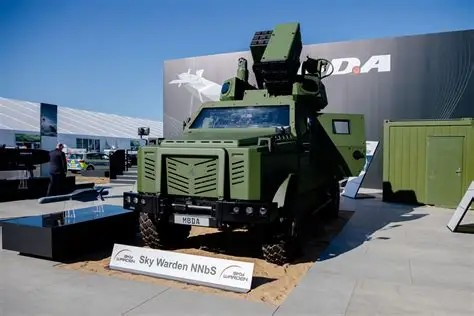
MBDA brings Sky Warden into the show on the back of its first international export contract, signed with a Middle Eastern customer in November 2025, and a now-mature multi-effector stack that fuses the CILAS HELMA-P laser, hit-to-kill interceptors, hunter drones and the Mistral 3 missile under a single AI-assisted command layer. Thales positions EagleShield at the civil-military seam, with its Gamekeeper radar already protecting Heathrow and operational with Airways New Zealand. Rafael’s Drone Dome, freshly contracted with Qatar, carries among the deepest operational pedigree with combat use against Hamas munitions and Houthi attack drones. IAI’s Drone Guard family, Leonardo’s Vision suite, Hensoldt’s Twinvis and Spexer radars, Diehl’s IRIS-T-based effectors, and KNDS’s land-platform integrators round out the European-Israeli incumbent set.
The transatlantic counterpoint is AeroVironment’s newly unveiled Halo Shield, a tile-based, plug-and-play architecture that can integrate the LOCUST laser, Switchblade loitering munitions, and Titan RF effectors. And then there is the new school: Aaronia’s AARTOS passive-RF backbone, Echodyne’s Ku-band micro-Doppler radars, and Munich-based TYTAN Technologies, which is building software-defined autonomous interception as a venture-funded European challenger. Eurosatory 2026 is where these competing schools’ gun-and-missile primes, RF-heavy Israeli integrators, American open-architecture entrants, and European deeptech challengers share the same hall for the first time.
That is why Eurosatory 2026 feels different from Eurosatory 2024. Two years ago, the dominant lessons were still being drawn from Ukraine, Gaza and the first wave of mass drone adaptation. By 2026, the conversation has matured. The focus is no longer solely on tactical drones as battlefield accessories, but also on counter-UAS clusters, AI-enabled detection, electronic warfare resilience, attritable air systems, autonomous teaming, and integrated command networks. The question has shifted from “who has drones?” to “who can operate, defend, recover and adapt inside a drone-saturated battlespace?”
The period after Eurosatory 2024 has only reinforced this direction. Ukraine and Gaza had already shown the operational value of drones in ISR, artillery correction, urban combat and precision attack. Since then, Operation Sindoor and the wider US-Iran / Israel-Iran confrontation have added further lessons: saturation matters, air defence can be probed, command networks can be stressed, and the line between tactical drones, one-way attack systems, cruise missiles, ballistic missiles and electronic warfare is becoming increasingly blurred. For India, Operation Sindoor was a reminder that drone warfare is no longer a distant European or West Asian story. It is part of the South Asian battlespace, where escalation control, layered air defence, counter-UAS, resilient communications and rapid decision-making will define future deterrence.
Counter-UAS Becomes Core Defence
This is also why counter-UAS has become one of the most important defence categories worldwide.
The problem is not merely detection. It is not enough to know a drone is present. Modern defence requires continuous sensing, rapid classification, command-and-control integration, response orchestration, and an appropriate effect, kinetic or non-kinetic, depending on the mission context. The defender must be able to manage a fast-moving kill chain, often amid clutter, confusion, and deliberate deception.
If there is a single category where Eurosatory 2026 will decide industrial winners and losers, it is counter-UAS. The doctrinal scaffolding is already in place. NATO’s 2025 Integrated Air and Missile Defence Policy frames IAMD as a 360-degree problem against the full air-and-missile threat, the European Commission’s 2026 Drone and Counter-Drone Security Action Plan pushes the EU toward a unified approach, and in April 2026 NATO Allied Command Transformation ran its first Layered Counter-UAS Initiative Crucible at Romania’s Capu Midia range radar, acoustic sensors, RF detectors, electronic warfare, and both kinetic and non-kinetic effectors stitched into a single layered architecture, with Ukrainian operators on the ground to ensure the scenarios reflected what the war has actually taught.
The problem the architecture is trying to solve is no longer detection. Almost every system on the Eurosatory floor can detect. The problem is the kill chain: sensing, classifying, deciding and engaging fast enough to matter when a saturation attack of Shahed-class one-way munitions, FPV drones and decoys arrives in the same ninety seconds. That is where the schools of thought diverge.
The European gun-and-missile school, led by Rheinmetall with Skynex, bets that the cost-per-shot problem is solved not by avoiding hardware but by making the hardware itself cheaper to fire. AHEAD programmable airburst rounds at € 1,000 per engagement against drones costing $20,000 each. The Israeli school, exemplified by Rafael’s Drone Dome and IAI’s Drone Guard, leans into radar-EO-RF fusion and jamming as the first response, with kinetic effectors held in reserve. The American open-architecture school, freshly articulated in AeroVironment’s Halo Shield and Lockheed Martin’s modular C-UAS, treats the entire kill chain as software-defined and effector-agnostic: bring your own laser, your own loitering munition, your own RF jammer; plug them into the same C2 tile.
And the new European deeptech school, TYTAN in Munich, Tekever and Quantum-Systems on the ISR side, Aaronia on the passive-RF side, argues that autonomous interception by attritable AI-driven drones will eventually beat both guns and missiles on the cost curve.
What every credible 2026 architecture has in common is that the answer is layered. Radar for bulk detection, passive RF for the silent and dark targets, EO/IR for terminal identification, jamming and spoofing as the first soft-kill option, lasers and hit-to-kill interceptors as the hard-kill backstop, and a unified C2 layer that can manage all of it without forcing the operator to context-switch between consoles. Isolated point solutions- the trade-show booth with a single sensor and a single jammer will not survive the procurement cycles that follow this show.
For India, the read-across from Operation Sindoor is direct. A drone-saturated South Asian battlespace is no longer hypothetical. The counter-UAS architecture that the Indian Army’s Directorate General of Air Defence eventually fields will need to do exactly what NATO is rehearsing at Capu Midia: fuse radar, RF, EO/IR, EW, and kinetic effects into a single networked kill chain, scaled to the northern, western, eastern, and maritime fronts. Eurosatory 2026 is, in that sense, also a procurement map for New Delhi.
Beyond Platforms
The interesting part is that this shift is not only tactical. It is strategic.
A drone is not just a flying object. It is a policy problem, a procurement problem, a doctrinal problem, and in many cases a sovereignty problem. It challenges assumptions about airspace control, border security, urban vulnerability, and critical infrastructure protection. It also creates a new industrial race. Nations want domestic production, local integration, exportable solutions, and technologies that can evolve with the threat rather than lag behind it.
That is why Eurosatory matters so much. The exhibition will not simply show equipment. It will show where the defence world is placing its bets. With more than 500 new solutions, major technology clusters, and a strong focus on innovation, it provides a live map of the industry’s direction. And right now, that map points clearly toward drones, robotics, AI, electronic warfare, and integrated air defence.
The New Symbol of Power
If there is a single lesson from this shift, it is that power has become less theatrical and more algorithmic.
The old image of strength was a platform on a tarmac, a formation in the sky, or a visible show of force. The new image is quieter. It is a dispersed mesh of sensors, effectors, and data links. It is the ability to see first, decide first, and act first. It is a system that can adapt faster than the adversary can target it. In that world, the most dangerous actor is not always the biggest one. It is the one that can move quickest through the kill chain.
That is why the title works. If the Devil wore Prada, he belonged to a world of visibility, confidence, and controlled spectacle. But today, he would fly drones because the nature of dominance has changed. It is less about being seen and more about shaping what others see. Less about ceremony, more about effect.
Eurosatory 2026 will not just showcase that transition. It will reinforce it. The exhibition’s focus on remote warfare, tactical drones, counter-UAS, and air-ground operations makes one thing unmistakable: the future of defence is not arriving in a single dramatic moment. It is assembling itself, system by system, in the air above us.
And that is the real meaning behind the metaphor.
The Devil has not disappeared. He has simply adapted to the age of autonomy. He no longer needs Prada to command attention. He needs reach, intelligence, and the ability to appear where he is least expected.
Today, he flies drones.
Cdr Rahul Verma (r), former Cdr (TDAC) at the Indian Navy, boasts 21 years as a Naval Aviator with diverse aircraft experience. Seaking Pilot, RPAS Flying Instructor, and more, his core competencies span Product and Innovation Management, Aerospace Law, UAS, and Flight Safety. The author is an Emerging Technology and Prioritization Scout for a leading Indian Multi-National Corporation, focusing on advancing force modernization through innovative technological applications and operational concepts. Holding an MBA and Professional certificates from institutions such as Olin Business School, NALSAR, AXELOS, and IIFT, he’s passionate about contributing to discussions on aviation, unmanned technology, and policy. Through writing for various platforms, he aims to leverage his domain knowledge to propel unmanned and autonomous systems and create value for Aatmannirbhar Bharat and the Indian Aviation industry.