Chaitali Bag
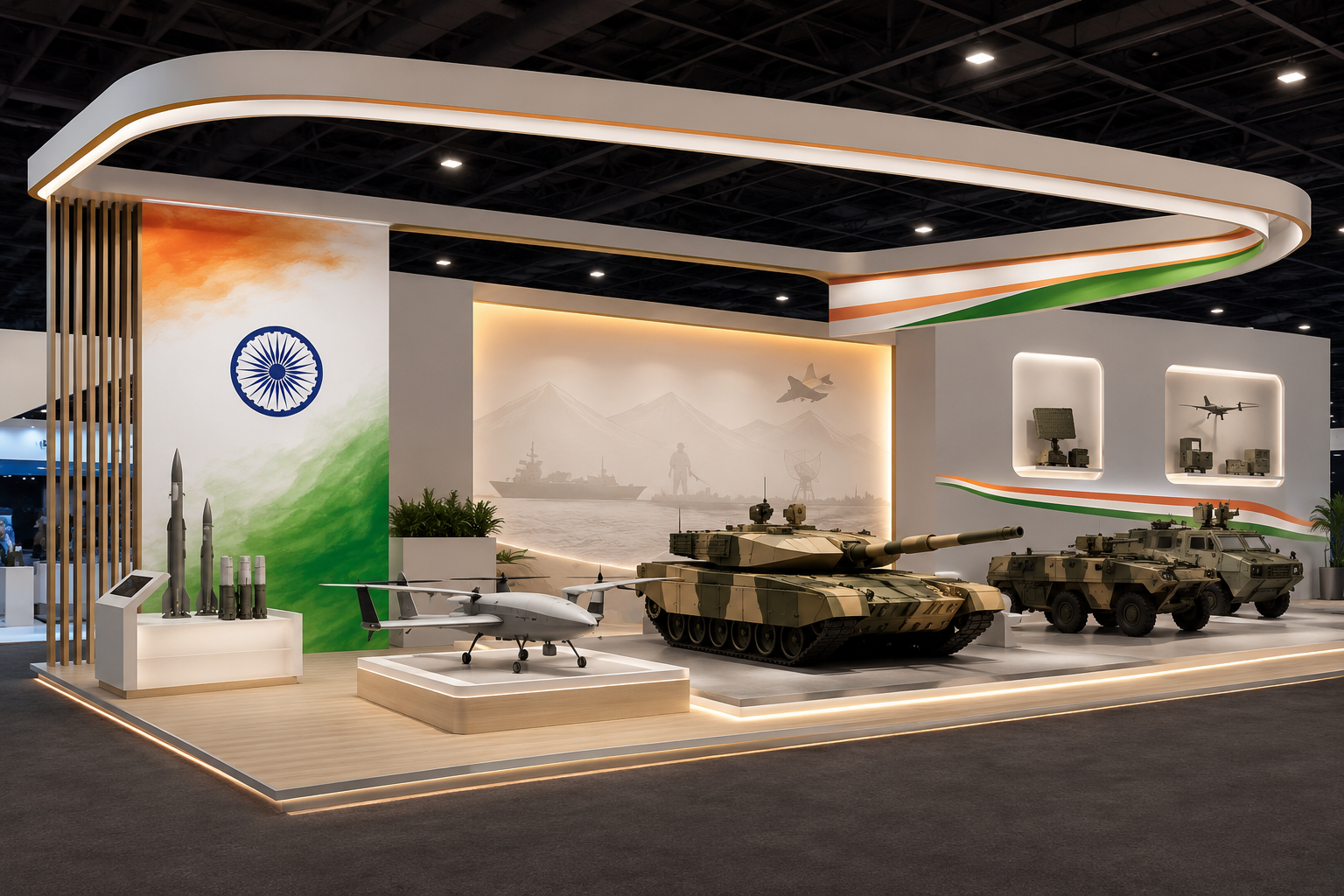
As the gates swing open at Eurosatory 2026 in Paris this June, India’s presence announces itself not as a polite nod but as a full-throated strategic statement. Once stereotyped chiefly as one of the world’s largest defence importers, India is now circulating a different set of invitations: to partner, to co-produce, to buy Indian-made systems that are robust, cost-competitive, and tailored for a wide range of theatres. The Indian delegation at Eurosatory 2026, a lively mix of public-sector giants, nimble private manufacturers, drone startups, electronics specialists, ammunition makers, and advanced systems integrators, encapsulates a decisive reorientation. The message is simple and unapologetic: “Make in India” has matured into “Make for the World.”
This transformation did not occur overnight. It is the product of deliberate policy, sustained investment, and an ecosystem that has steadily evolved from licensed production and large-scale procurement to indigenous design, modular manufacturing, and export-minded commercialization. The Society of Indian Defence Manufacturers (SIDM) organizing a cohesive industry delegation signals more than organisational competence; it signals confidence. Where once Indian delegations might have come primarily to study and purchase, they now arrive to sell, to forge joint ventures, to negotiate technology transfers, and to demonstrate that India can be a reliable, cost-effective supplier for a wide range of end-users.
Eurosatory, as one of the world’s foremost land and air-land defence shows, is the perfect stage for this message. The exhibition convenes procurement officials and militaries recalibrating force structures in the wake of protracted European rearmament, supply-chain realignments, and a global scramble for more resilient options. NATO partners and other states are looking to diversify suppliers away from single-source dependencies; emerging markets are seeking systems that balance capability and affordability; and new domains, especially unmanned systems and electronic warfare, reward agility and rapid iteration. Indian firms, with competitive engineering talent, scale manufacturing capacity, and increasingly export-ready offerings, are seizing this opening.
The portfolio India brings to Eurosatory 2026 is broad and strategically coherent. From artillery systems and ammunition to battlefield communications and electronic warfare suites, from radars and sensors to armoured mobility and counter-drone systems, the spectrum reflects both legacy competencies and frontier innovation. Notably, the proliferation of UAV and loitering-munition startups reveals a dynamic micro-economy of fast-moving firms that can prototype, field, and adapt at speeds that older defence-industrial paradigms struggle to match. Complementing them are established public-sector producers whose deep production lines and systems-integration experience lend scale and credibility to export ambitions.

This duality established industrial backbone plus startup dynamism- is a formidable asset. It allows India to pitch entire systems or modular subsystems, offering partners options that range from licensed manufacture to full co-development. For many potential buyers, particularly in Asia, Africa, and parts of Latin America, Indian systems offer an attractive trade-off: modern capabilities at a fraction of Western costs, backed by a willingness to share technology and long-term support relationships. For European and other advanced-market firms, Indian partners provide access to a large, growing market and manufacturing efficiencies that can bolster global competitiveness.
Geopolitics amplifies the strategic import of India’s presence. Europe’s defence market is no longer a closed club; it is being reshaped by urgent demand, supply-chain resilience considerations, and strategic hedging. India is positioning itself as a complementary supplier, not a competitor to be sidelined, but a partner to be engaged. For India, the stakes are high and transformational: exporting indigenous defence systems expands strategic influence, underwrites domestic industry through economies of scale, and strengthens deterrence by deepening operational self-reliance. Economically, defence exports help validate R&D investments, create high-value jobs, and catalyse ancillary industries in electronics, composites, and advanced manufacturing.
Eurosatory 2026 thus functions as more than a trade fair: it is a strategic showcase of India’s industrial intent. The optics of a growing, confident Indian pavilion, the presence of cutting-edge drones and payloads, the demonstrations of resilient ammunition production lines, and the boardroom negotiations for co-production and lifecycle support together narrate a compelling story. They tell of a country reconfiguring its defence-industrial base from one primarily oriented toward import substitution to one purpose-built for global engagement.
The long arc of change will not be without challenges. Export controls, regulatory harmonisation, competition with incumbent suppliers, and the need for assured quality and after-sales support are real hurdles. Yet Indian firms appear to be learning quickly: embracing international certifications, aligning with interoperability standards, and investing in service networks and training. Strategic patience coupled with tactical agility may be India’s winning formula.
The Export Story: India’s Defence Industry Comes of Age
Few narratives in contemporary India capture both national aspiration and strategic recalibration as vividly as the meteoric rise of its defence exports. What once was a modest cottage industry, export figures languishing under ₹1,000 crore a decade ago, has, in a short span, become a global force: record exports of ₹38,424 crore in FY 2025–26, a staggering 62.66% jump over the prior year and an almost 25-fold expansion over ten years. This is not a transient spike but the crystallisation of policy, enterprise, technology and geopolitics aligning to rewrite India’s role in global defence markets. The tale of how India reached this inflection point is at once an economic success story, a strategic achievement, and a powerful statement about the country’s industrial maturation.
India’s Defence Export Growth
| Financial Year | Defence Exports (₹crore) | Key Trend |
| 2013–14 | 686 | Limited export footprint |
| 2016–17 | 1,522 | Early policy reforms begin |
| 2021–22 | 12,815 | Rapid private sector rise |
| 2023–24 | 21,083 | Strong systems exports |
| 2024–25 | 23,622 | Export diversification |
| 2025–26 | 38,424 | Record growth year |
A Policy Renaissance: Atmanirbhar Bharat & The Institutional Scaffolding
At the heart of India’s export surge is an unambiguous policy push. The Atmanirbhar Bharat (self-reliant India) programme reframed defence production from a matter of procurement to a matter of national capability. By prioritising domestic suppliers, tightening import substitution lists, raising foreign direct investment caps, and rolling out production-linked incentives, the government sent a clear signal: indigenous capacity building would be rewarded and scaled.
This policy mosaic did more than nudge procurement; it reshaped mindsets. Defence budgets and industrial strategies began to favour homegrown solutions, enabling sustained investments in manufacturing, quality assurance, and certification, areas critical to meeting export-grade standards. Simultaneously, a proliferation of dedicated testing facilities, simpler licensing frameworks and clearer offsets/industrial participation rules reduced friction for producers aiming at overseas markets. The result: a complex, layered ecosystem where thousands of MSMEs found viable entry points into defence supply chains. These firms, which a decade ago might have been restricted to low-volume components, are now integral to modular systems, subassemblies and niche technologies that feed global platforms.
Private Enterprise: Innovation, Agility& Commercial Ambition
While long-standing Defence Public Sector Undertakings (DPSUs) continue to hold prominence, the stealth revolution has been the emergence of a dynamic private sector. Indian private firms have shifted from being ancillary producers to headline exporters across several cutting-edge domains: unmanned aerial vehicles (UAVs), electro-optics, precision engineering, aerospace structures, battlefield electronics, naval systems and ammunition. This diversification is significant. It demonstrates not just volume growth but technological depth and systems integration capability.
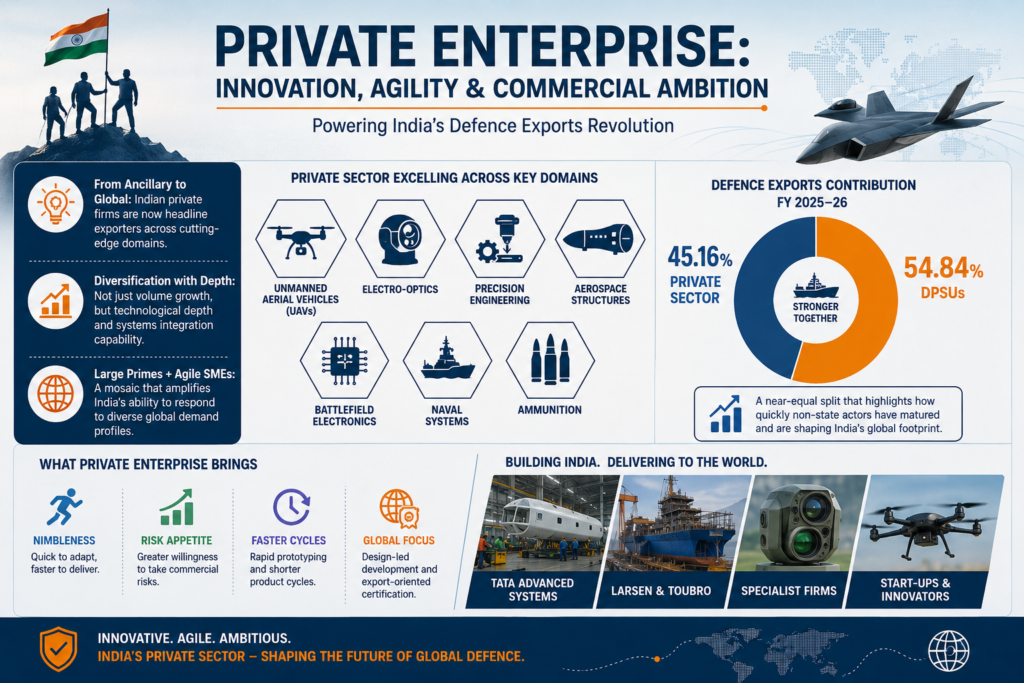
Private players brought nimbleness, a greater appetite for commercial risk, and faster product cycles to the table. Start-ups and established industrial houses alike embraced design-led development, rapid prototyping and export-oriented certification pathways. The data speak for themselves: in FY 2025–26, the private sector contributed 45.16% of defence exports, while DPSUs accounted for 54.84%—a split that highlights how quickly non-state actors have matured. Companies such as Tata Advanced Systems, Larsen & Toubro, and specialist firms have woven themselves into global supplier networks. At the same time, smaller innovators have carved out niches in high-demand technologies such as counter-UAV systems and precision subsystems. This mosaic, where large primes and agile SMEs co-exist, has amplified India’s ability to respond to diverse international demand profiles.
Export Composition FY 2025–26
| Sector | Share of Exports |
| DPSUs | 54.84% |
| Private Sector | 45.16% |
Technology Tides: Drones, Electronics & The War-Tested Turn
Global conflicts of the last decade, notably the wars in Ukraine and repeated crises in West Asia, changed the contours of defence procurement. Warfare is increasingly influenced by unmanned systems, electronic warfare, ISR (intelligence, surveillance, and reconnaissance), and precision munitions. India’s defence-industrial response to this change was remarkably prescient. A burgeoning drone ecosystem, comprising hundreds of firms focused on defence applications, emerged to meet the sudden and sustained global appetite for UAVs, loitering munitions, and even emergent concepts like swarm tactics.
Indian drone companies, ranging from proven producers of reconnaissance UAVs to makers of loitering munitions, have demonstrated operational credibility, export-readiness and competitive pricing. Firms such as ideaForge and Asteria Aerospace, along with defence conglomerates scaling autonomous systems lines, have plugged into regional demands where affordability, maintainability and rapid deployment matter. Beyond drones, India’s strengths in battlefield electronics, electro-optics, and precision manufacturing have found eager buyers. The convergence of battlefield-proven use cases and the cost-performance calculus of Indian products has accelerated export negotiations and deliveries.
Key Export Categories
| Segment | Major Products |
| Aerospace | Airframe structures, components |
| Land Systems | Artillery, armoured mobility |
| Naval Systems | Patrol vessels, electronics |
| Electronics | Radars, EW systems, sensors |
| Ammunition | Artillery shells, explosives |
| UAVs | Tactical drones, loitering munitions |
Markets: Global Reach & Strategic Diversification
One of the most striking dimensions of India’s defence export story is the breadth of its market reach. Indian defence products are now found in more than 100 countries, spanning Southeast Asia, Africa, the Middle East, Europe and Latin America. This diversification is strategically valuable: it reduces dependency on any single market, deepens bilateral defence ties, and opens pathways for longer-term interoperability and logistics cooperation.
Notably, the United States, the epicentre of global aerospace and defence, has become a significant destination for Indian-made components and sub-systems. This trend is driven not merely by price competitiveness but by India’s integration into supply chains of global primes through offset-linked manufacturing and shared platform projects. As Indian firms absorb quality certifications and supplier audits from major Western contractors, they gain credibility that further unlocks markets. Simultaneously, India’s exports to Africa and Southeast Asia are fostering defence diplomacy: training, maintenance, and lifecycle support bundled with hardware strengthen geopolitical partnerships and create enduring commercial relationships.
Challenges Ahead: Quality, Scale & Lifecycle Support
The export figures are impressive, but scaling further requires confronting real challenges. Defence customers demand not only initial deliveries but robust lifecycle support, spares, training, upgrades and secure logistics. Developing this after-sales ecosystem at scale remains an imperative. Meeting stringent certification regimes of advanced buyers, maintaining consistent quality across hundreds of suppliers, and expanding high-value manufacturing capacity are non-trivial tasks.
Additionally, sustaining innovation pipelines, particularly in electronics, semiconductors and sensor technologies, requires steady investment, talent cultivation and deeper R&D linkages between industry and academia. Finally, balancing strategic autonomy with participation in global supply chains will necessitate nuanced policy calibration: open enough to attract technology partnerships, guarded enough to protect critical capabilities.
The Strategic Payoff: Diplomacy, Deterrence & Industrial Pride
Beyond economics, India’s growing defence exports carry deep strategic significance. Defence trade builds interoperability, mutual trust, and long-term security partnerships. As recipient countries rely on Indian platforms, they gain reasons to align on training, doctrine and regional security frameworks. Export success also strengthens India’s deterrence posture by demonstrating indigenous capability, an important signal in a region where military modernisation is tightly observed.
Equally powerful is the intangible: industrial pride. The narrative of “Made in India” moving from assembled platforms to sophisticated subsystems, lethality-enhancing technologies, and systems integration is a morale booster for engineers, entrepreneurs, and policymakers. It validates long-term investments and inspires a new generation to see defence engineering as both a patriotic and profitable pursuit.
Why Eurosatory Matters For India
Eurosatory matters for India because it is the stage on which ambition, capability and strategy converge. As Europe’s premier defence exhibition, it offers India three strategic opportunities that could reshape its defence-industrial trajectory: access to European markets, deeper joint development partnerships, and meaningful supply-chain integration.
Access to European Markets
European militaries are rethinking supply resilience and cost structures, creating an opening for Indian systems that combine competitive pricing with rising technological sophistication. For Indian manufacturers, Eurosatory is a place to demonstrate mature offerings: from electronics and sensors to UAVs and vehicle systems, to procurement officials, integrators and prime contractors who are actively diversifying sources. Success in Europe would validate Indian products against rigorous standards, broaden export destinations, and accelerate the shift from opportunistic sales to sustainable market penetration.
Joint Development Partnerships
India’s defence firms are no longer content with licensing deals; they seek co-development across advanced domains such as AI-enabled battlefield systems, robotics, autonomous mobility and next-generation munitions. Eurosatory brings potential partners into one ecosystem: defence primes, subsystem specialists, academic labs and venture-backed startups, facilitating teaming arrangements, technology transfers and shared-risk programs. Such collaborations can shorten development cycles, combine complementary strengths, and create products tailored to both European and global requirements.
Supply-Chain Integration
The next phase of India’s export growth will likely come less from selling whole platforms and more from deep integration into global defence manufacturing ecosystems. Indian suppliers already produce fuselages, wings, precision assemblies and electronic subsystems for major global companies. Eurosatory provides the visibility and networking needed to expand those roles: winning subcontracting work, qualifying to NATO and OEM standards, and embedding Indian suppliers into long-term industrial partnerships that underpin modern defence procurement.
The Challenges Ahead
India’s momentum is real, but important hurdles remain. Certifications and standards entail lengthy cycles and demanding validation processes: breaking into NATO-standard procurement ecosystems requires demonstrated combat reliability and exhaustive testing. Scale and delivery matter: global customers expect consistent quality, punctual delivery, robust lifecycle support and clear upgrade pathways. R&D intensity must increase, moving beyond licensed production to original intellectual property, and advanced systems engineering is essential to compete on capabilities, not just cost. Finally, export financing, competitive credit, sovereign guarantees, and diplomatic backing often determine contracts in developing markets and must be part of India’s playbook.
From Import Dependency To Industrial Confidence
India’s presence at Eurosatory 2026 is more than commercial posturing; it signals strategic intent. The country is shifting from being one of the world’s largest defence importers to becoming a credible manufacturing ecosystem capable of designing, producing and exporting increasingly sophisticated military systems. Where India once attended global shows primarily as a customer, it now arrives as a competitor, asserting technological maturity, industrial scale and export ambition.
The transformation is incomplete, and the path forward demands sustained investment in standards, scale, R&D and financing. Yet the direction is unmistakable. In the crowded halls of Paris, Eurosatory 2026 showcased that the world’s defence industry is taking notice: India is no longer just buying the future of defence—it’s building and selling it.