Staff Correspondent
The announcement of a strategic partnership between Thales and Renault Group to develop and industrialise the large‑scale production of the TOUTATIS loitering munition marks a decisive moment in the evolution of France’s defence industrial base. At a time when national and European security environments are characterized by heightened geopolitical competition, rapid technological change and renewed emphasis on industrial sovereignty, the collaboration between a premier defence integrator and a leading automotive manufacturer exemplifies a concerted effort to align technological excellence, manufacturing scale and strategic autonomy. This essay examines the significance of the partnership in the context of sovereign defence capabilities, assesses the technological and industrial rationale underlying the collaboration, evaluates the operational implications of TOUTATIS and associated systems such as the 4 TROOP tactical vehicle, and explores the strategic, economic and ethical considerations that accompany large‑scale domestic production of loitering munitions.
Sovereignty, Resilience & the Wartime Economy
The contemporary security landscape has revived concerns about the resilience of defence supply chains and the capacity of national industries to sustain prolonged high‑intensity operations. Wars in Europe and beyond have underscored the vulnerability of critical military supplies to geopolitical disruption and the strategic consequences of dependence on foreign sources for munitions, sensors and platforms. In this environment, the French government has emphasized the need to rebuild a wartime economy: an industrial posture capable of rapid production surges, a secure supply of critical components, and domestic control over essential systems.
The Thales–Renault Group partnership directly responds to this strategic imperative. By combining Thales’ systems engineering, sensor integration, and defence electronics expertise with Renault Group’s mass‑production know‑how, manufacturing infrastructure, and supply‑chain management, the collaboration is designed to deliver an indigenous capacity to produce advanced loitering munitions at scale. The projected manufacturing capability, potentially 1,000 units per month from the first year of production, beginning as early as 2027, would constitute a notable enhancement of France’s sovereign capacity to rapidly equip its armed forces and sustain operations without reliance on external providers.
Industrial Rationale: Complementary Capabilities & Scale
The rationale for this tie‑up rests on the complementary strengths of the two partners. Thales possesses deep domain knowledge in defence electronics, guidance and sensor suites, electromagnetic resilience and systems integration, capabilities critical to the development of modern loitering munitions that must operate in contested electromagnetic environments and integrate with broader command‑and‑control architectures. Renault Group brings proven expertise in industrial engineering, process optimisation, quality control, high‑volume assembly and logistics. Automotive manufacturing techniques, lean production, automation, supplier network orchestration, and just‑in‑time components management can materially reduce unit costs, shorten lead times, and accelerate ramp‑up.
Translating prototype or low‑rate defence systems into high‑throughput production requires addressing a distinct set of challenges: supply‑chain security for electronic and energetic components, test‑and‑acceptance infrastructure, modular assembly lines that manage variability, and rigorous standards for reliability and safety. Renault’s experience in designing scalable, repeatable manufacturing processes and managing global supplier ecosystems provides the operational know‑how to industrialise the TOUTATIS design while meeting the quality and traceability requirements of defence procurement. Conversely, Thales’ responsibility for the core system architecture, warhead integration and compliance with military specifications preserves the technical fidelity and operational performance of the weapon system.
Technological & Operational Attributes of TOUTATIS
TOUTATIS is described as a short‑range loitering munition engineered for high‑intensity conflicts. Its defining attributes —deployability by dismounted soldiers, compatibility with multiple launch platforms (vehicles, aircraft, naval systems), robustness to electromagnetic jamming, a mission‑configurable warhead, and the capacity to operate within drone swarms—reflect contemporary operational priorities. These priorities include distributed lethality, survivability in contested electronic environments, scalability of effects and assurance of human oversight.
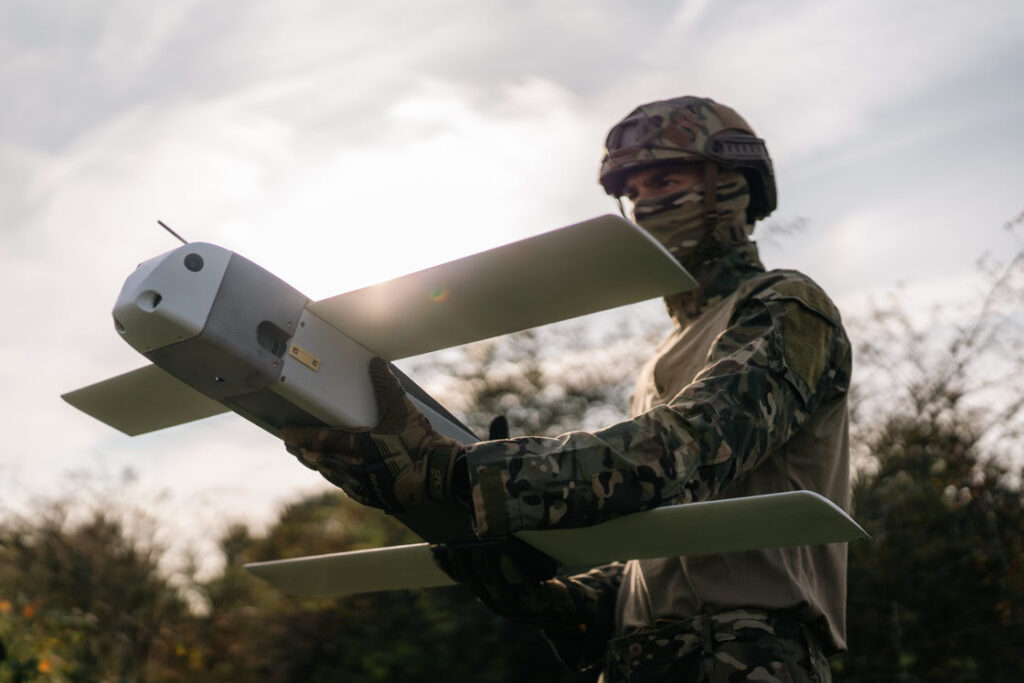
The capacity to be launched from a range of platforms enhances tactical flexibility: ground forces can employ the system from for-hire vehicles like the 4 TROOP, while aviation and naval platforms can use it to extend their strike envelope. Electromagnetic resilience is critical in a battlefield increasingly characterised by electronic warfare; robustness in this domain preserves mission success when GPS, datalinks or radio frequencies are contested. The mission‑configurable warhead speaks to the need for effect tailoring, selecting lethality and blast characteristics appropriate to target types while seeking to limit collateral damage. The preservation of human decision‑making in the strikes loop addresses legal, ethical and doctrinal requirements surrounding the use of lethal autonomous systems, ensuring accountability and adherence to rules of engagement.
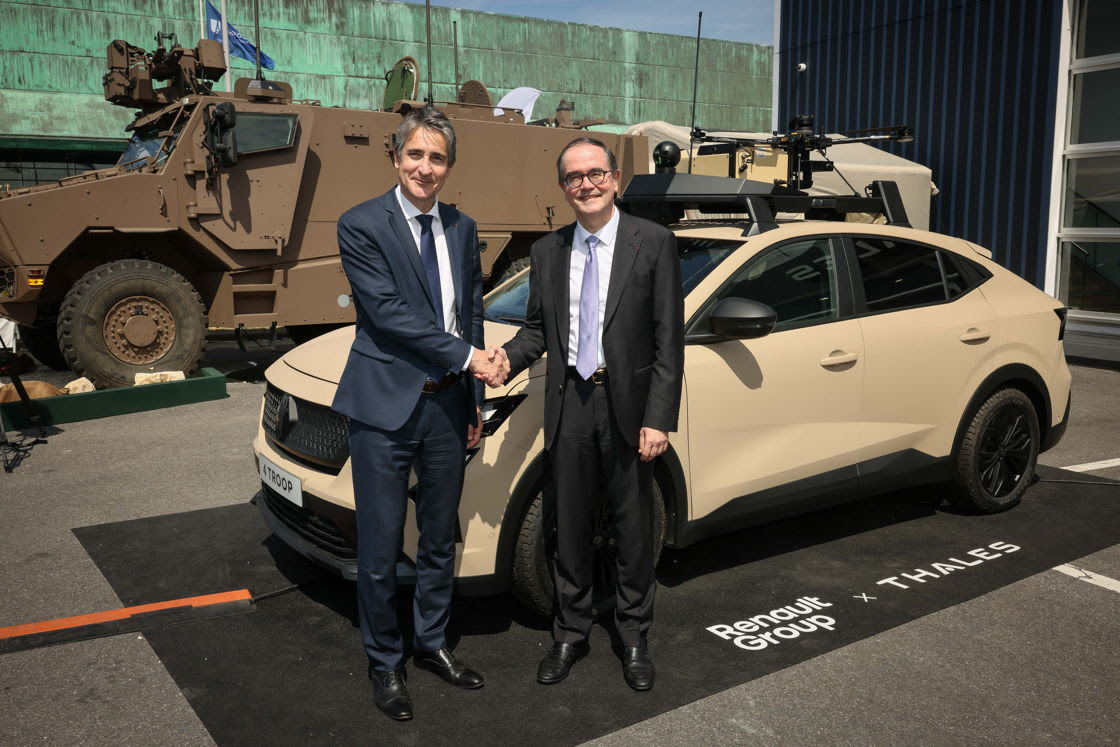
The capacity for swarm operations augments the system’s operational reach: coordinated launches of multiple loitering munitions can overwhelm defences, provide redundancy against losses, and conduct distributed sensing and targeting. Integrating such systems with advanced command‑and‑control, sensors and AI‑assisted decision tools, as showcased by the 4 TROOP solution, suggests a future in which tactical formations deploy integrated lethal‑and‑nonlethal effects with enhanced situational awareness and faster decision cycles.
The 4 TROOP Vehicle: Integration of Drones, Sensors & AI
The co‑presentation of the 4 TROOP tactical vehicle demonstrates how the partnership envisions systems beyond the munition itself: vehicles that embed drone launch and recovery, sensor fusion, secure communications and AI‑enhanced decision support. The military utility of such a vehicle is significant. By co‑locating launch capability, situational-awareness sensors, and resilient communications within a mobile platform, armed units can reduce decision latency, increase survivability through dispersion and rapid manoeuvre, and exploit the modularity of swarm‑centric tactics. Using hybrid communications and AI decision aids may enable more efficient target identification, threat prioritisation and rules‑of‑engagement compliance, thereby amplifying the operational advantages of loitering munitions while attempting to mitigate risks associated with misidentification or escalation.
At the strategic level, this partnership strengthens national autonomy in a capability that is increasingly central to modern combined arms operations. A reliable domestic production line reduces vulnerability to export controls, supply denial and geopolitical leverage. It also affords France greater influence in shaping European defence-industrial cooperation: a scaled-up French capacity could underpin collaborative procurement, supply to partners in coalition contexts, and interoperability standards.
Economically, the collaboration promises to generate industrial activity, secure high‑skilled employment, and sustain a defence‑oriented supply chain across electronics, energetic materials, precision manufacturing and software. Leveraging automotive mass‑production approaches may reduce per‑unit costs and broaden export competitiveness, though this will depend on demand, certification regimes and international market dynamics for loitering munitions. The dual‑use nature of many enabling technologies (AI, communications, sensors) further increases domestic value capture, with possible spillovers into civilian sectors such as autonomous vehicles and smart manufacturing.
The large‑scale production of loitering munitions raises important ethical and legal questions. Loitering munitions fall into a contested normative area between guided munitions and autonomous weapons; their design deliberately preserves a human decision‑maker in the engagement loop, which addresses some core concerns about fully autonomous lethal systems. Nevertheless, questions remain about proportionality, discriminative capacity in complex environments, and the governance of swarm operations that may act semi‑autonomously. Ensuring rigorous rules of engagement, operator training, robust identification capabilities and transparent accountability mechanisms is essential.
On the international stage, the proliferation of loitering munitions could alter escalation dynamics, lower the threshold for certain kinds of strikes, and complicate arms‑control efforts. France’s development of a sovereign capability will need to be accompanied by clear doctrines, export controls aligned with international humanitarian law, and diplomatic engagement aimed at responsible norms for the use and transfer of such systems.
While the partnership offers compelling advantages, it is not without risk. Rapid production scale‑up requires secure and diversified supply chains for semiconductors, sensors, energetic components and rare materials. Global competition for these inputs, combined with potential export restrictions and the risk of component shortages, could constrain delivery schedules. Integrating defence‑grade assurance processes with high‑throughput automotive manufacturing practices will require careful harmonisation to preserve reliability without sacrificing speed.
Cybersecurity and electronic resilience are further points of vulnerability: large fleets of networked munitions and integrated vehicles increase the surface for cyberattacks, spoofing and jamming. Addressing these risks requires robust cyber‑defence, redundancy, secure communications, and resilient software architectures. Finally, public and parliamentary oversight, plus adherence to export and use controls, will be necessary to maintain societal trust in the deployment of these capabilities.