Kamal Shah
Assured access to orbit is becoming a cornerstone of India’s national security. As defence operations rely ever more on satellite communications, navigation and intelligence, the ability to launch, replenish or augment space assets at short notice can strengthen resilience and strategic autonomy—not just technological capability.
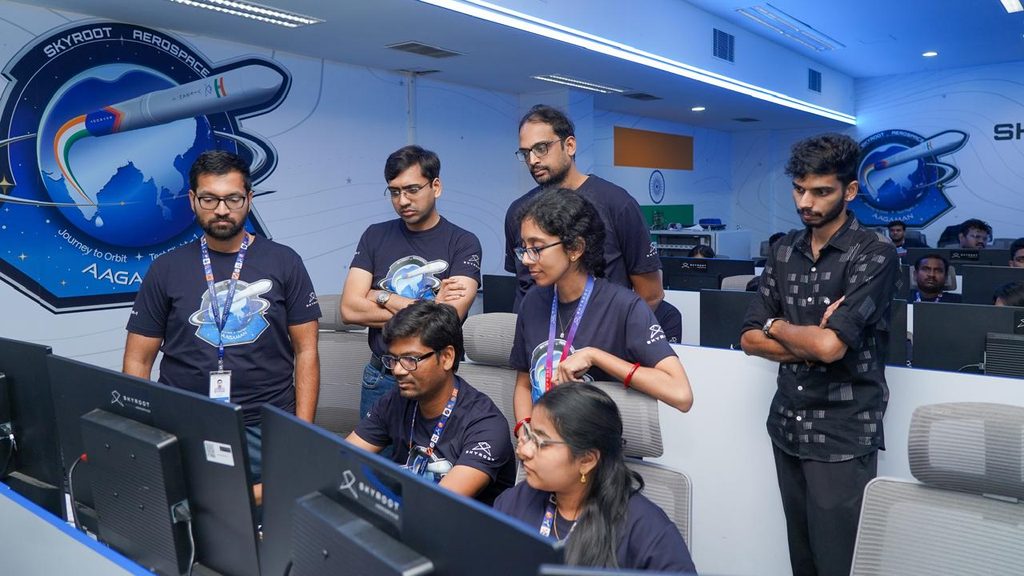
ISRO’s achievements laid the foundation. Now, private launch providers are helping build a more responsive, diverse space ecosystem. Skyroot Aerospace is contributing through its indigenous Vikram family of launch vehicles, designed to expand India’s access to space.
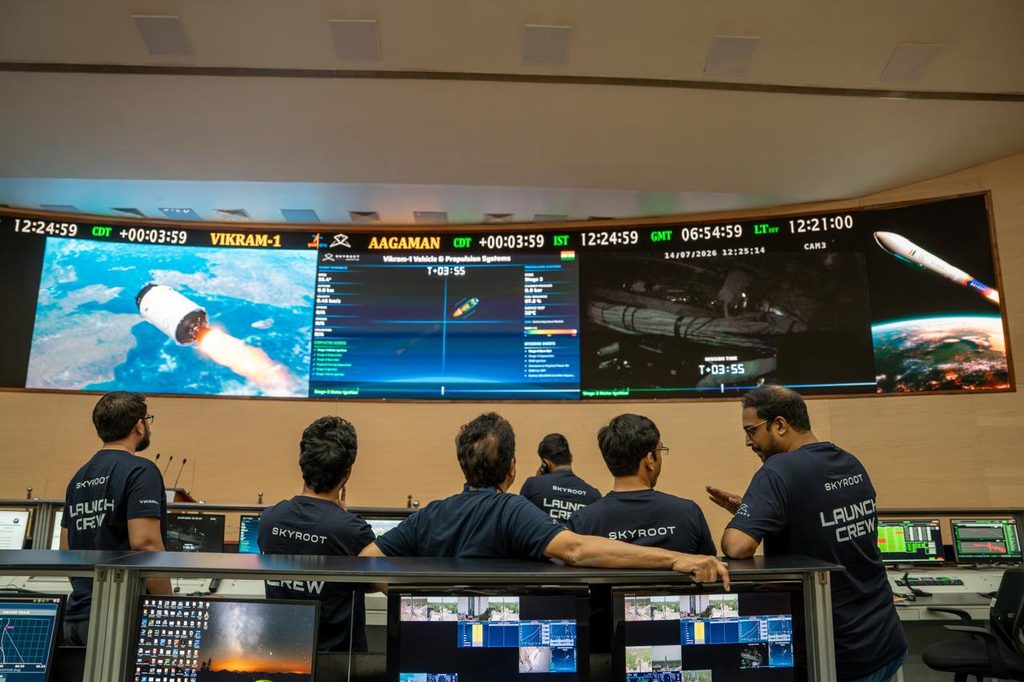
As referenced in this interview, Vikram-1’s successful orbital flight in July 2026 marked a milestone for Skyroot and India’s private space sector. Its significance goes beyond one launch: it demonstrates the growing role of Indian industry in developing independent launch capability. The next test is scaling that capability—with the manufacturing capacity, infrastructure and operations needed to serve commercial demand and strategic needs reliably.
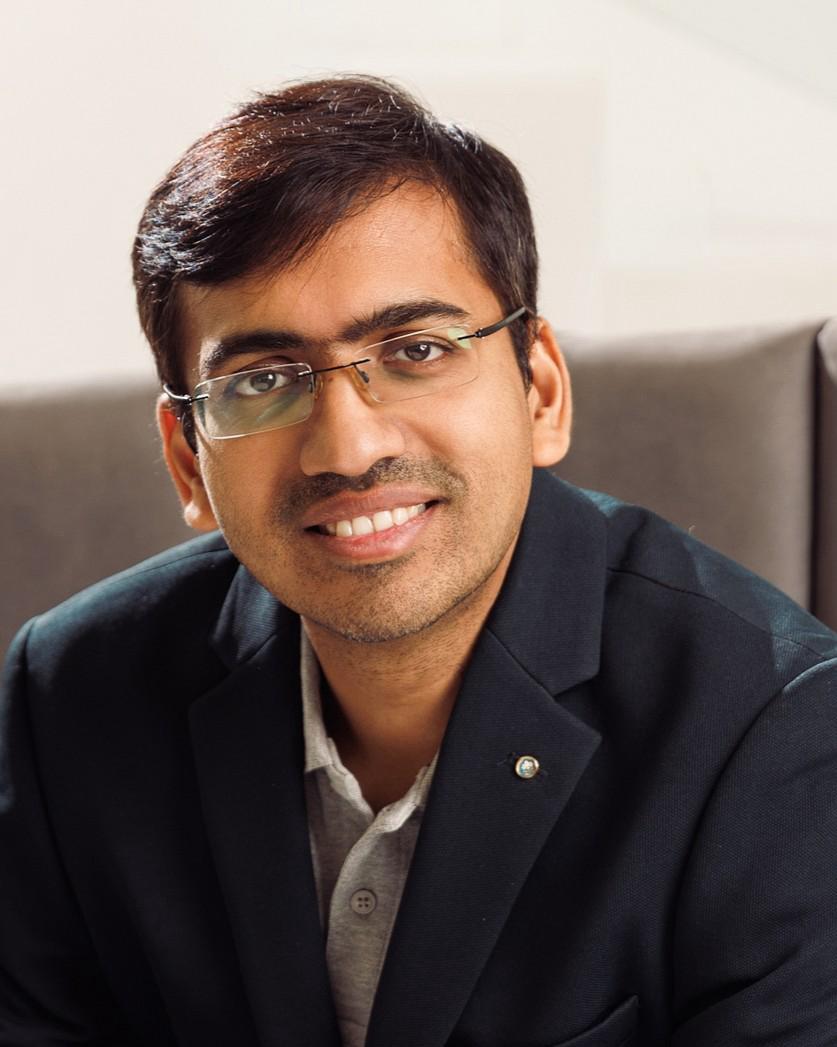
In this exclusive interaction with Indian Aerospace & Defence Magazine (IA&D), Pawan Kumar Chandana, Co-Founder and CEO of Skyroot Aerospace, discusses private launch providers’ role in national security, the engineering philosophy behind the Vikram vehicles, and the need to connect launch services with satellites, ground systems and end users. He also addresses the policy, procurement and government–industry partnerships required to grow India’s launch ecosystem.
For India, the strategic prize is not simply reaching orbit—it is being able to do so independently, when needed. Skyroot aims to help make that capability dependable and indigenous.
Q. How do you currently define “defspace,” and what capabilities should India prioritize for the coming decade among secure communications, persistent Earth observation, navigation, space situational awareness, and resilient launch access?
A. Defence space, or “defspace,” refers to the use of space infrastructure and capabilities to strengthen a nation’s security, strategic autonomy, and operational preparedness.
Space is increasingly becoming integral to national security. From secure communications and navigation to intelligence, surveillance and reconnaissance, the ability to access and operate in space is now a strategic necessity.
For India, I believe the priority should be to build a comprehensive and resilient space ecosystem rather than focus on any single capability. Secure satellite communications, persistent Earth observation, indigenous navigation capabilities and space situational awareness are all important components.
However, one foundational capability enables all of these: reliable and responsive access to space.
As satellite constellations expand and space becomes increasingly contested, countries must be able to deploy, replenish, and augment their space assets without depending on external launch providers.
India has built tremendous capabilities through ISRO over the decades. The emergence of private launch companies now creates an opportunity to complement these capabilities with greater launch frequency, flexibility and responsiveness.
At Skyroot, our focus is on contributing to this critical layer of national space infrastructure by developing reliable, cost-effective launch vehicles that can serve both commercial and strategic requirements.
Q. Considering the evolving landscape of space technology and geopolitical interests, how can commercial launch providers most effectively augment national security objectives, and what strategic framework should India adopt to integrate dedicated government missions with commercially operated launch services optimally?
A. I believe the future of India’s space ecosystem will be built on a strong partnership between government institutions and private industry.
ISRO has established the technological foundation and demonstrated India’s ability to undertake some of the world’s most complex space missions. Private companies can now build on that foundation by bringing additional capacity, innovation, operational flexibility and commercially sustainable launch services.
For national security, commercial launch providers can play a particularly important role in ensuring launch capacity is available when required, without every mission needing a dedicated government-developed launch system.
A useful framework would have government agencies define their strategic requirements, while qualified commercial providers compete to deliver launch services against clearly established performance, reliability, and security standards.
This would allow government institutions to focus resources on advanced research, strategic technologies, and specialised missions, while private industry contributes routine and responsive access to orbit.
The objective should not be to create separate government and commercial ecosystems, but to build an integrated national capability where both reinforce each other.
Government and private-sector collaboration through memoranda of understanding and public-private partnerships for launch ports, services and supporting infrastructure will be essential to scaling launch capacity quickly. With global demand for launch services already exceeding available supply, India should take immediate steps, including identifying suitable land parcels on both its eastern and western coasts for future launch infrastructure. With coordinated support from the Central and State governments, India can emerge as a preferred destination for efficient, cost-effective launches.
Ultimately, a strong domestic commercial launch industry is itself an important strategic asset for India.
Q. Could you elaborate on the specific design philosophies and engineering trade-offs that led to the selection of a carbon-composite and solid propulsion primary stage, complemented by a restartable liquid upper stage, for the Vikram-1 launch vehicle? What distinct advantages does this architecture provide in precision, versatility, and efficiency across different payload-deployment scenarios?
A. When we began developing Vikram-1, our fundamental objective was to create a launch vehicle that could be manufactured efficiently, scaled commercially and deliver reliable access to space.
The architecture reflects a combination of technological choices made with that objective in mind.
Carbon-composite structures offer significant advantages in terms of strength-to-weight ratio. Reducing structural mass is particularly important in launch vehicles because every kilogram saved can improve payload performance.
Solid propulsion offers advantages in design simplicity, storage, and operational readiness. It also lets us leverage India’s established expertise in solid rocket technology while building our own manufacturing capabilities.
Liquid propulsion provides an additional level of control and flexibility, particularly for orbital manoeuvres and precise payload deployment.
With Vikram-1, we have combined these technologies to develop a launch architecture that balances performance, manufacturability, reliability and cost.
Our fully 3D-printed Raman engine technology is another important part of this approach. Additive manufacturing allows us to simplify complex engine geometries and reduce manufacturing complexity.
The successful orbital mission of Vikram-1 in July 2026 validated several important elements of this architecture.
For us, the larger objective is not simply to optimise one rocket, but to establish a technological and manufacturing foundation that can support an entire family of launch vehicles.
Q. Considering the inherent complexities of in-space propulsion, what are the most significant design and operational challenges in developing a restartable upper stage capable of reliably executing multiple engine ignitions and precisely delivering payloads to diverse orbital destinations?
A. In-space propulsion is a particularly demanding area of rocket engineering because the operating conditions are very different from those experienced during atmospheric flight.
One major challenge is ensuring reliable engine ignition and performance in the vacuum and microgravity environment of space.
Propellant management, thermal conditions, guidance and navigation, and the ability to execute manoeuvres with very high precision are also important considerations.
For a launch vehicle, reaching space is only one part of the mission. Delivering a satellite to its intended orbit with the required accuracy is equally important.
This becomes even more significant when customers require different orbital parameters or when multiple payloads need to be deployed during a mission.
At Skyroot, we have invested significantly in propulsion technologies, including our 3D-printed liquid engines and orbital adjustment capabilities, to address these requirements.
Our approach is to progressively build and validate these capabilities through extensive ground testing and flight experience.
As the small-satellite market evolves, I believe orbital precision and mission flexibility will become increasingly important differentiators for launch providers.
Q. Launch is only one part of a defence space architecture. How should launch providers work with satellite builders, ground-segment operators and users to make an end-to-end capability resilient?
A. A space mission should ultimately be judged by the capability it delivers to its end users, not simply by the successful launch of a vehicle. A satellite becomes operationally valuable only when the launch vehicle, spacecraft, ground infrastructure and downstream applications function as parts of a coordinated system.
Achieving this outcome requires collaboration among launch providers, satellite manufacturers, ground-segment operators and end users from the earliest stages of mission planning. Decisions about satellite design, deployment requirements, orbital parameters and operational timelines can all shape the launch architecture. Early coordination helps ensure that these elements support the mission’s intended purpose.
Resilience is particularly important in defence applications. Systems must incorporate redundancy, enable interoperability and be capable of recovering from disruptions. In this context, a launch provider can contribute significantly by providing access to orbit that is predictable, frequent and flexible. When satellite operators can deploy additional capacity or replace assets within shorter timeframes, they can strengthen the resilience of the wider architecture.
India’s growing private space ecosystem presents an opportunity to develop this integrated approach. Companies can specialize in different parts of the value chain while coordinating their efforts to deliver complete space capabilities. Such collaboration would help shift the focus from launching individual assets to providing reliable, end-to-end services that meet users’ needs.
Q. As more satellites and commercial missions enter orbit, how should operators address conjunction risk, debris mitigation and responsible end-of-life disposal?
A. The rapid growth of satellite deployments offers significant opportunities while increasing responsibility across the space ecosystem. As a shared environment, space requires long-term stewardship to sustain the industry.
Satellite operators should prioritize space situational awareness, conjunction monitoring, responsible mission planning, and end-of-life disposal from the design stage onward. Launch providers can also support sustainability through accurate orbital insertion and careful mission planning. International cooperation on tracking, information sharing, and operational standards is equally important.
As India’s commercial space sector expands, it has an opportunity to contribute meaningfully to these efforts. Responsible operations are increasingly becoming a fundamental requirement for participation in the global space industry, not merely a regulatory obligation.
Q. Considering India’s strategic needs, which of Skyroot’s advanced technologies—like cryogenic propulsion, enhanced payload capacity, or flexible orbital deployment—holds the most significant future impact, and what are their most challenging development milestones?
A. I would look at these technologies as complementary capabilities rather than identify one as being more important than the others.
The future of launch is about achieving the right combination of payload capacity, cost efficiency, reliability and mission flexibility.
At Skyroot, we are developing the Vikram family of launch vehicles to serve a growing range of satellite customers and orbital requirements.
Increasing payload capacity matters because it lets us serve larger satellites and more demanding missions while improving launch economics.
Advanced propulsion technologies, including cryogenic propulsion, could improve vehicle performance and efficiency.
At the same time, flexible orbital deployment is becoming increasingly relevant as customers seek more precise access to specific orbits rather than simply reaching space.
The major challenge in developing any of these technologies is not just demonstrating them individually, but integrating them into a launch system that performs reliably and can be manufactured and operated at commercial scale.
The successful orbital flight of Vikram-1 was an important milestone for us. It demonstrated India’s private-sector capability to develop and launch an orbital-class rocket.
Our focus now is to build on that foundation, increase launch frequency, and progressively expand the capabilities of the Vikram family.
Ultimately, the most significant advancement will be the ability to make access to space increasingly reliable, affordable and available on demand.
Q. What would you like defence planners and policymakers to understand about the technical limits and realistic timelines of private-sector launch capability?
A. I think the most important thing to recognise is that building reliable launch capability is a complex engineering undertaking that requires sustained investment, rigorous testing and patient capital.
Unlike many other technology sectors, rockets operate in extremely demanding environments, with very little margin for error.
Developing a launch vehicle involves mastering multiple disciplines simultaneously, including propulsion, structures, avionics, guidance, manufacturing and systems integration.
Even after a successful first mission, scaling to frequent, reliable commercial operations requires additional infrastructure, manufacturing capacity, testing, and flight experience.
At the same time, India’s private space industry has demonstrated that it can move quickly and deliver globally competitive technologies.
Skyroot’s journey from becoming the first Indian private company to launch a rocket into space with Vikram-S in 2022 to successfully reaching orbit with Vikram-1 in 2026 illustrates how rapidly indigenous capabilities can develop when talent, technology, capital and institutional support come together.
For policymakers, I believe the most effective approach is to provide clear long-term requirements, predictable regulatory frameworks and opportunities for private companies to demonstrate their capabilities through actual missions.
Government procurement can also play an important role in creating sustained demand and enabling industry to invest confidently in capacity and technology development.
The need of the hour is for immediate, effective solutions that extend beyond launch capability alone. We must develop the entire space ecosystem—from payloads and satellites to launch vehicles, launch services and assured domestic supply chains. The defence forces, as end users, and governments, as facilitators, can play a major role in keeping private industry productively engaged through collaborative programmes and streamlined procedures that enable faster decision-making and execution.
We should be ambitious about what India’s private space industry can achieve, while recognising that reliable launch capability is built through disciplined engineering, repeated testing and operational experience.
The long-term objective should be to create an Indian launch ecosystem that is not only technologically capable, but also commercially sustainable, globally competitive and strategically dependable.
All responses are attributed to Pawan Kumar Chandana, Co-Founder & CEO, Skyroot Aerospace.