The ₹810.79-crore order for 160 Satellite Smart Anti-Airfield Weapons (SAT-SAAW) is a targeted investment in the Indian Air Force’s stand-off strike capability—and a test of whether indigenous design can translate into timely production, reliable integration and a sustainable domestic supply chain.
Staff Correspondent
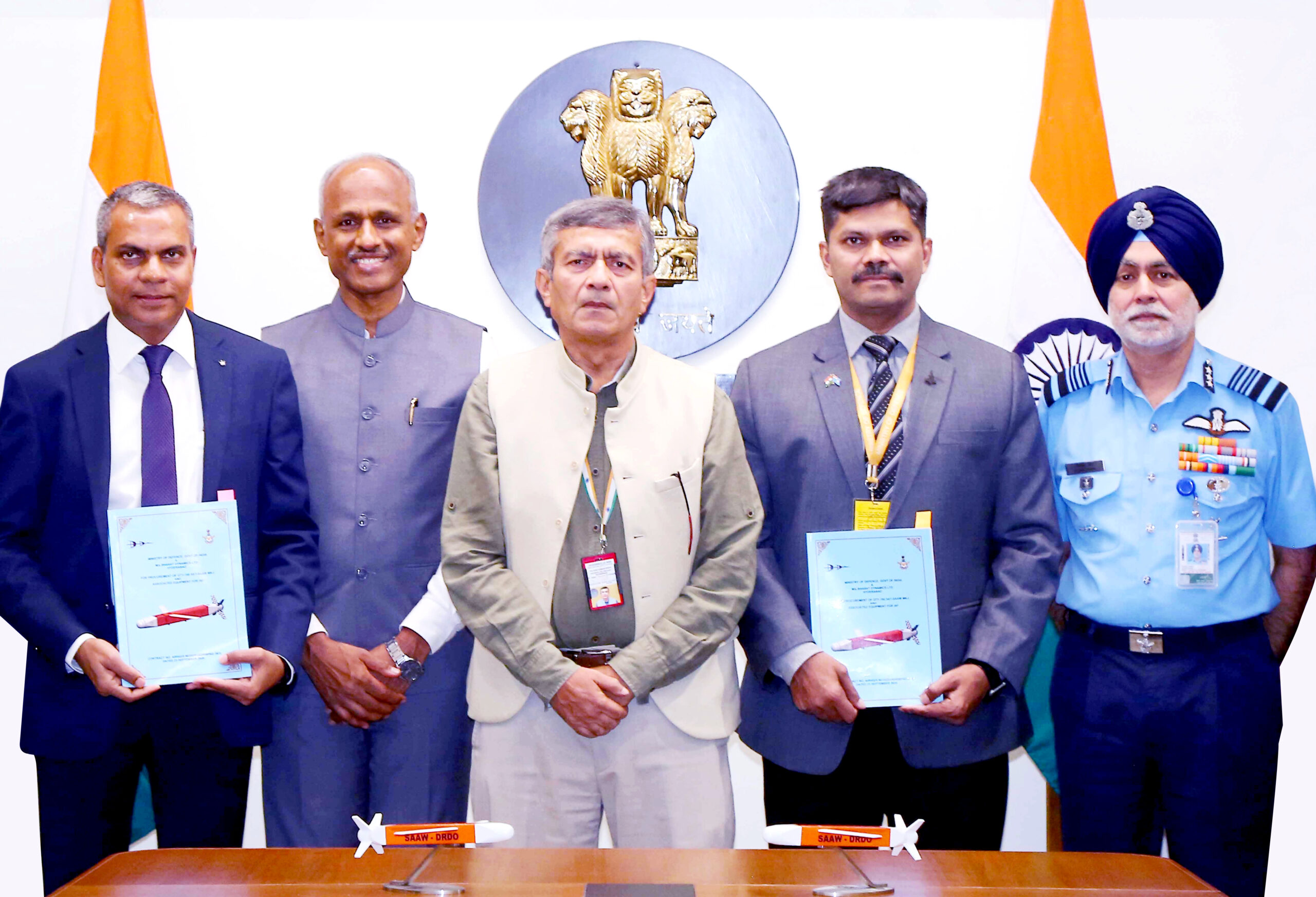
The Ministry of Defence’s September 23, 2026 contract with Bharat Dynamics Limited (BDL) for 160 Satellite Smart Anti-Airfield Weapons, along with associated equipment, marks a significant step in the Indian Air Force’s effort to expand its precision-strike options. Signed in New Delhi in the presence of Defence Secretary Rajesh Kumar Singh, the ₹810.79-crore contract falls under the Buy (Indian–Indigenously Designed, Developed and Manufactured) category.
The weapon’s importance lies in the combination of its intended mission, the aircraft from which it can be employed and the industrial model behind its production. SAT-SAAW is an air-to-ground precision-guided glide bomb designed to engage airfield-related targets from long stand-off distances. Its planned integration with the Jaguar, Hawk and Su-30MKI gives the IAF a way to add a specialised strike capability across more than one aircraft type.
The contract is not simply a munitions purchase. It is also a commitment to manufacture an indigenous weapon system at scale, build domestic content into its supply chain and deliver it to operational units over a defined period.
Airfields as a strategic target set
Airfields are central to air power. Their runways, taxiways, dispersal areas and supporting infrastructure enable aircraft to operate, refuel and regenerate sorties. A weapon designed to neutralise airfield targets can therefore contribute to a broader effort to disrupt an adversary’s ability to sustain air operations.
The stand-off aspect is especially relevant. A glide weapon can be released from an aircraft without requiring the aircraft to fly directly over the target. That can give planners greater flexibility in how they approach a strike and help manage the risk to aircrew and aircraft. The practical value of that flexibility will depend on the weapon’s verified performance, the accuracy and resilience of its guidance, and how well it is integrated with the launching aircraft and the IAF’s wider mission systems.
The announcement does not specify the weapon’s range, target effects or the number of weapons assigned to particular aircraft. Those details should not be inferred from the contract. What is clear is the intended operational role: a precision-guided air-to-ground weapon capable of attacking airfield targets from stand-off distances.
A multi-platform weapon, with integration work to do
The stated compatibility with the Jaguar, Hawk and Su-30MKI is notable because these aircraft occupy different places in the IAF’s fleet. A weapon usable from several platforms can offer commanders more options in force planning and may reduce reliance on a single aircraft type for a specific mission.
But “can be launched from” is the beginning of an integration process, not its end. Each aircraft must be cleared to carry and release the weapon safely. That involves compatible carriage arrangements, aircraft software and mission planning, crew training, and testing under the relevant operational conditions. The contract’s reference to associated equipment is therefore important: weapon capability depends on the supporting hardware and systems needed to carry, prepare and employ it.
The Hawk’s inclusion also raises a practical question about how the IAF intends to use the platform in this role. Its stated compatibility expands the potential platform set, but the operational concept, qualification status and fleet-level employment arrangements are not detailed in the information provided. The weapon’s contribution will ultimately be measured by successful integration and the options it gives the IAF in practice.
Indigenous design must be matched by indigenous production
The Defence Research and Development Organisation (DRDO) designed and developed SAT-SAAW, with BDL contracted to supply 160 weapons and associated equipment. The announced indigenous content is 60%. Further indigenisation is planned for the Initial Measurement Unit, Long Impact Delay Fuse and Twin Store Carrier.
That combination points to a broader model for defence production: DRDO develops the system, a public-sector manufacturer undertakes production, and domestic suppliers provide an expanding share of key components. The three named sub-systems matter because they extend indigenisation into the weapon’s measurement, fuzing, and carriage architecture, rather than leaving domestic content as a headline percentage alone.
The 60% figure is a useful baseline, but the longer-term industrial value will depend on what it includes and how it grows. Domestic content has the greatest strategic effect when it brings local design authority, qualified suppliers, secure access to critical components and the ability to repair or replace them without prolonged dependence on external sources. The planned indigenisation of additional sub-systems is therefore an important part of the contract’s self-reliance case.
BDL’s role will be to turn a developed weapon into a repeatable production capability. That requires consistent quality, reliable component supply, acceptance testing and support arrangements that can sustain the weapon after delivery. For the IAF, a weapon’s availability and maintainability are as consequential as its design performance.
Delivery schedule & operational readiness
Deliveries are scheduled across the financial years 2027–28 and 2028–29. This provides a defined window for production and induction, but the order’s operational effect will depend on the pace of deliveries and the parallel work needed to prepare aircraft and personnel.
Weapons entering service must be accounted for, stored, maintained and incorporated into training and planning. Aircrew need to understand the weapon’s employment procedures; maintenance personnel need the documentation and equipment to support it; and operational planners need confidence that the capability will be available when required. These activities take time and must progress alongside manufacturing.
The contract’s stated value and quantity indicate a focused procurement. They do not, on their own, establish how the weapons will be distributed across squadrons, what stock levels the IAF considers necessary or whether additional orders are planned. Those remain matters for future announcements. The immediate benchmark is whether the contracted quantity is delivered on schedule and can be inducted with the required support.
The strategic balance
For the IAF, SAT-SAAW would add another option to its precision-strike inventory. A specialised airfield weapon can complement other weapons and mission profiles; it does not replace the need for a balanced force equipped to address different target types and operational conditions. Its value will rest on how it fits into that larger mix.
For India’s defence industry, the contract tests a different but equally important capability: the ability to progress from indigenous development to production at scale. A successful programme would strengthen the link between DRDO design work, BDL manufacturing and domestic sub-system suppliers. It could also build experience in areas such as precision guidance, fuzing, aircraft integration and quality assurance that are relevant to other programmes.
The procurement therefore carries two measures of success. The first is operational: whether the weapon gives the IAF a dependable, integrated stand-off strike option. The second is industrial: whether Indian production can meet the schedule, raise domestic content and provide lifecycle support.
The ₹810.79-crore contract sets that process in motion. The decisive evidence will arrive over the next two delivery years—in the form of weapons accepted, aircraft qualified, suppliers sustained and an operational capability that can be maintained over time.