Chaitali Bag
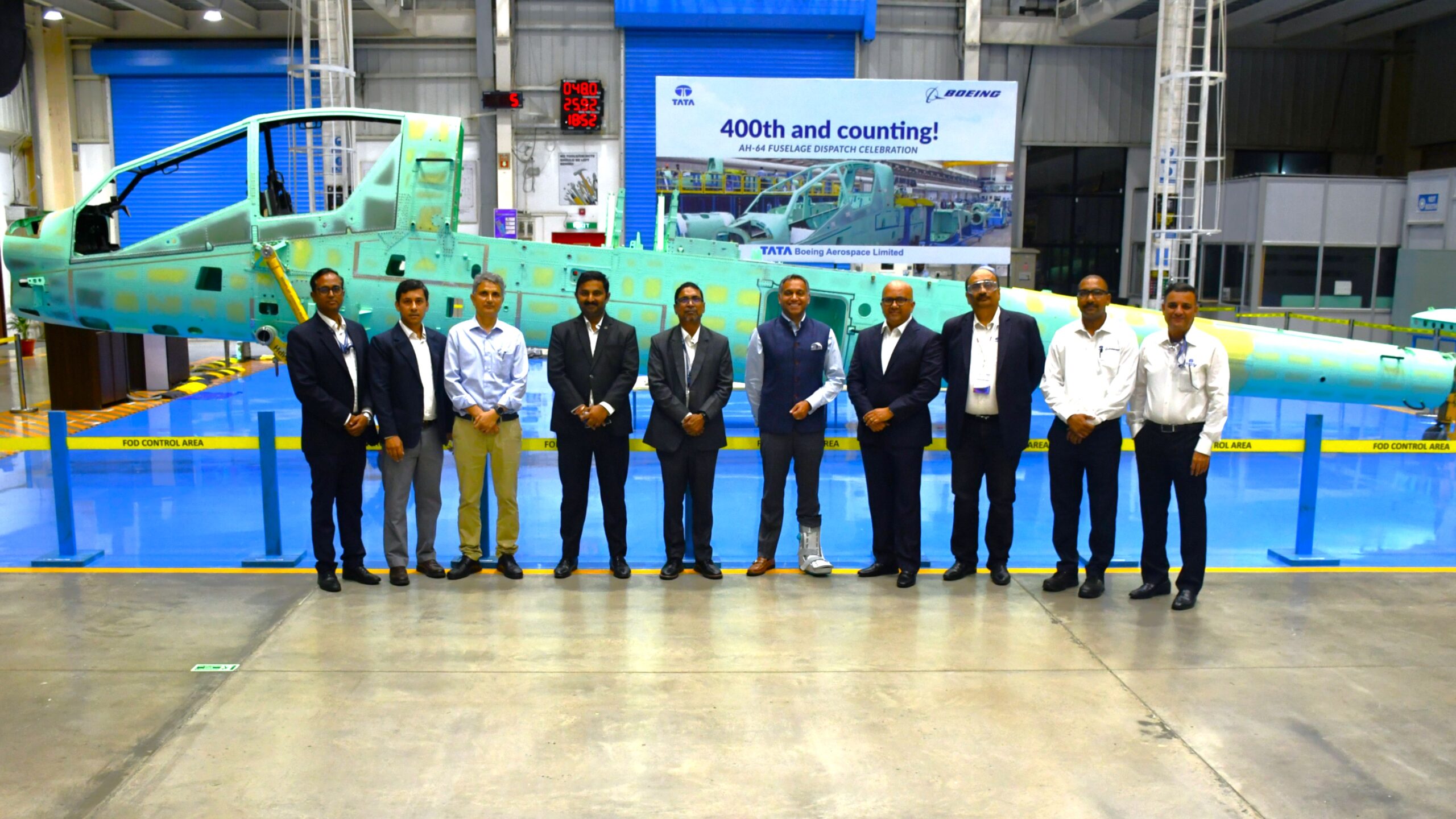
The rollout of the 400th AH-64E Apache fuselage from Tata Boeing Aerospace Limited (TBAL) in Hyderabad is more than an industrial milestone. It reflects the steady integration of Indian manufacturing into high-value global defence supply chains—an area traditionally dominated by established aerospace producers in the United States and Europe.
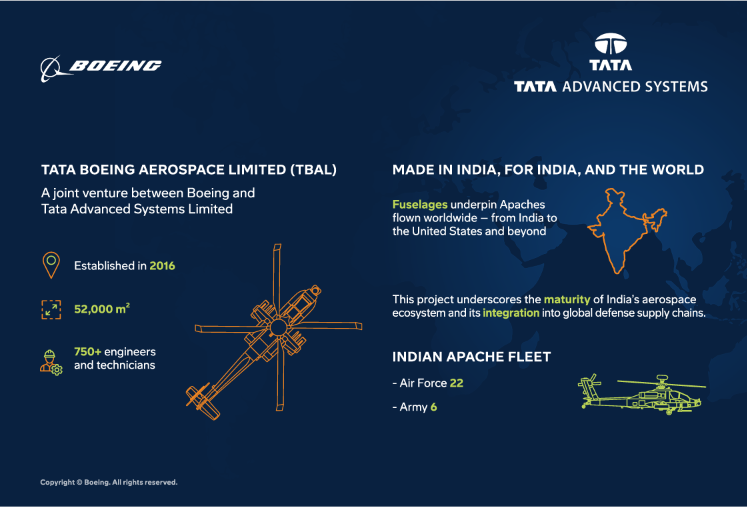
Established in 2016 as a joint venture between Boeing and Tata Advanced Systems, TBAL has developed into a key supplier for the Apache attack-helicopter programme. The facility’s fuselages are incorporated into aircraft delivered worldwide, including to the U.S. Army, underscoring confidence in Indian-made structures for one of the world’s most widely deployed combat-helicopter platforms. Of the roughly 1,300 Apaches operating across 19 countries, the Indian Army received six AH-64Es in 2025, while the Indian Air Force operates a fleet of 22.
The 400-fuselage benchmark matters because of the work involved. A helicopter fuselage is a core aerostructure, demanding precision engineering, strict quality control and reliable production consistency. TBAL’s workforce of more than 750 engineers and technicians, supported by robotics, automation and advanced aerospace-manufacturing systems, demonstrates that India is increasingly contributing not merely labour or basic components, but sophisticated assemblies central to modern military platforms.
For India, this progress supports the broader objective of building domestic defence-industrial capability under the Atmanirbhar Bharat initiative. Such partnerships can help build specialised skills, strengthen local supplier networks, and expose Indian firms to global certification, quality, and production standards. They also offer a route towards greater participation in lifecycle support, maintenance and, potentially, future design and systems-integration work.
Yet the milestone should be viewed with measured optimism. Manufacturing fuselages represents a substantial achievement, but strategic autonomy will ultimately depend on India’s ability to deepen capabilities in areas such as propulsion, mission systems, sensors, avionics, weapons integration and original design. The next test for the domestic aerospace sector will be whether global production partnerships can translate into greater indigenous intellectual property and a larger share of the value chain.
Still, the Hyderabad rollout marks a meaningful shift. India is emerging as a dependable manufacturing base for advanced defence platforms with global customers, rather than solely as a major buyer of military equipment. As the Apache programme continues to serve armed forces across multiple continents, TBAL’s contribution offers a clear illustration of how international collaboration can advance both India’s industrial ambitions and its place in the global aerospace-defence ecosystem.