Chaitali Bag
PHDCCI’s 3rd International Conference on UAVs & Counter-UAVs highlights why India’s next defence technology challenge is no longer simply about building better drones, but about creating an integrated ecosystem capable of sensing, deciding, acting, and surviving in an increasingly contested battlespace.
The character of warfare is changing rapidly, and few technologies illustrate that transformation as clearly as unmanned aerial vehicles. Once regarded largely as intelligence, surveillance, and reconnaissance platforms, UAVs have evolved into multi-role combat systems capable of precision strikes, electronic warfare, targeting, logistics, maritime surveillance, and battlefield networking. At the same time, the proliferation of low-cost drones has created a corresponding challenge: how to detect, identify, track and neutralise an expanding range of unmanned threats.
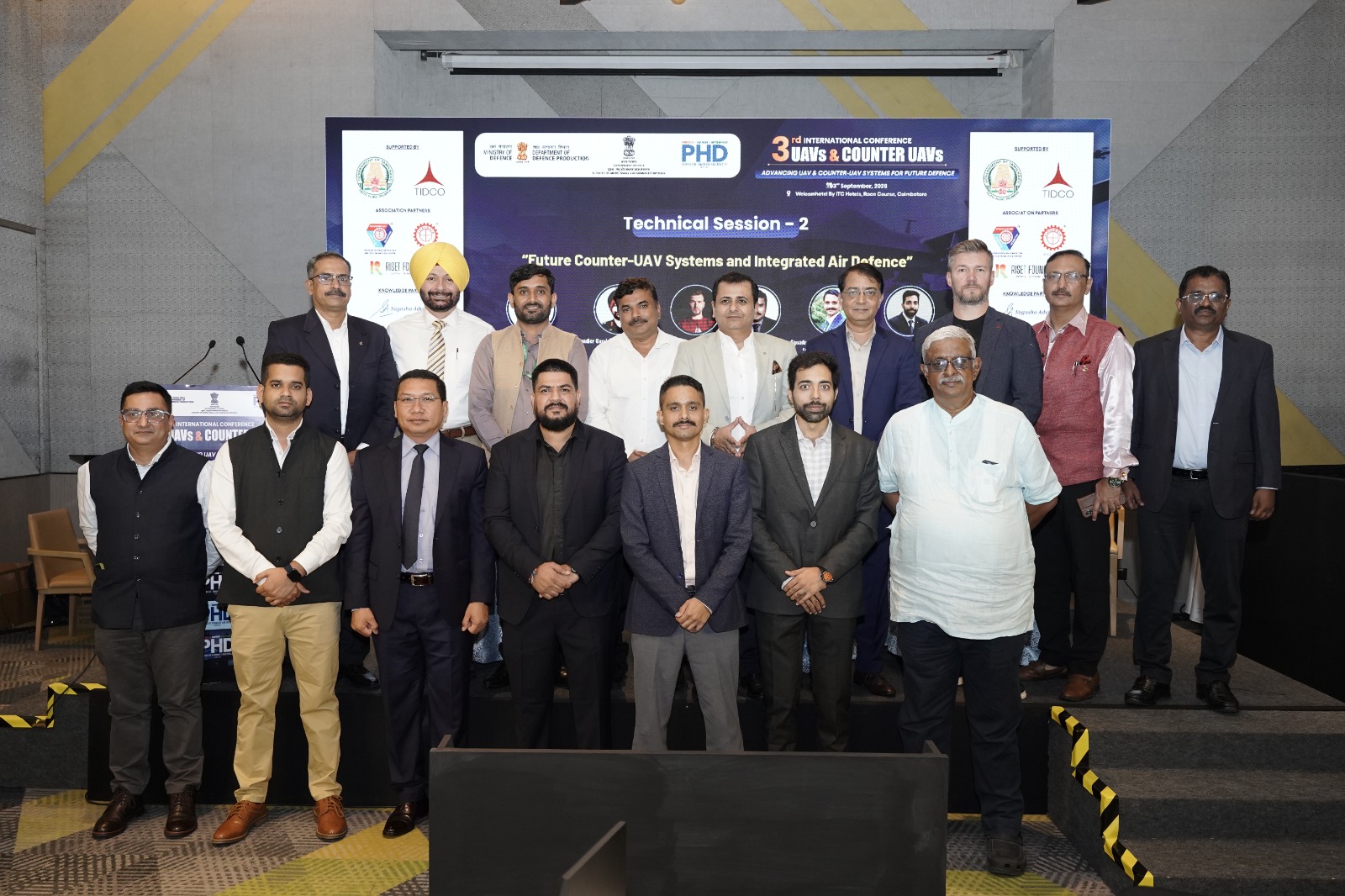
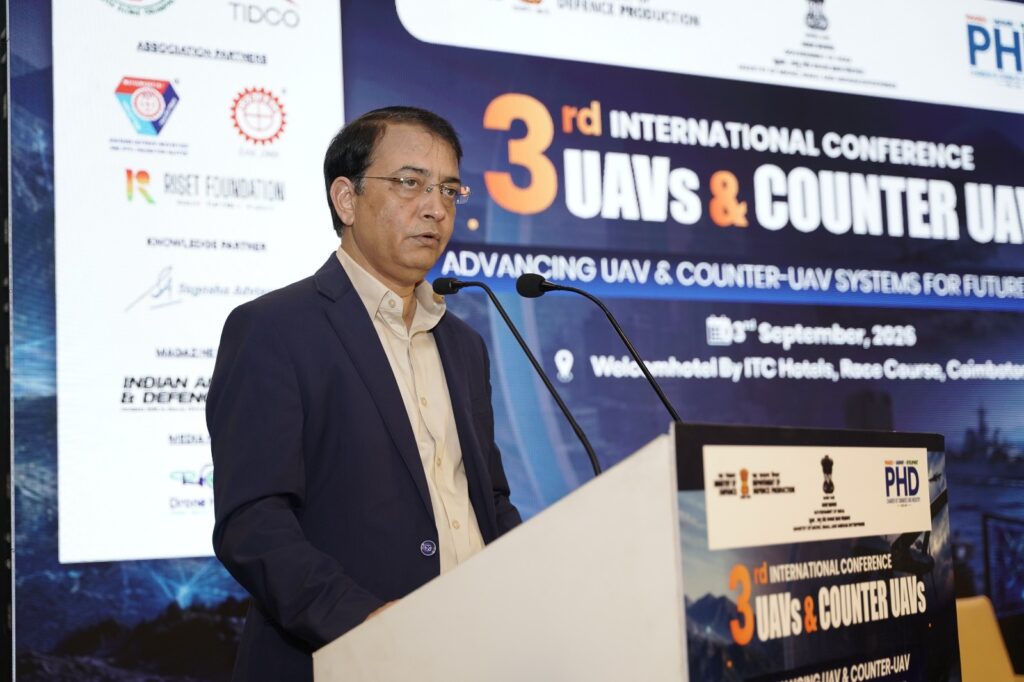
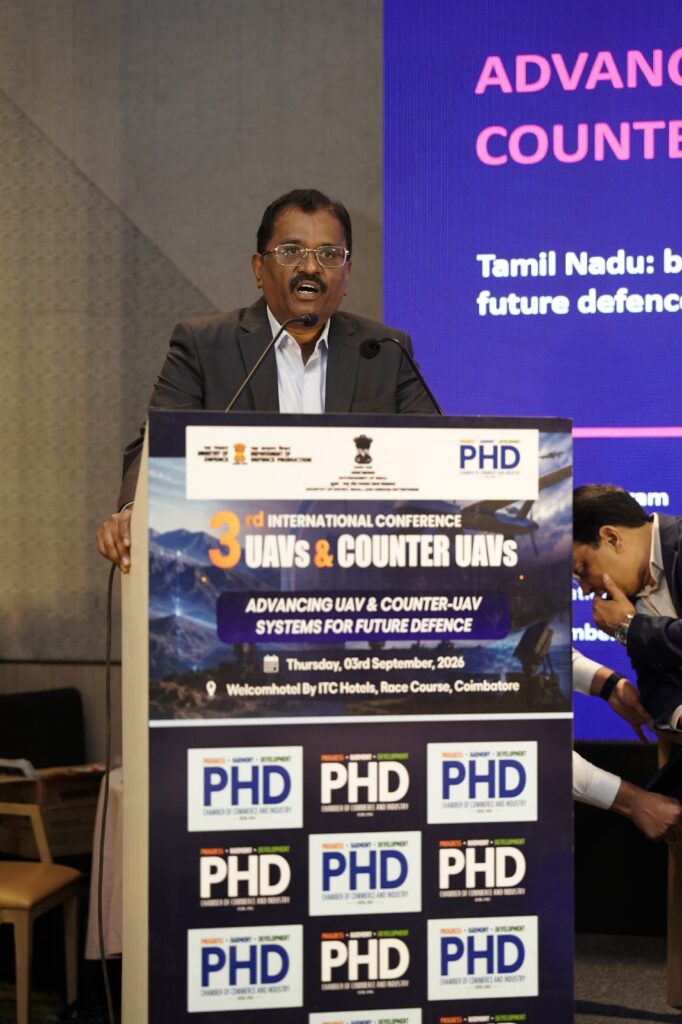
This emerging reality was at the heart of the 3rd International Conference on UAVs & Counter-UAVs, organised by the PHD Chamber of Commerce and Industry (PHDCCI) on 3 September 2026 at Welcomhotel by ITC Hotels, Race Course, Coimbatore, Tamil Nadu. Held under the theme “Advancing UAV & Counter-UAV Systems for Future Defence,” the conference brought together senior government officials, defence representatives, industry leaders, international experts, technology companies and start-ups, with more than 140 industry delegates participating.
Supported by the Ministry of MSME, Government of India; the Department of Defence Production, Government of India; and the Tamil Nadu Industrial Development Corporation (TIDCO), the conference was significant not merely as a technology forum but also as an indicator of where India’s unmanned warfare ecosystem is heading.
The Battlefield Is Becoming Unmanned & Contested
The most important takeaway from the deliberations was that UAVs and Counter-UAV systems can no longer be treated as separate technology categories.
The operational relationship is increasingly circular. Every advance in UAV autonomy, communications, sensors, payloads, and swarm capabilities creates a corresponding requirement for improved detection, identification, electronic warfare, kinetic interception, and directed-energy technologies. Counter-UAV systems, in turn, must evolve continuously because the threat itself is becoming more autonomous, distributed and difficult to detect.
This is fundamentally different from the traditional air-defence paradigm.
Conventional air defence was designed primarily around relatively expensive and identifiable threats such as aircraft, helicopters, cruise missiles and ballistic missiles. The drone challenge introduces a radically different cost-and-complexity equation. A defender may have to respond to large numbers of relatively inexpensive systems, operating at low altitude, with small radar cross-sections and increasingly autonomous behaviour.
The answer therefore cannot be based exclusively on expensive interceptors.
It requires layered, networked and intelligent defence.
AI is becoming the bridge between UAV & Counter-UAV
The discussions on AI-enabled and autonomous UAVs, swarm technologies and loitering systems point towards an important transition: the future UAV will increasingly be defined not simply by its airframe or propulsion system, but by its ability to process information and make decisions within an operational network.
AI can potentially transform several elements of the UAV mission cycle—from navigation and target recognition to route optimisation, collaborative behaviour and mission management. Swarm technology takes this evolution further by allowing multiple unmanned platforms to function as a coordinated system rather than as individual aircraft.
For militaries, however, this also creates a serious Counter-UAS challenge.
A swarm does not necessarily need to overwhelm an air-defence system through individual technological superiority. It can exploit the defender’s limited sensor capacity, engagement channels, reaction time and ammunition stocks through numbers and distributed behaviour.
Consequently, future Counter-UAS architecture will require multi-sensor fusion, automated threat prioritisation and rapid decision-making. Radar, radio-frequency detection, electro-optical/infrared sensors, electronic warfare systems and other detection technologies will have to operate as part of a common architecture.
The decisive capability may therefore lie less in any single sensor or effector and more in the quality of information fusion and speed of the kill chain.
From detection to defeat: The Counter-UAV challenge
Technical Session 2, “Future Counter‑UAV Systems and Integrated Air Defence”, really sharpened the focus on a pressing challenge: detection is only the opening move.
The panel dove into the full technology stack powering next‑generation Counter‑UAS solutions: radar and RF detection, electronic warfare, directed energy, multi‑sensor fusion, and AI‑driven decisioning. Together, these layers are coalescing into a robust Counter‑UAV architecture, but sensing alone won’t win the fight.
A viable system must rapidly classify a contact: is it a conventional aircraft, a friendly UAV, a commercial drone or a hostile threat? It must then assess intent and select the right response — from electronic jamming, deception and cyber measures to kinetic interception or cutting‑edge directed‑energy options — all governed by the operational context and rules of engagement.
That reality forces a nonnegotiable requirement: sensor‑to‑shooter integration.
If a threat is detected but the data can’t be relayed quickly and reliably to the right effector, the system is incomplete. And no matter how capable an interceptor may be, it’s useless without dependable sensor cueing. The clear takeaway: the future belongs to tightly integrated systems, not stand‑alone products.
Lessons from contemporary conflict
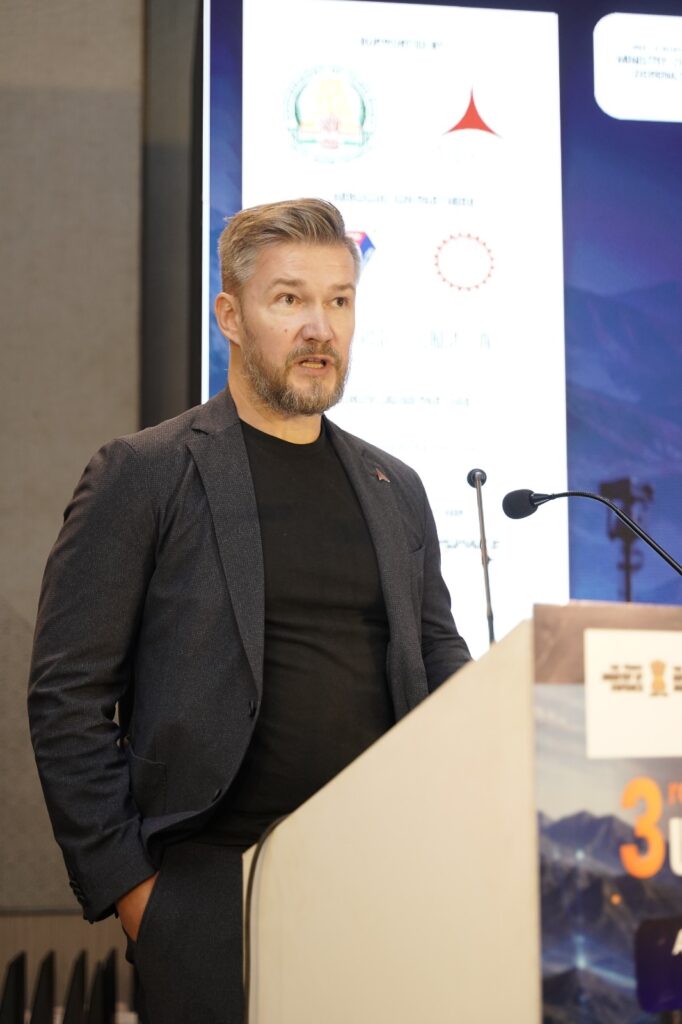
The participation of experts from Estonia and Thailand added an important international dimension to the conference.
The experience emerging from contemporary conflicts—particularly the war in Ukraine—has demonstrated how quickly UAV technology can evolve once systems are exposed to an operationally contested environment. Drones are being adapted, modified and employed in increasingly innovative ways, while electronic warfare and Counter-UAS capabilities are simultaneously being refined to defeat them.
For India, the lesson is particularly relevant.
Technology development cycles in the unmanned domain are becoming shorter. A platform that is highly effective today may face new vulnerabilities tomorrow as adversaries adapt their electronic signatures, communications architecture, flight profiles and employment concepts.
This makes continuous experimentation, rapid prototyping and operational feedback essential components of defence innovation.
The objective should not simply be to develop a successful UAV or Counter-UAV system. It should be to create an ecosystem capable of rapidly identifying operational lessons and incorporating them into the next generation of technology.
Tamil Nadu’s emerging strategic advantage
One of the most important aspects of the Coimbatore conference was its connection with Tamil Nadu’s growing defence-industrial ecosystem.
TIDCO’s role in developing defence infrastructure, including UAV testing and validation capabilities, is strategically important because one of the persistent challenges facing Indian defence start-ups is the transition from prototype to an operationally credible system.
Building a prototype is only the beginning.
Military systems must demonstrate reliability, environmental robustness, interoperability, maintainability, cybersecurity, communications resilience and performance under realistic operating conditions. Testing and validation infrastructure can therefore become a critical bridge between innovation and military induction.
For Tamil Nadu, this creates an opportunity to build a broader UAV innovation-to-production pipeline—linking start-ups and MSMEs with testing facilities, larger defence companies, armed forces, research institutions and international partners.
Such an ecosystem can also help address one of India’s traditional defence-industrial weaknesses: the gap between promising technology and scalable manufacturing.
MSMEs & start-ups: from component suppliers to capability builders
The strong participation of industry delegates also demonstrated that the UAV sector is particularly suited to India’s expanding start-up and MSME ecosystem.
Unlike some conventional defence platforms that require enormous capital investment and long development cycles, UAV technologies allow smaller companies to innovate across specific technology layers. These include navigation, communications, sensors, propulsion, composite structures, artificial intelligence, autonomy, payloads and Counter-UAS technologies.
However, India must avoid creating an ecosystem dominated by disconnected technology demonstrations.
The next phase must emphasize systems integration and deployability.
A successful Indian UAV industry will need to move from selling individual components to delivering mission-ready capabilities. This requires stronger collaboration between start-ups, established defence companies, government laboratories, academia and the armed forces.
Equally important will be the development of common standards, testing protocols and interoperability frameworks that enable systems from different manufacturers to operate together.
Maritime UAVs widen the opportunity.
The conference’s emphasis on maritime applications is particularly relevant for India.
With a vast coastline and growing maritime-security requirements, UAVs can provide persistent surveillance over large areas while reducing the burden on conventional manned platforms. Unmanned systems can potentially support coastal surveillance, naval operations, search and rescue, logistics and maritime domain awareness.
But the maritime environment also introduces unique challenges, including communications reliability, weather, saltwater exposure, long-endurance requirements and the need to integrate UAV-generated data with existing naval and coastal surveillance networks.
This reinforces the larger point: the future UAV is not merely an aircraft—it is a node in a wider operational information architecture.

Directed energy & the economics of defence
The inclusion of directed-energy technologies in the Counter-UAV discussions highlights another emerging dimension.
The economics of drone warfare can become unfavourable if a defender repeatedly uses expensive missiles or other high-cost interceptors against inexpensive unmanned systems. This creates a requirement for a broader portfolio of effectors, including electronic warfare and potentially directed-energy systems, alongside conventional kinetic solutions.
The strategic objective should be to create a cost-effective layered response in which the least expensive effective countermeasure is used against a particular threat.
That could become especially important against massed drone attacks and swarm operations.
From conferences to capability
The real value of conferences such as the PHDCCI event lies ultimately in what follows after the discussions.
India has already developed considerable momentum in UAVs, defence electronics, AI, autonomy and start-up-led innovation. The next challenge is to translate that momentum into operational capability at scale.
Three priorities stand out.
First, integration must become the organising principle. UAVs, Counter-UAV systems, radars, electronic warfare, air-defence weapons and command-and-control systems must operate as part of a common architecture.
Second, testing and validation infrastructure must expand. The faster technologies can be tested under realistic conditions, the faster India can move from prototypes to reliable operational systems.
Third, operational feedback must drive innovation. Lessons from contemporary conflicts demonstrate that unmanned warfare is continually evolving. India’s acquisition and development processes therefore need mechanisms that allow rapid upgrades rather than treating induction as the end of the development cycle.
The Next Frontier: An Indian Unmanned Warfare Ecosystem
The Coimbatore conference demonstrated that India’s UAV conversation has matured considerably. The question is no longer whether unmanned systems will play a major role in future warfare. That proposition is already evident.
The more consequential question is whether India can create an ecosystem capable of designing, manufacturing, testing, integrating, deploying and continuously upgrading both UAVs and their countermeasures.
The answer will depend on collaboration.
Government policy must provide direction and procurement pathways. The armed forces must articulate realistic operational requirements. Defence majors must provide scale and systems integration capabilities. MSMEs and start-ups must bring speed and innovation. Testing institutions must provide credible validation. International partnerships can contribute technology, operational experience and access to global markets.
The presence of representatives from India, Estonia and Thailand at the PHDCCI conference offered a useful illustration of this collaborative model.
The future battlefield will not be defined by drones alone. It will be defined by the contest between unmanned systems and the networks designed to detect, disrupt and defeat them.
India’s strategic opportunity is to ensure that it is not merely a consumer of this transformation, but one of the countries shaping it.
The message emerging from Coimbatore was therefore clear: UAV and Counter-UAV capability must evolve together. The winner will be the ecosystem that can sense faster, decide faster, respond intelligently and adapt continuously.