Chaitali Bag
The joint Tejas sorties undertaken by Indian Air Chief Marshal Amar Preet Singh and Japan Air Self-Defence Force (JASDF) Chief of Staff General Takehiro Morita during Exercise Veer Guardian-2026 represent more than a high-visibility aviation event. They are a compact expression of a wider shift in India-Japan defence relations: from strategic convergence in principle to increasingly practical cooperation between operational forces.
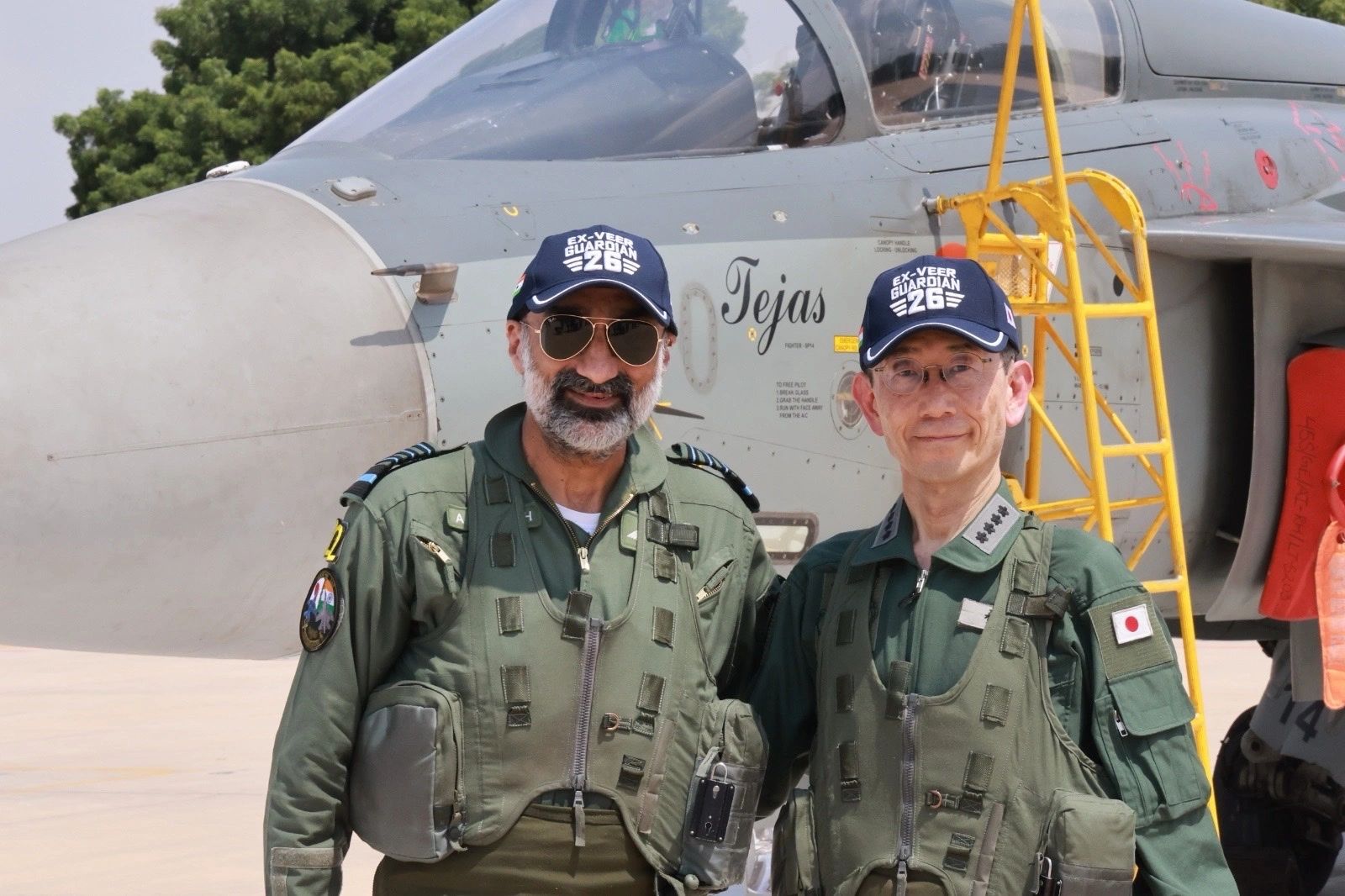
At Air Force Station Jodhpur, Air Chief Marshal Singh flew solo in an indigenous Light Combat Aircraft (LCA) Tejas and led the formation. General Morita flew in a twin-seat Tejas trainer with Group Captain I. Samrat, commanding officer of the Tejas Squadron. The approximately 20-25 minute sortie took place against the backdrop of the bilateral exercise, which runs from September 9 to 22 and brings together Indian Tejas, Su-30MKI and Rafale aircraft with Japanese F-2A fighters.
Its timing is significant. Veer Guardian-2026 is the first bilateral exercise in which JASDF fighter aircraft have landed and operated from Indian soil. The deployment of Japanese F-2A aircraft to India, coupled with General Morita’s familiarisation flight in the Tejas, gives the exercise both operational and strategic relevance. It signals that the India-Japan air partnership is moving beyond staff talks, port calls and symbolic exchanges toward exposure to each other’s platforms, operating procedures, maintenance practices and air-combat culture.
A Flight With Strategic Meaning
Senior commanders flying in military aircraft is not unusual. Yet the choice of the Tejas makes this sortie noteworthy. For India, the aircraft is not merely another fighter in its inventory. It is a visible product of the country’s long-running effort to build indigenous aerospace design, manufacturing, testing and sustainment capacity. Placing the Tejas at the centre of a prominent India-Japan engagement conveys confidence in the programme and in the broader objective of defence self-reliance.
General Morita’s flight in the Tejas trainer offered direct exposure to the aircraft and to the operational environment surrounding it. His reported appreciation of India’s indigenous aerospace capabilities and training ecosystem carries particular value because it comes in the context of an exercise involving one of Asia’s most technologically capable air forces. The JASDF operates in a demanding environment shaped by frequent air-defence alerts, complex maritime geography and the need to integrate closely with allied and partner forces.
The two chiefs’ participation also sends an institutional message. It demonstrates leadership-level endorsement of closer engagement, which matters when military cooperation requires sustained investment in planning, logistics, information-sharing and training. Such exchanges may help create pathways for future fighter-training interaction, instructor familiarisation and professional exchanges, as indicated by the Indian Air Force.
Veer Guardian & the Operational Dimension
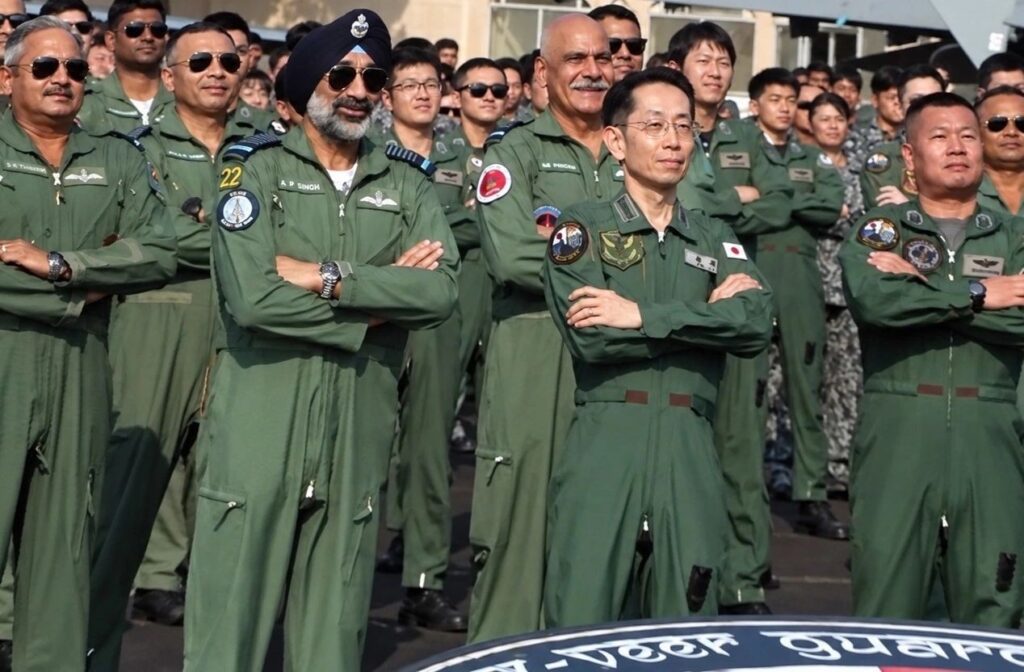
The composition of Veer Guardian-2026 is itself revealing. India’s Tejas, Su-30MKI and Rafale represent three distinct strands of the IAF’s combat aviation capability: indigenous light-fighter development, a heavy multirole fleet with long-range reach, and a modern Western-origin multirole platform. Japan’s F-2A adds another dimension, bringing an aircraft optimised for Japan’s national defence needs and shaped by the JASDF’s sophisticated air-defence and maritime operating environment.
Exercises involving varied aircraft types are important because interoperability is not achieved simply by flying formations together. It is built through the repeated alignment of mission planning, communications, airspace management, ground support, safety procedures, maintenance practices and debriefing methods. Advanced missions can test how forces interpret a tactical problem, make decisions under time pressure and adapt when plans change.
The focus areas identified for Veer Guardian-2026 – advanced operational missions, mission planning, professional exchange, engineering and aerospace safety – suggest an exercise designed to create this deeper familiarity. In modern air operations, the quality of preparation and support is often as consequential as an individual aircraft’s performance. Common or compatible practices in flight safety, engineering oversight and mission generation can make future cooperation more credible and more efficient.
For the IAF, engagement with the JASDF offers exposure to a force that places exceptional emphasis on readiness, procedural discipline, and integrating air operations with wider regional security requirements. For Japan, operating from an Indian air base creates practical understanding of Indian infrastructure, training conditions and the challenges of sustaining missions far from home bases. These are modest but meaningful building blocks for any future expansion of bilateral air cooperation.
The First Japanese Fighter Deployment to India
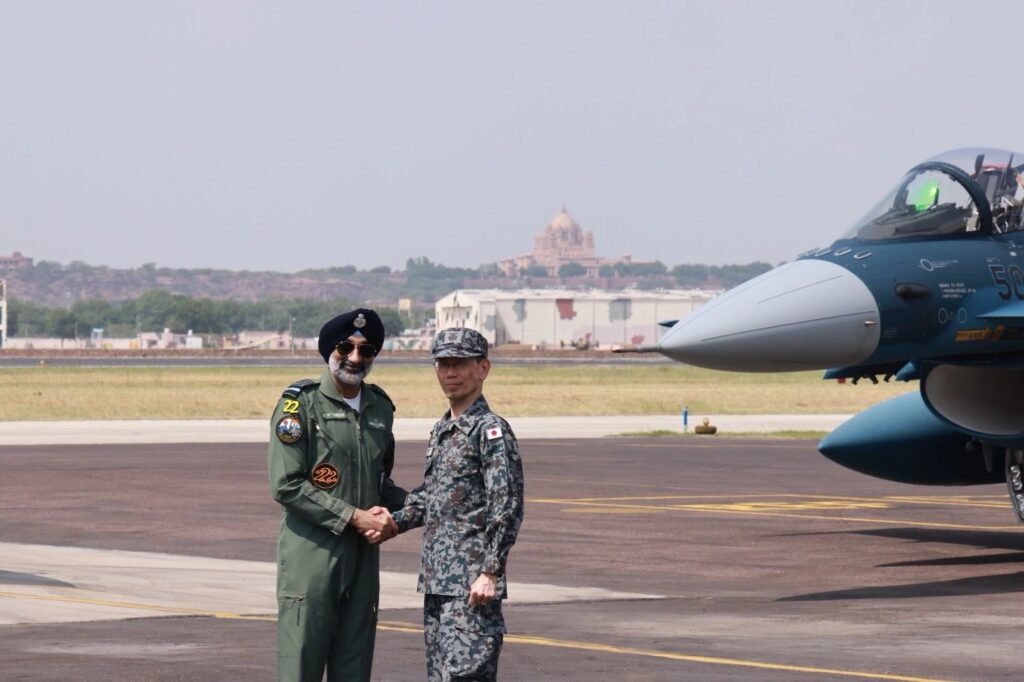
The arrival of Japanese F-2A fighters for Veer Guardian-2026 is a milestone in itself. It is the first time JASDF fighter aircraft have operated from Indian territory during a bilateral exercise. Such deployments require more than diplomatic approval. They involve advance coordination on basing, fuel, maintenance, security, airspace management, ground handling, communications and emergency procedures.
That practical complexity is precisely why the deployment matters. It shows growing comfort between the two air forces and lays the groundwork for more ambitious future exercises. Repetition will be crucial. A single deployment is an important beginning, but routine interoperability develops only when forces meet regularly, compare lessons and build professional relationships across flying squadrons, engineering units, operations rooms and headquarters staffs.
The F-2A’s presence also has symbolic resonance. Japan’s willingness to deploy frontline fighter aircraft to India reflects the widening geographical scope of its security partnerships. Meanwhile, India’s hosting of the JASDF sends a clear message that its air bases and air force are increasingly central to regional defence engagement. Neither country is likely to view the exercise as directed at a single adversary; however, it occurs in an Indo-Pacific environment marked by sharper strategic competition, more frequent military activity and concern over the resilience of the regional order.
The Indo-Pacific Context
India and Japan share a broad interest in a stable, rules-based Indo-Pacific, secure sea lines of communication and respect for sovereignty. Their defence relationship has expanded accordingly through dialogues, naval activity, logistics arrangements and growing contact among the armed services. Air-force cooperation is a particularly important next step because air power shapes surveillance, deterrence, rapid response and the protection of maritime approaches.
Veer Guardian should therefore be understood as part of a larger architecture of strategic cooperation. It does not create a military alliance, nor does it automatically imply joint operational commitments. Instead, it enlarges the two countries’ ability to understand each other, communicate efficiently and operate in proximity when their interests converge.
This distinction matters. The value of bilateral exercises lies not only in immediate tactical outcomes but in the confidence built over time. Familiarity between forces can reduce uncertainty during contingencies, support humanitarian assistance or disaster-relief missions, and improve each partner’s capacity to coordinate with a wider network of friendly countries.
Tejas as an Industrial & Diplomatic Signal
The sortie also highlights the diplomatic role of indigenous defence technology. The Tejas programme has often been assessed through questions of production tempo, capability development and its place within India’s force structure. In Jodhpur, however, the aircraft carried an additional meaning: it became a vehicle for strategic communication.
By placing a foreign air-force chief in the trainer variant while the Indian air chief flew a single-seat Tejas, the event projected confidence in the platform and the ecosystem supporting it. The symbolism does not by itself translate into procurement or industrial cooperation. But it strengthens the international visibility of Indian aerospace capability and demonstrates that the Tejas can be presented as part of a credible frontline training and operational environment.
General Morita’s reported description of the aircraft as a symbol of India’s technological innovation reinforces this message. International recognition is especially useful for an indigenous programme because defence platforms depend not only on their technical characteristics, but also on confidence in production, maintenance, training and long-term support.
What Comes Next
The immediate outcome of Veer Guardian-2026 will be measured in training lessons, mission debriefs and professional contacts. Its longer-term value will depend on whether India and Japan build on this experience through regular air exercises, expanded personnel exchanges and more complex mission sets.
Possible future areas of cooperation could include fighter-training exchanges, aircrew and instructor familiarisation, engineering and safety workshops, mobility and logistics coordination, or structured discussions on maritime air operations. Each would deepen understanding without requiring either country to compromise its strategic autonomy.
The joint Tejas sortie at Jodhpur should therefore be viewed as a strategic marker rather than an isolated ceremonial moment. It combined India’s indigenous aerospace ambition, Japan’s first fighter deployment to Indian soil and the two air forces’ shared interest in practical interoperability. In a region where security partnerships increasingly depend on the ability to act together as well as speak together, Veer Guardian-2026 shows that India-Japan air cooperation is gaining greater operational substance.