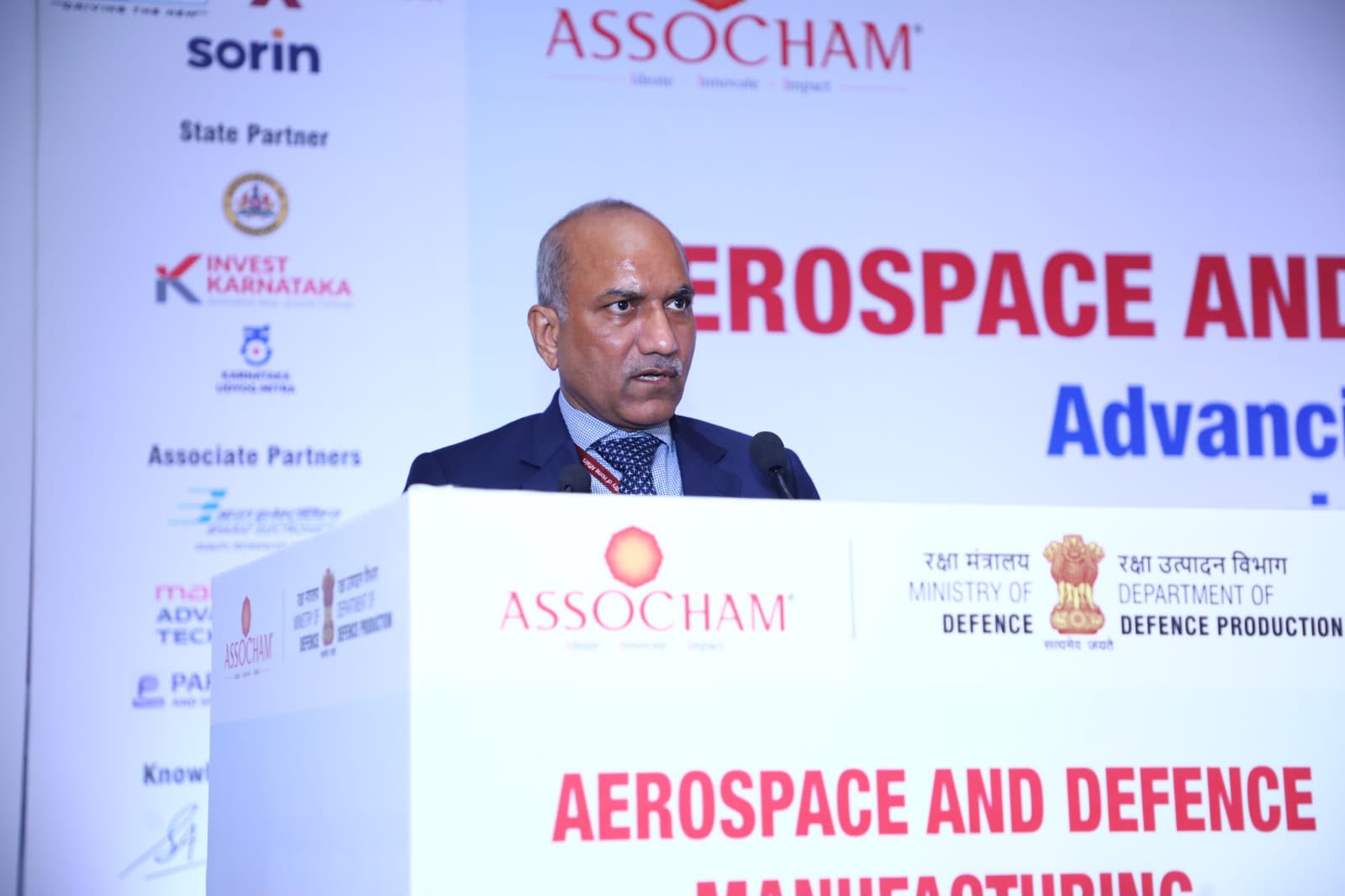
India’s defence manufacturing sector is at a historic inflection point — and the next leap must be from manufacturing to designing if India is to become a global aerospace and defence powerhouse.
Staff Correspondent
At the National Conference on “Aerospace & Defence Manufacturing – Advancing India’s Leadership in Global Market” in New Delhi, Sanjeev Kumar, Secretary, Department of Defence Production, Ministry of Defence, highlighted a staggering transformation: domestic defence production has soared more than four-fold to Rs 1.78 lakh crore in FY 2025–26 from Rs 43,000 crore in 2013–14. Exports have vaulted even more dramatically, from just Rs 686 crore in 2013–14 to nearly Rs 39,000 crore last year, with Indian defence goods now reaching buyers in over 100 countries. Aerospace exports alone accounted for nearly Rs 6,300 crore, a testament to the deepening and durable international partnerships India is forging.
Sanjeev Kumar pointed to the twin engines of this success: Atmanirbhar Bharat and Make in India. These initiatives, paired with targeted policy reforms and enabling platforms, have created the conditions for India to move from being a large-scale assembler to a globally trusted manufacturing hub. Policy measures such as reserving 75% of the capital acquisition budget for Indian companies, prioritising indigenously designed and developed platforms, and supporting instruments like the Technology Development Fund, IDEX and the Srijan portal have fuelled a vibrant domestic ecosystem. MSMEs now account for 50–60% of the value in many platforms delivered by defence PSUs, proving India’s industrial base is maturing rapidly.
But the Defence Secretary sounded a clarion call: manufacturing scale alone will not secure India’s place among the world’s defence innovators. To be a true strategic and economic leader, India must build its own intellectual capital — the high-value capability to design, develop and own technology. He urged industry to invest in genuine R&D and move beyond dependence on technology transfer. “No country, no company gives their latest technology to anybody else except their own forces,” Kumar warned, urging some players to take “the difficult path” of indigenous design. Only by creating and owning core technologies can India achieve real self-reliance and long-term global leadership.
The government has also worked to reduce bureaucratic friction and streamline defence manufacturing. Licensing procedures have been streamlined: long, multi-member evaluation committees have been disbanded, and approvals now move directly through the responsible Joint Secretary, in consultation with DRDO and DGQA — typically within three weeks unless additional information is needed. Export licensing has also been rationalised, with delegation to the Joint Secretary level, and discussions are underway for a one-time, multi-year export authorisation framework for long-term supply partners of global OEMs. These measures are designed to foster predictable, long-term engagement with international customers and partners.
Industry leaders echoed the sector’s strategic and economic significance. Anil K Agarwal called aerospace and defence a defining chapter in India’s growth story, emphasizing the sector’s potential to transform the nation’s industrial and technological landscape.
India today has the talent—engineers, scientists, skilled workers and entrepreneurs—and increasingly robust policy and investment support. What remains is the decisive pivot from manufacturing under licence to home-grown design and innovation. That shift will demand bold investments, sustained R&D, and a willingness to tread the harder path of indigenous development. If industry and policy together embrace that challenge, India is poised not just to supply the world, but to shape the future of defence and aerospace technology globally.
With great enthusiasm, Mr. Anil K Agarwal, Past President of ASSOCHAM, opened the conference by underscoring a pivotal truth: India’s aerospace and defence sector stands at a watershed in the nation’s growth journey. No longer content with merely meeting domestic needs, India is ambitiously reimagining itself as a global hub for manufacturing, technology, exports and supply chains in aerospace and defence. He credited this bold shift to the vision and leadership of Prime Minister Shri Narendra Modi and the focused efforts of the Ministry of Defence and the Department of Defence Production, and he warmly applauded the remarkable progress the Ministry has achieved in recent years.
The inaugural address set the tone for three dynamic thematic sessions. Session I explored “Building a Future-Ready Aerospace and Defence Manufacturing Ecosystem,” Session II charted the path “From ‘Make in India’ to ‘Make for the World’,” and Session III looked ahead to “Futuristic Technologies for Defence Manufacturing.”
At Session II, Dr. N Yuvraj, Secretary of the Industries and Commerce Department, Government of Andhra Pradesh, shared his state’s vigorous push to fortify its aerospace and defence ecosystem. He detailed ongoing and planned investments in testing infrastructure and supporting facilities across aerospace, space and defence domains. Dr. Yuvraj also highlighted initiatives related to ammunition production and negotiations with the Ministry of Defence on shared munitions storage — underscoring Andhra Pradesh’s eagerness to collaborate with industry and stakeholders to create the infrastructure required for sustained future growth.
Representing Karnataka, Ms. Khushboo Goel Chowdhary, Commissioner for Industrial Development and CEO of Invest Karnataka, spoke with pride about her state’s entrenched strengths. Karnataka already enjoys a dominant position in space and defence, she said, backed by a robust ecosystem that brings together HAL, BEML, BEL, DRDO, numerous research institutes, global OEMs and over 2,000 MSMEs actively contributing to the sector.
Panellist Mr. Rajiv Gupta, Chairman of ASSOCHAM’s National Council on Aerospace and Defence, emphasized a pragmatic roadmap: localisation as the crucial first step to build domestic production capability, followed by elevating the competitiveness of India’s entire ecosystem — from supply chains and MSMEs to IT, engineering and execution — so the nation can meet and exceed global expectations as it scales.
The conference also saw the launch of a timely knowledge report, “Aerospace and Defence Manufacturing: Advancing India’s Leadership in Global Market,” produced by ASSOCHAM in collaboration with Sugosha Advisory — a resource poised to inform strategy and catalyze action.
Closing the event, Mr. D S Rajora, Deputy Secretary General of ASSOCHAM, delivered the vote of thanks, expressing gratitude to the chief guest, speakers, industry leaders, diplomats and state representatives for their spirited participation.
The event reaffirmed ASSOCHAM’s steadfast commitment to partnering with government and industry to strengthen India’s aerospace and defence manufacturing ecosystem, deepen indigenous design and innovation capabilities, and position India as a trusted, self-reliant global manufacturing and export powerhouse — all in pursuit of the nation’s vision of a developed India by 2047.