Chaitali Bag
Airbus has rapidly shifted from vendor to strategic partner in India’s booming aviation and aerospace story. Under Jürgen Westermeier’s leadership as President and MD for India & South Asia, the company has deepened its investments across manufacturing, engineering, pilot training, supply chain development, and defence, closely aligning with India’s Aatmanirbhar Bharat and Make in India goals. In an exclusive interview with Indian Aerospace & Defence, Jürgen Westermeier brings out how Airbus now fields a commanding share of India’s commercial fleet, runs the country’s first private-sector aircraft and helicopter Final Assembly Lines, and is accelerating deliveries and localized production to meet surging demand. In a wide-ranging interview, Westermeier highlights how Airbus is navigating global geopolitical and supply chain headwinds while helping to build India’s aerospace capabilities and supplier base. By localizing helicopter manufacturing, expanding defence collaboration, and treating India as a “material country,” Airbus signals that India’s aviation success is integral to its own global ambitions. The conversation underscores a forward-looking, mutually reinforcing partnership poised to drive India’s next phase of aviation growth and self-reliance.

Q. Considering the prevailing uncertainties, how would you characterize the medium- to long-term outlook for the Indian aviation industry in terms of demand recovery, capacity expansion, financial resilience, and regulatory or infrastructural constraints?
A. The current operating environment remains complex and dynamic. We are actively monitoring global uncertainties and working as partners with our customers to meet their requirements. Despite the complex environment, we continue to see a strong appetite among airlines worldwide.
India is a really important partner for Airbus. Its long-term structural drivers (economic growth of 6-7% and growing infrastructure of 200+ airports by 2030) remain intact. We believe that the Indian market will continue to grow strongly. There are about 800 aircraft in service today, and we anticipate this number will nearly triple over the next 10 years.
There is potential for growth and an increased propensity to travel, so the number of trips per capita is tremendous. Today, it’s about 0.13 trips on average per person in India, which should grow to 0.29 by 2035. There is a lot of room for more people to travel. The revolution we have seen in domestic travel over the past decade and a half, we expect to see in the regional and long-haul markets.
Q. Could the ongoing conflict involving Iran and other parties in the Middle East be affecting international delivery schedules and logistics, and if so, what specific types of disruptions might be expected?
A. The market for air travel is inherently cyclical, yet the prevailing long-term trajectory remains one of growth in demand. Airlines require aircraft that combine strong economic performance, an attractive passenger experience and operational versatility across diverse markets to thrive amid these fluctuations.
Recent delivery performance underscores the industry’s ability to meet that need. In May, we achieved notable production and commercial results, delivering 81 aircraft to 45 customers and securing a gross order for 379 aircraft; year-to-date deliveries for Airbus rose by 8% in 2026 versus 2025. Delivery activity to Middle East carriers continued to strengthen in May, with seven aircraft handed over: two A350s to Emirates; one A320neo each to Air Arabia, Gulf Air and Royal Jordanian; and two A321neo to Saudia, including Saudia’s first A321XLR. June saw further momentum, with 89 aircraft delivered to 49 customers. Overall, first‑half 2026 deliveries increased by 15% relative to H1 2025 (351 versus 306).
These figures reflect both the recovery and expansion of air travel demand and the industry’s capacity to supply modern, efficient aircraft that support airline profitability and passenger satisfaction across a wide range of markets.
Q. Are airlines becoming more cautious about ordering or accepting delivery of new aircraft, given reports that Air India is delaying deliveries and that the XLR’s delivery to IndiGo is also delayed?
A. We are a long-cycle industry and our customers have long-term fleet plans. As I shared before, airline demand for latest-generation, low-emission aircraft remains robust. For Airbus, India has solidified its position as a cornerstone market. We will be delivering more than 1,200 aircraft over the next decade, which works out to an average of 120 aircraft per year to Indian carriers (at peak about 150 aircraft/yr). This translates to an incredible cadence of more than two Airbus aircraft arriving in India every week for the next 10 years. The positive thing is that airlines are looking to secure capacity for their future growth.
Q. How good is the supply chain situation now in the wake of the West Asia crisis?
A. We are scaling our production. To do so, we are collaborating closely with our suppliers to navigate the current macroeconomic environment. The current supply chain situation is looking a lot better than it was some time ago. Of course, there are still challenges on engines, cabin and equipment availability.
India remains a vital, reliable partner in our strategy to diversify operations and enhance long-term business resilience. The Indian supply chain has exceptional talent, technological capabilities and a willingness to invest and scale. India’s aerospace supply chain competes with the best in the world in terms of delivery performance and innovation. We are working to expand our sourcing bouquet from India. Today, we are procuring services and components worth $1.6Bn every year. We are on a trajectory to procure $2Bn from India well before 2030.
The next phase of our sourcing growth in India involves tapping into its maturing raw-material ecosystem. Indian suppliers are already stepping up, investing to meet strict aviation-grade standards. We will introduce a major step change in our sourcing policy by integrating raw materials and ramping up component sourcing.
Q. Airbus has a significant presence in India and is also bullish about the prospects. In the current scenario, what distinguishes the Indian market from the rest?
A. India plays a key role in the future of Airbus. Since 2025, India has become a ‘material country’ to Airbus — meaning our success as a global company is now intrinsically linked to our success and integration in India. Our relationship with India has evolved far beyond a buyer-seller dynamic. Airbus is uniquely invested in the nation’s industrial fabric.
Today, we account for 72% of the in-service fleet in India and hold 72% of the order book for the next 10 years – This is a position of great responsibility! The excellence of the Indian supply chain is integral to Airbus’ global industrial ramp-up as we push to deliver more than 9,000 aircraft worldwide over the next 10 years. We quite literally cannot hit our global targets without India.
Similarly, the timely and efficient execution of our C295 and H125 Final Assembly Line projects is absolutely material to Airbus. As is the case with the performance of our engineering and digital centres in Bengaluru. So, you see, Airbus’s success in India now has a direct, material impact on our company’s financial and operational performance. That is our level of dependency on India. That is our level of commitment to India. You could say Airbus has woven its long-term destiny with India.
Q. What is your outlook for the helicopter industry in the country now that the H125 helicopter FAL has been established locally despite having no initial orders, and do you believe this FAL will help open and grow the market?
A. This FAL is proof of Airbus’ selfless commitment to the Government of India’s ‘ Aatmanirbhar Bharat’ programme. It is a testament to Airbus’ strategy to put ‘Make in India’ at its core.
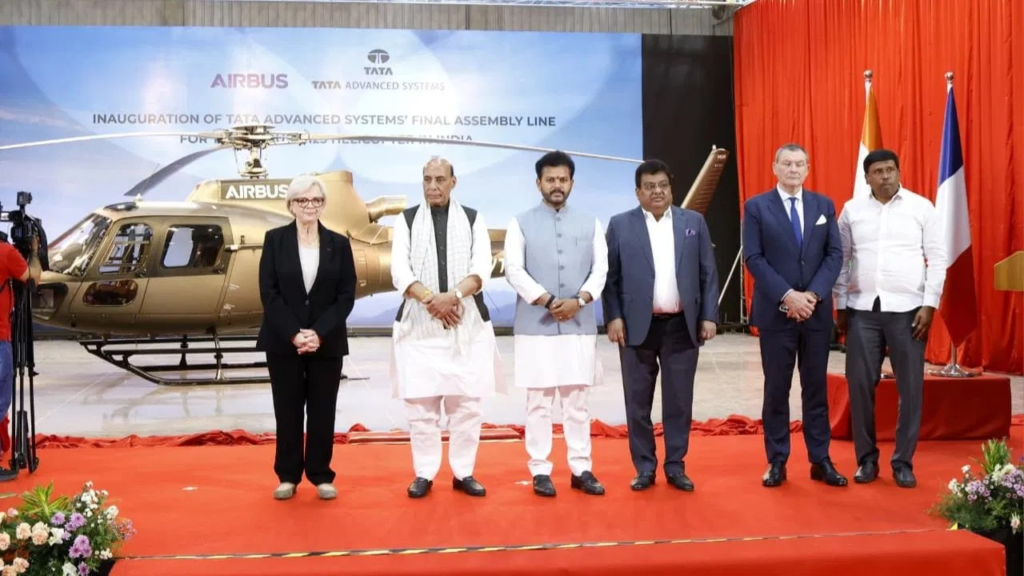
You are right. We are setting up this assembly line without a single order. Why are we doing this? We are setting up this FAL because we are convinced about the latent demand for helicopters in India. A ‘Made-in-India’ helicopter will not only be a symbol of the confident ‘New India’ but will also unlock the true potential of the helicopter market in the country.
The FAL, which is being built by our trusted partners TASL, will catalyse the underdeveloped civil & para-public market in the region. It will allow us to be closer to our customers. It will trigger a local helicopter supply chain (H125 and H130 aerostructures with Mahindra; helionix avionics maintained out of Bengaluru engineering centre). This FAL will also have the capacity to produce the military variant of the H125 – the H125M – to meet the requirements of the Indian armed forces.
Q. Are you planning to install a commercial aircraft FAL in India?
A. We are often asked this question – and it overlooks the fact that Airbus already has two FALs in India today! Airbus is the only foreign OEM to develop two FALs in India, making it unique in doing so.
Airbus has a strategic approach to India. We have adopted both top-down and bottom-up approaches to manufacturing in India. On the one hand, we are working to develop India’s supply chain, where the real value of manufacturing lies. In fact, the Airbus industrial footprint in India today already generates more foreign exchange value. Since 2019, pre-COVID, we have tripled our annual sourcing volume from India, from about $500Mn to $1.6Bn in 2025, working with 100+ suppliers and generating more than 15,000 jobs. We will continue to grow this footprint. On the other hand, you have Airbus, as the only foreign OEM, developing two FALs in India for the C295 and the H125, in partnership with Tata. These FALs will galvanise the aerospace industrial ecosystem and support Indian companies, both large companies and MSMEs, in developing new competencies and capacities.
Again, Airbus has not one but two pilot training centres in India with an installed capacity of 14 Full Flight Simulators. We are deeply invested in developing human capital – we are working with the IITs and Gati Shakti Vishwavidyalaya, providing scholarships, building curriculum, and establishing a centre of excellence for R&D in sustainable aerospace. Our strategy takes a holistic approach to ecosystem development.
Q. What is your assessment of the country’s expanding aerospace presence, and how is Airbus leveraging synergies between its commercial and defence divisions to support this growth?
A. I have already spoken about how we strive to be a strategic partner in India’s nation-building. Our efforts are dedicated towards leveraging India’s market, talent and technology to develop it into a holistic aerospace and defence powerhouse.
‘Make in India’ sits at the heart of Airbus’ strategy, serving as a North Star for all long-term industrial investments and localised manufacturing efforts. India is not only a market but also a strategic resource and industrial hub because India brings the right mix of competitiveness and competencies. Airbus is developing a holistic and state-of-the-art aviation and aerospace ecosystem in India across all dimensions:
- Assembly: We have established two Final Assembly Lines in India for the C295 and the H125 Helicopter, both programs in partnership with Tata. These are the first instances of private-sector aircraft and helicopter manufacturing in India. The first Made in India C295 and H125 will be delivered in 2026 and 2027, respectively.
- Manufacturing: We have tripled our sourcing from India from $500Mn in 2019 up to $1.6Bn in 2025. Not only have volumes significantly increased, but the value of the content has significantly grown, including complex components manufacturing like the A320neo cargo doors (Tata), the A320/A330 flap track beams (Dynamatic), the A220 doors (Dynamatic) and the main fuselage of the H130 and H125 helicopters (Mahindra). We are on track to raise $2Bn from India before the end of the decade.
- Engineering: Our Engineering and Digital centres in Bengaluru have witnessed a fast development from 1079 FTEs in January 2021 up to 3600 as of today.
- Training: We have invested in two pilot training centres in India: our fully owned training centre combined with our headquarters at Delhi Airport, with a capacity of 4 simulators, and a JV with Air India in Gurugram (10 simulators) that was inaugurated in 2025.
- MRO: We are supporting HAL to develop their civil MRO capabilities. We also inaugurated a helicopter MRO facility with Indamer in Nagpur in 2023. Every Airbus commercial aircraft and every helicopter produced today has parts, components and technologies designed, manufactured and maintained in India.
- Human Capital: Skilling is an integral part of our strategy in the country and we have engaged in partnerships with leading universities, including a pathbreaking engagement with the Gati Shakti University in Vadodara. The Airbus industrial footprint in India today generates more than 15000 jobs for the country and will continue to grow.