Cdr Rahul Verma (r)
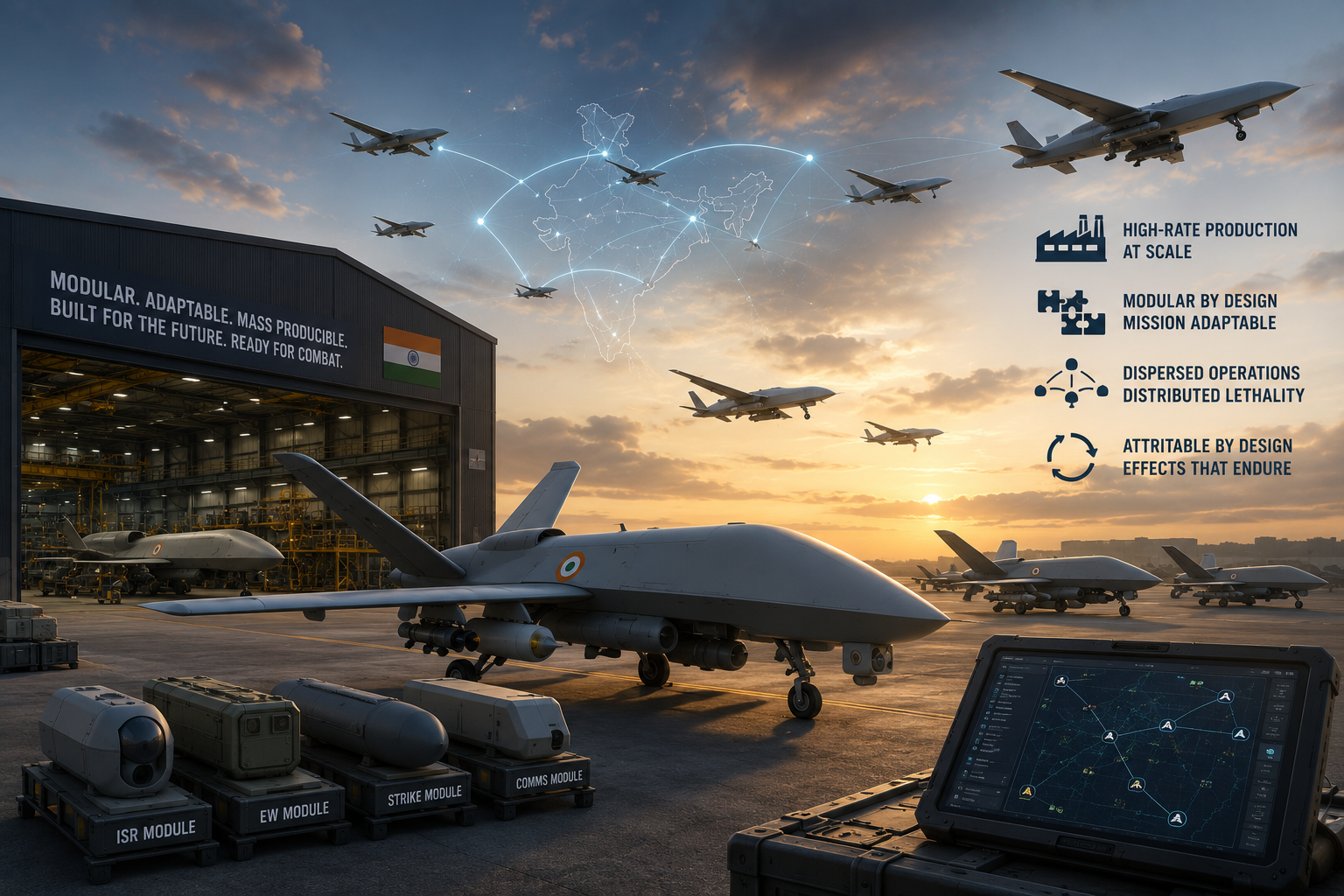
The next aircraft India urgently needs may not be a better fighter, a larger transport aircraft or another exquisite platform shaped by an ever-expanding list of requirements. It may instead be a family of affordable, autonomous and modular aircraft that can be produced in large numbers, configured rapidly, dispersed widely, and risked in combat without paralyzing the campaign when some are inevitably lost.
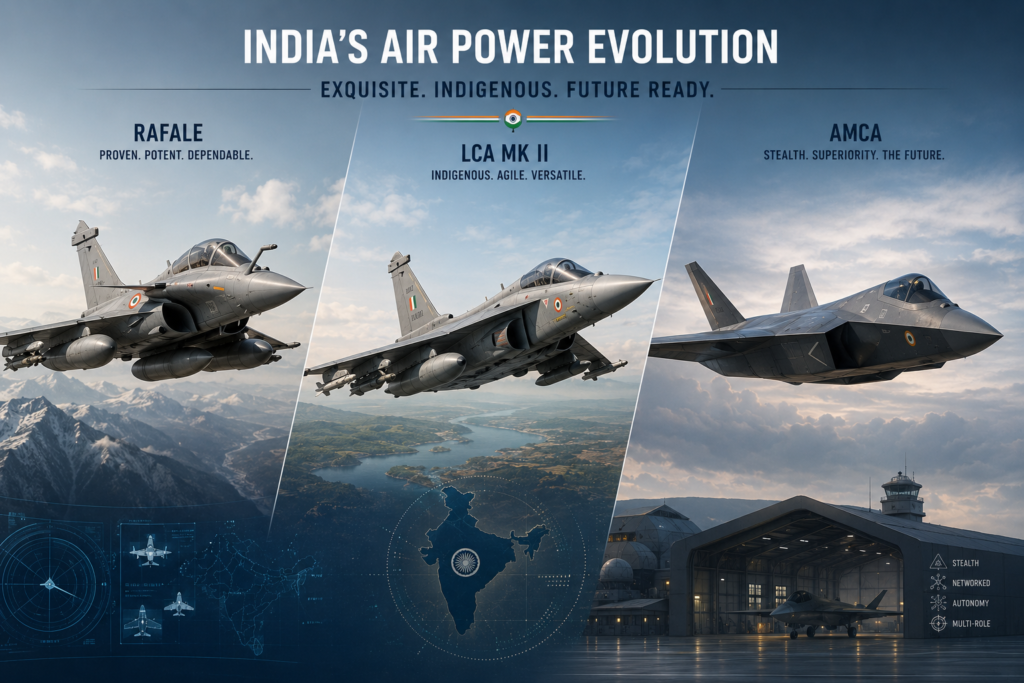
This does not diminish the importance of the Rafale, Light Combat Aircraft Mk II, Advanced Medium Combat Aircraft or India’s other high-end aviation programmes. Air superiority will still require sophisticated crewed aircraft, advanced sensors, long-range weapons and highly trained aviators. But exquisite aircraft alone cannot generate mass across a large and contested battlespace.
That is the deeper significance of the United States Defense Innovation Unit’s Massed Modular Aircraft effort. Its trigger is a theatre-range unmanned aircraft designed not merely for performance, but for high-rate production, open architecture, rapid payload change and deliberate tolerance of combat attrition. It matters less as an American template than as evidence of a changing philosophy: future air power will be measured by how quickly a force can build, adapt, disperse and replace airborne effects.
For India, the question is uncomfortable but necessary: Are we still designing air power for the platform-centric wars of the past while potential adversaries prepare for distributed systems, autonomous mass and industrial replenishment?
The Economics of Air Power Have Changed
Military aviation has traditionally been governed by scarcity. Aircraft were expensive, fleets were limited and platforms were expected to serve for decades. Procurement therefore rewarded multirole capability, long service life and successive blocks of upgrades. The result was the exquisite platform: technologically advanced, highly capable and correspondingly difficult to replace.
That logic remains valid for missions demanding survivability, reach and human judgement. It becomes fragile in an environment shaped by layered air defences, long-range precision weapons and electronic attack. A sophisticated aircraft may survive an engagement, but its runway, fuel farm, maintenance infrastructure, or command node may not.
The operational problem is therefore no longer only whether an aircraft can penetrate enemy defences. It is whether the air campaign can continue after aircraft, bases and support infrastructure have been struck. Mass offers resilience. A force with sufficient numbers can disperse, absorb losses, create multiple dilemmas and continue producing effects even when individual systems are destroyed.
Here, one distinction is important. An expendable aircraft is intended to be consumed in a mission. An attritable aircraft is recoverable and reusable, but affordable and available enough for commanders to expose it to risks unacceptable for a crewed fighter or strategic surveillance asset. Attritability is not another word for cheapness. It is a deliberate balance among capability, reliability, survivability, production rate and operational risk.
From the Perfect Aircraft to the Available Aircraft
Indian procurement frequently begins with a reasonable ambition to define the best possible operational requirement and acquire a platform that satisfies it. Over time, sensors, payloads, environmental conditions, communications, certification demands and indigenous-content provisions accumulate. The aircraft becomes heavier, more complicated and more expensive. Delivery timelines lengthen, quantities decline and the original urgency is diluted.
The services may eventually receive a highly capable aircraft—but too few and too late.
Massed modular aircraft demand a different question. Instead of asking, “What is the finest aircraft that can fulfil every conceivable mission?”, acquisition authorities should ask:
“What is the minimum viable air vehicle that can carry rapidly interchangeable mission effects and be manufactured at the rate required by war?”
This is not an argument for lowering operational standards. It is an argument for placing requirements in the correct layer of the system. The air vehicle need not permanently contain every capability. It must provide the payload, power, cooling, communications, computing, range and flight performance needed to host different mission packages. The payload determines what the aircraft does; the architecture determines how quickly it can do something else.
What Modularity Should Mean
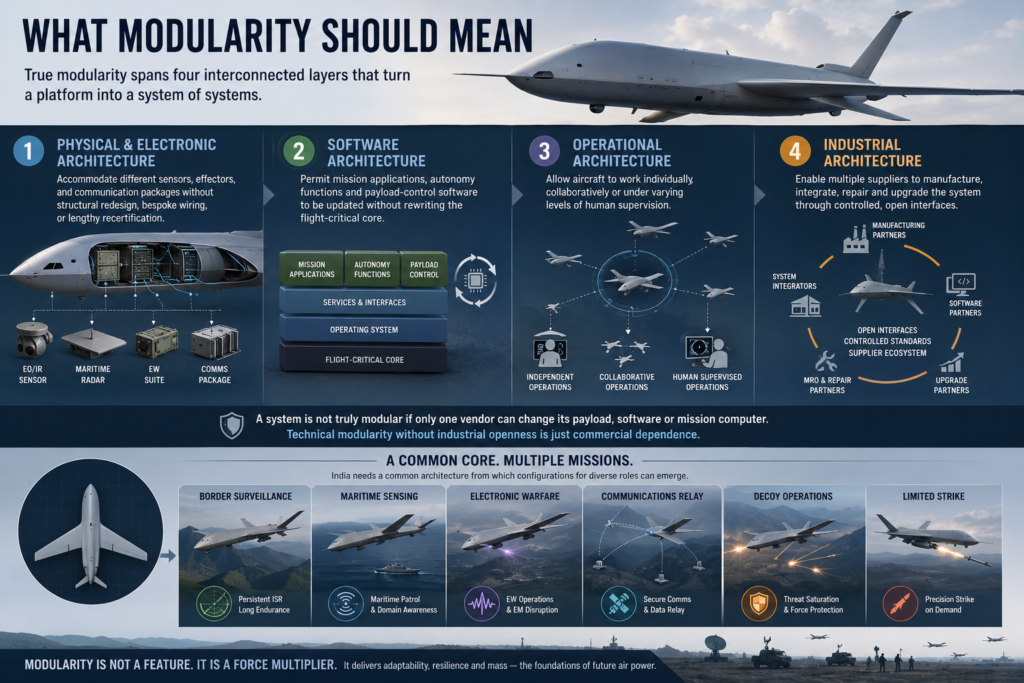
“Modular” has become one of defence marketing’s most overworked words. A replaceable camera or an empty payload bay does not create a modular combat system. For massed aircraft, modularity must span four interconnected layers.
First, the physical and electronic architecture must accommodate different sensors, effectors, and communication packages without structural redesign, bespoke wiring, or lengthy recertification. Second, the software architecture must permit mission applications, autonomy functions and payload-control software to be updated without rewriting the flight-critical core. Third, the operational architecture must allow aircraft to work individually, collaboratively or under varying levels of human supervision. Finally, the industrial architecture must enable multiple suppliers to manufacture, integrate, repair, and upgrade the system through controlled, open interfaces.
The last layer is decisive. An aircraft cannot credibly be described as modular if only one vendor can change its payload, software or mission computer. In that case, technical modularity merely disguises commercial dependence.
General Atomics’ Gambit family illustrates the value of a common core supporting different roles. Its relevance lies not in copying a foreign design, but in understanding the logic. India needs a common architecture from which configurations for border surveillance, maritime sensing, electronic warfare, communications relay, decoy operations and limited strike can emerge.
Architecture, not Another Isolated Platform
India is not starting from zero. It already has UAVs, loitering munitions, autonomy software, electronic warfare payloads, and a widening aerospace base. The gap is the procurement intent that binds them together.
The Army, Navy and Air Force still tend to generate requirements through separate pipelines, often creating different airframes, ground-control stations, data links, payload interfaces, training systems and sustainment chains for overlapping missions. The outcome is fleets within fleets: small numbers of platforms, each with its own spares, software, operators, test equipment and vendor dependencies.
A credible Indian Massed Modular Aircraft programme should therefore begin with a government-controlled reference architecture, rather than a single, all-encompassing aircraft specification. The services, DRDO, certification agencies, and industry should agree on the interfaces for payload power and mounting, secure communications, mission computing, degraded navigation performance, autonomy, cybersecurity, software assurance, weapons integration, safety, and digital configuration control.
Industry should then compete at several levels. One company may produce the air vehicle, another the propulsion system, several may develop payloads, and specialist software firms may provide autonomy or mission applications. The government need not own every line of code, but it must control the interfaces sufficiently to avoid being captive to a single prime contractor.
The software layer is where this becomes real. Leading autonomy providers have shown what platform-agnostic, open-architecture autonomy looks like in practice: flying across different airframes, swapping mission software between vendors on a single sortie, and coordinating teams of aircraft and effectors under a single human supervisor. All three sell developer kits precisely so that a customer can build their own behaviours on top of them. India can and should exploit that: license a kit to learn the interface patterns and field an early capability quickly. But a foreign SDK exposes interfaces, not the flight-critical core, and much of it is subject to export controls, so treating it as anything more than a bridge simply shifts dependence from an airframe vendor to a foreign software vendor. The sovereign move is to adopt the pattern, not rent the stack: mandate an Indian reference architecture; have DRDO, private autonomous firms, and startups build an indigenous core for those same open interfaces; and, over successive block upgrades, swap the foreign engine out behind a stable interface. A stack you cannot recompile and re-certify under fire is not your stack.
This is strategic autonomy in a software-defined aerospace system.
Production Rate is a Combat Parameter
An aircraft that meets every performance requirement but cannot be produced rapidly may have little relevance after the opening phase of a war. Production capacity must therefore become a key performance parameter rather than an industrial appendix.
Future solicitations should require bidders to declare monthly output, time required to double production, dependence on imported critical components, alternative suppliers, surge tooling, repair timelines, and the percentage of the system that is replaceable at the field or unit level. These questions are as operationally important as range, endurance and payload.
The next conflict may require systems to be replenished while they are being employed and lost. Inventory depth, repair velocity, and software release cycles will shape combat power. Fifty exquisite aircraft without a replacement pipeline may be less resilient than 200 good-enough aircraft backed by distributed manufacture, common support and continuous improvement.
This also changes what the industry must optimize. The winning aircraft may not be the one that dominates a demonstration. It may be the one that can repeatedly leave the production line with consistent quality, accept a new payload without destabilizing the platform, be repaired close to the theatre, and return to service quickly. Factories, supply chains, software pipelines and test facilities are no longer merely support functions; they are extensions of the combat system.
The Institutional Test
The hardest barrier will not be aerodynamic. It will be cultural and institutional. Military aviation has traditionally treated aircraft loss as exceptional, particularly where fleets are small and replacement cycles are measured in years. Attritable systems require commanders and acquisition authorities to accept that some losses may be inherent in creating operational effect.
That does not mean tolerating unreliable equipment or treating every aircraft as ammunition. Reliability remains non-negotiable. What changes is the relationship among quality, quantity and risk.
Procurement organizations must also become comfortable buying architectures rather than finished platforms. Software, payloads and mission roles will evolve faster than the airframe. India therefore needs shorter development spirals, operational experimentation, limited-series manufacture and rapid block upgrades. The sequence should increasingly become design, prototype, experiment, produce, deploy, learn and improve.
Some configurations will become obsolete quickly. That is not a programme failure, but it is the cost of remaining relevant. The greater failure would be delivering a perfectly compliant aircraft after the operational problem has moved on.
From Deterrence to National Endurance
The 2026 NATO Summit in Ankara reinforced a wider shift in strategic thinking: deterrence must be backed by endurance. A prolonged conflict will test far more than military inventories. It will simultaneously test economic resilience, industrial output, information systems, political cohesion and the public’s willingness to absorb disruption. The boundary between military preparedness and national preparedness is therefore steadily dissolving. In that context, massed modular aircraft are not merely an aviation choice. They are one expression of a nation’s ability to convert software, supply chains, private capital, manufacturing capacity and operational learning into sustained combat power. For India, the real measure will not be how many systems can be unveiled before a crisis, but how quickly they can be produced, repaired, reconfigured and returned to the fight after it begins.
From the Flight Deck
A naval aviator learns early that combat aviation is not sustained by the aircraft in the air alone. It is sustained by the deck beneath it, the maintainers, handlers, armourers, controllers, spares, fuel, procedures and relentless ability to launch the next sortie. The finest aircraft on deck has limited value if it cannot be turned around, rearmed and put back into the fight.
The same truth now applies on a national scale. The next air war will not be decided only by which side fields the finest fighter or longest-range weapon. It will also be decided by which side can regenerate sensing, deception, electronic attack, communications and strike effects after losses have begun.
India must continue investing in the Rafale, LCA Mk II, AMCA, and other high-end combat aircraft. But these platforms must be supported by an affordable layer of modular, autonomous, and attritable mass operating ahead of them, alongside them, and in missions where risking a crewed aircraft would be disproportionate.
This is not a choice between exquisite platforms and mass. A balanced force requires both.
From the flight deck, the lesson is simple. Wars are not won by the aircraft too precious to launch. They are won by the force that can recover, reconfigure and launch again, sortie after sortie, even after the first aircraft do not return.
Cdr Rahul Verma (r), former Cdr (TDAC) at the Indian Navy, boasts 21 years as a Naval Aviator with diverse aircraft experience. Seaking Pilot, RPAS Flying Instructor, and more, his core competencies span Product and Innovation Management, Aerospace Law, UAS, and Flight Safety. The author is an Emerging Technology and Prioritization Scout for a leading Indian Multi-National Corporation, focusing on advancing force modernization through innovative technological applications and operational concepts. Holding an MBA and Professional certificates from institutions such as Olin Business School, NALSAR, AXELOS, and IIFT, he’s passionate about contributing to discussions on aviation, unmanned technology, and policy. Through writing for various platforms, he aims to leverage his domain knowledge to propel unmanned and autonomous systems and create value for Aatmannirbhar Bharat and the Indian Aviation industry.