
Vijay Grover

The Indian aviation market presents a fascinating paradox. To an observer tracking the long-term fundamentals, over the last decade, India has shown, and still promises to be, the single most exciting growth frontier in global commercial aviation. Industry projections indicate that India’s commercial aircraft fleet is expected to double from 812 to over 1,600 by 2036.
While most Western markets are buying planes simply to replace their ageing fleets, India is buying planes to feed an insatiable, brand-new domestic demand waiting to boom. The order pipeline of Indian carriers totals nearly 1,000 planes. A demand that manufacturers like Boeing and Airbus are unable to meet.
Former CEO Pieter Elbers had reaffirmed before his exit that their strategy was to “add one plane weekly for 10 years and target a 40% international capacity increase”. This is only one operator’s wish list; there are many more whose orders are still a decade away from being delivered. The fact that the Directorate General of Civil Aviation (DGCA) cleared an ambitious 26,495 weekly departures across 126 airports—representing a 6% capacity increase over the previous winter- doesn’t mean the captains of the industry share the same optimism. They remain heavily focused on stability, airspace restrictions, and controlling the skyrocketing operational costs.
The excitement gives way to the reality that most local airlines are operating under a heavy cloud of caution. Reeling from historic fiscal pain and unprecedented external shocks over the last six months, domestic operators are intentionally hitting the brakes on hyper-aggressive expansion, pivoting instead toward strict capacity discipline and yield protection. The recent flare-up of the conflict is adding to the apprehensions.
The period from 2015 to 2025 can be called the “Decade of the Runway” in India. In the last decade, India saw an Infrastructure Revolution, with 88 new airports built or operationalised. While some serve efficiently, many of them are still underconnected.
About 15 new greenfield terminals and airport cities are coming up and should provide deeper penetration into the country’s hinterlands. The structural foundation powering global optimism about Indian skies isn’t just built on passenger numbers; it is anchored in concrete business plans.
Over the last decade, India’s aviation sector has undergone a massive, unprecedented infrastructure transformation. For years, the single biggest bottleneck for Indian aviation was the lack of secondary airports and choked metro runways. Today, the country is finally unlocking the physical space airlines have long desperately needed.
The just-launched Noida International Airport (Jewar), which officially opened its gates and commenced commercial flight operations on June 15, 2026, is a massive greenfield project that provides the National Capital Region (NCR) with a crucial second gateway, instantly easing the heavy congestion at Delhi’s IGI Airport. Similarly, the Navi Mumbai International Airport, having successfully initiated domestic services, is scheduled to launch its international passenger and cargo operations on July 15, 2026, giving the landlocked Mumbai Metropolitan Region the dual-airport ecosystem it has required for decades. With Navi Mumbai Airport planning a massive expansion not just as an airport but as an Airport City Complex, the aviation sector has been excited about it for the last decade.
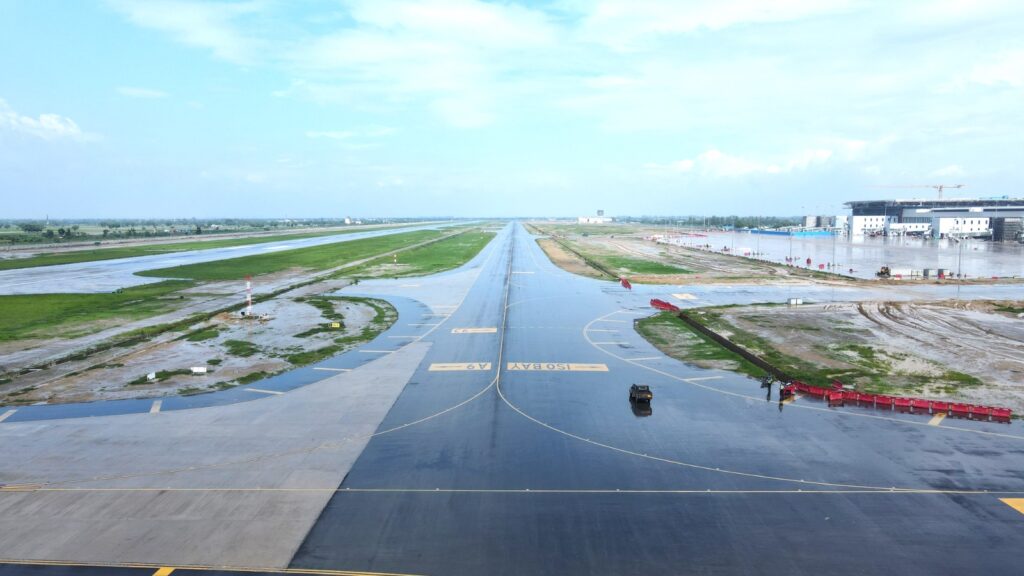
Jeet Adani, Director, Adani Airport Holdings Limited, recently said: “Around the world, the most successful airport districts have become centres of commerce, tourism and urban growth. As India’s aviation market expands, airports have an opportunity to create value far beyond aviation. We are creating a network of integrated urban destinations where airports become catalysts for investment, employment, better passenger experiences and the long-term growth of the cities they serve.”
Not just Delhi and Mumbai, but other cities are looking at air connectivity as well. Beyond these mega-hubs, dozens of Tier-2 and Tier-3 cities have seen brand-new terminal buildings open or enter the final stages of readiness under the PM Gati Shakti and UDAN frameworks, laying the groundwork for airlines to scale up safely once the current macroeconomic storm passes. Karnataka, the IT state, continues to deliver on its promises. With connectivity to 7 Tier 2 cities, not just with Bengaluru, but also with Mumbai and Delhi, the airports are becoming engines of growth. As the Industries Minister of the state, M B Patil, says, “Karnataka is working towards formulating its own Civil Aviation Policy to strengthen regional air connectivity and ensure the long-term viability of smaller airports across the state”.
The policy will examine key aspects such as the fund-sharing model between the State and the Centre and explore ways to sustain operations even after schemes like #UDAN conclude.
The turbulence of 2026 has given the industry a harsh reality check. However, this world-class infrastructure, which promises to make India an aviation hub, is currently meeting a brutal short-term reality check. The first half of 2026 has served as a reminder of how vulnerable airline balance sheets remain to external shocks such as a fuel price surge. While rating agency ICRA recently downgraded the domestic industry’s outlook to Negative, driven by an unprecedented spike in projected net losses for Indian carriers, the Government is confident that the coming months offer hope for the industry in General and the aviation sector in particular. India’s Union Minister for Civil Aviation posted on X, “Despite global uncertainties, India records its highest-ever monthly domestic air traffic, reaffirming the strength of the country’s aviation sector under the leadership of Hon’ble Prime Minister Narendra Modi,” and he is hopeful that the winter season will give a further boost.
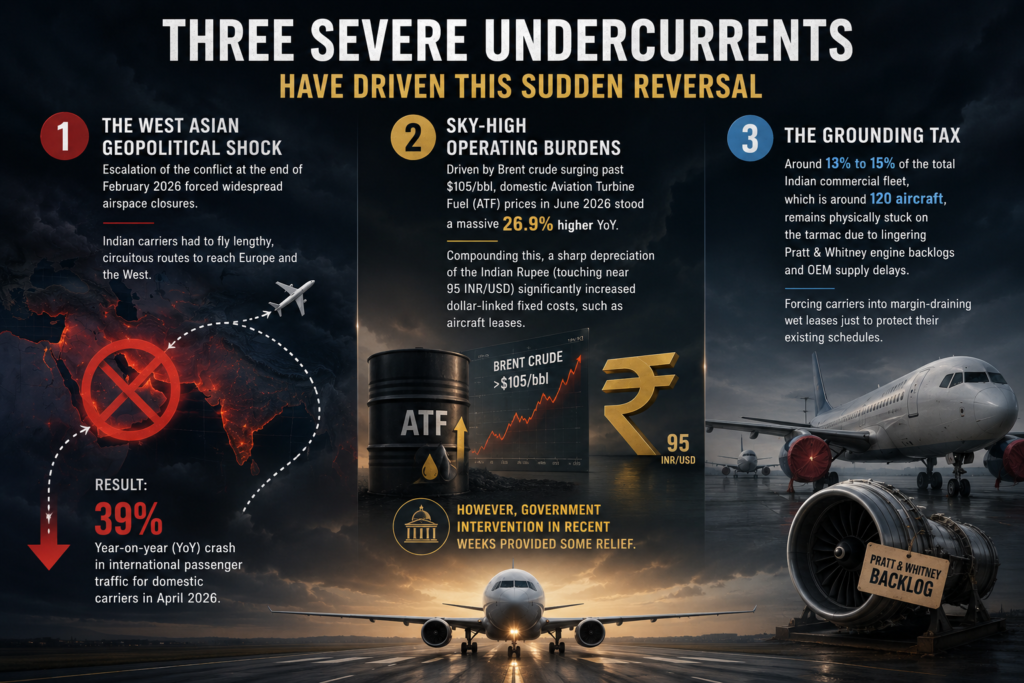
Three severe undercurrents have driven this sudden reversal,
- The West Asian Geopolitical Shock: Escalation of the conflict at the end of February 2026 forced widespread airspace closures. Indian carriers had to fly lengthy, circuitous routes to reach Europe and the West. The result? A steep 39% year-on-year (YoY) crash in international passenger traffic for domestic carriers in April 2026. The re-escalation of the conflict is cause for concern.
- Sky-High Operating Burdens: Driven by Brent crude surging past $105/bbl, domestic Aviation Turbine Fuel (ATF) prices in June 2026 stood a massive 26.9% higher YoY. Compounding this, a sharp depreciation of the Indian Rupee (touching near 95 INR/USD) significantly increased dollar-linked fixed costs, such as aircraft leases. However, government intervention in recent weeks provided some relief.
- The Grounding Tax: Around 13% to 15% of the total Indian commercial fleet, which is around 120 aircraft, remains physically stuck on the tarmac due to lingering Pratt & Whitney engine backlogs and OEM supply delays, forcing carriers into margin-draining wet leases just to protect their existing schedules.
As the industry moves toward the high-demand festive and Christmas quarter (Q3 FY2027), passengers should not expect headline-grabbing, cut-throat fare wars. Learning from the ghosts of past bankruptcies, which saw airlines like Jet Airways, Kingfisher, and Go Air facing severe cash burn and going bust, Indian airlines are choosing to protect their wallets rather than blindly chase market share.
Instead of adding dozens of flights and slashing ticket prices, most carriers are keeping flight schedules tight. By keeping supply slightly below actual demand, they can command higher ticket prices, protecting their yields. Holiday travel demand is relatively inelastic; people will pay to see family, so airlines are passing high external costs directly to the consumer to patch up damaged balance sheets.
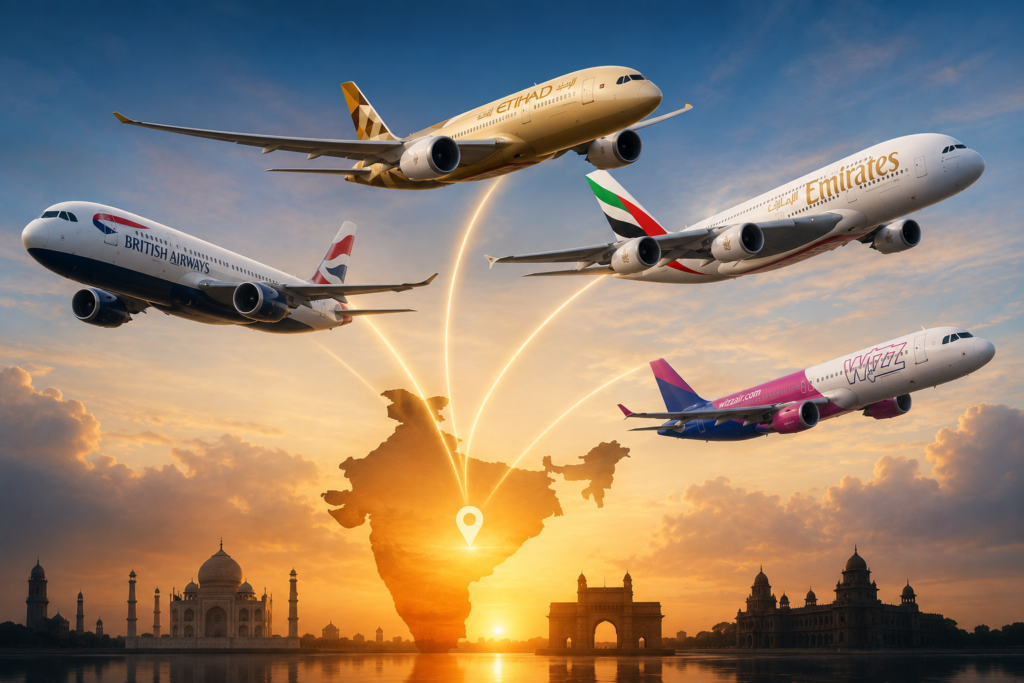
While Indian companies act with deep financial caution, international mega-carriers ranging from Middle Eastern giants like Emirates and Etihad to European airlines like British Airways and low-cost pioneers like Wizz Air are aggressively trying to expand their footprints here. Singapore-based Scoot is also sparing no effort to tap the Indian sector with newer routes. Global operators see past the short-term turbulence, looking directly at India’s newly minted airport infrastructure and long-term structural goldmines:
India promises steady and rising growth, as per capita air travel remains incredibly low at roughly 0.1 trips per year, compared to 0.5 in China and over 2.0 in the US. With a population of 1.4 billion and a surging middle class, it represents the world’s largest untapped pool of future international flyers. This potential is what the industry is looking at. It will need a few policy changes and encouragement from the Government of India.
India boasts the largest global diaspora, ensuring highly resilient, year-round “Visiting Friends and Relatives” (VFR) traffic that foreign airlines can seamlessly monetize through their hubs.
The Way Forward is to get the Government of India to abandon the protective stance that has created a duopoly between Air India and IndiGo. Historically, India has been protective of its skies, limiting bilateral seat entitlements to shield domestic carriers from being overwhelmed by foreign giants. However, given the current domestic capacity crisis and skyrocketing ticket prices, there is a compelling case for shifting toward a more liberalized, open-skies approach.
Liberalizing international codeshares and expanding bilateral rights would inject immediate capacity, bring down airfares for Indian consumers, and prevent market monopolies as domestic consolidation shapes a duopoly between IndiGo (65% market share) and the Air India Group (24.7% market share).
By progressively easing seat caps and allowing deeper international joint ventures, India can utilize its phenomenal new airport infrastructure to transition from a protected, defensive market into the aggressive global aviation epicentre it is destined to become in the coming decade.
Vijay Grover is the Editor of Indian Aerospace & Defence. He is a veteran Indian journalist whose work has significantly influenced television newsrooms at outlets such as Zee News, NewsX, and TRT World. Renowned for shaping newsroom practices and ethical standards, he has critiqued the decline of field reporting and the rise of desk-driven propaganda.