Cdr Rahul Verma (r)

“The character of war changes; the nature of war does not.”
— Carl von Clausewitz
If one surveys the last decade of conflict, it becomes increasingly clear that unmanned systems have not merely entered the battlefield; they have altered its geometry. What began as improvised quadcopters over insurgent-held towns has matured into coordinated drone campaigns targeting energy infrastructure, military bases, and urban centres. The shutdown of Gatwick Airport and the attacks on facilities owned by Saudi Aramco were not anomalies; they were early signals of a structural shift.
The defender’s first instinct was understandable. Ring the asset with sensors and jammers. Build a protective bubble. Detect, disrupt, neutralise. For much of the past decade, counter-drone deployments followed what practitioners informally called the “kill-box” model: a radar, a jammer, and an EO/IR sensor deployed around a refinery, airbase, or sensitive installation. The approach was reactive and asset-centric. It was shaped by incidents such as the shutdown of Gatwick Airport in 2018 and the drone attacks on facilities owned by Saudi Aramco. Protect the installation. Neutralise the threat. Restore normalcy.
But the drone threat did not remain confined to isolated incursions. It scaled. It multiplied. It learned.
The Drone Menace: Democratization, Attritability & Saturation
Today’s drone threat environment is defined less by technological sophistication and more by accessibility and economics. Commercial UAVs are inexpensive and modifiable. Navigation modules and high-resolution optics are globally available. Drones are expendable. They are attractive by design. An adversary is willing to lose them.
This has created cost asymmetry. A low-cost drone compelling the defender to deploy high-cost interceptors distorts the economic balance of air defence. We saw early indications of this dynamic during the Nagorno-Karabakh conflict, where loitering munitions and UAVs altered battlefield calculus. Air Defence systems optimised for traditional aircraft struggled against small, low signature targets operating in numbers. Attritable airpower challenged expensive, platform-centric defence structures.
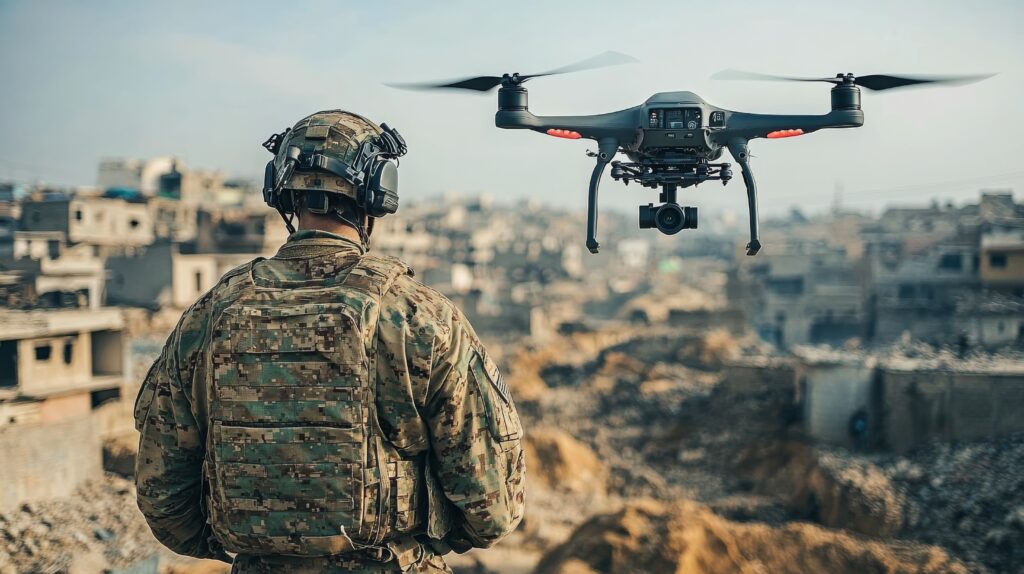
The lesson deepened during the ongoing Russian invasion of Ukraine. Both sides have employed large numbers of FPV drones, loitering munitions and ISR UAVs. Swarm logic, rapid iteration and mass production have compressed engagement timelines and saturated defensive nodes. The conflict has also exposed the cost-exchange imbalance inherent in attritable drone warfare. High-value air defence systems have, in several instances, been neutralised or suppressed by comparatively low-cost loitering munitions and FPV drones. The architectural lesson is unmistakable: static, installation-bound defence postures struggle when faced with distributed, adaptive drone campaigns that operate across depth rather than frontage. Survivability now depends not merely on interception, but on distributed awareness and layered redundancy.
Most recently, in the Red Sea, Houthi UAV and missile attacks against commercial shipping forced the United States Navy and coalition forces into layered defensive postures. Ships could not rely on a single sensor or weapon. They required integrated radar, electronic warfare, CIWS, and missile systems operating under a unified combat system. The sea itself became a reminder that distributed threats demand a layered, networked response. These global examples underline one central truth: Defensive bubbles do not scale against distributed, attritable drone warfare.
In short, isolated kill-boxes cannot defend a nation’s airspace.
This realisation is now driving a doctrinal shift from asset protection to grid protection.
The Rise of the Counter Drone Grid
What is emerging across advanced militaries and critical infrastructure ecosystems is not an upgrade in equipment, but a rethinking of architecture. Counter UAS is no longer being conceived as a collection of protective bubbles; it is being designed as a distributed nervous system.
In this construct, heterogeneous nodes like fixed installations, mobile formations, naval units, airport perimeters, energy corridors and even urban law enforcement sensors are no longer standalone entities. They are networked contributors to a shared command fabric. The language of procurement is shifting accordingly. OEMs increasingly speak of “ecosystems” rather than systems, of open interfaces rather than proprietary boxes.
The intellectual leap is subtle yet transformative. Every sensor and every effector becomes a node within a national lattice of awareness. Radar tracks, passive RF detections, electro-optical cues, civil air traffic data, and emerging unmanned traffic management feeds are federated into layered air pictures. These pictures are not static displays but dynamic, continuously reconciled representations of low-altitude airspace.
Decision-making follows architecture. When visibility becomes shared, engagement ceases to be local. A drone detected over one node can be tracked, classified and, if required, neutralised by another. Spectrum emissions are coordinated rather than improvised. Effectors are prioritised according to context and availability rather than proximity alone. This is the essence of the grid paradigm: distributed sensing, federated fusion, and orchestrated response.
The doctrinal implication is profound. The question is no longer, “How do I protect this refinery, this airbase, this convoy?” It becomes, “How do I exercise persistent control over sovereign low altitude airspace?” Asset defence gives way to airspace governance. Local reaction matures into theatre-level orchestration.
In that transition lies the difference between defending points and defending nations. What fundamentally distinguishes a grid from a network is latency discipline. In a kill-box, the detect decide engage loop is localised and often sequential. In a grid, it becomes parallelised. Multiple nodes validate, correlate and assign confidence simultaneously. This compresses decision cycles from minutes to seconds. Against swarm densities where engagement windows may be measured in tens of seconds, latency becomes as decisive as firepower. The grid is therefore not merely a connectivity upgrade; it is a tempo advantage.Top of Form
Bottom of Form
Mission Sudarshan Chakra: India’s Emerging Architecture
India’s own evolution towards a grid construct is taking shape under the broad umbrella of Mission Sudarshan Chakra. A long-term effort to build an AI-enabled, multilayered air defence shield integrating legacy ground-based air defence with new sensors, electronic warfare capabilities, and counter-drone systems.
Over the past five to six years, all three Services and multiple agencies have adopted anti-drone solutions. The next logical step is integration. The objective is to stitch together disparate systems into a permanent, networked architecture capable of real-time detection, interservice track correlation, and layered neutralisation across geographies.
Operational experience has reinforced this necessity. During Operation Sindoor, hostile drones of foreign origin targeted both military and civilian installations. AD guns and other assets proved effective, but the episode underlined a deeper lesson: legacy weapons and emerging technologies must function within a unified grid if response timelines are to remain decisive.
Within the Sudarshan Chakra vision, soft-kill and hard-kill capabilities are expected to coexist natively. Electronic warfare for non-kinetic neutralisation will operate alongside DEW systems, guns, and missiles. Crucially, the emphasis is shifting from buying more standalone jammers to building AI-enabled, multi-sensor fusion and automated command-and-control layers that orchestrate all available tools.
Multi-Sensor Fusion: The Quiet Centre of Gravity
Low-altitude airspace is not empty sky; it is a cluttered, contested and deeply ambiguous environment. Ground reflections confuse radar. Small radar cross-sections blur into background noise. RF detection systems fall silent when confronted with autonomous, preprogrammed drones. Electro-optical and infrared sensors depend on line of sight, contrast, and weather. Each sensor sees something and misses something.
Individually, they offer fragments of truth.
Unfused, those fragments create hesitation.
The real breakthrough in modern counter-UAS architecture is not a new radar or a more powerful jammer. It is the emergence of AI-driven fusion engines that reconciles these fragments into coherence. Radar tracks, passive RF detections, EO/IR cues, ADS-B inputs and aviation feeds are ingested, correlated, scored and continuously refined. False tracks are suppressed. Duplicate detections collapse into a single entity. Behavioural patterns begin to emerge over time.
One drone becomes one track.
One track becomes one confidence score.
One confidence score becomes one calibrated response pathway.
In such an architecture, the operator no longer arbitrates disagreements among sensors. He is commanding a reconciled air picture. Decision latency shrinks. Cognitive overload reduces. Escalation becomes deliberate rather than reactive. This shift carries deeper strategic implications. The effectiveness of counter-drone defence begins to depend less on the peak performance of individual sensors and more on the harmony between them. Sensor power matters; sensor orchestration matters more.
Indigenous initiatives in multi-sensor orchestration, particularly within naval and maritime environments where radar, EO, and RF systems must coexist within dense electromagnetic ecosystems, as being undertaken by M/s Tardid Technologies, reflect this growing understanding. The challenge is not merely detection; it is disciplined correlation under spectrum constraints.
The centre of gravity in counter-UAS architecture is therefore moving quietly but decisively. This shift has profound implications for force design. In high-density drone environments, the limiting factor is not the number of interceptors available but the clarity of the air picture. False positives consume ammunition. False negatives invite penetration. AI-driven confidence scoring and probabilistic track validation reduce both risks. In effect, fusion engines become gatekeepers of escalation. They determine when the spectrum is disrupted, when energy is emitted and when kinetic force is justified. Data integrity thus becomes a warfighting function in its own right.
Edge Autonomy and Central Coherence
Designing such a grid requires balancing autonomy at the edge with coherence at the centre.
Tactical nodes must retain the ability to detect, classify and engage within seconds, even if backhaul links are degraded or jammed. This is essential in swarm scenarios and contested electromagnetic environments.
Simultaneously, higher headquarters must aggregate tracks from multiple nodes, deconflict across services and agencies, manage rules of engagement and integrate counter UAS feeds with broader air defence and air traffic control frameworks. Cloud-enabled, or data centre-based C2 layers, allow pattern of life analysis and long-term intelligence on adversarial tactics.
Open interfaces and interoperable APIs become critical in this environment. Closed, proprietary systems cannot sustain a national grid.
Precision Electronic Warfare in High-EMI Environments
Traditional anti-drone jamming has often relied on brute force, wideband emissions that overwhelm control and GNSS links. While effective in limited contexts, such approaches can degrade friendly communications, radar systems and navigation infrastructure, particularly in naval dockyards, airbases and dense communication hubs.
The technological trajectory is therefore moving towards precision electronic warfare. Narrow-band, protocol-aware jamming selectively targets hostile control links while preserving friendly spectrum usage. Directional antennas focus energy on the threat rather than saturating entire sectors. RF cyber techniques enable link takeover or controlled landings instead of indiscriminate denial.
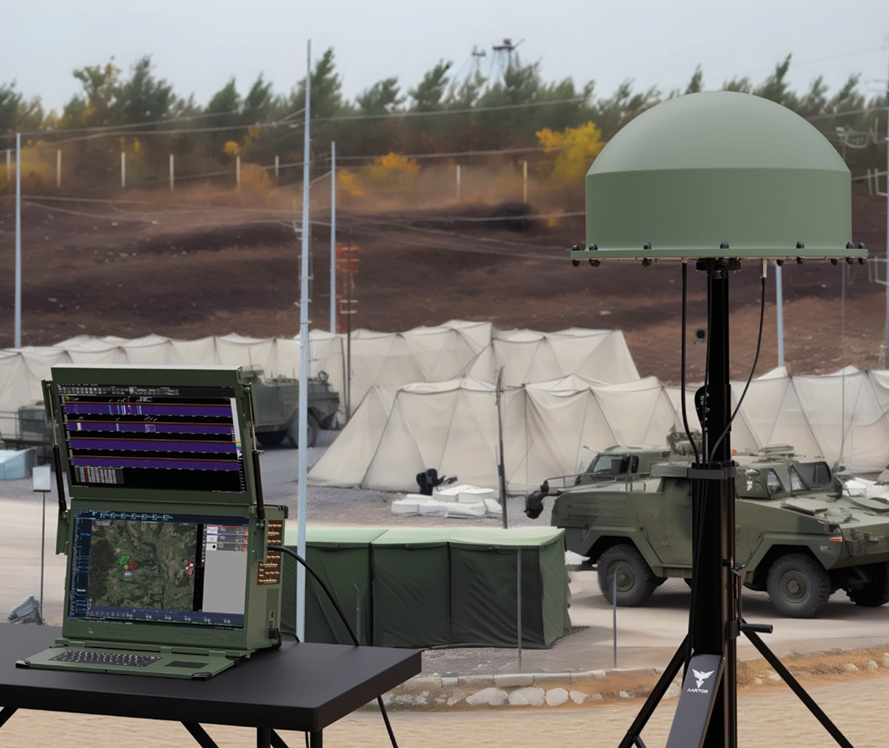
In this context, passive RF-centric architectures assume renewed importance. Systems such as the Aaronia AG X9, which integrate wideband spectrum analysis with the IsoLOG 180 direction-finding array, enable precise geolocation of drone control and telemetry links without emitting active radar energy. When layered with a 4D radar capable of tracking range, altitude, azimuth, and velocity, such configurations offer a balanced, low-EMI-impact architecture suited to spectrum-dense military environments.
The doctrinal implication is clear: electronic warfare within a grid must be spectrum managed and coordinated, not ad hoc.
Layered Effectors, Calibrated Escalation
If fusion is the brain of a counter drone grid, effectors are its instruments of authority. And authority in modern air defence is not expressed through singular capability, but through layered choice.
An integrated grid derives its resilience from the availability of multiple response options, each governed by context, rules of engagement and operational necessity. The objective is not indiscriminate neutralisation, but calibrated dominance.
Soft kill measures often represent the first rung on the escalation ladder. Communication disruption, selective GNSS denial and protocol-aware intervention allow defenders to impose control without immediate destruction. In civilian or densely populated environments, these reversible effects preserve proportionality while restoring airspace order.
Directed energy systems introduce a second layer. High-energy lasers offer precision engagement with minimal collateral risk once positive identification is achieved. High-power microwave systems extend this logic into the swarm domain, imposing area effects against multiple targets simultaneously with relatively low logistical burden. Their scalability makes them particularly relevant as attritable drone tactics proliferate.
Yet even as new technologies mature, kinetic systems remain indispensable. Larger unmanned platforms, hardened targets, or high-confidence hostile profiles may demand physical neutralisation. Legacy air defence guns and missile systems, when cued by fused, multi-sensor tracks rather than isolated radar returns, experience a dramatic increase in relevance and precision. Integration does not displace these systems; it amplifies their effectiveness. In saturation scenarios, sequencing becomes as critical as selection. Soft-kill measures may disperse or delay an incoming formation, buying seconds for directed-energy engagement. Directed-energy may thin the density before kinetic systems address residual high-confidence threats. The objective is not a simultaneous reaction but an orchestrated effect. Layering, therefore, is not redundancy; it is choreography.
What ultimately distinguishes a mature counter drone grid is not the diversity of its tools, but the discipline of its escalation. Detection flows into classification. Classification informs effect selection. Engagement is followed by immediate assessment. Each stage is visible across echelons, governed by clear command authority and synchronised within the broader air defence framework.
In such a construct, response is neither impulsive nor delayed. It is measured, layered and deliberate, preserving spectrum integrity, operational tempo and command clarity.
That is the difference between possessing weapons and exercising airspace control.
Why the Grid Paradigm Matters
The evolution from point defence to integrated grids represents more than a technological adjustment; it signals a doctrinal recalibration. Air defence below traditional radar horizons can no longer be treated as an adjunct mission. It is emerging as a core dimension of national airspace sovereignty. The grid paradigm demands structural interoperability, shared data standards, spectrum discipline and cross-service trust. Without these, hardware proliferation merely produces noise.
Counter UAS is no longer merely a tactical acquisition problem. It is a challenge in national airspace management. The first generation of systems protected assets. The emerging generation seeks to protect theatres. The mature generation will protect nations, through coherence, integration and disciplined orchestration. In that future, the defining question will not be how powerful a jammer is, but how intelligent and interoperable the grid behind it has become.
From the Flight Deck
I learned the meaning of a shared picture long before drones became strategic vocabulary.
On the flight deck at sea, often at night, sometimes in marginal weather, survival never depended on a single instrument. The bridge, the combat information centre and the air department had to see the same plot, trust the same track and speak the same language. A radar return without confirmation meant uncertainty. An isolated contact meant risk. Fragmented awareness was not an inconvenience; it was a danger.
When a helicopter turned finals, every team watched the same display. If one node saw something different, it was resolved immediately. At sea, there is no margin for parallel realities. The modern low-altitude battlespace feels strikingly similar. It is crowded, fast-moving and unforgiving. Drones skim terrain, disappear into clutter and reappear over critical assets with little warning. In such an environment, defensive bubbles offer comfort but not control. They protect installations. They do not command airspace.
Coherent grids do.
In the years ahead, the decisive advantage will not belong to the loudest jammer, the longest range missile or the most powerful emitter. It will belong to the side that builds institutional trust in its air picture, that fuses without hesitation, escalates without confusion and applies force with disciplined calm.
Because beneath every rotor arc and every radar sweep lies the same truth I learned at sea, “You survive not by seeing more but by ensuring everyone sees the same thing”.
Cdr Rahul Verma (r), former Cdr (TDAC) at the Indian Navy, boasts 21 years as a Naval Aviator with diverse aircraft experience. Seaking Pilot, RPAS Flying Instructor, and more, his core competencies span Product and Innovation Management, Aerospace Law, UAS, and Flight Safety. The author is an Emerging Technology and Prioritization Scout for a leading Indian Multi-National Corporation, focusing on advancing force modernization through innovative technological applications and operational concepts. Holding an MBA and Professional certificates from institutions such as Olin Business School, NALSAR, AXELOS, and IIFT, he’s passionate about contributing to discussions on aviation, unmanned technology, and policy. Through writing for various platforms, he aims to leverage his domain knowledge to propel unmanned and autonomous systems and create value for Aatmannirbhar Bharat and the Indian Aviation industry.