Shubhangi Palve

Finance Minister Nirmala Sitharaman presented her ninth consecutive Union Budget on February 1, 2026, and the signal from North Block was unambiguous. Defence has received a clear push.
The Ministry of Defence has been allocated Rs 7.85 lakh crore for FY 2026–27, about 15% higher than last year’s Budget Estimate of Rs 6.81 lakh crore. At roughly 14.67% of total central government expenditure, defence remains the single largest budget head among all ministries.
At first glance, it appears to be a strong statement of intent. But as always with defence budgeting, the real story lies in the details.
The Long Arc Since 2014
To understand this year’s allocation, it helps to step back. When the Modi government took office in 2014, the defence budget stood at about Rs 2.29 lakh crore. In just over a decade, it has more than tripled. That trajectory signals continuity rather than surprise.
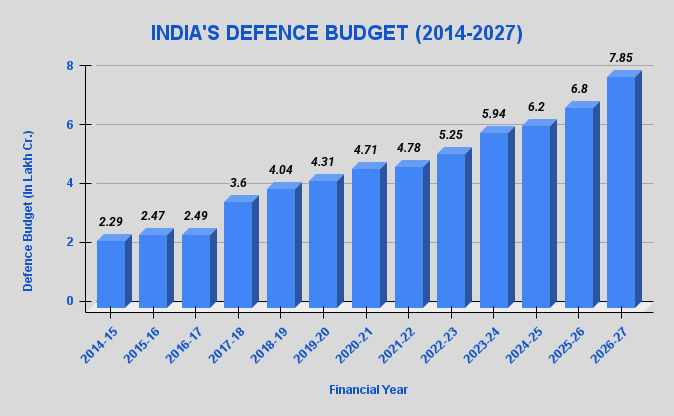
Yet there is a subtle shift beneath the surface. While the absolute numbers have risen sharply, defence’s share of total central expenditure has declined from 17.1% in FY 2014–15 to 14.7% in 2026–27.
Over the same period, overall government expenditure has grown at an annualised rate of 10.2%, while defence spending has grown at 8.8%. In other words, defence has grown, but not as fast as the broader budget.
As a share of GDP, the allocation stands at about 2% for FY 2026–27. That remains below the 3% benchmark recommended by the Parliamentary Standing Committee on Defence. If pensions are excluded, effective defence spending drops to roughly 1.6% of GDP.
For a country facing simultaneous challenges from China and Pakistan, that gap will continue to be debated.
Capital Expenditure: A Visible Push
The most notable feature of this year’s budget is the jump in capital expenditure. The total capital allocation stands at Rs 2.19 lakh crore, about 21.8% higher than last year’s Budget Estimate of Rs 1.80 lakh crore. Of this, Rs 1.85 lakh crore is earmarked for capital acquisition alone, nearly 24% more than the previous year.
This is not incremental growth. It is a deliberate expansion.
Within capital spending, ‘Other Equipment’ receives Rs 82,217.82 crore, up more than 30% from last year. This category typically covers a wide range of modernisation requirements, including networked systems and ground-based platforms.
Aircraft and aero engines are allocated Rs 63,733.94 crore. Although last year’s revised estimates had temporarily crossed Rs 72,000 crore, this year’s Budget Estimate sets a substantial baseline for sustained air power procurement.
Naval modernisation sees a modest rise to Rs 25,023.63 crore. Research and development under the capital head is pegged at Rs 17,250.25 crore, reflecting a continued push for the development of indigenous capabilities. Allocation for Joint Staff and Services has also increased, pointing to a steady policy focus on theatre commands and jointness.
Still, context matters. Over the past decade, capital expenditure has averaged about 27% of the defence budget, well short of the 40% that many experts consider ideal. For FY 2026–27, capital outlay is budgeted at roughly 29%. The Standing Committee on Defence has previously suggested that a 60:40 revenue-to-capital ratio would be healthier. India is not there yet.
Revenue, Salaries & the Pension Weight
The revenue side of the budget remains substantial. For FY 2026–27, Rs 3,65,478.98 crore has been provided under revenue heads, a 17.24% increase over last year’s Budget Estimate. Of this, Rs 1,58,296.98 crore is earmarked for operational and sustenance expenditure, with the rest largely going towards pay and allowances.
Salary and pension together are estimated to account for around 44% of total defence expenditure this year. Defence pensions alone stand at Rs 1,71,338.22 crore, up 6.56% over the previous Budget Estimate. More than 34 lakh pensioners will be covered through SPARSH and other mechanisms. In addition, Rs 12,100 crore has been allotted to the Ex-Servicemen Contributory Health Scheme, marking a sharp rise over last year.
The looming 8th Pay Commission recommendations could add further pressure in the coming years. Even as capital allocations rise, the structural weight of salaries and pensions continues to limit fiscal flexibility. The tension between modernisation and manpower-heavy force structures remains unresolved.
Domestic Industry: Ambition & Reality
A striking feature of this year’s capital acquisition plan is the continued emphasis on domestic procurement. Rs 1.39 lakh crore, or 75% of the capital acquisition budget, has been earmarked for procurement from domestic industry, including private players.
This is meant to reassure the industry that policy intent will be backed by orders. Domestic defence production has grown at an annualised rate of about 8% between 2016–17 and 2024–25, reaching Rs 1.54 lakh crore in FY 2024–25. Public sector undertakings have accounted for roughly 80% of this output.
The government has set an ambitious target of Rs 3 lakh crore in indigenous production by FY 2028–29. Achieving that would require annual growth of about 18% from current levels.
There are constraints. Studies by the Stockholm International Peace Research Institute have noted that many Indian-designed defence platforms continue to rely on imported critical components such as engines and radars. Indigenous production is expanding, but technological depth remains uneven. Quality concerns have also surfaced periodically, raising questions about oversight and the robustness of the supply chain.
Contracts, Approvals & the Pipeline
According to official data from the Ministry of Defence, contracts worth Rs 2.10 lakh crore were concluded up to December 2025 in the current financial year. Acceptance of Necessity approvals has crossed Rs 3.50 lakh crore. The pipeline includes next-generation fighter aircraft, smart munitions, ships and submarines, unmanned systems and specialist vehicles.
The scale is significant. But India’s procurement system has historically struggled with delays, cost escalations and procedural complexity. Higher allocations will only translate into capability if acquisition cycles become more predictable and efficient.
Border Infrastructure & R&D
Beyond hardware acquisition, the budget reinforces two additional areas.
Allocation to the Border Roads Organisation (BRO) under the capital head has been increased to Rs 7,394 crore. This will support tunnels, bridges and airfields in strategically sensitive areas, while also aiding civilian connectivity and economic development in border regions.
The Defence Research and Development Organisation (DRDO) has been allocated Rs 29,100.25 crore, up from Rs 26,816.82 crore last year. Of this, Rs 17,250.25 crore is for capital expenditure. The intent is clear: strengthen the research base while tying it more closely to operational requirements.
Operation Sindoor & the Strategic Context
This year’s budget cannot be separated from the political and military backdrop. The government has described Operation Sindoor as a ‘historic success’. The operation appears to have validated certain tactical investments, particularly in air power and underwater capabilities, while also exposing capability gaps.
The post-Operation Sindoor increase in capital outlay is therefore not just an accounting decision. It is a response to operational experience. The sharper allocations for aircraft, equipment and joint structures reflect that lesson.
At the same time, the budget does not fundamentally restructure the balance between manpower and modernisation. It addresses immediate tactical deficiencies but stops short of a deeper shift in force composition or pension reform. The burden of salaries and pensions remains substantial, and capital outlay, though rising, is still below the levels many experts consider optimal.
A Strong Signal, With Caveats
Taken together, the FY 2026–27 defence budget sends a clear signal of intent. It prioritises capital acquisition, reinforces domestic industry participation and acknowledges the need for sustained modernisation in a challenging neighbourhood marked by the reality of collusive threats.
Yet it also reflects structural constraints. Defence’s share of total government spending has gradually narrowed. Spending as a percentage of GDP remains below recommended levels. The revenue-to-capital imbalance persists.
This is therefore neither a dramatic break from the past nor mere incrementalism. It is a calibrated expansion within existing fiscal and structural limits. For analysts and practitioners alike, the real test will not lie in the headline figure of Rs 7.85 lakh crore, but in how effectively these allocations translate into credible, durable capability on the ground, at sea and in the air.
Shubhangi Palve is an independent journalist covering defence and aerospace. She writes regularly on the sector across multiple platforms, tracking policy, procurement, industry and strategic affairs. With over 17 years in the media industry, she has worked across print, television and digital newsrooms, bringing a grounded understanding of how the sector has evolved over time.