Chaitali Bag
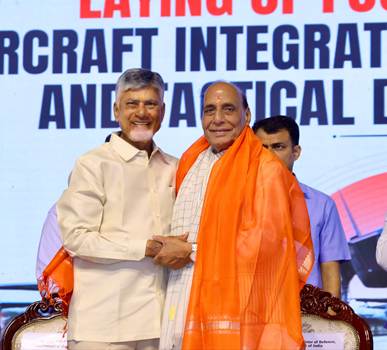
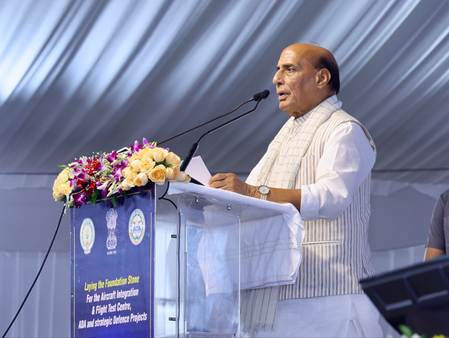
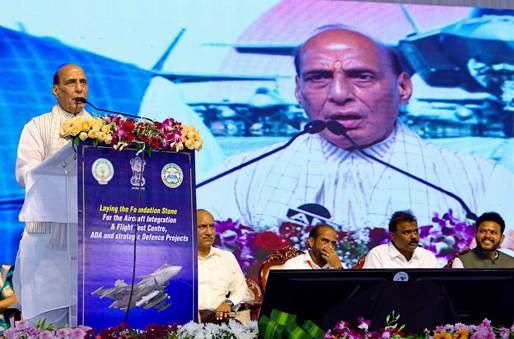
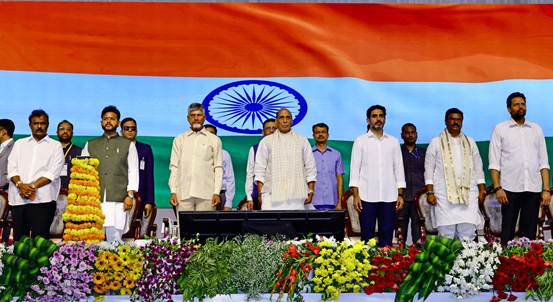
A decisive moment in India’s defence and aerospace journey unfolded at Puttaparthi and neighbouring sites in Andhra Pradesh. Raksha Mantri Shri Rajnath Singh, joined by Andhra Pradesh Chief Minister Shri N. Chandrababu Naidu, laid foundation stones and presided over groundbreaking ceremonies for a suite of strategic projects that together signal a vigorous push toward technological self-reliance, industrial expansion, and regional transformation.
At the heart of the announcements was the Core Integration & Flight Testing Centre for the Advanced Medium Combat Aircraft (AMCA) programme, a marquee indigenous effort to develop a fifth-generation fighter. With an AMCA programme outlay of roughly Rs 15,000 crore and a nearly Rs 2,000 crore investment just for the testing and integration facility, Puttaparthi is being positioned to join an elite club of sites where next-generation combat aircraft are brought to life. The Centre will fast-track systems integration, flight trials, and platform maturation, enabling India to design, test and field cutting-edge airpower under its own stewardship.
Complementing the AMCA initiative, the Raksha Mantri and the Chief Minister inaugurated the Naval Systems Manufacturing Facility in T Sirasapalli, Anakapalli district, aimed at producing advanced underwater weapons and naval combat systems. Together with the Defence Energetics Facility and the Ammunition & Electric Fuses Plant at Madakasira, these projects cover a broad spectrum of materiel needs across the armed services’ air, sea and land domains, demonstrating deliberate strategic diversification rather than isolated investment.
The events also underscored an embrace of public–private collaboration and decentralised industrial growth. A consortium of eight private drone companies announced plans for a Drone City in Kurnool, and several industry players signed MoUs with the Andhra Pradesh government to establish defence manufacturing units in the state. These initiatives reflect a Whole of People and PPP-driven approach that the Raksha Mantri hailed as transforming defence production into a mass movement, one that leverages private enterprise, academia, and local suppliers to build resilient, large-scale supply chains.
Shri Rajnath Singh framed these projects as more than industrial spending: they are instruments of national security and socio-economic renewal. In his address, he described Aatmanirbharta—self-reliance in defence, as a critical imperative amid global turbulence, arguing that dependence on others undermines strategic autonomy. He called the new facilities “Growth Poles” likely to generate substantial employment, link local engineering colleges and ITIs to high-technology ecosystems and catalyse small and medium enterprises. The promise is twofold: fortify the nation’s defence posture while creating sustained livelihoods and technical skill development for local youth.
The timing of the announcements was notable: the Raksha Mantri projected that defence production would reach an all-time high of around Rs 1.75 lakh crore within one to two months, underscoring the momentum already underway in India’s defence industrial base. The initiatives in Andhra Pradesh, like spanning the AMCA flight-test hub to naval systems manufacturing, energetics and fuses plants, and dedicated drone infrastructure, exemplify a strategic roadmap that marries ambitious capability development with regional industrialisation.
The recent announcements around India’s defence manufacturing renaissance are nothing short of exhilarating. With bold investments, strategic partnerships, and a clear national vision, the country is not merely plugging gaps in capability; it is charting a decisive course toward technological self-reliance, enhanced maritime strength, and a vibrant defence-industrial ecosystem that will ripple into the broader economy.
At the heart of this momentum is the Naval Systems Manufacturing Facility being established by Bharat Dynamics Limited (BDL) with an investment of Rs 480 crore. Focused on autonomous underwater vehicles (AUVs), underwater counter-measure systems, and next-generation torpedoes, this facility represents a quantum leap for India’s undersea warfare and maritime security posture. By producing critical components and subsystems domestically, previously imported, the project reduces dependence on external suppliers, accelerates indigenous innovation cycles, and sharpens the operational edge of the Indian Navy. Beyond defence utility, this initiative promises to catalyse the Blue Economy, enabling coastal industries, research institutions, and startups to leverage homegrown technologies for commercial and security applications alike.
Complementing this is the Defence Energetics Facility of Agneyastra Energetics Limited (a Bharat Forge subsidiary), backed by an investment of Rs 1,500 crore. Energetics like propellants, warheads, and related materials are the beating heart of modern munitions. Building capacity here anticipates the demands of future battlefields, ensuring that India’s force posture is supported by reliable, cutting-edge ordnance developed and manufactured at scale domestically. Likewise, HFCL Limited’s Ammunition and Electric Fuse Plant, with its Rs 1,200 crore investment, tackles another linchpin of munitions effectiveness. As Raksha Mantri rightly pointed out, fuses are among the most critical components of ammunition; producing them domestically marks a significant stride toward comprehensive ammunition self-reliance and resilience.
Equally inspiring is the emphasis on democratizing defence innovation. The envisioned Drone City, championed as a hub where small units and young entrepreneurs collaborate, embodies the Make-in-India spirit. Drone technology has transformed both warfare and civilian life, spawning applications from precision surveillance and logistics to agriculture and disaster response. By nurturing a clustered ecosystem of innovators, the region can become a national “Drone Hub,” exporting expertise and products globally, creating jobs, and fostering a culture of rapid prototyping and commercialization.
Underlying these projects is a broader strategic shift in governance and industry relations. Over the past decade, defence production in India has surged from Rs 46,000 crore in 2014 to nearly Rs 1.54 lakh crore today and exports have climbed from a modest Rs 600 crore to roughly Rs 40,000 crore. These figures reflect more than arithmetic growth; they signify the success of policies that bridge public and private capabilities, enabling a Whole of Government, Whole of Country, and Whole of People approach. Public-private partnerships, start-ups, MSMEs, and large corporates now share the stage in a mass movement to secure and empower the nation.
The implications are profound. Indigenous manufacturing of naval systems, energetics, fuses, and drones enhances strategic autonomy, shortens supply chains, and allows India to tailor systems to its unique operational needs. Economically, these investments stimulate high-tech manufacturing, skilled employment, and export-led growth. Strategically, they strengthen deterrence, improve readiness for future conflicts, and bolster maritime domain awareness, which is crucial for a nation with a vast coastline and expanding maritime interests.
But technological and industrial progress must be matched by social vigilance. In his address, Raksha Mantri cautioned against misinformation, a non-kinetic threat that can erode public trust, disrupt order, and blunt national response in crises. In an era when falsehoods spread rapidly, civic responsibility and media literacy are integral to national security. Citizens, innovators, and institutions must therefore work together not just to build sophisticated hardware, but to cultivate resilient, informed communities that support national objectives.
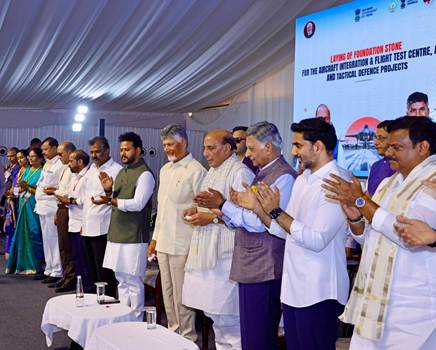
The recent remarks by the Chief Minister of Andhra Pradesh capture a moment of pride and forward momentum for India’s defence and aerospace ambitions. Commending Prime Minister Narendra Modi and the Raksha Mantri for their sustained focus on indigenisation and self-reliance, the Chief Minister highlighted how persistent reforms, targeted investment and a culture of innovation have strengthened the nation’s preparedness and elevated its global standing in strategic sectors. This is not merely rhetoric; it reflects an ongoing transformation in how India conceives, builds and deploys its defence capabilities.
Operation Sindoor, cited by Shri N. Chandrababu Naidu as a flagship example, symbolizes that transformation. As an emblem of technological progress and Aatmanirbharta in defence, the operation showcases India’s ability to plan and execute complex, technology-driven initiatives using domestic resources and expertise. Such successes send a clear message: India is increasingly capable of designing and delivering advanced defence solutions at home, reducing dependence on external suppliers while nurturing indigenous talent and industry.
The foundation stones laid for new facilities and infrastructure, the Chief Minister observed, are not just construction milestones; they are investments in the nation’s strategic resilience and regional economic growth. State-of-the-art manufacturing plants, testing facilities and support ecosystems strengthen defence preparedness by shortening supply chains, improving responsiveness and enabling iterative innovation. Simultaneously, these developments catalyze local employment, skill development and ancillary industries, creating a virtuous cycle of progress that benefits both national security and regional prosperity.
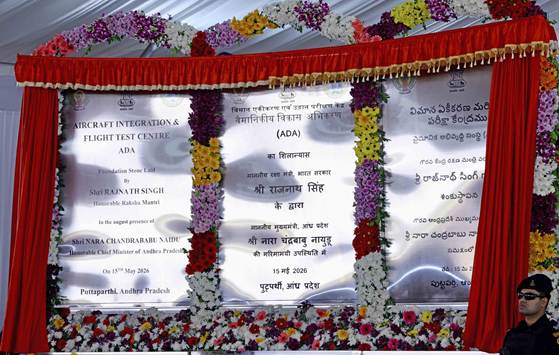
Equally notable was the Chief Minister’s clarion call to industry and entrepreneurs: “Design-in-Andhra Pradesh, Make-in-Andhra Pradesh, lead-from-Andhra Pradesh.” This compelling invitation, backed by the State Government’s assurance of full cooperation, positions Andhra Pradesh as an enabling ecosystem for defence and aerospace enterprises. By combining policy support with focused investments in innovation, infrastructure and industrialisation, the three pillars, the Chief Minister rightly underscored that the state aims to attract technology builders, manufacturers and investors who can transform strategic intent into tangible capability.
The synergy between central initiatives and state-level ambition is crucial. As India charts a course toward Viksit Bharat, coordinated efforts among the Union government, state administrations, industry and academia will determine the pace and depth of progress. The presence of dignitaries such as the Minister of Civil Aviation, senior defence production officials and industry representatives at the event signals cross-sector alignment and readiness to collaborate. Such partnerships can accelerate technology transfer, enhance supply chain resilience, and foster an ecosystem where innovation translates into deployment.