Staff Correspondent
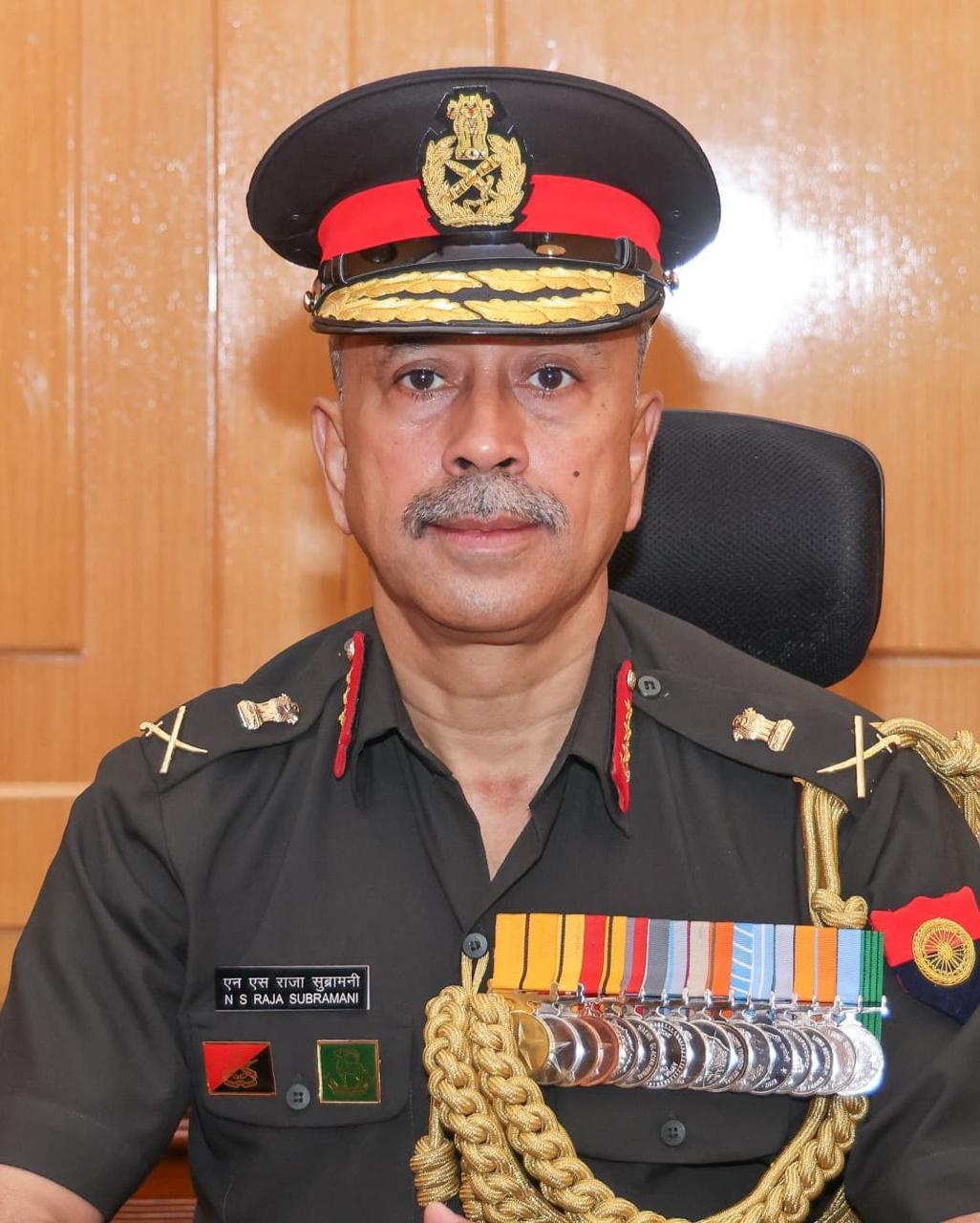
The appointment of Lieutenant General NS Raja Subramani (Retd), PVSM, AVSM, SM, VSM, as the Chief of Defence Staff (CDS) and Secretary to the Government of India, Department of Military Affairs, marks a moment of considerable significance for India’s defence establishment. This decision, effective from the date of assumption of charge and valid until further orders, ensures continuity of senior leadership following the completion of General Anil Chauhan’s tenure on 30 May 2026. The selection of Lieutenant General Subramani reflects the Government’s emphasis on operational experience, jointness, institutional knowledge, and seasoned stewardship at a time when strategic exigencies along India’s borders and the evolving regional security environment demand calibrated, coherent, and forward-looking defence leadership.
Lieutenant General NS Raja Subramani’s military career, spanning over four decades, is distinguished by a pattern of progressive command, staff and instructional appointments across multiple theatres and responsibilities. A graduate of the National Defence Academy and the Indian Military Academy, he was commissioned into the 8th Battalion of the Garhwal Rifles on 14 December 1985. His professional development is bolstered by advanced academic credentials: an M.A. from King’s College London and an M.Phil. in Defence Studies from Madras University, coupled with completion of courses at the Joint Services Command and Staff College, Bracknell (UK), and the National Defence College, New Delhi. This blend of academic rigour and institutional professional military education complements his operational experience, equipping him with both theoretical frameworks and practical insights necessary for the CDS role.
Lieutenant General Subramani’s operational resume encompasses an extensive array of command appointments under testing conditions. He commanded the 16 Garhwal Rifles during Counter-Insurgency operations in Assam as part of Operation Rhino, demonstrating competence in complex internal security operations that demand a fusion of kinetic action, civil-military coordination and intelligence-driven operations. His leadership of the 168 Infantry Brigade in Jammu & Kashmir and subsequently of the 17 Mountain Division in the Central Sector during challenging operational periods underscores his familiarity with high-altitude, mountainous warfare and counterinsurgency in sensitive sectors. Notably, his command of II Corps—the Indian Army’s premier strike formation on the Western Front—signifies experience in large-scale mechanised and offensive operations, planning and integrated manoeuvre, and the orchestration of significant force concentrations.
Such breadth of command spans both dimension and depth, from unit-level leadership in counterinsurgency to corps-level responsibilities involving offensive planning and operational readiness. This experience is particularly relevant for the CDS, whose remit includes fostering jointness among the services, advising the government on military strategy, force structure and preparedness, and ensuring that operational plans reflect coherent tri-service integration.
Beyond field commands, Lieutenant General Subramani has held a diverse range of staff and instructional positions that have expanded his institutional and strategic purview. His appointments include Brigade Major of a Mountain Brigade, Divisional Officer at the National Defence Academy, and Assistant Military Secretary in the Military Secretary’s Branch, which provided exposure to personnel management and officer career planning. As Colonel General Staff (Operations) at Headquarters Eastern Command and as Brigadier General Staff (Operations) in the Eastern Command, he was centrally involved in operational planning and regional strategy.
His tenure as Deputy Commander of a Rashtriya Rifles Sector in Jammu & Kashmir and as Deputy Director General of Military Intelligence at the Integrated Headquarters expanded his appreciation of internal security dynamics, intelligence synthesis and inter-agency coordination. In instruction, he served as Chief Instructor (Army) at the Defence Services Staff College, Wellington, shaping mid-career officer education and promulgating joint operational thought. As Chief of Staff, Headquarters Northern Command, he acquired intimate knowledge of the operational dynamics on the sensitive Northern borders. Internationally, his role as Defence Attaché in Kazakhstan provided him with diplomatic exposure and an understanding of defence diplomacy and regional security architectures.
Collectively, these staff and instructional appointments complement his command experience, offering the administrative, doctrinal and diplomatic competencies essential for the CDS, who must bridge the military, bureaucratic and political dimensions of defence governance.
The office of the Chief of Defence Staff embodies a centralizing aspiration: to create a single-point military advisor to the government, to drive tri-service integration, to rationalize procurement and logistics, and to enhance joint capability development. Lieutenant General Subramani’s profile—combining operational command on the Western and Northern fronts, intelligence and counterinsurgency experience, staff-level operational planning, instructional leadership and international exposure—aligns with these institutional priorities.
His prior role as Military Adviser to the National Security Council Secretariat from September 2025 to the present has strengthened his engagement in national security policymaking and strategic-level decision-making. His recent incumbency as Vice Chief of the Army Staff (July 2024–July 2025) and as General Officer Commanding-in-Chief, Central Command (March 2023–June 2024) further demonstrates his familiarity with high-level Army administration, logistics, force modernization priorities and operational readiness imperatives.
In the context of India’s contemporary security environment, characterized by a sustained focus on border management amid both near-peer and asymmetric challenges, the need for integrated theatre commands, rapid modernization amid fiscal constraints, and an increasing emphasis on defence diplomacy, leadership that can operationalise jointness while respecting service cultures and operational requirements is critical. Lieutenant General Subramani’s career trajectory suggests an ability to navigate these complexities: to act as a synthesizer of service perspectives, a proponent of interoperable doctrines, and a pragmatic manager of resources consonant with strategic imperatives.
As CDS and Secretary to the Department of Military Affairs, Lieutenant General Subramani will confront a multifaceted agenda. Foremost among these is the acceleration of jointness through the establishment and operationalization of theatre commands, enhanced tri-service training, standardization of doctrines, integrated logistics and unified command-and-control mechanisms. Balancing the legitimate service-specific equities with the compelling need for integrated capabilities will require judicious diplomacy, clear conceptual frameworks and incremental yet irreversible reforms.
Defence modernization and indigenisation present another priority. The CDS must integrate capability development plans across the services, synchronize procurement to avoid duplication, and promote indigenisation aligned with strategic autonomy objectives. Coordinating with the Defence Research and Development Organisation, the Ministry of Defence, industry stakeholders and international partners will be essential to achieve timely capability delivery.
Operational preparedness along India’s Western and Northern borders will remain a continuing responsibility. Ensuring that force posture, logistics, intelligence sharing, and rapid-response mechanisms are aligned for both conventional deterrence and hybrid threats will be imperative. Given Lieutenant General Subramani’s direct experience on these fronts, he is well-positioned to prioritize realistic training, infrastructure enhancement and joint operational doctrines that reflect lessons learned.
Furthermore, institutional reforms in personnel management—career planning, joint postings, and human resource policies that nurture a joint mindset—will require attention. As Secretary to the Department of Military Affairs, the CDS has a mandate to influence such policies; success depends on articulating clear incentives, career pathways and education that encourage inter-service exchange and collaboration.
The conferment of high military decorations, Param Vishisht Seva Medal, Ati Vishisht Seva Medal, Sena Medal and Vishisht Seva Medal, attests to Lieutenant General Subramani’s distinguished service and professional excellence. These honours reflect sustained contributions across operational, staff and instructional domains.
His appointment as CDS offers an opportunity for legacy-building: to entrench institutional mechanisms for jointness, to accelerate capability development and indigenisation, and to refine the civil–military interface in defence policymaking. Effective stewardship could yield enduring enhancements to India’s defence posture: improved operational coherence, enhanced deterrence, and a more efficient defence ecosystem.