Ran Samwad 2026
Chaitali Bag
Ran Samwad 2026 convened at a moment when the character of conflict no longer fits neat categories. Framed under the theme “Multi-Domain Operations: An Imperative for Addressing Conventional and Irregular Threats,” the seminar assembled war practitioners, scholars, technologists and strategists to interrogate how India must think, organize and fight in an era where battles unfold simultaneously across land, sea, air, space, cyber and the human mind.
The central claim driving the conversation was deceptively simple: warfare has always been multi-dimensional. From the ruses of ancient epics to the emergence of navies, air power and space assets, the contest for advantage has stretched across domains and exploited cognitive levers of deception and influence. What is new is the scale, speed and coupling of those domains. Modern conflict, the speakers argued, is no longer linear or episodic; it is persistent, layered and global in consequence — producing second- and third-order effects on economies, supply chains and civic institutions long after kinetic operations cease.
This reality demands a reappraisal of operational art. Traditional notions of manoeuvre and attrition are insufficient when non-kinetic levers — information operations, cyber intrusions, economic coercion — can erode an adversary’s will or capability as effectively as a battalion. The imperative is integration: a focused, coordinated and mutually supportive strategy across domains that avoids stovepipes and duplication of core expertise. Integration, the seminar repeatedly emphasised, is both technical and conceptual: shared intelligence, interoperable command structures and a common operational picture are as vital as doctrinal coherence and cultural willingness to operate jointly.
A second pillar of the Ran Samwad dialogue was the centrality of ISR (Intelligence, Surveillance and Reconnaissance). True multi-domain advantage arises from fusing sensing across platforms and domains to create a shared picture that shortens decision cycles. ISR integration enables anticipatory action and permits commanders to weigh cascading effects across the target system — from a contested port’s closure to ripple effects in global commerce — informing clearer war-termination criteria and more precise end-state design.
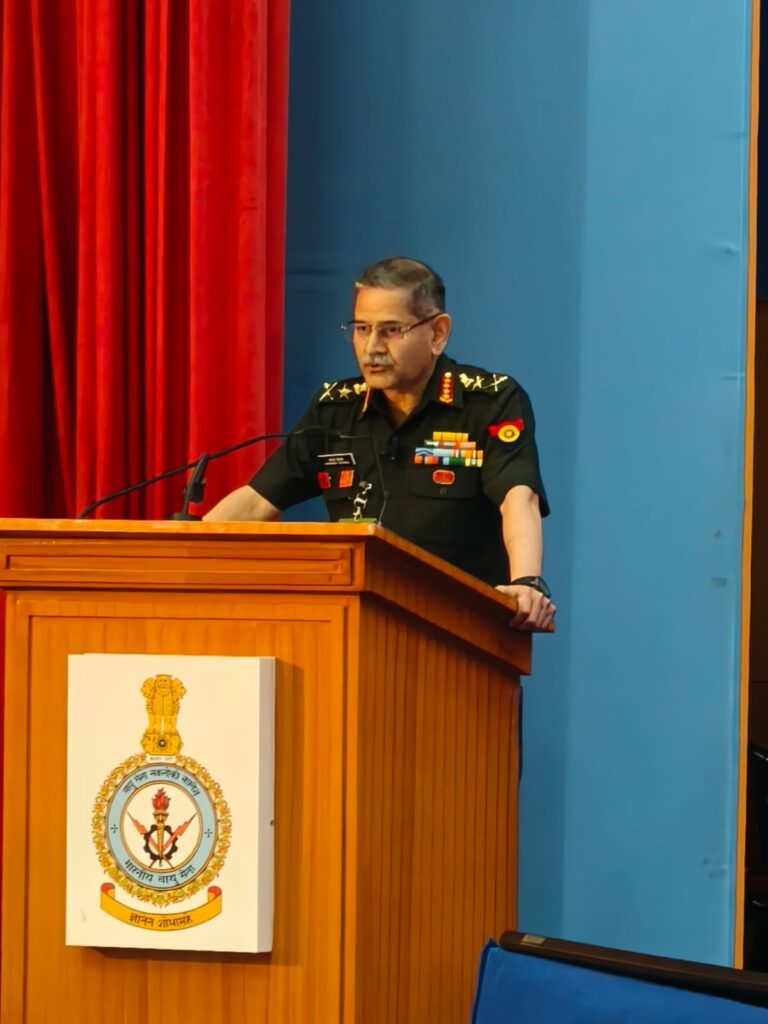
Participants pressed for evolution in the very idea of jointness. Mere coordination or deconfliction is inadequate; what is required is orchestration of effects: unified planning that anticipates cross-domain interactions, command arrangements that permit rapid effect assignment, and multinational and interagency linkages that synchronize military, economic and information instruments of national power. This convergence places a premium on force development that is resilient and distributed — smaller, networked units and platforms that can operate under contested conditions, degrade gracefully, and regenerate capability.
Preparing such forces, the seminar argued, rests on advanced simulation and war-gaming. Digital environments that realistically model the interplay of cyber, space, electromagnetic and kinetic effects become laboratories for concept development and rehearsal. These tools help stress-test doctrines, validate interoperability, and cultivate the tempo of command required when decisions must be made with incomplete or ambiguous information.
Yet technology alone will not secure an advantage. Ran Samwad’s most insistent message concerned human capital, institutions and training. Modern MDO demands commanders and staffs who combine deep professional mastery in a core domain with genuine cross-domain literacy: the cognitive agility to perceive interactions, anticipate adversary cascades, and make high-consequence decisions under pressure. Training must therefore shift from platform-centric proficiency to mission-centric, problem- and scenario-based learning that emphasizes critical thinking, adaptive planning, and multi-domain execution.
Professional Military Education must be overhauled to embed joint and cross-domain modules, cultivate analytic and creative problem solving, and make systematic use of simulations and red-teaming. Equally important is building institutional linkages beyond the barracks: sustained partnerships with universities, technology firms and research laboratories; table-top and live exercises that include civil authorities and industry; and cultural norms that prize intellectual curiosity and innovation as much as technical competence.
Ran Samwad 2026 also placed the MDO debate in a broader strategic frame. Modern conflict is not exclusively a military matter: economic coercion, information ecosystems and technological dependencies are integral battlegrounds. India’s approach, therefore, must be whole-of-nation — a synchronised application of state capabilities and societal resilience to deter and, if necessary, impose costs on adversaries across multiple vectors.
The keynote address by Air Marshal Ashutosh Dixit, PVSM, AVSM, VM, VSM, at Ran Samwad 2026 delivered a crisp, urgent blueprint for how India’s armed forces must evolve to meet the complex character of twenty-first-century conflict. Framed around Multi‑Domain Operations (MDO), the speech argued that the era in which war began with a visible, single‑domain blow is gone. Instead, hostilities now germinate invisibly across space, cyberspace, the electromagnetic spectrum and the cognitive domain, unfold simultaneously across all theatres, and demand a doctrinal and cultural overhaul as much as technological adaptation.
The Changing Character Of Conflict
The Air Marshal opened by challenging the conventional imagery of war. Modern campaigns, he said, often begin long before the first kinetic strike: networks are probed, satellites are targeted, information ecosystems are poisoned, and public perception is shaped to create advantage. On today’s battlefield, actions in one domain cascade into others; a cyber intrusion can preclude manoeuvre, a denial‑of‑service attack can alter political will, and electronic warfare can blind precision fires. The consequence is that tactical moves can produce immediate strategic effects, requiring commanders to think and act across domains in real time.
Importantly, the keynote cautioned against equating change with technology alone. Historical military revolutions — from Blitzkrieg to the Gulf War — combined platforms with new doctrine, organization and operational art. For India now, the central organising idea must be convergence: not merely buying capable platforms, but knitting them together into cohesive, decision‑centric systems.
Contemporary Lessons In Convergence
Drawing lessons from recent crises, the address highlighted three theatres that make convergence tangible. The Ukraine conflict showed how smaller, adaptive forces can leverage commercial satellite imagery, resilient communications, secure digital networks and precision fires to impose disproportionate costs. Resilience, decentralized initiative and the smart fusion of disparate capabilities proved decisive; exposed logistics and rigid, centralized command structures were liabilities.
In the Middle Eastern clashes—where state and sub‑state actors employ stealth platforms, carrier strike groups, submarines, ballistic missiles, loitering munitions and economic levers—the speaker noted how no single domain proved decisive. Rather, the contest was fought across sea, air, land, space, and information simultaneously, and regional instability had effects far from the theatre—impacting India’s maritime security and supply chains.
Closer to home, recent Indian operations from 2021–2025 reinforced that jointness and real‑time integration are not abstract ideals but operational necessities. Tactical success increasingly depends on how quickly and smoothly the services can share information, delegate authority and act together.
What MDO Means For India
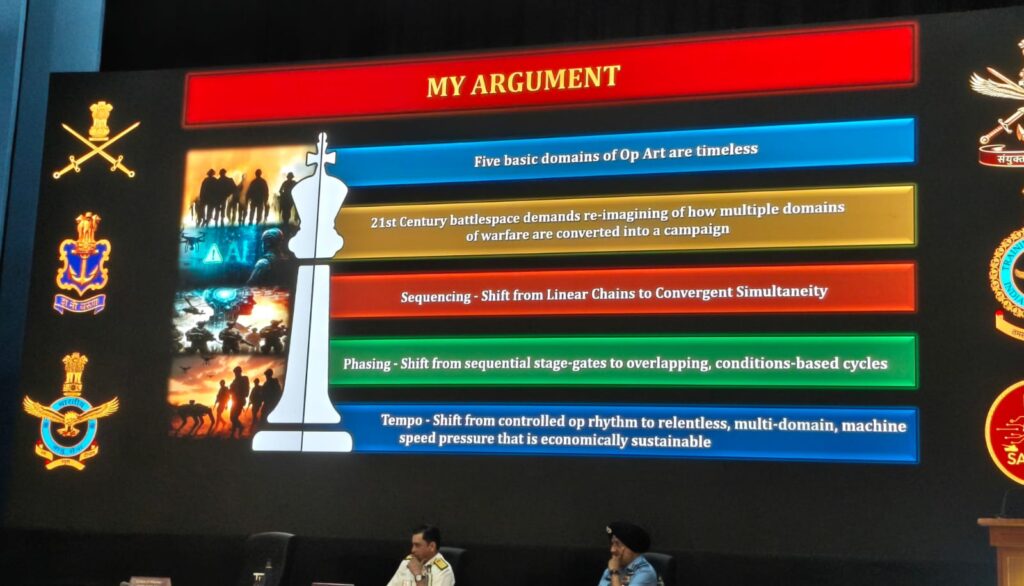
MDO, as Air Marshal Dixit defined it, is not a buzzword but an architecture: the deliberate integration of capabilities, information flows, and command authority to achieve decision superiority across domains at speed. It is not satisfied by cosmetic inter‑service talk, isolated cyber initiatives, or the acquisition of high‑end platforms without regard for how they operate together.
Operationalizing MDO requires fundamental change: integrated force structures; command relationships that enable rapid, delegated decision‑making; common data standards and secure networks; joint training and professional pathways; doctrine that prizes systems thinking; and an industrial base structured for interoperability from the design table onward. The emphasis should shift from service‑centric equities to “what we can do together, faster.”
Strategic Imperatives And Threats
India faces a spectrum of threats that blur peace and war: cross‑border turbulence, low‑signature incursions, swarms of unmanned systems, electronic and cognitive warfare, misinformation campaigns and cyber intrusions. Such challenges do not respect service boundaries and cannot be countered sequentially. They demand synchronized, simultaneous responses—where air, land, sea, space, cyber and informational effects are orchestrated in unison.
Further, he warned that strategic shocks beyond India’s immediate neighbourhood, such as escalation in the Middle East, disruptions to global commerce, or technological coercion, can quickly influence India’s security calculus. Thus, MDO must be outward-looking, enabling forces to protect national interests far from home and to operate coherently with partners.
Core principles for capability convergence
The address closed with practical, principle‑based guidance. First, data orchestration and mission command are inseparable: the problem is not only how much data exists but how to ensure the right information reaches the right decision‑maker at the right time. This requires delegated authority, secure, joint communications, common data architectures and trusted processes for distributed decision‑making.
Second, the speed of decision must be institutionalized. Doctrine, training, and organizational culture should reward initiative within a framework of shared intent. Third, resilience—of communications, logistics, and sensors—must be engineered so that the force can operate through degradation. Fourth, the defence industrial ecosystem should be incentivized to build interoperable systems by design, with standardized interfaces and modularity.
Finally, it was insisted that MDO is ultimately about people and institutions as much as it is about systems. Achieving seamless integration will require cultural transformation toward jointness: common education and career paths, joint professional military education, and leadership that empowers lower echelons to act decisively.
Multi-Domain Operations: From Domain Silos To Seamless Fusion
The character of war is changing. The Chief of Army Staff, General Upendra Dwivedi, PVSM, AVSM elucidated that contemporary conflict is less a sequence of isolated campaigns and more an ongoing, dispersed struggle that spans regions, actors and instruments of power. In this environment, the old model—six domains operating in parallel under siloed leadership—no longer suffices. The imperative is clear: militaries must evolve from domain-centric constructs toward integrated Multi-Domain Operations (MDO), where domains do not merely coexist but interlock dynamically, shifting weight and leadership as the fight demands.
Rethinking The Domain
The COAS said that at the heart of MDO is a shift in how commanders conceive their force. Where once the land component thought in terms of terrain and attrition, modern land forces must operate as “land forces” with reach across air, maritime, cyber, space and the cognitive/electromagnetic battlespace. This is not simply adding capabilities; it is reimagining how those capabilities are orchestrated. A successful MDO posture enables any domain to operate freely while deliberately creating conditions in other domains that enhance overall effectiveness.
Four propositions frame this approach. First, conflict today is effectively perpetual, dispersed and multi-theatre—an undeclared global contest where lessons and threats evolve daily. Second, leading a battle now requires a 3D, layered perspective: a land commander must understand how ground manoeuvre, electronic warfare, cyber effects, space-enabled sensing, and information operations interrelate. Third, the payoff of MDO accrues when domains operate in constant, adaptive interplay—synchronized where necessary, decentralized where advantageous—thereby enabling complex adaptive systems to exploit opportunities. Fourth, moving from concept to capability demands conceptual clarity, structural reform and demonstrable results.
Transforming Concept Into Capability
Transformation is organizational as much as technical. The Indian Army’s recent initiatives illustrate the breadth and depth required. Exercises since 2024 have stressed cross-ministerial participation and tested interagency integration. Structural reforms—integrated theatre commands, dedicated ISR and special operations brigades, long-reach precision formations (codified under “Shakti” concepts), new signal regiments focused on electromagnetic superiority, and psychological defence units for information campaigns—reflect a PSC model: concept, structure, consequences.
These measures aim to deliver the enabling seams that allow domains to complement rather than compete. Networked sensors from first-person-view (FPV) systems to high-altitude drones, resilient space services for navigation and communications, and layered electronic warfare and cyber capabilities are staples of that networked battlefield. Equally vital are doctrine, training and command arrangements that permit decentralized execution while preserving coherent strategic intent.
Persistent Challenges
General Upendra Dwivedi insisted that realizing MDO is not an engineering task alone; it is profoundly institutional and conceptual. Integration must span the horizontal axis of domains and the vertical axis of war: policy, strategy, operations and tactics. Disparities between levels—where strategic goals, operational design and tactical execution are misaligned—undermine the most capable technologies.
Hybrid and grey-zone competition compounds the problem. Non-kinetic levers—legal, informational, economic, political—are deployed alongside or below the threshold of armed engagement. The land domain must therefore prioritize means that are non-high-tech, non-contact and non-kinetic when appropriate, preparing space for conventional options rather than defaulting immediately to them.
Three Debates Ahead
As militaries operationalize MDO, three debates will shape outcomes:
1. From Domain Silos to Domain Fusion: Progression must be managed—from maintaining domain expertise and “purity,” through coordination models, to genuine fusion where capabilities are conceived and employed as composite effects rather than as sequenced deliverables.
2. Centralization versus Decentralization of Command: MDO depends on frictionless information flow and shared intent. The tension between centralized direction for strategic coherence and decentralized initiative for tempo and resilience must be resolved through doctrine, mission command principles, and trusted networks.
3. Military–Civil Integration: Modern battlefields extend into economic, informational and societal spaces. Effective MDO requires whole-of-government and whole-of-society mechanisms—legal, technical and organizational—to synchronize military action with diplomatic, economic and informational instruments.
Multi-Domain Operations represent a necessary evolution, not a cosmetic addition, to contemporary military art. They demand new mental models, reworked organizational architectures, and a cultural shift to operate in persistent, multi-actor competition. Success will be measured not by acquisition lists but by the ability to orchestrate domains so that the right effect, in the right domain, at the right time, achieves strategic outcomes while preserving political and operational freedom of action. In short, MDO is less about adding six separate tools and more about crafting a single, adaptive instrument of national power.
Ran Samwad 2026 closed on a measured note, underscoring a pivotal shift in how militaries conceive conflict. Conceived as a forum for serving officers to bring frontline perspectives into doctrinal debate, the seminar moved beyond jargon to interrogate Multi-Domain Operations (MDO) as an emergent, practice-driven reality.
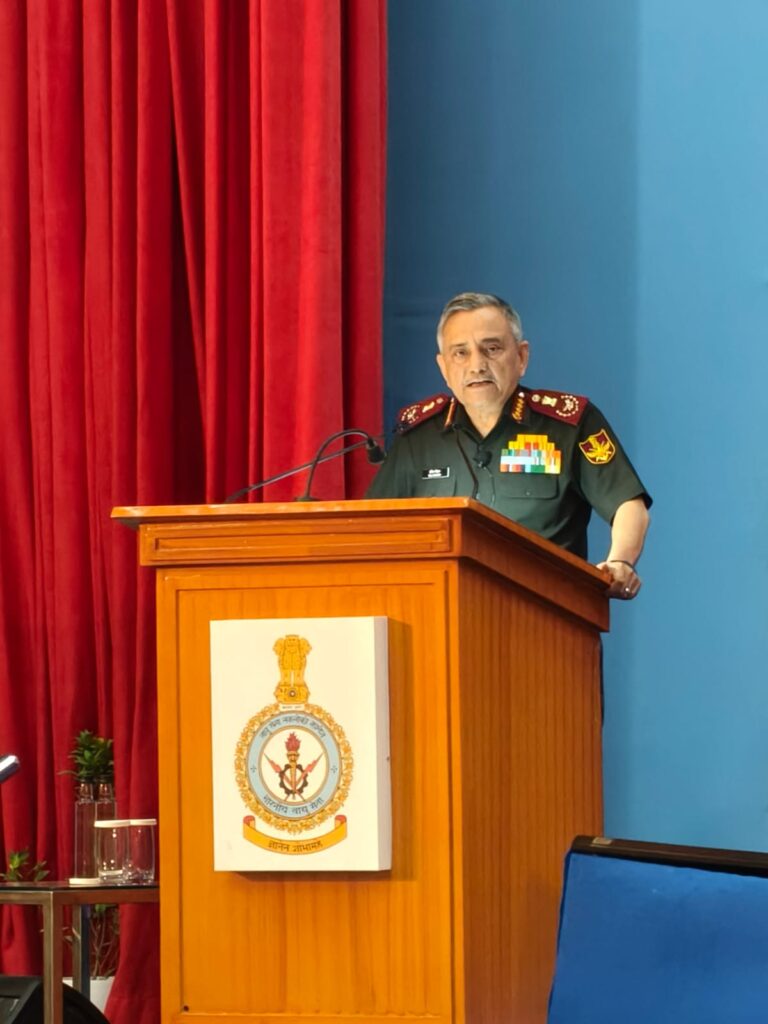
Chief of Defence Staff General Anil Chauhan, PVSM, UYSM, AVSM, SM, VSM, on day two of Ran Samwad 2026, said that debates cut across structure, technology and judgment. He discussed as the participants questioned whether legacy hierarchies suit a battlespace that blurs domain boundaries and considered experimental constructs such as multi-domain task forces. ISR was reframed: sensors proliferate and data abounds, but the limiting factor is interpretation—speed and quality of insight—not collection. Consequently, analytics and AI were discussed not as panaceas but as enablers of decision superiority, capable of reshaping the OODA loop by forecasting adversary intent and accelerating command cycles.
Doctrine, too, was challenged. Panellists argued that operational art must evolve to encompass synthetic and cognitive effects alongside the physical. The seminar broadened the vocabulary—from domains to dimensions—adding time, cyber/electromagnetic effects, and the cognitive realm to describe conflict’s expanding topology. This reframing highlights critical differences between combat at the military-technical level and “total war” pursued through political or cognitive means without kinetic engagement.
Civil-military boundaries and rules of engagement emerged as central concerns as the distinction between military and civilian targets, and between state and non-state actors, became less clear. The need for realistic simulation and rigorous war-gaming was emphasized to stress-test organizations, concepts and civil-military interoperability in these contested spaces.
Ran Samwad II’s core takeaway was pragmatic: MDO remains a work in progress, conceptually “hazy” but operationally urgent. Success will rest less on novel hardware than on institutional adaptation: clearer jointness among services, faster and better decision-making, and doctrinal humility to integrate synthetic and cognitive effects. In the evolving calculus of modern war, the value of a decision will be judged by its correctness and its timeliness—nothing else.