Staff Correspondent
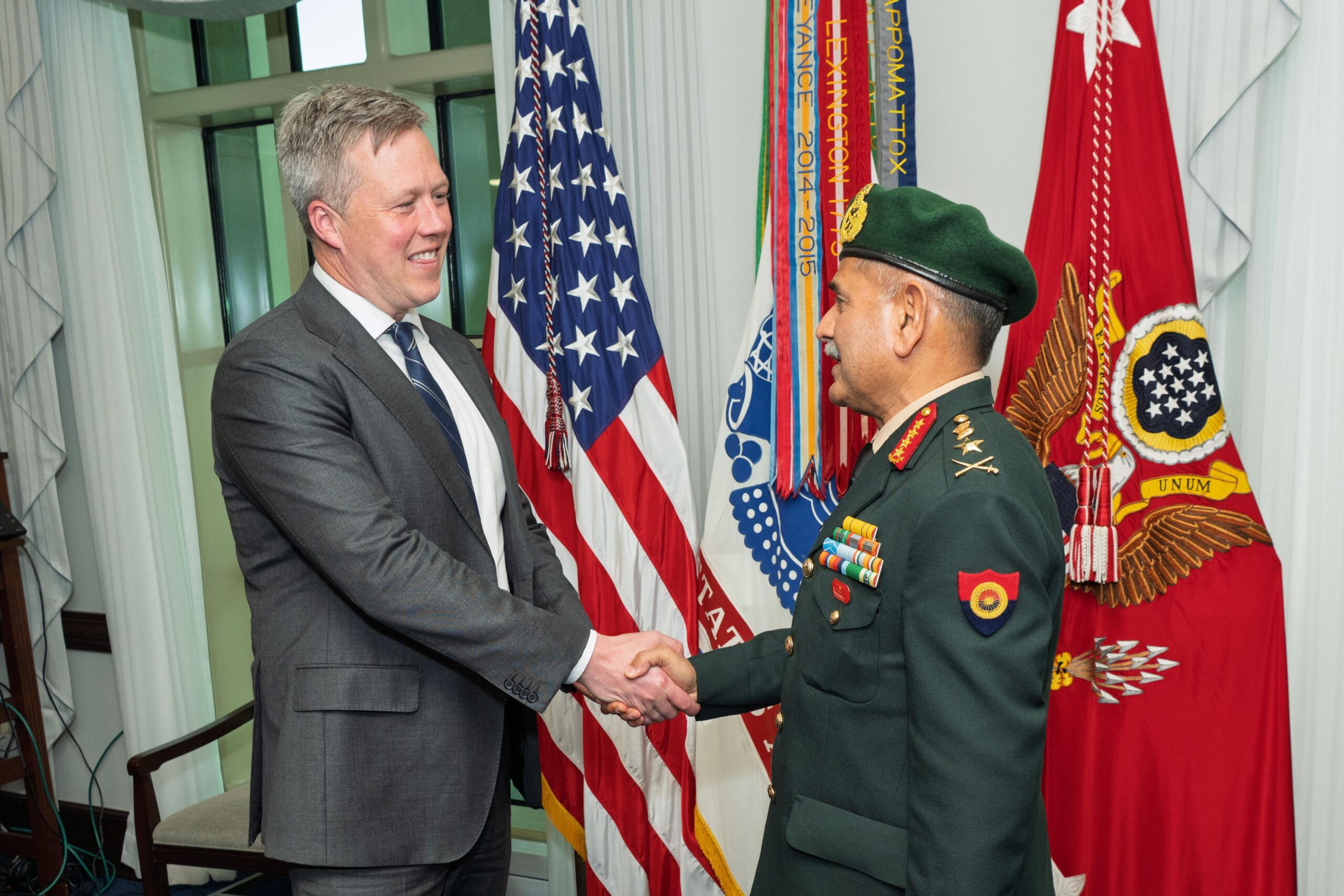
General Upendra Dwivedi’s visit to the Pentagon from April 20 to 23 represents a noteworthy moment in the evolving strategic partnership between India and the United States. At a time when the international security environment is characterized by rapid technological change, complex geopolitical competition, and an array of transnational threats, high-level military engagements such as this one serve both symbolic and practical purposes: they reaffirm political will, help to harmonize doctrines and procedures, and create institutional pathways for sustained cooperation. This essay examines the substantive contours of General Dwivedi’s meetings at the Pentagon, the strategic rationale underpinning deeper India–US military cooperation, the principal avenues for pursuing enhanced collaboration, and the broader implications of this deepening partnership for regional and global security.
The India–United States relationship has matured markedly over the past three decades from wary engagement to a multifaceted strategic partnership that now encompasses defence, technology, intelligence sharing, and joint exercises. India’s growing importance as a regional power in the Indo-Pacific, its acquisition of advanced capabilities, and its experience operating in complex, contested environments make it a natural partner for the United States, which seeks capable, reliable partners to uphold a rules-based order and preserve strategic stability. Conversely, India benefits from access to advanced technologies, doctrinal insights, and interoperability with one of the world’s most capable militaries. In this context, General Dwivedi’s engagement with senior Pentagon leadership reflects shared recognition that closer military-to-military ties advance mutual interests—deterrence, crisis management, maritime security, counterterrorism, humanitarian assistance and disaster relief, and emerging domains such as cyber and space.
Substantive Outcomes Of The Pentagon Engagement
General Dwivedi’s meetings at the Pentagon with Secretary of the Army Daniel P. Driscoll, Acting Chief of Staff General Christopher LaNeve, and other senior officials, including Under Secretary of Defense for Policy Elbridge Colby and National Guard Bureau Chief General Steven S. Nordhaus, signal both breadth and depth to the bilateral agenda. These interactions emphasized several important themes:
– Interoperability and jointness: The parties highlighted the need to enhance interoperability across command, control, communications, computers, intelligence, surveillance and reconnaissance (C4ISR), logistics, and tactical procedures. Improved interoperability reduces friction in combined operations and exercises, allowing for more effective coordination in peacetime engagements and contingencies.
– Training and capability development: The discussions underscored opportunities for expanded professional military education, staff exchanges, and joint training exercises at unit and doctrinal levels. Such initiatives build common operational foundations, allow cross-pollination of best practices, and accelerate capability maturation within the Indian armed forces.
– Institutional linkages and policy coordination: Engagements with defence policy and National Guard leadership reflect a deliberate effort to institutionalize cooperation beyond episodic interactions. Strengthened institutional linkages facilitate long-term planning for technology transfer, co-development projects, logistics cooperation, and synchronized policy responses to emerging security challenges.
– Broader strategic dialogue: Meetings at senior levels allow for candid exchanges on regional developments and potential collaborative approaches to shared challenges. This strategic dialogue helps identify complementary priorities—maritime domain awareness, critical infrastructure protection, counterterrorism, and capacity building for partners in the region—and calibrate practical cooperation.
Pathways for deeper cooperation
The meetings point to multiple pathways through which India and the United States can deepen their military relationship:
– Expanded exercises and operational coordination: Increasing the scale, sophistication, and regularity of bilateral and multilateral exercises—covering land, maritime, air, cyber, and space domains—will improve interoperability and demonstrate shared resolve. Exercises can be designed to replicate realistic scenarios that both nations might face collectively.
– Joint capability development and defence industrial collaboration: As India pursues indigenous modernization under initiatives such as Make in India and Atmanirbhar Bharat (self-reliance), there remains scope for co-development and co-production with U.S. partners. Cooperative programs can transfer critical technologies, develop niche capabilities, and create interoperable systems tailored to regional contingencies.
– Institutionalized exchanges and education: Expanding officer exchanges, staff college programs, and think-tank interactions will embed shared doctrines and strategic perspectives. Such people-to-people ties cultivate mutual understanding and professional networks essential for crisis management and coalition operations.
– Information sharing and combined planning: Deeper collaboration in intelligence sharing, maritime domain awareness, and combined logistics planning—especially for operations in the Indo-Pacific—can enhance preparedness and resilience. Mechanisms for sharing real-time information and coordinating responses to grey-zone activities would strengthen deterrence.
– Cooperation in emerging domains: The U.S. and India can jointly shape norms and capabilities in cybersecurity, space operations, artificial intelligence for defence, and countering disinformation. Cooperation on these fronts can be both capacity-building and governance-oriented, reflecting common interests in secure, stable use of new technologies.
A deepening India–US military relationship carries implications for the regional order and global security. First, enhanced cooperation bolsters deterrence by improving combined capabilities, thereby complicating potential coercive strategies by revisionist actors. Second, it contributes to regional capacity-building: joint initiatives and training can enable partner states in the Indo-Pacific and beyond to better secure their maritime and territorial integrity. Third, such cooperation can support stability by providing mechanisms for coordinated responses to crises such as natural disasters, humanitarian emergencies, or sudden security shocks.
At the same time, closer India–US military ties are not devoid of risks. Deeper alignment may provoke concern among other regional actors and requires careful diplomatic management to avoid unintended escalation. India’s strategic autonomy has been a central tenet of its foreign policy; sustaining that autonomy while pursuing deeper operational ties with the United States demands nuanced policy calibration from both capitals. Transparent dialogue with regional stakeholders and a clear articulation of the cooperative relationship’s defensive and stabilizing intent will be important in mitigating misperceptions.
General Upendra Dwivedi’s visit to the Pentagon exemplifies the pragmatic and strategic momentum in India–US military relations. The high-level discussions—spanning interoperability, training, policy coordination, and broader strategic dialogue—reflect an agenda oriented toward practical cooperation that enhances collective capacities to address contemporary security challenges. As both nations seek to navigate a complex international environment, institutionalizing and broadening military cooperation offers tangible benefits: improved readiness, shared deterrence, enhanced crisis response, and cooperative development of emerging defence capabilities. Success will depend on sustained political will, mutual respect for each country’s strategic priorities, and an emphasis on transparency and regional confidence-building. If pursued thoughtfully, the strengthened defence partnership that General Dwivedi’s visit symbolizes can contribute meaningfully to regional stability and to a rules-based, secure international order.