Chaitali Bag
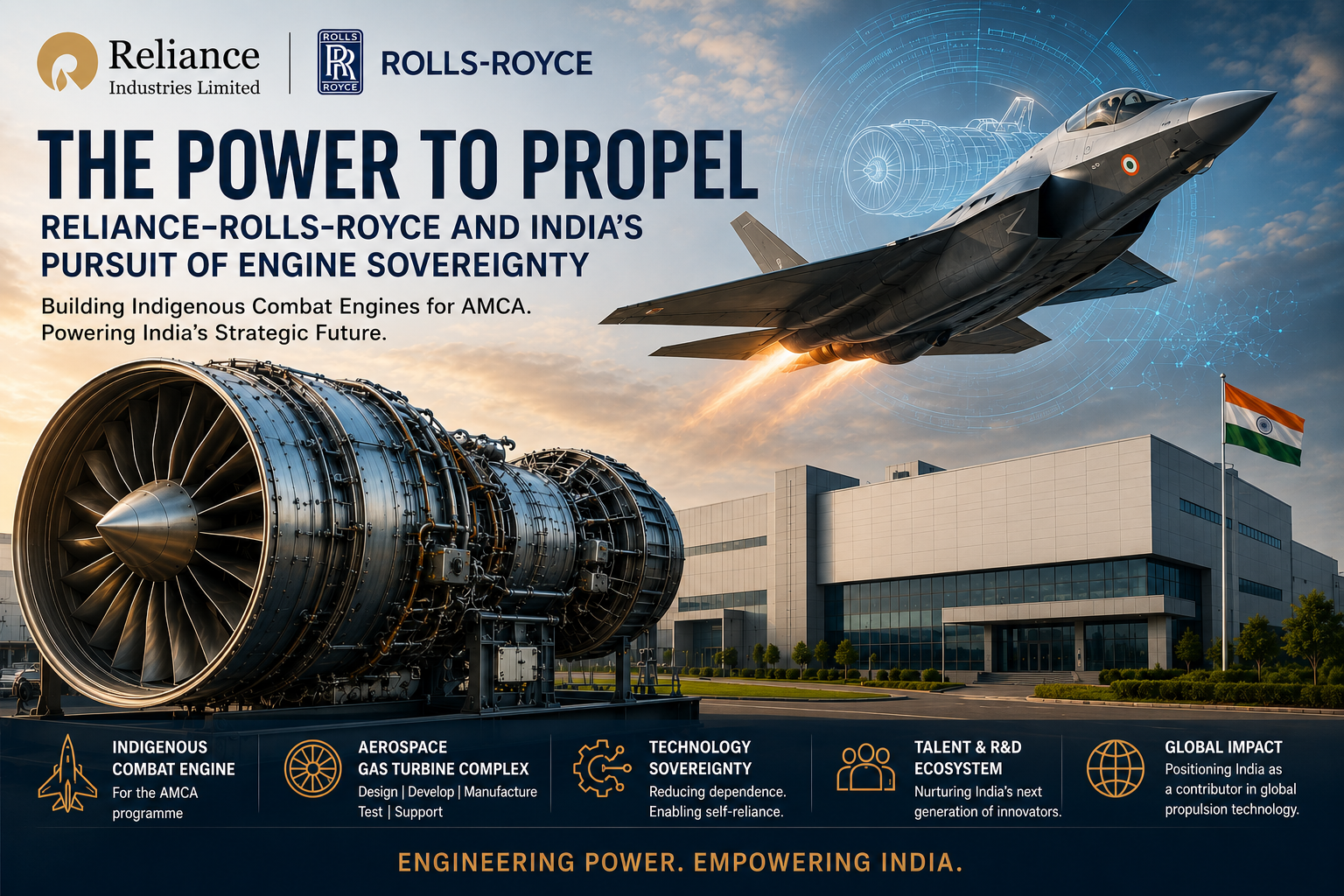
Reliance Industries Limited and Rolls‑Royce have announced a partnership whose implications extend far beyond a conventional industrial tie-up: it is a strategic convergence of capabilities, ambition, and national aspiration that could reshape India’s defence-industrial landscape and propel the country toward genuine technological sovereignty in aero‑propulsion. The proposed collaboration to design, develop, manufacture and deliver an indigenous combat engine for the Advanced Medium Combat Aircraft (AMCA) programme, anchored by the prospective creation of an Aerospace Gas Turbine Complex as a centre of excellence, is an audacious, forward‑looking initiative that blends world‑class engineering with India’s industrial scale and execution strength. This essay celebrates that vision, examines its potential impact, and outlines why the alliance between Reliance and Rolls‑Royce is an exciting and consequential milestone for India and for global aerospace.
A timely convergence of intent & capability
At a time when nations are increasingly prioritizing strategic autonomy in critical technologies, the Reliance–Rolls‑Royce partnership is strikingly well‑timed. The AMCA programme is India’s next‑generation indigenous fighter aircraft effort, and its success hinges on a sovereign, high‑performance combat engine. This technological artefact sits at the apex of engineering complexity. Rolls‑Royce brings to the table century‑deep expertise, refined design philosophies, validated thermodynamic solutions, and decades of experience across military and civil propulsion. Reliance contributes industrial heft, systems capability, manufacturing scale, supply‑chain mastery, and a proven track record of executing large, complex national projects across energy, materials and advanced technologies. Together, they form a powerful complement: global engineering excellence married to robust national industrialization capacity.
Building an Aerospace Gas Turbine Complex: More than bricks & turbines
The proposed Aerospace Gas Turbine Complex is not merely a factory. Framed as a centre of excellence for power and propulsion technology, it offers a holistic, end‑to‑end capability: concept and engine architecture design, high‑precision component manufacturing, advanced materials and composites integration, systems integration and testing, production scaling, and through‑life support. Such a facility would serve multiple purposes simultaneously:
– Enable sovereign design authority over combat engine technologies, reducing dependence on external suppliers and technologies.
– Seed domestic capability in cutting‑edge subdomains (single‑crystal turbine blades, high‑temperature alloys and coatings, additive manufacturing for hot‑section components, high‑precision aerofoil fabrication, advanced testing rigs and engine health monitoring systems).
– Create a talent and R&D ecosystem, attracting and training engineers, scientists and technicians in aero‑propulsion.
– Serve as a platform for dual‑use innovations, with spillovers into civil aerospace, power generation and emerging propulsion modalities such as hydrogen‑enabled turbines or hybrid powertrains.
Strategic dimensions: defence, economy & geopolitics
The strategic value of an indigenous combat engine cannot be overstated. Engines are intellectual and industrial bottlenecks: the capability to design, validate and confidently field a fighter engine confers operational independence from supply chain resiliency in wartime to sovereign sustainment and upgrades during peacetime. For India, this would translate into operational flexibility for the Indian Air Force, cost efficiencies over life cycles, and the ability to evolve platform capabilities unencumbered by export controls or technology denial regimes.
Economically, a successful indigenous engine programme can spawn an ecosystem of suppliers and sub‑contractors, creating high‑value manufacturing jobs and enabling Indian firms to ascend the global aerospace value chain. The collaboration could position India as an exporter of propulsion technology and services, not only enhancing national prestige but also diversifying trade avenues and strengthening technological diplomacy.
Geopolitically, partnerships that blend global expertise with domestic execution strengthen India’s strategic partnerships while asserting its industrial independence. By working alongside Rolls‑Royce, India benefits from world‑class knowledge transfer without ceding control of core capabilities. Over time, this can rebalance technology flows, enabling India to be a contributor rather than merely a consumer in global propulsion innovation.
Technological & industrial challenges & how the partnership can meet them
Designing a combat engine for a fifth‑generation class fighter is a nontrivial engineering challenge. High thrust‑to‑weight ratios, thermal management, signature reduction, materials capable of sustaining extreme temperatures, and reliability under combat conditions all require sustained R&D, rigorous testing and meticulous systems integration. Developing indigenous capability demands investment across multiple vectors: advanced metallurgy, fabrication tolerances, high‑precision machining, simulation and modelling, test facilities, and a lifecycle sustainment ecosystem.
The Reliance–Rolls‑Royce alliance, by virtue of its complementary strengths, is well positioned to meet these challenges. Rolls‑Royce contributes deep design knowledge, engine architectures, and proven methodologies for validation and certification. Reliance brings capital, procurement and supply‑chain development abilities, manufacturing scale, and a domestic market understanding that is indispensable for translating prototypes into production realities. Together they can de‑risk development paths, accelerate timelines, and institutionalize knowledge transfer culminating in an indigenous capability that is both robust and exportable.
Economic multiplier effects & industrial modernization
Beyond the engine itself, the project is a lever for modernizing India’s manufacturing base. Realizing the Aero Gas Turbine Complex will require the creation of advanced supply chains for precision metallurgy, ceramics, and composites, as well as investments in metrology, automation, and digital engineering. The knock‑on effects include workforce upskilling, growth of SMEs in the aerospace supply chain, incentivized investment in research institutions and universities, and a culture of rigorous engineering standards that can elevate other industrial sectors.
Moreover, the complex could catalyse development in adjacent domains such as civil aero engines, industrial gas turbines, marine propulsion, and next‑generation energy systems, broadening economic returns and reinforcing national resilience across multiple strategic sectors.
National aspiration, Atmanirbhar Bharat & global competitiveness
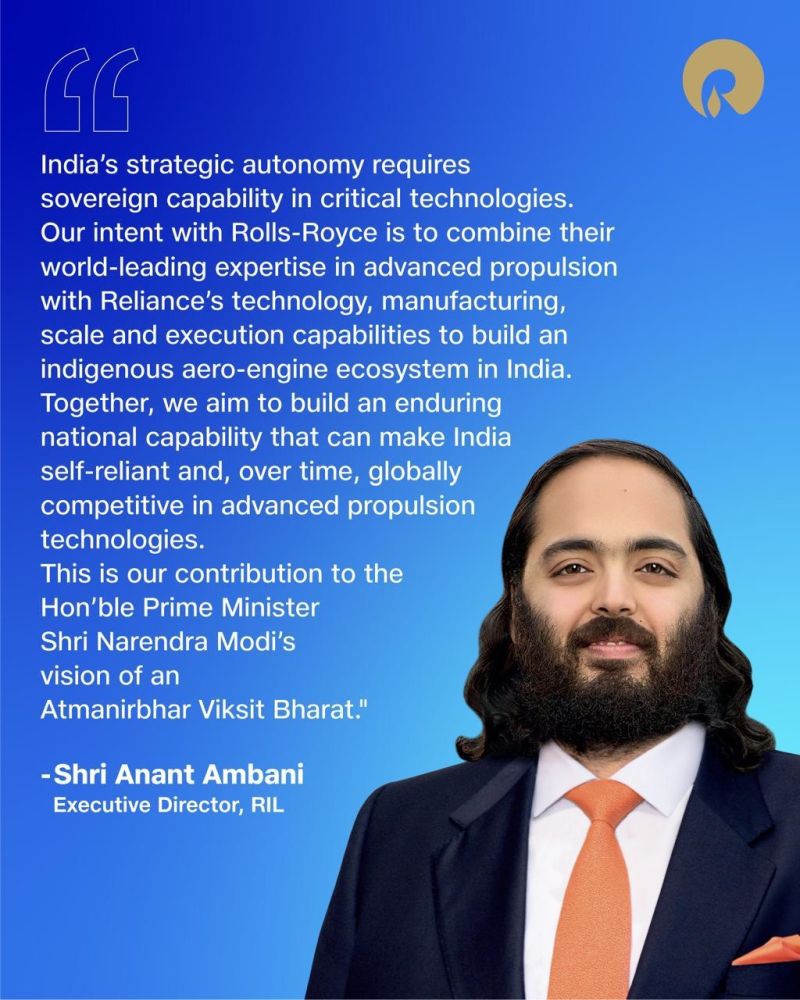
The partnership aligns explicitly with India’s Atmanirbhar Bharat vision: to indigenize critical technologies, reduce strategic dependencies and nurture homegrown champions. Yet the ambition is not merely inward‑looking. Reliance and Rolls‑Royce emphasize global competitiveness: the aim is to build capabilities that enable India not only to meet domestic defence needs but also to compete in international markets for propulsion systems and services. For a large country with growing defence and civil aerospace ambitions, achieving that level of maturity would be transformational.
Human capital & knowledge ecosystems
An enduring national capability depends on people. The project promises to stimulate education and skills development in aerospace engineering, materials science, computational fluid dynamics, and systems engineering. Partnerships with academic institutions, dedicated apprenticeship and training programs, and research collaborations can form a persistent pipeline of talent. The experience of scaling from design to through‑life support will institutionalize best practices, enabling future indigenous programmes to start from a significantly more advanced base.
No ambitious technological endeavour is without risk: schedule slippage, technical setbacks, regulatory and certification hurdles, and cost escalations are real possibilities. Managing these risks requires clear governance, staged development pathways, transparency in intellectual property arrangements, and sustained public‑private coordination. The partnership should adopt iterative validation milestones, invest in simulation and ground test infrastructure early, and cultivate an ecosystem of verified suppliers to avoid single‑point failures.
A landmark step with long horizons
The Reliance–Rolls‑Royce strategic intent to develop a sovereign combat engine for the AMCA, underpinned by an Aerospace Gas Turbine Complex, is an inspiring and consequential initiative. It represents a pragmatic synthesis of global engineering pedigree with domestic industrial capability, a model that can deliver technological sovereignty while remaining outward‑looking and globally competitive. If executed with rigour, transparency and a focus on capability building, the partnership could be a defining chapter in India’s industrial and defence history: seeding an indigenous aero‑propulsion ecosystem, creating high‑value economic opportunities, and enabling India to exercise greater strategic autonomy in defence and aerospace.
This collaboration is more than technical cooperation; it is a statement of intent — an embrace of the future in which India builds, sustains, and exports advanced propulsion systems. For students, professionals and policymakers, it offers a blueprint for how nations can attain strategic capabilities by combining international expertise with domestic scale and ambition. In that sense, the Reliance‑Rolls‑Royce alliance is not merely a commercial venture: it is a clarion call for India’s ascent as a self‑reliant, technologically sophisticated global player in advanced propulsion.