
The Rise of a Defence & Space Nation
Chaitali Bag
When India stepped onto the world stage as a free and independent nation on 15 August 1947, it did so with reality pressing in on every side: a modest industrial base, limited technological expertise, and defence forces that relied heavily on foreign equipment. The legacy of colonial rule left the country facing daunting developmental challenges and scarce resources. Roads to progress were few and arduous, and the march toward self-reliance seemed at times uphill and uncertain.
Yet from that very moment of constraint sprang a powerful and unyielding dream. India’s founders and its people resolved to transform scarcity into strength, and dependence into capability. They set their sights on a bold, resolute objective: to craft a sovereign nation whose security, scientific prowess, and technological know-how would never again be at the mercy of others. This was more than policy; it was a clarion call to build indigenous industry, to cultivate homegrown research and innovation, and to arm the nation with the skills and infrastructure required to stand independently in an unpredictable world.
This aspiration energized generations of leaders, scientists, engineers, and citizens. Factories rose where none had stood, research institutions were founded and nurtured, and a culture of innovation began to take root. Training programs produced skilled technicians and professionals; universities expanded their horizons; defence laboratories and industries embarked on ambitious projects to design, test, and produce equipment tailored to India’s needs. The nation invested in science and technology as engines of growth and independence, knowing that self-reliance in these fields would translate into strategic autonomy and socio-economic transformation.
Eighty years later, that ambition has evolved into something far more consequential.
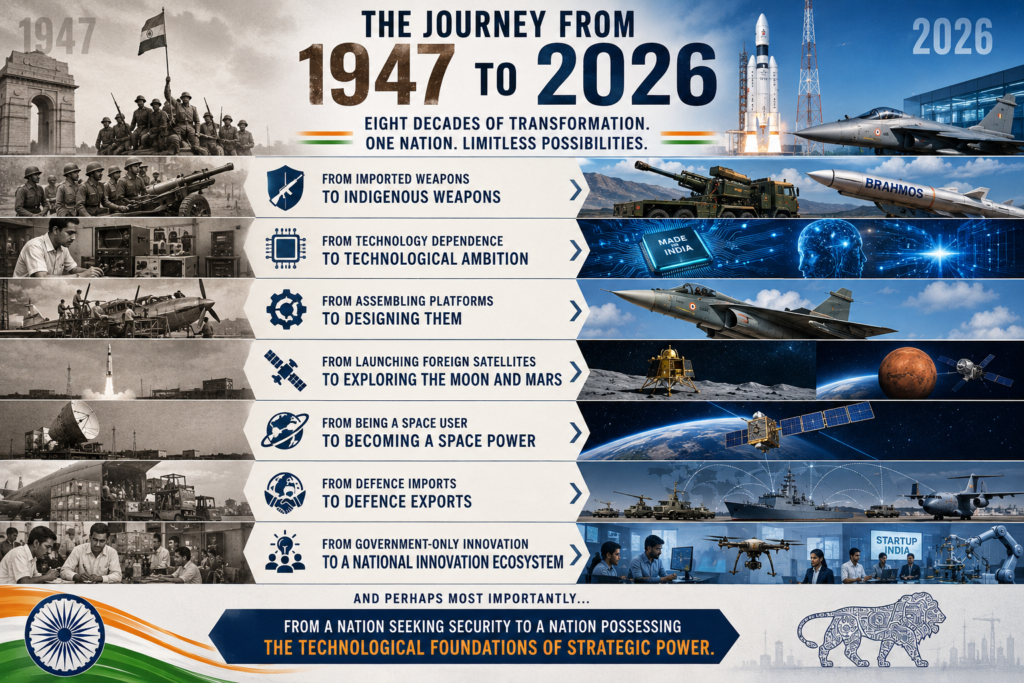
India today stands as a confident technological power: a nuclear-armed state with a credible strategic deterrent, a burgeoning defence-industrial base, expanding military space capabilities, and one of the world’s most accomplished space programmes. From crafting its earliest indigenous missiles to operating aircraft carriers and nuclear submarines; from launching satellites on modest rockets to landing on the Moon and demonstrating autonomous space docking—India’s path has been defined by persistence, experimentation and an unshakable faith in its own ingenuity.
The past 80 years are therefore more than a tale of economic or political change. They are the story of a nation that has taught itself to design, develop and manufacture the critical technologies needed to defend its sovereignty and to chart its own destiny.
The Beginning: Security in an Uncertain World
At the moment of Independence, India faced an unusually severe security predicament. The newly sovereign nation was compelled to create and equip its armed forces from scratch while simultaneously laying the foundations for scientific research, industrial capacity, and national infrastructure. Unsurprisingly, the early years were marked by heavy reliance on foreign suppliers: aircraft, tanks, artillery, warships, radars and many other essential systems were imported to meet urgent defence needs.
Yet India’s leaders quickly understood that long-term security could not be sustained by imports alone. They set out to cultivate homegrown technological capability so that the nation could design, develop, and produce its own defence tools. This conviction sparked the establishment of indigenous science and defence institutions. Organisations such as the Defence Science Organisation and a number of research establishments began to foster technical expertise across disciplines.
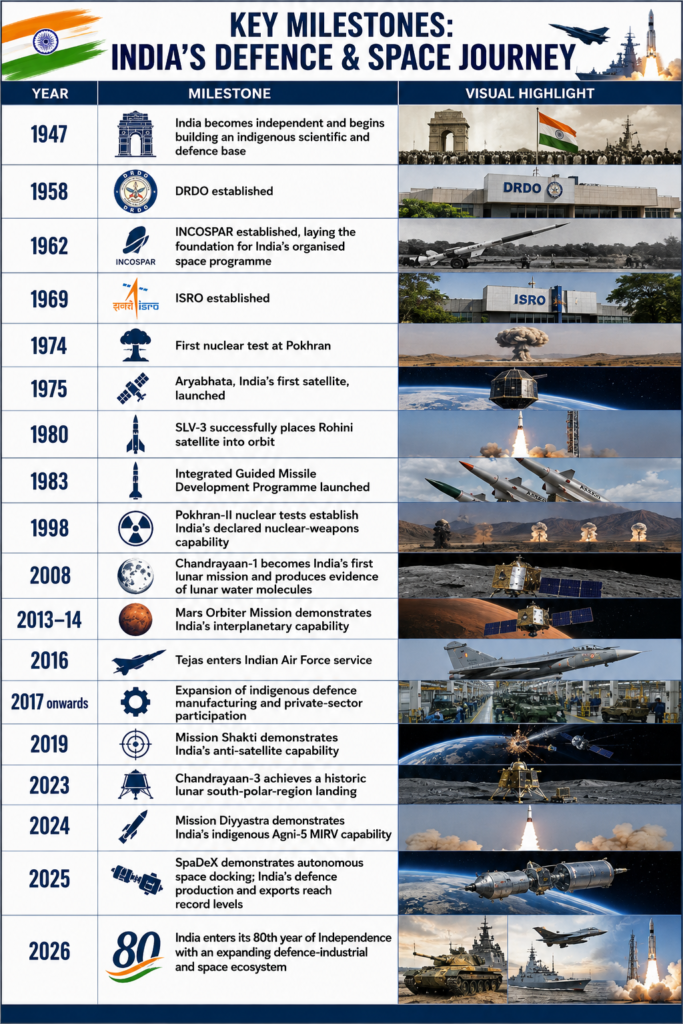
A decisive turning point came in 1958 with the formation of the Defence Research and Development Organisation (DRDO). What began as a compact entity of roughly ten establishments has since expanded into an extensive network of laboratories and centres covering aeronautics, missile systems, electronics, armoured and combat vehicles, naval systems, radar and electronic warfare, advanced computing and a broad array of other fields. Over decades, DRDO and its partner institutions have transformed India’s capacity to innovate, indigenise and integrate complex defence technologies.
The guiding idea behind this long effort was both simple and powerful: strategic autonomy demands technological autonomy. By investing early and persistently in indigenous research, development, and production, India set itself on a path to reduce dependence, strengthen deterrence, and build a self-reliant defence-industrial base.
From Import Dependence to Indigenous Defence
The transformation did not happen overnight.
India’s defence technology journey was characterised by failures as much as successes. Projects took years, technologies were difficult to master, and international restrictions often limited access to advanced technologies.
But every setback produced knowledge.
The Integrated Guided Missile Development Programme of the 1980s became a watershed. The development of the Prithvi and Agni missile families demonstrated that India could master complex propulsion, guidance, control, and systems integration technologies.
Over subsequent decades, indigenous programmes expanded dramatically.
The Light Combat Aircraft Tejas, Arjun main battle tank, Pinaka multi-barrel rocket launcher, Akash air-defence system, advanced radars, electronic warfare systems, unmanned systems and a wide range of naval technologies progressively changed the character of India’s defence ecosystem. DRDO itself describes these programmes as having provided a “quantum jump” in India’s military technological capability and deterrence.
The evolution was not confined to missiles and aircraft.
India developed increasingly sophisticated naval capabilities, including indigenous warships, submarines and strategic platforms. The emergence of nuclear-powered ballistic missile submarines added an important dimension to the country’s strategic deterrence architecture.
The result is a military-industrial ecosystem that is vastly more capable than the one inherited in 1947.
The Nuclear & Strategic Technology Leap
India’s march toward strategic technological maturity reached a watershed moment with its nuclear programme, a journey that transformed not just the nation’s deterrent posture but the entire fabric of its scientific and industrial base. The Pokhran detonations of 1974 and 1998 were dramatic signposts: unequivocal demonstrations of India’s resolve to secure an independent strategic capability. Yet the story behind those flashes of light is far more expansive than the weapons themselves.
Nuclear arms were never an isolated achievement. Their creation demanded breakthroughs across an array of disciplines: advanced materials science to withstand and channel extreme conditions, cutting-edge electronics to control and safeguard devices, high-performance computation for design and simulation, propulsion technologies for delivery systems, precision engineering to produce reliable components, and sophisticated systems integration to make disparate technologies work in concert. Each of these domains pushed laboratories, universities, and industries across India to innovate, adapt and scale.
Over decades, a broad ecosystem took shape. Research institutions matured, industrial supply chains deepened, and engineering talent proliferated. Programs that began with targeted objectives radiated capability outward: investments in one area fertilized progress in others. The cumulative effect was the gradual construction of a strategic spectrum that reaches far beyond a handful of tests or platforms.
Today, India’s deterrent is layered and resilient. Strategic forces rest on land-based missiles, air-delivered options and credible sea-based systems, a triad that conveys sophistication, redundancy and survivability. This multidimensional posture would have been unimaginable in the earliest years after Independence, when technological resources and industrial capacity were limited and dispersed.
The broader lesson of this long arc is vital and inspiring: strategic capability does not spring from a lone weapon or a single technological leap. It is the product of sustained, decades-long investment in science, engineering and industry, a patient accumulation of expertise, infrastructure and institutions that together yield national power and security. India’s experience illustrates how persistent commitment to technological development can reshape a nation’s strategic destiny.
The Space Dream: From Bicycle Wheels to the Moon
If India’s defence story is one of strategic necessity, its space story is perhaps the most inspiring example of ambition overcoming scarcity.
India’s space odyssey began at a time of scarce resources and no indigenous launch capability, driven by visionary scientists like Dr. Vikram Sarabhai, who imagined space as a tool for national development, transforming communications, meteorology, remote sensing, agriculture, and education.
The creation of INCOSPAR in 1962 and the founding of ISRO in 1969 gave that vision institutional force. A milestone came in 1975 with the launch of Aryabhata, India’s first satellite—an extraordinary achievement for a young nation that announced its arrival on the space stage.
Homegrown launch vehicles followed, proving India’s growing technical prowess. The SLV-3 showed that the nation could place satellites into orbit; the PSLV then became the dependable workhorse, celebrated for its reliability and versatility. The GSLV and subsequent advanced launch systems pushed India’s ambitions even farther.
What began as a mission to harness space for development has blossomed into a full-spectrum space capability spanning communications, navigation, Earth observation, weather forecasting, fundamental science and bold planetary exploration.
From Chandrayaan to Mars
India’s space programme soon pushed past Earth’s neighbourhood and aimed for deeper horizons.
Chandrayaan-1, launched in 2008, marked India’s first lunar mission and delivered landmark science, including clear evidence of hydroxyl and water molecules on the Moon’s surface. That success was followed by a bold interplanetary step: the Mars Orbiter Mission (Mangalyaan), which showcased India’s ability to execute a cost-effective, high-performance mission to another planet.
The next milestone was Chandrayaan-3. Its August 2023 soft landing near the Moon’s south polar region placed India among the select group of nations capable of precise lunar landings. Chandrayaan-3 proved not only that India could reach the Moon, but that it could achieve a controlled touchdown and operate on the surface in one of the most demanding lunar environments. Official records even note it as the first successful landing near the lunar south pole.
Beyond national pride, Chandrayaan-3 highlighted India’s advancing mastery of navigation, propulsion, autonomous systems, communications, robotics, thermal control, and mission operations, signalling a maturing, confident space programme ready for even greater challenges.
Building a Human Spaceflight Capability
The next frontier is human spaceflight.
India’s Gaganyaan programme embodies the nation’s bold aim to develop an indigenous capability to send Indian astronauts into Low Earth Orbit and bring them home safely. ISRO calls Gaganyaan the bedrock of a long-term Indian human spaceflight and exploration effort.
Achieving this goal demands far more than a reliable launch vehicle. Life-support systems, crew-escape mechanisms, human-rated propulsion, environmental control, parachute recovery, retrieval operations, crew training, space medicine and mission-control infrastructure must all perform flawlessly in concert.
The experience of Group Captain Shubhanshu Shukla aboard the Axiom-4 mission to the International Space Station in 2025 has added an important practical dimension to India’s preparations. ISRO has highlighted how that mission delivered valuable operational insights that will feed into Gaganyaan.
India Steps Confidently into the Age of Space Docking
India’s space program has taken a thrilling leap into more sophisticated orbital operations. In 2025, the SpaDeX mission achieved autonomous docking and undocking between satellites—including power transfer making India the fourth country to demonstrate this critical capability. That milestone is more than a technological badge of honour; it’s a strategic game-changer.
Docking technology is the backbone of tomorrow’s space endeavours: it enables space stations, on-orbit servicing and repairs, modular assembly of large structures, sample-return missions, and complex human spaceflight operations. In short, India is moving decisively from merely reaching space to truly operating and innovating in it—a profound shift with long-term implications.
Space as Strategic Infrastructure
India’s space program now extends far beyond pure science. Satellites are woven into the fabric of everyday life and national resilience, powering communications, navigation, weather forecasting, disaster response, agriculture, mapping, maritime domain awareness, and security. NavIC, India’s regional navigation system, has bolstered strategic autonomy in positioning and timing. Advanced Earth-observation platforms deliver sharper imagery and richer data, while communications satellites expand connectivity across the nation. Space-based intelligence and surveillance are becoming integral to modern military operations.
As space, defence, communications, AI, and digital technologies converge, India’s future military and economic strength will depend as much on its capabilities beyond the atmosphere as on land, at sea, and in the air. The SpaDeX success signals that India is not just participating in the space age—it’s helping define the next chapter.
From Government Labs to a Nationwide Defence Ecosystem
India’s defence landscape has undergone a remarkable shift. What was once the exclusive domain of government laboratories and public-sector units has blossomed into a dynamic, national defence ecosystem.
Today, private industry, start-ups, MSMEs, universities and research institutes are integral to national security. Homegrown firms are innovating across drones and counter-drone technologies, AI, electronic warfare, radars, communications, space systems, propulsion, advanced materials and precision weapons. That expanding industrial base matters: future conflicts will be decided by technologies that outpace conventional procurement cycles. Rapid innovation, scalable manufacturing and continual upgrades will increasingly determine strategic advantage.
From “Make for India” to “Make for the World”
The shift is nowhere more evident than in defence exports. In FY 2024–25 India recorded a record ₹23,622 crore in defence exports (up from ₹21,083 crore the year before). The private sector contributed ₹15,233 crore, while DPSUs accounted for ₹8,389 crore. Shipments spanning ammunition, weapons, subsystems, components and full systems reached roughly 80 countries.
This marks a dramatic move away from decades of import dependence. India is now exporting an array of offerings, from protective gear and components to artillery, naval platforms, missiles and helicopters. The goal has evolved: beyond self-reliance, India is building globally competitive defence companies ready to serve the world.
The Industrial Revolution in Defence, a transformation in scale, sophistication and strategic depth, is now plainly visible in India’s defence industrial base.
Production tells the story. In FY 2024–25 India’s annual defence production climbed to about ₹1.51 lakh crore, an 18% jump from ₹1.27 lakh crore the year before and nearly double the output of FY 2019–20. Crucially, the private sector now accounts for roughly 23% of that output. Those figures are not just accounting entries: they mark a shift from isolated technological demonstrations to repeatable, scalable industrial capability.
Technology proofs and prototypes show what we can invent. Production lines show what we can build at scale. Foreign buyers show whether those goods meet global standards. India is steadily advancing through all three stages: proving technologies, industrializing them, and beginning to compete internationally. That progression is what converts scientific achievement into real-world military power.
The Defence–Space Convergence
As India moves into its ninth decade of independence, an equally significant shift is underway at the intersection of defence and space. Modern warfare is increasingly waged through and enabled by space-based systems: satellites for secure communications, navigation and timing; intelligence, surveillance and reconnaissance; missile warning; electronic warfare; and networked command-and-control. At the same time, space assets themselves are strategic instruments that demand resilient, sovereign capabilities.
This overlap creates powerful opportunities for Indian industry to build dual-use systems that serve civilian economies and military needs alike. The technologies that will shape the next phase include artificial intelligence, quantum communications, advanced sensors, autonomy and robotics, hypersonics, reusable launch vehicles, distributed satellite constellations and space-based surveillance architectures. As these domains mature, the lines between aerospace, defence, space and advanced technology will blur ever further.
The imperative is clear: to turn prototypes into production lines, and production lines into globally competitive supply chains that underpin national security. India’s rising production figures and growing private-sector role indicate that the country is beginning to meet that imperative, building not only gadgets and launches, but an enduring industrial foundation for defence and space in the decades ahead.
The Road to 2047
As India marks its 80th Independence Day, we should celebrate past achievements and set bold sights on what must be done by the centenary in 2047.
Realizing India’s defence and space ambitions will demand long-term, sustained investment across R&D and advanced manufacturing, including semiconductors, propulsion, materials science, AI, cyber, and quantum technologies. Success won’t come from single institutions working in isolation; it will come from integrated ecosystems.
The future belongs to partnerships. The government must set strategic direction and create demand; the armed forces must define operational needs; DRDO and national labs must pursue high‑risk, high‑payoff research; industry must manufacture and scale; start‑ups must disrupt and innovate; universities must supply deep fundamental research; and international alliances must unlock co‑development and global markets.
Our goal is clear: build an Indian defence and aerospace ecosystem that not only secures domestic needs but competes and wins on the world stage by 2047.
Eight Decades of Freedom, Eight Decades of Technological Self-Belief
Eight decades after Independence, India’s rise is a testament to self-belief powered by science.
From a nation that once laboured to build basic industry and technology, India now designs satellites and launches interplanetary missions, fields ballistic and cruise missiles, builds fighter jets, warships and submarines, runs advanced space systems and exports defence platforms worldwide.
The journey is far from over.
Critical technology gaps remain — in propulsion, engines, semiconductors, advanced materials, autonomous systems, and cyber and space security. India must speed the translation of research into deployable systems and scale up industrial capacity to manufacture complex platforms.
Still, the trajectory is clear.
The first 80 years laid the foundations. The next 20 must convert those foundations into global technological leadership.
As India aims for Viksit Bharat 2047, technological sovereignty will be judged not just by weapons counts or satellite launches but by the nation’s ability to imagine, design, develop, manufacture, protect and export the technologies that define power.
From the early Republic’s labs to the Moon, from Prithvi and Agni to Tejas and advanced naval systems, from Aryabhata to Chandrayaan and SpaDeX, one truth endures:
A nation is truly independent when it owns the knowledge and capability to secure its future.
At 80, India has moved beyond the pursuit of independence. It is building the technological strength to sustain it.