Staff Correspondent
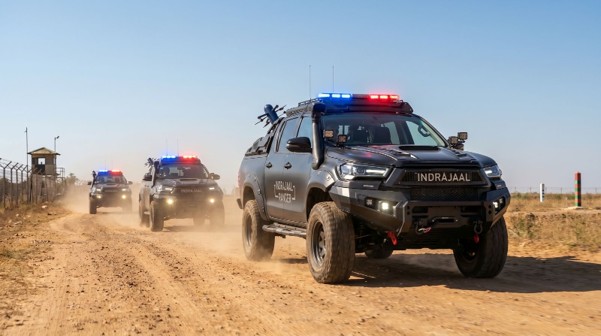
A new dawn for homeland security has arrived in India — one in which the guardians of the streets will no longer look only at the pavement and the skyline but will actively patrol the very air above us. With the rollout of the Indrajaal Ranger™ and government contracts totalling approximately ₹155 crore, India has taken a bold, confident step to lead the world in operationalising counter-drone patrolling at scale. This is not merely a procurement headline; it is the inauguration of a new category of security infrastructure: the Anti-Drone Patrol Vehicle. The implications are profound, practical and pioneering.
From Ground Patrols to Sky Patrols: A Natural Evolution
For more than a century, patrol cars have been the visible embodiment of public safety—ubiquitous, mobile and reassuring. But the twenty-first century is defined by new domains of risk as much as by new means of protection. Small unmanned aerial systems (sUAS), lightweight commercial drones and improvised aerial devices have emerged as nimble vectors for smuggling, surveillance, hostile disruption and targeted attacks. These threats are dynamic: they arise in different locations and at varying times, and they exploit the porosity of low-altitude airspaces surrounding borders, highways, stadiums, and public gatherings. The response, therefore, must be equally mobile, precise and persistent.
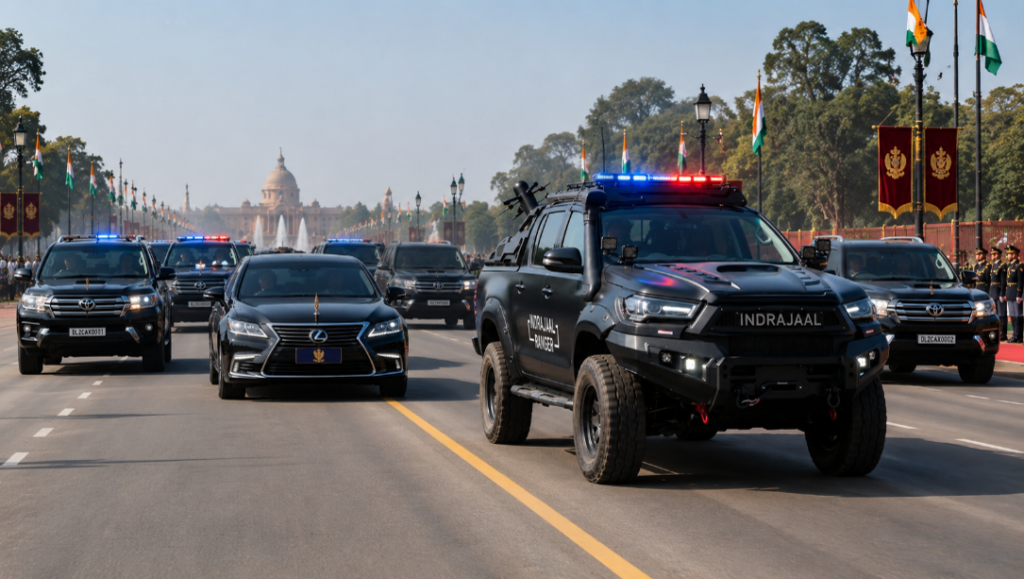
The Indrajaal Ranger™ answers that call. Where fixed-site counter-UAS systems have an undeniable role in protecting strategic installations, they cannot follow a moving convoy, attend a sudden mass gathering, or trail a fleeting route along a remote border. The Ranger’s promise is simple and revolutionary: take protection with you. Turn the sky into a patrolled domain in the same way roads and neighbourhoods have been patrolled for decades. India’s decision to deploy these vehicles — in border villages, along VVIP routes and on city streets — signals a decisive rethinking of how public security meets airborne threats.
A Homegrown, Purpose-Built Innovation
Indrajaal Autonomous Defense Systems, in partnership with Sigma Advanced Systems, has transformed concept into capability. The Ranger is India’s first purpose-built Anti-Drone Patrol Vehicle to receive ARDTC approval, and it has been operationally validated through government evaluations — a testament to its maturity, reliability, and mission readiness. Built around SkyOS™, an integrated operating environment that fuses sensors, AI-based tracking and identification, command-and-control, and layered countermeasures, Ranger is more than a kit bolted onto a vehicle. It is a self-contained, autonomous counter-UAS ecosystem engineered to function at speed and under realistic operational constraints.
Layered Protection: Detect, Deny, Defeat
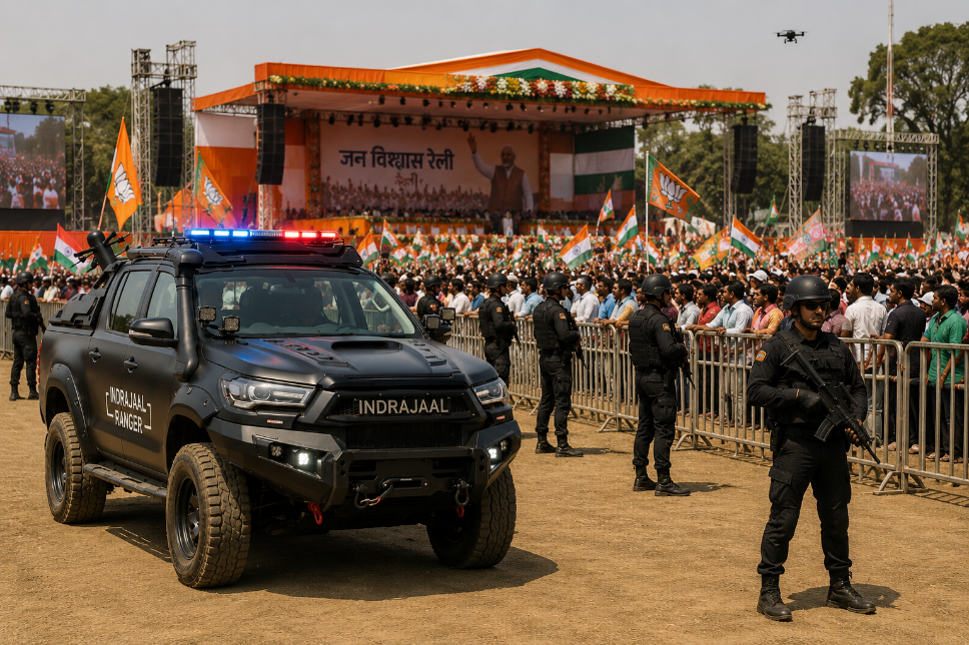
What sets the Ranger apart is its holistic approach to the problem of rogue drones. Rather than relying on a single technique, it brings together complementary methods to ensure flexibility and effectiveness across a range of scenarios:
– Retractor — Take Control: This capability enables secure takeover of a suspect drone, allowing authorities to recover the device intact for forensic analysis, evidence collection and investigation. In a world where attribution and evidence matter enormously, controlled capture is a game-changer.
– Lakshman Rekha — Keep Out: By establishing a virtual perimeter, the vehicle can deny entry to unauthorized aerial devices. This preventive layer preserves operational space around convoys, VVIP routes, critical infrastructure and public events without immediate kinetic engagement.
– Net Interceptor — Take Down: When electronic or control measures are insufficient, the Ranger can physically intercept and capture hostile drones, minimizing collateral risk and preserving public safety.
Together, these layers form a resilient defensive posture that adapts to mission needs — whether preventing a drug-laden quadcopter from crossing a border, safeguarding a VVIP motorcade, protecting a crowded festival, or guarding critical infrastructure that stretches for kilometres.
Operational Reach: Border Security, VVIP Protection, Urban Safety
The recent orders — ₹145 crore for border-security deployment and approximately ₹10 crore for urban police and VVIP protection — illustrate the versatility of Ranger deployments and the strategic breadth of India’s vision. Along the borders, Rangers will bolster surveillance and interdiction against cross-border smuggling and clandestine aerial reconnaissance. For cities and VVIP routes, they provide responsive tactical coverage for moving targets and ephemeral events. This dual deployment profile shows that counter-drone patrolling is not an abstract capability reserved for military bases; it is a practical, everyday public-safety function.
A Model for the World
While a number of countries have developed advanced counter-UAS technologies, India’s decision to institutionalize anti-drone patrolling as an enduring, government-scale capability is internationally trailblazing. Where other nations have often relied on episodic or private-sector interventions for urban counter-drone tasks, India is creating a state-operated, permanent layer of security that can be tasked across jurisdictions and missions. This is a powerful assertion of sovereignty over the low-altitude domain and an example that many nations are likely to study and emulate.
Technology Meets Doctrine: The Importance of Integration
The impact of the Ranger goes beyond hardware. Its success depends on integration into existing security doctrine, training of personnel, coordination across agencies, and legal frameworks that govern the use of force, privacy, and evidence collection. The adoption of SkyOS™, with its sensor fusion and AI-driven identification, promises to reduce false positives and speed decision-making in complex environments. The vehicle’s mobility eases logistical burdens: rather than repositioning static assets or relying on temporary measures, agencies can shift protective envelopes fluidly and responsively as threats evolve.
Human-Centered Security
It is important to emphasize that technology like the Ranger amplifies human judgment; it does not supplant it. Skilled operators, law enforcement professionals and commanders will decide when to engage each protective layer, and the controlled-capture capability preserves the evidentiary value of intercepted drones. The Ranger’s design reflects an understanding that public security requires lawful, proportionate and accountable responses. In the hands of trained operators, the vehicle becomes an enabler of safer public spaces, more secure borders and more resilient civic life.
Economic & Strategic Ripple Effects
Procurements of this scale do more than buy capabilities; they catalyze a domestic industrial ecosystem. The Indrajaal-Sigma orders support indigenous research and manufacturing, drive supply-chain development, and foster skilled employment in a strategically important tech sector. The visibility of a homegrown anti-drone platform enhances India’s defence-tech reputation and opens opportunities for exports, cooperation and standard-setting worldwide.
A Confident Step into a Safer Future
The deployment of Indrajaal Ranger™ vehicles across India’s borders and cities is a decisive statement: the nation intends to master the challenges of the low-altitude domain proactively rather than reactively. By making anti-drone patrolling a permanent, government-operated capability, India is not only protecting its citizens and critical assets — it is also shaping how modern states will maintain order and safety in an era of rapidly proliferating aerial technologies.
As these vehicles begin their patrols along border tracks, through rural hinterlands and down bustling urban avenues, they will become as familiar and reassuring as the police cars that have long kept watch over our streets. But their scope reaches higher — literally and figuratively. They herald a new era in which the sky is secured with the same tenacity and ingenuity with which nations have long secured the ground beneath their feet.
Drones have rewritten the rules of security, and India is answering with energy and ingenuity. Kiran Raju Penumacha of Indrajaal Autonomous Defence Systems captures the moment: Ukraine has shown the world what drones can do in war, and now that threat has spilt into everyday life. Borders, airports, cities, public events, critical infrastructure and VVIP movements all demand continuous protection of low-altitude airspace. The Indrajaal Ranger™—built for mobility and autonomy—puts counter-drone capability where the danger moves, making Counter-UAS not an occasional luxury but a permanent pillar of national safety.
Sunil Kalidindi of Sigma Advanced Systems highlights the wider achievement: this programme embodies India’s thriving defence manufacturing ecosystem. Advanced indigenous technologies are now being developed, produced, and fielded at operational scale, proving that Indian industry can meet complex national security needs. The partnership between Indrajaal and Sigma is a powerful example of how private enterprise and national vision combine to fortify borders and urban spaces with next-generation tools.
Globally, the shift is clear and urgent. Counter-UAS is no longer only a wartime requirement—recent large-scale operations and reactive policy moves after high-profile incidents show that governments must treat drone defence as everyday homeland security. India’s induction of the Indrajaal Ranger™ aligns with this global evolution and reinforces Atmanirbhar Bharat: homegrown technology and manufacturing rising to the challenge. Fast, adaptive and proudly indigenous, this is how nations can stay a step ahead of a rapidly changing aerial threat.
In embracing the Indrajaal Ranger™, India has taken a landmark step: converting advanced counter-UAS technologies into a serviceable, mobile public-good capability. The investment is a declaration of intent and capability — that India will protect its citizens, its leaders and its infrastructure with innovation, resolve and forward-looking public policy. The sky, once an unmonitored avenue for mischief and threat, will now be patrolled, defended and governed — and India has taken the lead.