Dr Anu Sharma

The outer space domain has been witnessing significant transformation in the 21st century. Space has increasingly become a contested arena of geopolitical competition, military modernisation, and technological rivalry. The growing dependence of modern armed forces on space-based assets for communication, navigation, intelligence gathering, surveillance, reconnaissance, and precision targeting has enhanced the importance of this domain as a critical component of national security. Further, strategic competition among major global powers like the United States, China, and Russia has accelerated the militarisation of space, creating a complex security environment in which emerging powers must reassess their capabilities and vulnerabilities. For India, with expanding strategic ambitions and growing security challenges, modifying its military space strategy has become an imperative rather than a choice.
India’s military space strategy is evolving due to rapid development of counter-space capabilities. While India traditionally emphasised the peaceful uses of outer space, the changing strategic environment has compelled New Delhi to acknowledge the military dimensions of space security. India tested its Anti-Satellite Weapon System (ASAT) in 2019, marking a watershed moment in India’s strategic thinking, signalling a shift from passive reliance on space assets to active consideration of space deterrence and defence. However, the challenge for India remains the development of a comprehensive military space strategy that integrates institutional reforms, technological innovation, resilience measures, and deterrence frameworks to safeguard its interests in an increasingly contested space environment.
Evolution of India’s Military Space Capabilities after the 2019 ASAT Test
The evolution of India’s military space capabilities has been gradual but significant. During the Cold War and the post-Cold War periods, India’s space program, led by the Indian Space Research Organisation (ISRO), was largely focused on civilian applications, including telecommunications, weather forecasting, disaster management, and socio-economic development. Many of these capabilities had dual-use applications. Military requirements were not the primary driver of India’s space endeavours.
With the emergence of China as a significant space power, the strategic environment changed. Beijing’s successful test of its ASAT weapons in 2007 demonstrated its ability to destroy satellites in low Earth orbit. This further highlighted the vulnerability of space assets to kinetic attacks. The test raised concerns among Indian strategic planners about the security implications of space warfare. China’s growing integration of space capabilities into military operations further underscored the need for India to strengthen its own military space architecture.
India’s response culminated in Mission Shakti in March 2019, when it successfully conducted an ASAT weapon test using a modified ballistic missile interceptor to destroy one of its own satellites in low Earth orbit. Through this test, India became the fourth country after the United States, Russia, and China to demonstrate an ASAT capability. India further signalled its entry into the exclusive group of states possessing counter-space technologies.
The significance of Mission Shakti continued beyond the technological achievement itself. Strategically, it served as a declaration that India recognised space as a potential domain of conflict and was prepared to develop capabilities necessary for deterrence. The test demonstrated India’s ability to threaten adversary satellites if required, thereby introducing an element of deterrence into its space strategy. It also reflected a broader shift in Indian strategic thinking from viewing space solely as a support domain to recognizing it as an operational and potentially contested warfighting environment. However, the ASAT test also highlighted important challenges. The creation of space debris raised concerns about the sustainability of the orbital environment. At the same time, the demonstration of kinetic capabilities alone did not address broader issues of space resilience, satellite protection, and command-and-control integration. So, the test represented not the culmination but the beginning of India’s effort to develop a comprehensive military space strategy.
The Defence Space Agency & Emerging Space Command Structures
Recognising the growing strategic importance of space, India has undertaken institutional reforms to enhance military space governance. One of the most significant developments has been the establishment of the Defence Space Agency (DSA) in 2019. The DSA is India’s first dedicated military organisation responsible for coordinating space-related activities in the armed forces. The agency was created to improve integration between the Army, Navy, and Air Force in the utilisation of space assets. Its responsibilities include developing military space doctrine, coordinating operational requirements, enhancing space situational awareness, and supporting the development of counter-space capabilities. The creation of the DSA further reflects India’s recognition that future military operations will increasingly depend on effective exploitation of the space domain. India also established the Defence Space Research Organisation (DSRO) to develop technologies for military space applications. The DSRO serves as a bridge between scientific research institutions and defence requirements, enabling the development of advanced capabilities, including electronic warfare systems, space surveillance technologies, and counter-space mechanisms. The future trajectory of India’s military space governance may entail establishing a dedicated Space Command. Such a command would consolidate operational planning, enhance inter-service coordination, and provide unified leadership for military space activities. As space becomes increasingly integrated into military operations, establishing a comprehensive command structure could significantly improve India’s ability to respond to emerging threats and exploit opportunities in the space domain.
Space as a Force Multiplier for ISR, Navigation, and Missile Targeting
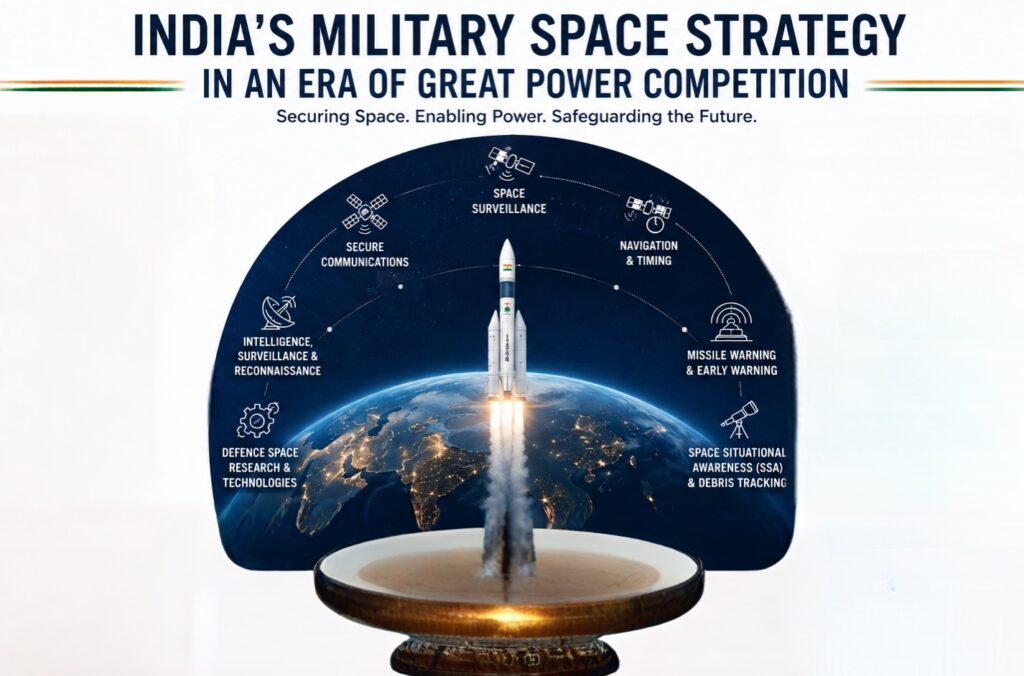
The importance of space in modern warfare stems from its role as a force multiplier. Space-based systems enhance the effectiveness of military operations by providing critical information and communication capabilities that support decision-making, situational awareness, and precision engagement. Intelligence, Surveillance, and Reconnaissance (ISR) capabilities constitute one of the most important military applications of space. Satellites equipped with optical, radar, and electronic sensors enable continuous monitoring of adversary activities across vast geographic areas. For India, ISR satellites play a crucial role in monitoring developments along its long borders, tracking military deployments, and supporting maritime domain awareness in the Indian Ocean Region. Navigation represents another critical function. India’s Navigation with Indian Constellation (NavIC) system provides independent positioning, navigation, and timing services, reducing reliance on foreign systems such as GPS. Military access to accurate navigation data enhances troop mobility, enables precision-guided munitions, and supports coordinated operations across multiple domains. Furthermore, space-based communications systems are also important. Modern military operations require secure, reliable, and uninterrupted communications among dispersed forces. Dedicated military satellites enhance command-and-control capabilities and facilitate real-time information sharing among operational units. Space assets also support precision targeting and missile operations. Satellite data contribute to target identification, trajectory calculation, and battle damage assessment. In an era characterised by long-range precision strike capabilities, access to accurate space-derived information significantly enhances military effectiveness. In this, the lessons of recent conflicts, including the Russia-Ukraine conflict and Operation Sindoor, have further demonstrated the decisive role of space-enabled capabilities in contemporary warfare. Commercial and military satellites have become integral to intelligence collection, battlefield awareness, and communications resilience. These developments underscore the necessity for India to expand and diversify its military space infrastructure.
India’s Quest for Space Deterrence and Resilience
As competition in space intensifies, deterrence and resilience become the central pillars of India’s military space strategy. Traditional notions of deterrence based on nuclear capabilities are increasingly being supplemented by considerations of space security. The idea is not necessarily to dominate the space domain but to prevent adversaries from exploiting vulnerabilities or achieving strategic advantages through attacks on space assets. In this context, India’s ASAT capability contributes to deterrence by signalling the ability to impose costs on adversaries. However, effective space deterrence requires more than offensive capabilities. It also depends on resilience, with the capacity to withstand, recover from, and adapt to disruptions. Building resilience involves several measures. India must diversify its satellite architecture by deploying larger constellations rather than relying on a limited number of high-value assets. Distributed constellations reduce vulnerability by ensuring that the loss of individual satellites does not cripple operational capabilities. Also, enhancing space situational awareness is essential. Improved tracking of objects in orbit enables early detection of potential threats and facilitates informed decision-making during crises. Investments in ground-based sensors, radar systems, and data-sharing arrangements can strengthen India’s ability to monitor the space environment. Another important aspect of this is cyber security, which must become an integral component of military space planning. As satellites increasingly depend on digital networks, they become vulnerable to cyber attacks that can disrupt operations without physical destruction. Protecting the command-and-control networks and satellite infrastructure therefore becomes more critical. Finally, partnerships with like-minded nations can contribute to resilience. Cooperation with the United States, France, Japan, and Australia in areas such as space situational awareness, satellite communications, and technology development can strengthen India’s capabilities while supporting broader strategic objectives.
Conclusion
India’s military space strategy is entering a phase where strategic adaptation will be as important as technological advancement. As space becomes increasingly intertwined with geopolitical competition, India must balance security imperatives with its long-standing commitment to the responsible use of outer space. The future of India’s space power will depend not only on acquiring capabilities but also on its ability to shape international norms, strengthen strategic partnerships, and contribute to a stable space order. In an environment marked by uncertainty and rapid technological change, India’s success will ultimately rest on integrating national security objectives with broader aspirations of strategic autonomy and global leadership in the space domain.
Dr Anu Sharma is an Assistant Professor at the Amity Institute of Defence and Strategic Studies (AIDSS), Amity University, Noida, with prior tenure as a Research Fellow at the Centre for Air Power Studies (CAPS), New Delhi. Her research focuses on the politics and international relations of Iran and the broader West Asian region, and she has published and presented numerous papers nationally and internationally. She authored the book Through the Looking Glass: Iran and its Foreign Relations (KW Publishers, 2020; co-published by Routledge, 2022).
*The views expressed are those of the author and do not represent the institution.