Cdr Rahul Verma (r)

“In modern war, the decisive blow may come not from the most advanced platform, but from the cheapest system the defender failed to prioritise.”
From Aramco to Epic Fury: The Evolution of a Strike Doctrine
To understand how Iran’s strike doctrine has matured, it is useful to trace its operational employment over time. What emerges is not a series of isolated attacks, but a clear progression from proof of concept to sustained campaign execution.
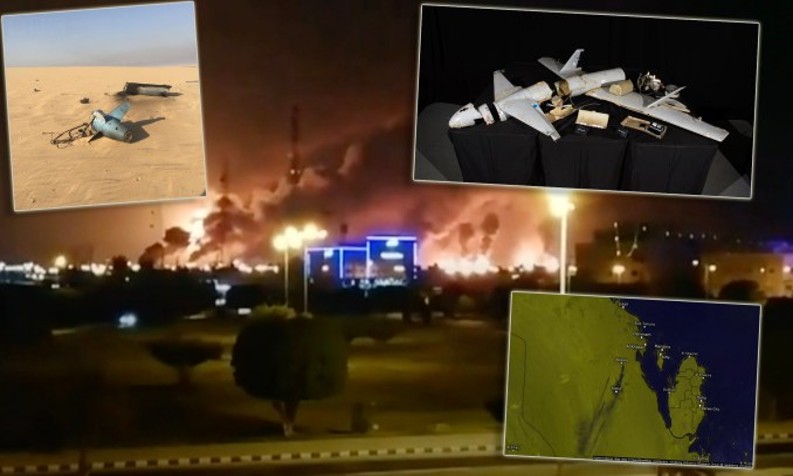
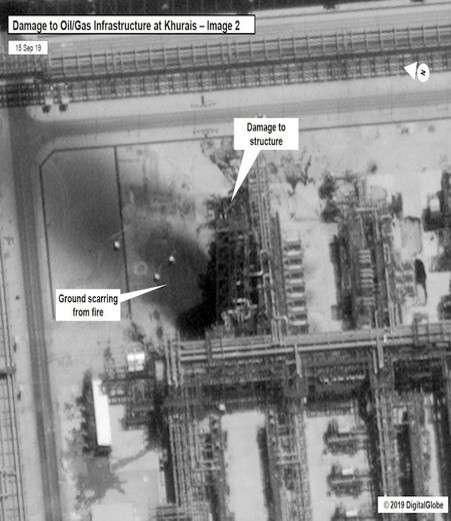
The September 2019 strike on Abqaiq and Khurais marked the first visible demonstration of this model. A coordinated mix of drones and cruise missiles penetrated Saudi air defences, temporarily disrupting nearly 5% of global oil supply. The lesson was not just about vulnerability, but about design, attack geometry, low-altitude ingress, and mixed-platform coordination.
In January 2020, the ballistic missile strike on Ayn al-Asad airbase in Iraq added another dimension. Unlike earlier perceptions of Iranian missile inaccuracy, the attack demonstrated improved precision against fixed military targets. It signalled a transition from symbolic retaliation to calibrated, infrastructure-focused strike capability.
By April 2024, Iran’s first direct strike on Israel revealed a more complex operational construct. A mixed salvo of approximately 170 one-way attack drones, 30 cruise missiles, and over 100 ballistic missiles was launched. The drones were largely intercepted, but their role was not necessarily to penetrate. They acted as decoys and saturation elements, forcing early defensive engagement and shaping the battlespace for follow-on threats.
The October 2024 strike marked a further evolution. Drones were notably reduced or absent, and the attack relied heavily on more advanced ballistic systems such as Fatah-1 and Kheibar Shekan. Reports suggested improved strike accuracy, with a higher proportion of missiles reaching intended aim points. This indicated doctrinal flexibility, the ability to adapt strike composition based on prior engagement outcomes.
By mid-2025, Iran demonstrated something more significant than strike capability campaign persistence. Over 12 days, more than 1,000 drones were deployed to maintain continuous pressure. Despite high interception rates, the operational objective was achieved: to strain defensive systems, consume interceptors, and impose psychological and logistical stress.
Equally important was Iran’s ability to reconstitute its inventory rapidly, announcing the addition of nearly 1,000 drones shortly after the campaign. This highlighted a critical dimension of modern warfare, industrial depth as a component of combat power. This evolutionary arc culminated in Operation Epic Fury in early 2026, which represents the most complete expression of Iran’s strike doctrine to date.
Within hours of the opening strikes, Iran launched over 2,000 one-way attack drones and approximately 500 ballistic missiles across a wide geographic arc and distributed theatre of operations. Targets included US and allied military installations in Qatar, Kuwait, Bahrain, and the UAE, as well as critical energy infrastructure such as LNG facilities and port complexes.
From an operational standpoint, this was not a single strike event. It was a multi-theatre sustained-pressure campaign.
Drone launch rates peaked at several hundred per day, creating continuous engagement demands on coalition air defence systems. The objective was not necessarily catastrophic destruction at each target, but persistent disruption across geography and time. Energy infrastructure was targeted not just for physical damage, but for its second-order effects on global markets.
What Epic Fury confirmed clearly and unambiguously is the role of drones as a forcing function in modern warfare.
Even under sustained counter-strikes, including thousands of coalition air sorties and the destruction of hundreds of drone-related facilities, the threat was not eliminated. Intelligence assessments suggested that a significant proportion of missile launchers remained intact, and thousands of drones were still available at the time of the ceasefire.
This is the critical insight.
| THE OPERATIONAL ARC: FROM ABQAIQ TO EPIC FURY | |
| Sep 2019 | Aramco (Abqaiq/Khurais): 18 drones + 7 cruise missiles penetrate Saudi Patriot coverage; 5% of global oil supply disrupted overnight. |
| Jan 2020 | Ayn al-Asad, Iraq: SRBM salvo hits point targets with precision; 100+ US troops sustain traumatic brain injuries. |
| Apr 2024 | First direct Israel attack: 170 Shaheds + 30 cruise missiles + 130 MRBMs. Drones absorbed as interceptor decoys; MRBM success rate low. |
| Oct 2024 | Second Israel attack: Drones dropped entirely. 200 advanced Fatah-1/Kheibar Shekan MRBMs; ~50% strike on-target aim points. |
| Jun 2025 | 12-Day War: 1,084 drones sustain 12-day pressure campaign; 99% intercepted but interceptor stocks strained; 31 killed in Israel. |
| Jan 2026 | Fleet reconstitution: Iran announces addition of 1,000 new drones — replacing nearly all those expended in the 12-Day War. |
| 28 Feb 2026 | Operation Epic Fury begins. Iran immediately launches 2,000+ drones and 500+ ballistic missiles against Israel and US bases in 9 countries. |
| Mar 2026 | Sustained drone campaign: Shahed strikes hit Bahrain (US 5th Fleet radar), Kuwait (6 US KIA at Port Shuaiba), Qatar (Ras Laffan LNG), UAE, Saudi Arabia. Strait of Hormuz closed. |
| Apr 2026 | Ceasefire (2-week): After 38 days, 13,000 coalition targets struck. US intel: ~50% of Iran’s missile launchers intact; thousands of Shahed drones remaining. |
The effectiveness of Iran’s strike model does not lie in any single wave of attack. It lies in its ability to absorb punishment, regenerate capability, and continue imposing cost over time.
From a doctrinal perspective, this represents a shift from “strike and signal” to “strike, sustain, and stretch the defender.”
For modern militaries, this evolution carries a clear warning. The challenge is no longer limited to intercepting a single, well-defined threat. It is about managing a continuous, adaptive, and economically asymmetric attack cycle.
That is the real legacy of Aramco, and the operational reality demonstrated by Epic Fury.
Missiles: Survivability Over Sophistication
The significance of Iran’s missile force lies less in its size and more in its structure, survivability, and increasing precision.
A key evolution has been the shift toward solid-propellant systems, enhanced mobility, and dispersed launch platforms. These changes improve survivability and enable repeated salvo-based operations under pressure.
From a practitioner’s standpoint, survivability is the centre of gravity. A missile that survives to launch is strategically more relevant than one with marginally better range or payload but vulnerable basing. Iran appears to have understood this trade-off clearly.
Equally important is accuracy. Improvements in guidance systems have transformed Iranian missiles from area-denial tools into instruments capable of targeting specific infrastructure, fuel depots, radar sites, logistics nodes, and command centres.
This combination of survivability, precision, and volume creates something more than deterrence. It enables a sustained strike capability that can influence both battlefield outcomes and escalation dynamics.
Cruise missiles add a complementary challenge. Their low-altitude profiles and radar-masking characteristics compress detection timelines and complicate engagement, particularly when layered into mixed-salvo attacks.
Drones & the Emergence of the Kill-Web
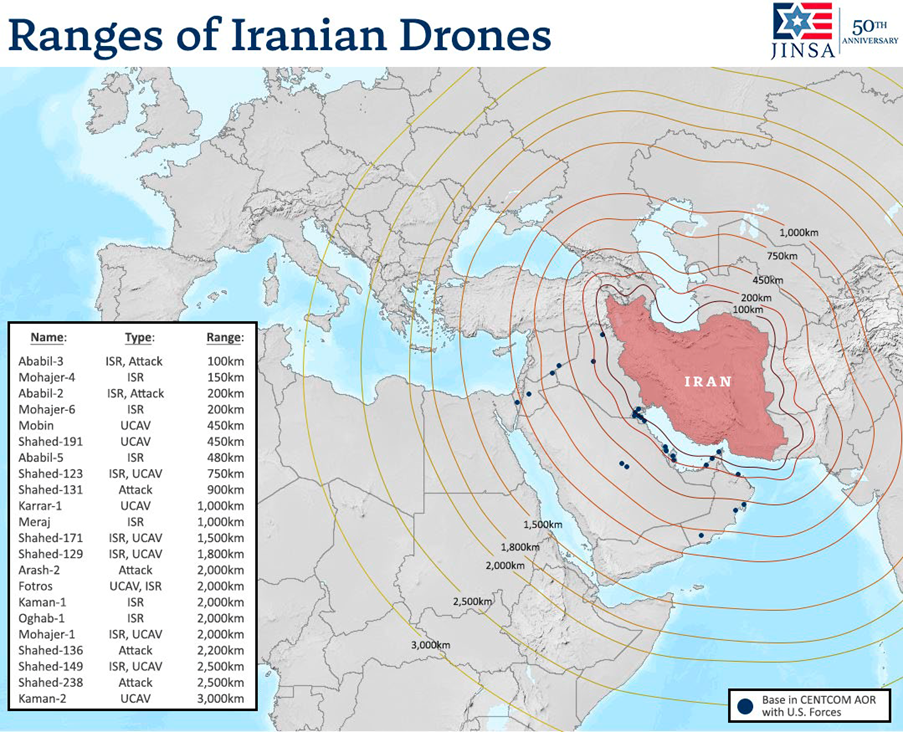
If missiles provide reach and shock, drones provide flexibility, persistence, and scale. In Iran’s case, they have become the operational equaliser.
The Shahed-136 represents the logic of attritable warfare. It is low-cost, long-range, and expendable. Its effectiveness lies not in sophistication, but in economic imbalance. Intercepting such systems often requires weapons that are significantly more expensive than the threat itself.
From an operator’s perspective, drones do not need to penetrate every layer of defence to be effective; they only need to force the defender into repeated, time-critical, and expensive decisions.
What stands out, however, is not the platform but the integration logic.
ISR drones cue strike assets. Loitering munitions exploit gaps. Decoys manipulate radar behaviour. Follow-on systems assess damage. This is not drone warfare in isolation; it is the early form of a distributed kill-web, operating without the technological sophistication typically associated with Western systems, but achieving many of the same operational effects.
That is where the real shift lies.
Saturation: The Battle for Decision Superiority
The defining feature of Iran’s strike model is saturation.
A coordinated salvo involving ballistic missiles, cruise missiles, and drones creates multiple simultaneous engagement problems. Each system behaves differently, arrives from different vectors, and demands a distinct defensive response.
The defender must detect, classify, prioritise, and engage under severe time pressure while preserving interceptor stocks and maintaining command-and-control coherence.
This creates not only tactical strain but also cognitive overload.
Which threats are real? Which are decoys? Which demands immediate engagement? How many interceptors can be expended before stocks are exhausted?
The attacker does not need to destroy the defence outright. It only needs to overload it and, in doing so, shift the contest from technological superiority to decision-making endurance. In modern warfare, the side that spends more per interception than the attacker spends per strike is already losing the economic battle.
Proxy Warfare & the Geometry of Ambiguity
Iran’s strike architecture becomes significantly more potent when combined with proxy networks.
Forward-based launch points reduce warning time and alter attack geometry. Attribution becomes more complex, even when system lineage is evident. Political thresholds for retaliation are blurred.
For conventional militaries, this creates an uncomfortable operational space. We are structured for clarity, identification, attribution, and response. Proxy-enabled warfare deliberately operates below that clarity, forcing hesitation where speed is required.
This enables a model of distributed, persistent pressure in which strikes can occur across multiple theatres without exposing Iranian forces directly.
Strategically, Iran has not only built an arsenal. It has exported a method of war.
Building Relevance Under Constraint
One of the most instructive aspects of Iran’s military evolution is that it has occurred under sustained sanctions.
Restricted access to high-end systems did not prevent capability development. It redirected it and, in some areas, made it more operationally relevant.
There is a tendency in advanced militaries to equate sophistication with effectiveness. Iran’s model challenges that assumption. In several cases, “good enough and available in numbers” may outperform “high-end but scarce.”
In missiles and drones, effectiveness is determined less by elegance and more by survivability, scale, and doctrinal integration.
Iran has aligned all three.
Why This Matters for India
India is not party to the 2026 Iran war, but Operation Epic Fury has crystallised in live operational data, exactly the threat environment India must prepare for across its own frontiers. Adversaries with access to Iranian and Chinese drone technology through documented transfer channels can replicate this operational model. The lessons are now empirical, not theoretical.
For India, the implications are not academic; they are immediate and operational. Our strategic geography includes western seaboard refineries, naval bases, ports, airfields, and industrial corridors spread across a vast and economically dense landscape. These are not easily defended through point-defence models alone.
As someone who has operated at sea and understands the vulnerability of fixed assets, I am concerned about a single high-end strike. It is sustained disruption. A coordinated combination of drones, cruise missiles, and proxy-launched systems could impose significant stress on even layered defences if employed intelligently.
India’s counter-UAS architecture must be designed as a unified kill chain from sensor to effector, with a shared data layer, an integrated autonomy stack and tiered engagement, rather than as independently procured platform programmes. Epic Fury showed that even well-equipped US forces faced simultaneous multi-country drone pressure at the edge of their C2 capacity. India’s C-UAS must be built for that tempo, not for the single-salvo scenario. We must be careful not to fight the next war with the comfort of legacy thinking. Investing disproportionately in high-end interceptors without matching investment in counter-UAS grids, electronic warfare, deception, and resilience will create a structurally imbalanced defence posture.
In practical terms, India must move from a point-defence mindset to a distributed survivability architecture.
The question is no longer “Can we intercept?”
It is “Can we endure?”
Indigenisation of drone production is a deterrence imperative. Iran’s industrial base, even after 13,000 coalition strikes against it, retained enough inventory to sustain 38 days of multi-theatre operations. That is what domestic production depth delivers and it cannot be replicated by import dependency.
Aatmanirbhar Bharat must be pursued as a spiral development model—where capability evolves from prototype to certified system through sustained investment and patience capital.
Conclusion: From the Flight Deck
From the flight deck, the lesson is clear.
Iran has not built the most sophisticated arsenal in the region, but it has built one of the most operationally coherent. It understands that modern warfare is no longer decided solely by platform superiority but by the ability to indigenise products, integrate systems, sustain pressure, and impose asymmetric costs.
The next decisive strike will not necessarily come from a fifth-generation aircraft or a singular high-end weapon. It is more likely to emerge from a coordinated wave of low-cost systems, drones, cruise missiles, and proxies, designed to stress the defender until failure.
That is the uncomfortable truth.
And the sooner we internalise it, the better prepared we will be.
Cdr Rahul Verma (r), former Cdr (TDAC) at the Indian Navy, boasts 21 years as a Naval Aviator with diverse aircraft experience. Seaking Pilot, RPAS Flying Instructor, and more, his core competencies span Product and Innovation Management, Aerospace Law, UAS, and Flight Safety. The author is an Emerging Technology and Prioritization Scout for a leading Indian Multi-National Corporation, focusing on advancing force modernization through innovative technological applications and operational concepts. Holding an MBA and Professional certificates from institutions such as Olin Business School, NALSAR, AXELOS, and IIFT, he’s passionate about contributing to discussions on aviation, unmanned technology, and policy. Through writing for various platforms, he aims to leverage his domain knowledge to propel unmanned and autonomous systems and create value for Aatmannirbhar Bharat and the Indian Aviation industry.