
Dr. Anu Sharma

Grey-zone warfare and hybrid threats have emerged as the most consequential security challenge confronting the Indian Army because they exploit the ambiguous space between peace and war. In this domain, coercion is real, often politically motivated, yet deliberately calibrated to remain below the threshold that would justify large-scale conventional retribution. For India, the grey zone is not a theoretical concept, but an operational reality shaped by cross-border terrorism, drone-enabled infiltration support, cyber intrusions, disinformation and misinformation campaigns, and non-kinetic pressure along the contested frontiers. The complexity of grey zone operations has been clearly acknowledged and the need for doctrinal adaptation to counter hybrid strategies employed by both state and non-state adversaries has also been highlighted in the past few years. This kind of threat environment can best be understood as a layered ecosystem, amplified by our adversaries on the northern and western frontiers. In the past, such threats were managed through conventional mechanisms; however, the enabling architecture surrounding this proxy model has changed. Low-cost drones and unmanned systems are now being utilised for reconnaissance, probing security gaps, and related activities—activities designed to be deniable. Such actions impose continuous tactical pressure while testing India’s escalation calculus, exemplifying a classic case of grey zone coercion. These tactics are complemented by cyber and information instruments aimed at shaping perceptions, slowing decision-making, and constraining political responses. In this context, the challenge for the Indian Army is not simply territorial defence but also managing a prolonged contest over signalling, surveillance, and narrative control in a high-altitude, high-stakes environment. This evolving threat matrix has led the Indian Army to rethink deterrence beyond conventional force postures and kinetic retaliation. Official military assessments have increasingly recognised that grey-zone challenges demand multi-domain preparedness, integrating cyber resilience, information dominance, and intelligence fusion with traditional land warfare capabilities.
The Indian government’s articulation of integrated theatre commands and the release of joint doctrines on cyberspace and information operations reflect this shift toward institutionalising responses to hybrid threats. Moreover, repeated incidents along the Line of Control (LoC) and the Line of Actual Control (LAC) indicate that ambiguity, persistence, and deniability define the operational logic of contemporary coercion, placing sustained pressure on India’s military decision-making frameworks.
The Indian Army’s Adaptation to Grey-Zone Warfare
In response to this evolving threat perception, the Indian Army’s posture is shifting its primary emphasis from conventional land warfare towards a multi-domain, intelligence-intensive, and technology-enabled approach. Cyber warfare and information warfare impacts are increasingly treated as integral components of deterrence and battlefield advantage rather than as ancillary capabilities. This shift reflects recognition that grey zone campaigns aim to disorient decision-making and erode political will rather than achieve rapid battlefield successes.
A central element of this change is the institutionalisation of cyber ability. India’s release of a Joint Doctrine for Cyberspace Operations in 2025 reflects an effort to integrate offensive and defensive cyber tools across the services, emphasising resilience, real-time intelligence integration, and coordinated operations. In this context, the Defence Cyber Agency plays a key role in this architecture, reinforcing the understanding that cyber defence cannot be compartmentalised. Land operations depend on secure networks, protected data flows, and resilient communications. Essentially, cyber capabilities provide non-kinetic response options that are significant in grey-zone warfare scenarios without triggering military escalation.
Information warfare and narrative building form the other critical pillar of this threat perception. Adversaries employ disinformation, manipulated media, and psychological operations to polarise societies, undermine trust in institutions, and impose reputational costs often synchronised with disasters. Indian military leadership has accentuated the need for “hybrid warriors,” including personnel capable of operating in the information domain. This has translated into greater emphasis on prompt, factual communication, counter-disinformation practices, tighter operational security, and integrated operational planning and information outcomes.
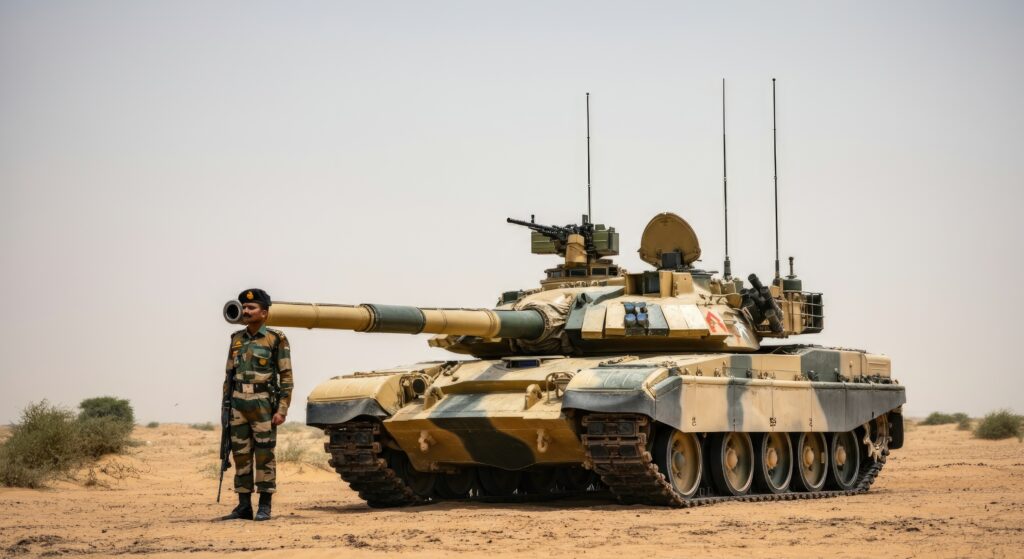
At the tactical level, technological absorption has become fundamental to denying adversaries advantages in the grey zone. The Army’s growing focus on counter-UAS measures, electronic warfare, and sensor fusion reflects an understanding that hybrid threats are often established as persistent, often subtle battles. Technology-enabled surveillance grids, including layered sensors and automated systems along the LoC, are designed to deny adversaries low-cost, low-risk infiltration routes and coercion. These systems focus on constant monitoring and quick response rather than force projection. Building on these operational shifts, the Indian Army’s adaptation to grey zone warfare also includes deeper institutional and doctrinal changes aimed at improving joint and interoperability in ambiguous situations. The emphasis on multi-domain operations reflects an understanding that the land, air, cyber, space-enabled intelligence, and information domains cannot be treated as separate or compartmentalised. Grey zone threats compress timelines and reduce attribution, requiring faster sensor-to-shooter loops, decentralised command structures, and greater autonomy at lower levels of command. As a result, training and professional military education are increasingly oriented towards preparing leaders for contested, information-saturated circumstances in which tactical actions can have strategic and political consequences.
Another important dimension of adaptation lies in intelligence integration and inter-agency coordination. There is a very thin line of difference between external aggression and internal security challenges in grey zone warfare, making coordination with intelligence agencies, paramilitary forces, and civilian authorities essential. The Indian Army’s approach increasingly prioritises intelligence fusion, that is, combining technical intelligence, human intelligence, cyber indicators, and open-source information to enable early warning and rapid acknowledgement. This focus on attribution is critical, as the ability to credibly identify the source of hostile actions underpins both deterrence and escalation control in ambiguous conflict settings.
Indian Army’s evolving posture reflects an acknowledgement that deterrence in the grey zone is cumulative rather than episodic. Success is measured less by decisive victories and more by the sustained denial of adversary objectives. By using cyber and information capabilities jointly, enhancing surveillance and counter-UAS measures, and investing in institutional resilience, the Indian Army is seeking to raise the cost, reduce the effectiveness, and limit the political impact of hybrid coercion—thereby reshaping the strategic calculus of adversaries operating below the threshold of war.
Deterrence, Escalation Management, and Strategic Implications
The defining challenge of grey zone warfare is that it is fundamentally a contest of thresholds and credibility. Adversaries seek to keep each action small enough to make retaliation appear disproportionate, while cumulatively imposing strategic cost. The Indian Army’s evolving approach, therefore, focuses on preventing accumulation by detecting micro-incursions early, building resilience against cyber disruption, denying proxy networks operational space, and controlling narrative fallout so that coercion does not translate into political paralysis. Deterrence in this environment requires a diversified set of measures. Precision remains important but must be supported by non-kinetic tools such as cyber, information, financial, and diplomatic measures. Recent Indian counterterrorism actions reflect this calibrated approach—firm yet measured, designed to impose pressure while managing escalation risks.
However, there remain significant constraints. Building cyber and information capabilities remains capacity-intensive, and competition with the private sector for skilled personnel is structural. Doctrinal integration across services and civilian agencies is challenging because hybrid threats cut across traditional jurisdictional boundaries, particularly in areas such as cyber defence of critical infrastructure. Moreover, adversaries benefit from this deniability and speed. False narratives can spread faster than official verification, and low-cost technologies like drones can be deployed repeatedly at minimal risk.
The Indian Army’s role in the geopolitics of grey zone warfare has expanded from guarding borders to managing an ecosystem of coercion that blends proxy violence, cyber intrusion, disinformation, and non-kinetic signalling. Its adaptation is visible in joint cyber doctrine, counter-UAS integration, surveillance grids, and growing competence in the information domain. There is a deeper strategic shift that is clear, wherein deterrence today is more about persistent denial, rapid attribution, calibrated multi-domain responses, and narrative control, which ensures that ambiguity does not translate into strategic disadvantage.
Conclusion
Grey zone warfare and hybrid threats now constitute a persistent and structurally embedded challenge for the Indian Army, rather than a temporary or episodic security concern. By operating below the threshold of open war, adversaries exploit ambiguity, deniability, and persistence to impose cumulative strategic pressure on India’s military decision-making, political resolve, and internal security environment. In this context, the Indian Army’s traditional strengths in conventional land warfare, while still necessary, need to be supported by deterring or neutralising such forms of coercion. The Indian Army has shifted towards a multi-domain approach that fuses cyber, information, intelligence, and advanced technologies with conventional forces. Institutional cyber frameworks and a greater focus on information operations reflect recognition that resilience, narrative control, and legitimacy are critical to deterrence and the management of escalation in grey-zone conflicts. At the tactical and operational levels, investments in counter-UAS systems, sensor fusion, and technology-enabled surveillance grids indicate a deliberate effort to deny adversaries the low-cost, low-risk avenues that enable grey-zone tactics. These measures prioritise early detection, rapid attribution, and sustained denial over the dramatic application of force, aligning military practice with the logic of cumulative deterrence. At the institutional level, improved intelligence integration, inter-agency coordination, and reforms in training and professional military education reflect an understanding that hybrid threats cut across traditional military–civilian boundaries and demand coordinated responses. Overall, the Indian Army’s evolving posture signals a clear strategic recalibration, in which deterrence in the grey zone is no longer defined by episodic retaliation but by persistent resilience, proportional multi-domain responses, and control over escalation dynamics. While constraints remain, however, there is a deliberate shift toward managing, rather than merely reacting to, the complex geopolitics of hybrid conflict along India’s contested frontiers.
Dr. Anu Sharma is an Assistant Professor at the Amity Institute of Defence and Strategic Studies (AIDSS), Amity University, Noida, with prior tenure as a Research Fellow at the Centre for Air Power Studies (CAPS), New Delhi. Her research focuses on the politics and international relations of Iran and the broader West Asian region, and she has published and presented numerous papers nationally and internationally. She authored the book Through the Looking Glass: Iran and its Foreign Relations (KW Publishers, 2020; co-published by Routledge, 2022).