Lt Col Narendra Tripathi (r)

As the Indian Army commemorates Army Day 2026, it does so at a pivotal moment in history, one where the character of warfare is undergoing a fundamental shift. Modern conflicts are no longer defined solely by massed formations, physical contact, or linear battlefields. Instead, they are shaped by information dominance, precision, autonomy, speed of decision-making, and the seamless integration of technology across domains.
For a nation aspiring to be among the world’s leading economic and strategic powers, the Indian Army’s role as the principal guarantor of sovereignty, stability, and deterrence has never been more critical. The scale and complexity of emerging threats demand not only courage and discipline, longstanding hallmarks of the Army, but also a deeply technology-enabled force structure capable of operating in contested, data-saturated, and multi-domain environments. Army Day 2026 is therefore not only a celebration of service and sacrifice; it is an opportunity to reflect on how technology is being engineered into readiness, ensuring that the Indian Army remains decisive in the wars of tomorrow.
The Changing Nature of Warfare: Lessons from Contemporary Conflicts
Recent global conflicts, from Eastern Europe to West Asia, have clearly demonstrated that modern warfare is increasingly decided before the first physical engagement, with drones, electronic warfare, cyber operations, precision fires, and real-time intelligence fusion shaping the battlefield in advance of troop contact. Non-contact warfare, characterised by stand-off engagements, autonomous systems, and algorithm-driven targeting, has become the operational norm, where numerical superiority alone is no longer decisive; instead, victory belongs to the force that can sense first, decide faster, and act with precision, thereby compressing the OODA loop. India’s own operational experiences, including Operation Sindoor, and the induction of systems such as the Integrated Drone Detection and Interdiction System (IDD&IS) and SAKSHAM/TRINETRA counter-UAS and situational awareness frameworks, reflect this shift in thinking, highlighting the importance of credible, scalable, and technology-backed capabilities that provide commanders with operational flexibility while retaining strategic and political control. These developments form the essential backdrop against which the Indian Army’s ongoing modernisation and technology absorption efforts must be understood.
Government Enablement and Strategic Alignment
The Indian Army’s technology-driven evolution has been significantly propelled by policy and structural reforms, including increased capital allocations, simplified procurement pathways, emergency acquisition mechanisms, and a strong focus on indigenous development under initiatives such as Atmanirbhar Bharat. This has accelerated capability induction and shifted the emphasis from platform-centric procurement to capability-centric development, treating technology as a core enabler of operational effectiveness rather than an adjunct. Recent advancements illustrate this change: the Army’s induction of indigenous loitering munitions such as the Nagastra-1R and other kamikaze drones after Operation Sindoor reflects a move towards modern strike and ISR capabilities; large-scale upgrades of systems like the Pinaka rocket system enhance precision and range; Army collaborations with academic institutions like IITs, Delhi Technological University (DTU) to train personnel in AI, robotics, and cyber domains strengthen human–technology integration; and the emergence of robotic mules and autonomous support platforms showcased during Army Day displays highlight robotics adoption for field logistics and surveillance. These examples demonstrate how innovation challenges, startup participation, and domestic industry partnerships are creating pathways for the faster absorption of emerging technologies across unmanned systems, AI, secure communications, and logistics automation, aligning national strategy with military operational requirements.
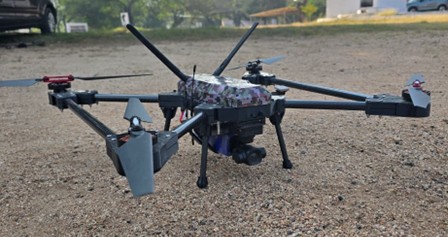
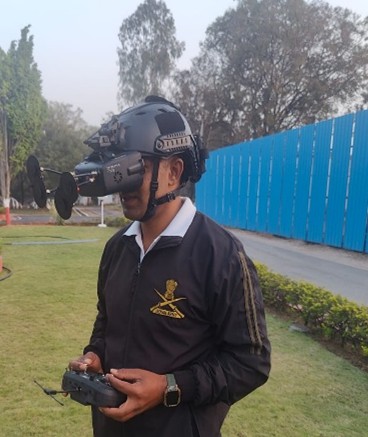
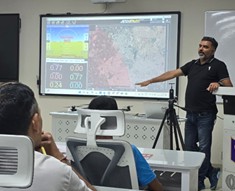
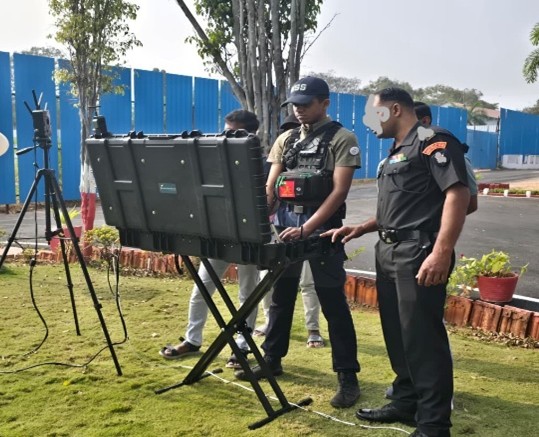
Training by Industry partners on new age Drone systems to Soldiers, Pic Courtesy: Zenerative Minds, Hyderabad
Unmanned and Autonomous Systems: From Assets to Ecosystems
Unmanned Aerial Systems (UAS) have emerged as one of the most visible and consequential technologies reshaping land warfare. What began as isolated platforms for intelligence, surveillance, and reconnaissance has evolved into multi-role operational enablers that support surveillance, targeting, logistics, training and evaluation, and force protection. The Indian Army has significantly expanded its unmanned inventory with a strong emphasis on indigenous platforms tailored for Indian operational environments. However, global operational experience has clearly demonstrated that battlefield advantage is not derived merely from the number of drones fielded, but from how effectively they are integrated, coordinated, and operationally exploited.
As drone density increases in the Tactical Battle Area (TBA), a key challenge has emerged: multiple drones operated by multiple users via OEM-specific control stations, leading to fragmented situational awareness. While such systems are effective at the local level, they restrict real-time information flow to higher commanders, slow decision-making, and limit synergised employment. Beyond swarm concepts, the urgent requirement today is integrated drone networking, where all drones operating in the TBA, tethered and untethered, feed centralised, synchronised data and live video into an integrated command-and-control centre. By presenting this information on a single, unified screen, supported by AI-assisted analysis and real-time dissemination, commanders at rear and higher echelons gain a faster, clearer understanding of the battlefield, thereby compressing the OODA loop and significantly enhancing operational efficiency.
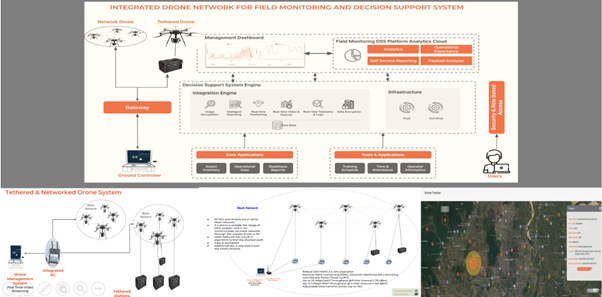
Integrated Drone network for field monitoring and decision support system, Pic Courtesy: Axldrone, Kochin
Artificial Intelligence: From Automation to Decision Support
Artificial Intelligence is often spoken about in conceptual terms, but its military value is fundamentally practical and operational. At its core, AI enables the rapid extraction of patterns, insights, and actionable intelligence from vast volumes of data, far beyond what human staff can process under time-sensitive operational conditions. Within the Indian Army, AI is already being applied in areas such as sensor data fusion, target recognition, predictive maintenance, and counter-UAS operations, where algorithms assist operators by filtering noise, prioritising inputs, and supporting faster decisions. However, the next major inflection point lies in adopting Generative AI (GenAI) as a comprehensive decision-support and knowledge-management tool rather than a narrowly embedded capability.
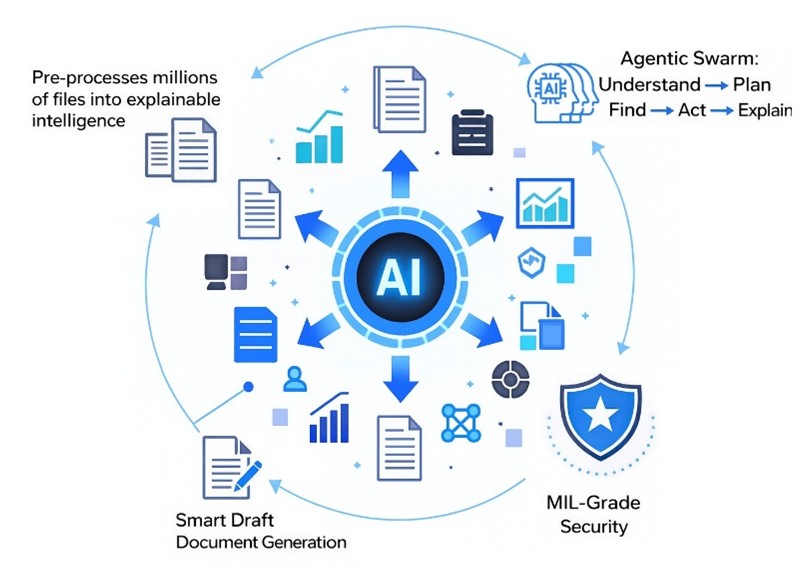
Gen AI is the future of data-centric warfare. Pic Courtesy: Zenerative Minds
When deployed as a secure, sovereign, on-premise capability, Generative AI can function as an intelligent staff assistant, able to understand natural-language queries and synthesise insights from operational databases, SOPs, technical manuals, intelligence summaries, and historical records. Such systems can automatically generate mission briefs, comparative operational analyses, logistics forecasts, and training assessments—significantly compressing planning cycles and reducing cognitive load on commanders and staff. A relevant example is TATHYA, developed and deployed by Zenerative Minds as a Mil-grade knowledge management and decision-support system capable of preprocessing millions of files into explainable intelligence. TATHYA incorporates an agentic swarm AI architecture that can understand, plan, find, act, and explain, along with smart RAG/RAFT-based generation to ensure accurate, context-aware outputs. In parallel, Zenerative Minds is the winner of the iDEX challenge for the Samvaad AI project for the Indian Navy, further demonstrating how GenAI, when designed for secure on-premises deployment, can be transformed into a trusted operational tool that ensures data sovereignty while enhancing judgment and situational awareness. Properly implemented, such GenAI systems have the potential to become powerful force multipliers at staff and command levels, augmenting human decision-making rather than replacing it.
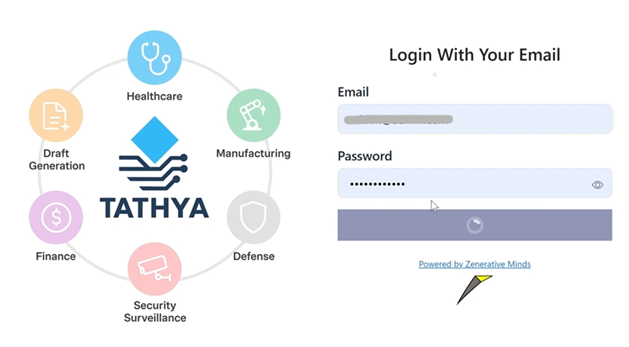
Tathya Gen AI system designed for Mil grade on-prem deployment, Pic Courtesy: Zenerative Minds, Hyderabad
Network-Centric Operations: The Digital Backbone of Combat
The effectiveness of drones, AI, and autonomous systems ultimately rests on the resilience and adaptability of the underlying communication networks, as modern operations require seamless connectivity between sensors, shooters, and decision-makers even in contested electromagnetic environments. Recent inductions of software-defined radios, tactical communication systems, and network-enabled battlefield management solutions have marked a decisive shift towards network-centric warfare, providing secure, interoperable, and upgradeable digital backbones that can evolve with emerging threats. Equally significant is the Army’s move towards integrated, single-pane-of-glass command interfaces, where live video feeds, telemetry, logistics status, and intelligence inputs are fused and displayed coherently on a unified screen, rather than across multiple isolated consoles. Such integration enables commanders to rapidly assimilate information, make timely decisions, and maintain operational tempo, underscoring the reality that in future conflicts, network clarity and information flow will be as decisive as firepower itself.
Electronic Warfare, Cyber, and Space: Invisible Domains, Visible Impact
Future conflicts will be contested as intensely in the electromagnetic spectrum and cyberspace as on physical terrain, with recent operational experiences demonstrating that dominance in these invisible domains can decisively shape ground outcomes. The widespread use of drones, sensors, and networked systems has made electronic warfare (EW) indispensable—not only to disrupt and deny adversary surveillance and communications, but equally to protect friendly forces and networks from jamming, spoofing, and cyber intrusion. On the ground, this is reflected in the deployment of indigenous counter-UAS grids, lightweight radars, electronic surveillance assets, and layered soft-kill and hard-kill responses around forward areas and critical installations, ensuring that hostile aerial threats are detected, classified, and neutralised before they can influence operations. At the same time, cyber resilience and space-enabled ISR, including satellite-based communications and imagery, provide commanders with beyond-line-of-sight awareness and secure connectivity across dispersed formations. The operational challenge for the Indian Army lies in seamlessly integrating EW, cyber, and space inputs with conventional manoeuvre and fires, so that information from these domains is delivered as actionable, real-time inputs at the tactical edge, directly supporting soldiers and junior commanders in field headquarters.
Robotics and Human–Machine Teaming
Robotics adoption within the Indian Army has been deliberate, pragmatic, and mission-driven, with emphasis placed on applications that deliver immediate operational value rather than autonomy for its own sake. Capabilities such as explosive ordnance disposal robots, surveillance systems, logistics support platforms, weapon-locating radars, autonomous sensors, and trials of wheeled and tracked unmanned ground vehicles demonstrate how robotics can significantly reduce risk to personnel while improving responsiveness and operational reach. The evolving concept of human–machine teaming recognises that machines excel in endurance, speed, and pattern recognition, while humans retain judgment, ethics, and command authority, ensuring that technology augments, rather than replaces, the soldier.
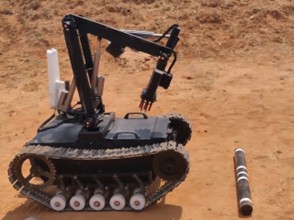
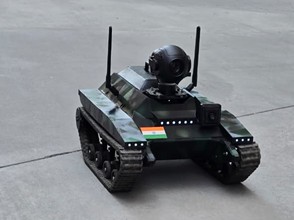
Tracked robotic platforms for ordnance disposal/Payload carriage/surveillance, designed by Lt Col Narendra Tripathi (r)
In addition to conventional UGVs, there is a growing operational need to incorporate indigenous legged robotic systems, including robotic dogs, particularly for reconnaissance, surveillance, perimeter security, urban operations, and difficult terrain where wheeled or tracked platforms face limitations. While a limited number of off-the-shelf robotic dog systems have already been inducted for specific roles, the greater strategic value lies in developing and owning the indigenous blueprints and core technologies of such systems. This approach would enable scalable production, role-specific customisation, and adaptation to India’s diverse terrains and operational requirements, ranging from urban and jungle environments to high-altitude and border areas, thereby transforming robotic dogs from niche imports into a sustainable, nationally controlled capability embedded within the Army’s broader robotics and human–machine teaming framework.
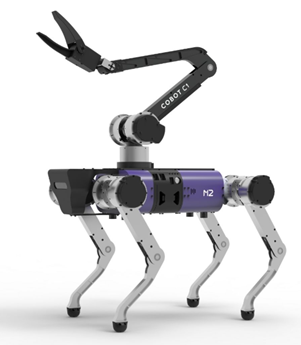
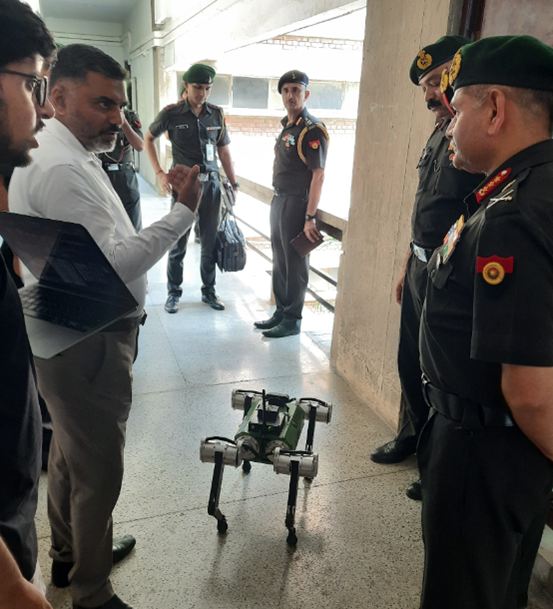
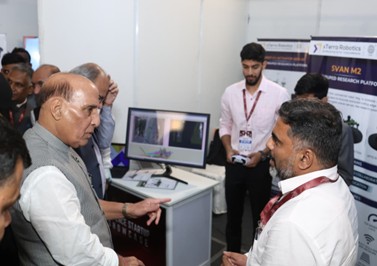
Indigenously developed quadruped robotic systems briefed to the Chief of the Army Staff, Gen Upendra Dwivedi, and the Hon’ble Raksha Mantri, Shri Rajnath Singh, showcasing India’s growing capabilities in autonomous ground robotics, Pic Courtesy: IIT Kanpur & XterraRobotics)
Logistics, Inventory, and Readiness: The Silent Enabler
Operational success is ultimately underpinned by robust and responsive logistics, and modern armies are increasingly recognising that combat readiness depends as much on data accuracy and visibility as on the physical availability of equipment. Reliance on manual inventory processes, fragmented records, and delayed audits can silently erode operational preparedness well before hostilities commence. Technology-enabled inventory management systems, built on RFID, computer vision, and AI-driven analytics, provide a decisive solution by automating the end-to-end lifecycle of assets, including receipt, storage, issue, inspection, and maintenance. Such systems offer commanders real-time insight into asset health, location, and availability, while predictive analytics forecast service life, inspection cycles, and readiness trends, enabling proactive and informed decisions. When implemented across formations, these capabilities elevate logistics from a reactive support function to a strategic enabler of sustained combat readiness.
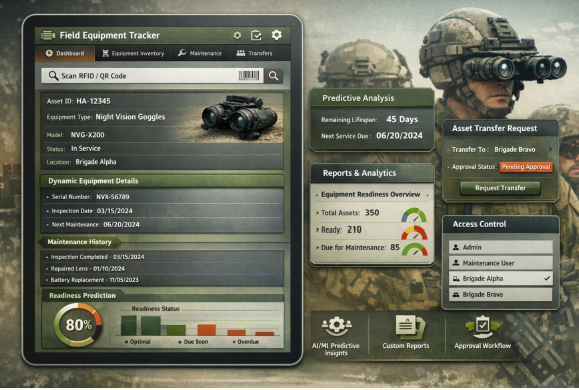
AI-based creative ideation for the proposed Equipment Tracker system
One of the most significant shifts shaping the Indian Army’s modernisation is the move beyond purely L1-driven procurement, particularly for emerging and disruptive technologies, where strategic capability cannot be built solely on the lowest cost. While fiscal discipline remains important, advanced systems demand iterative development, close user-developer collaboration, pilot deployments, and long-term partnerships, with global experience showing that leading militaries treat such technologies as strategic investments, accepting controlled risk to gain speed, learning, and adaptability. This thinking is increasingly reflected in India’s emphasis on problem-based challenges, phased induction, and operational validation. As Army Day 2026 is observed, the trajectory is clear: the Army is restructuring itself for a future defined by autonomy, data dominance, and multi-domain integration, with the next phase focused on rapid technology absorption, development of technology-literate leaders and soldiers, and strengthening indigenous innovation ecosystems through industry, academia, and veterans, supported by centres of excellence, unit-level experimentation, and doctrine aligned with technological realities to institutionalise innovation rather than treat it as episodic.
Conclusion: Readiness by Design
As the Indian Army moves into 2026, there is a clear and shared understanding that future conflicts will be won by forces that most effectively combine advanced technology with human judgment. Courage, discipline, and ethos remain enduring strengths, but they must now be reinforced by speed of action, seamless integration, and data-driven decision-making. Through the adoption of unmanned systems, artificial intelligence, secure networks, robotics, and intelligent logistics, alongside the growing contribution of Nari Shakti and veteran-led innovation, the Army is deliberately engineering readiness by design. In doing so, it ensures that as India progresses economically and strategically, its Army remains not merely relevant but truly decisive. On Army Day 2026, the message is unequivocal: the Indian Army is preparing not only to fight the next war, but to deter it through credible, technology-enabled strength.
Lt Col Narendra Tripathi (r) is an alumnus of IIT Kanpur with research in Exoskeleton. He is also an SME and independent consultant in military technology.