
Lt. Gen. AK Bhatt (r)

Space has traditionally been associated with scientific exploration, communications, navigation, and Earth observation. For decades, its contribution to Defence was largely understood as an enabling function, providing satellite communications, imagery, or navigation to support operations conducted on land, at sea, and in the air. That distinction is rapidly disappearing. Space is now emerging as a new domain of warfare. Very rightly, the US Space Force defines its mission as “Secure its nation’s interests in, from, and to Space”, which in military terms means to organise, train and ensure freedom of operations in Space.
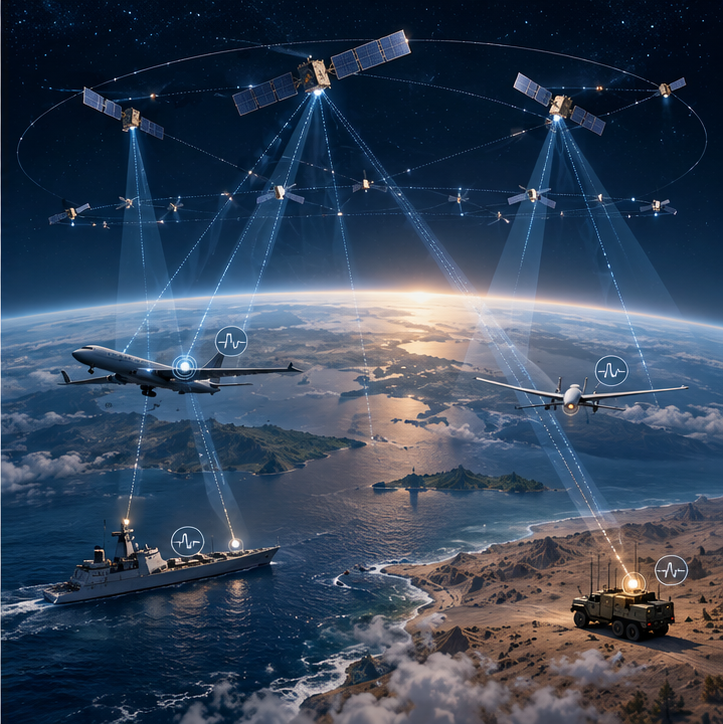
Space, as a new domain of warfare, is becoming integral to how military forces see, communicate, navigate, understand, and respond to developments across the entire battlespace. Missile tracking and anti-missile platform programs like the US Golden Dome and Indian Sudarshan Chakra also have a major space element. Intelligence, Surveillance, and Reconnaissance (ISR), Positioning, Navigation, and Timing (PNT), Satellite Communications (SATCOM), early warning and Space Situational Awareness (SSA) are no longer specialized capabilities operating at the margins of Defence planning. They have become fundamental for military effectiveness in future warfare.
From Enabling Operations to Shaping the Battlespace
The character of Space-enabled Defence is best understood by looking at what these technologies actually provide to the armed forces.
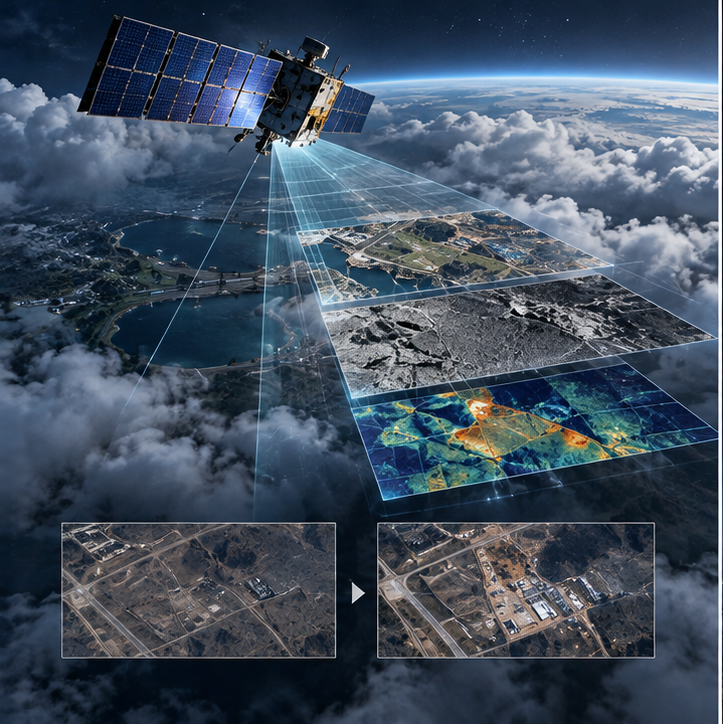
Intelligence, Surveillance, and Reconnaissance (ISR) – A satellite image alone is raw information. Its operational value emerges when imagery is collected repeatedly, compared over time, combined with other sources, and converted into effective intelligence. Different sensors, such as optical, multispectral, hyperspectral, and Synthetic Aperture Radar (SAR) systems, can provide different perspectives of an area of interest. SAR, for example, provides an important capability for observation under conditions where conventional optical imaging may be constrained. India’s existing Earth-observation architecture already includes optical and SAR systems, along with electromagnetic-spectrum sensing.
Operationally in ISR, there is a requirement for an all-weather and persistent capability. Repeated satellite patterns can reveal changes in infrastructure, movement, activity, and patterns over time. When information from multiple sensors is fused with other intelligence, it can provide a much more complete image of the operational environment. Artificial intelligence and machine learning can further help process large volumes of imagery and identify changes that require attention. ISR capability strengthens the OODA loop and supports post-strike assessment, which is equally critical in fast-flowing battles.
The same principle applies to Positioning, Navigation, and Timing (PNT); this is often an invisible capability, but underpins the functioning of modern military systems. Aircraft, ships, unmanned systems, and ground forces require accurate positioning and timing for navigation, coordination, and increasingly precise operations. A resilient indigenous PNT architecture is therefore not simply a navigation requirement. It is part of mission continuity. Presently, India’s indigenous navigation system, NaVIC, is limited by the number of operational satellites. This, however, is expected to be addressed with the launch of NVS-03 this month and the next two satellites in the near future. However, the more critical issue remains enabling the Indian Armed Forces to use NavIC effectively, which requires producing and deploying NAVIC receivers for weapon systems/platforms, missiles, tanks, and other military systems. The Indian Armed Forces currently continue to use GNSS systems such as US GPS, Galileo, and GLONASS, depending on the origin of a weapon, aircraft, ship, or other military vector. To achieve greater precision in the future, LEO-based PNT will need to be built up, and work by startups like Sanyark and VyomIC, both working in LEO-PNT, needs to be taken forward.
Satellite Communications (SATCOM) provides the connectivity that links these capabilities together. A satellite may collect critical information, but it must reach processing centres, commanders, and deployed forces securely and on time. The operational chain is therefore not merely sensor to satellite, but sensor to processing to command to operational unit. If communications are disrupted, even the best intelligence can lose value. India’s future SATCOM architecture must therefore focus not only on capacity but also on redundancy, protected connectivity, and resilience. Indian Defence-Space discussions on network-centric and multi-domain operations have also highlighted the need for secure, resilient SATCOM. This interconnectedness is what makes Space increasingly strategic. To ensure capacity, speed, and resilience, SATCOM will need to be provided from both GEO and LEO constellations in the future. The current architecture, based only on GEO satellites, would be inadequate.
ISR provides awareness, PNT provides precision, and SATCOM provides connectivity. Together, they create an information architecture that supports military decision-making.
When Space Itself Becomes Contested
The increase in Space Assets and the growing dependence on Space also creates a corresponding requirement to protect the space architecture from interference or disruption.
The recent announcement by the U.S. Secretary of the Air Force that the United States has deployed Space weapons has once again brought the weaponization of Space into focus. Although the Secretary was circumspect about the types of weapons involved, this open announcement may spark a New Space race for weaponisation among leading Space powers, which may also drag India into this quagmire as it moves to protect its assets.
Space Situational Awareness (SSA) is an essential first component of Space Defence preparedness. It involves detecting, tracking, and characterising objects in orbit; understanding their movement; and identifying situations that may affect the safety or functioning of National Space Assets. India’s IS4OM and NETRA programs, supported by radar and optical sensing infrastructure, represent important elements of this emerging capability. The private sector, including startups like Digantara, is also contributing through space-based sensing, orbital analytics, propulsion, collision avoidance, and rendezvous technologies.
Counterspace capabilities include both kinetic and non-kinetic means. Kinetic capabilities can physically affect space assets, while non-kinetic approaches include electronic warfare, jamming, spoofing, cyber operations, and directed-energy technologies. Space security can no longer be viewed only through the narrow lens of physically destroying satellites. This distinction matters because a satellite does not have to be destroyed to become ineffective. A communication link can be disrupted. A navigation signal can be interfered with, and a sensor can be degraded. A ground system can be compromised.
The objective of Space Defence must therefore extend beyond protecting the physical satellite to protecting the entire Space-to-Ground Architecture. India’s own capabilities are evolving in this environment. Mission Shakti demonstrated a kinetic counterspace capability, while India’s growing SSA infrastructure, rendezvous and proximity technologies, electronic warfare research, and private sector capabilities are broadening the technological base. The challenge ahead is not simply to develop individual counterspace capabilities but to build a resilient Space-Defence architecture capable of detecting, protecting against, and responding to a range of threats.
Building India’s DefSpace Architecture
India is now moving towards a more integrated DefSpace architecture in which ISR, PNT, SATCOM, SSA, Missile Defence, data processing, AI, cybersecurity, and resilience are not treated as separate technological programs but as interconnected elements of National Security. This transition also requires a clear understanding of the respective roles of government and industry.
Developing a large-scale private space sector alongside ISRO is important, as ISRO remains the anchor, retaining its core capabilities and responsibilities. In contrast, private industry can increasingly undertake commercial and routine activities and bring additional capacity into the ecosystem. The objective is to create a larger and more diversified National Space Enterprise.
For DefSpace, this partnership becomes particularly important because many space technologies are inherently dual-use. An Earth-observation capability can support both civilian applications and Defence ISR. Space-domain-awareness technologies can contribute to both Space safety and security. Rendezvous and docking technologies can support in-orbit servicing while also having relevance to the broader Space-security environment. AI, data analytics, communications and navigation technologies can similarly serve both commercial and Defence requirements.
India’s private sector is already becoming part of this architecture. The government’s confidence in industry is reflected in programmes such as the Space-Based Surveillance-3 initiative, under which 52 satellites are being developed: 31 by private companies and 21 by ISRO under NSIL. Companies such as Pixxel, GalaxEye, Dhruva Space, and SatSure are also developing multiple sensor options, including hyperspectral, OptoSAR, and SAR capabilities, further strengthening India’s Space-based sensing architecture.
But technology alone will not create capability. The more difficult transition is from prototype to operational deployment. Defence-Space companies need a pathway that moves from challenge definition to development, testing, qualification, procurement and sustained deployment. India’s DefSpace ecosystem has made progress in this direction, but accelerating operational induction, procurement and scaling of indigenous technologies remain important. Discussions under Mission DefSpace have specifically focused on strengthening these pathways.
Building a Multilayered DefSpace Future
India’s DefSpace architecture must evolve as an integrated and resilient system of systems. It must see through persistent ISR and Space-domain awareness, communicate through secure and resilient SATCOM, navigate and synchronise through reliable PNT, and understand the battlespace by combining data from multiple sensors with advanced analytics and AI. Equally important is the ability to continue operations under disruption. This requires redundancy across satellites, communication links, and ground infrastructure; protected systems; alternative pathways; and the ability to restore critical capabilities when required.
Building such an architecture will require close integration between the Armed Forces, ISRO, DRDO, industry, startups and academia. The Armed Forces must define operational requirements; ISRO must continue to provide strategic space capabilities and advanced research; DRDO must develop defence technologies; and industry and startups must contribute innovation, agility and scale.
The objective is therefore not simply to place more assets in orbit, but to build a resilient national DefSpace architecture in which the disruption of one capability does not compromise the mission as a whole. India’s Orbital journey is ultimately about moving from technology to capability, and from capability to resilience. The ability to see, communicate, navigate, understand and operate through disruption will increasingly shape the effectiveness and strategic autonomy of the Armed Forces.
DefSpace is not about fighting in Space alone. It is about ensuring that India can continue to operate effectively on Earth through space-enabled capabilities.
Lt Gen AK Bhatt PVSM UYSM AVSM SM VSM (r), Founding Director General of the Indian Space Association and Chairman of IIIT Kota and Ranchi, is a distinguished former Indian Army officer with over 39 years of service, including as Director General Military Operations and Chinar Corps Commander.