Larry Bell, Rushabh Mehta, Surabhi Sharma
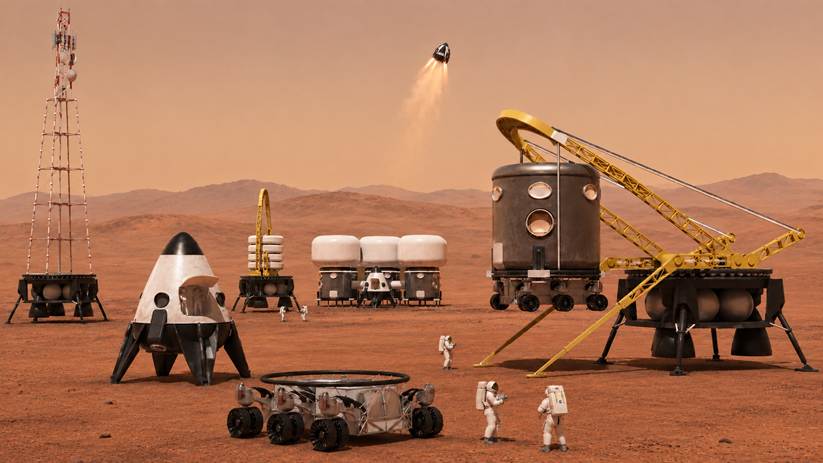
India’s human-spaceflight programme is moving from a first crewed mission toward an indigenous space station and, ultimately, a crewed lunar landing. The next challenge is not simply to accumulate more vehicles and technologies, but to determine how transportation, docking, habitation, logistics, power, communications, mobility and surface operations can function as one progressively expandable architecture.
India Is Moving Beyond a Single Human-Spaceflight Mission
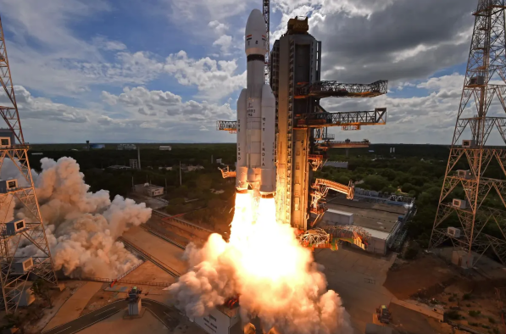
Gaganyaan is often described as India’s entry into independent human spaceflight. That description is accurate, but increasingly incomplete. The programme was established to demonstrate an indigenous capability to place Indian astronauts in low Earth orbit and return them safely. Yet India’s stated human-spaceflight trajectory now extends well beyond that first demonstration. The national Space Vision 2047 includes an operational Bharatiya Antariksh Station (BAS) by 2035 and an Indian crewed lunar mission by 2040. In 2024, the scope of Gaganyaan was formally expanded to include development of the first BAS module and precursor missions needed to validate technologies for building and operating the station.
By mid-2026, this progression had become more concrete. The planned BAS is described as a five-module indigenous station, with BAS-01 targeted for launch in 2028 and the complete station targeted for 2035. India has also demonstrated rendezvous, docking and undocking through SpaDeX—capabilities that ISRO itself identifies as essential for assembling and operating a space station and for future lunar missions requiring multiple launches.
These are not isolated milestones. Taken together, they mark a change in the character of India’s human-spaceflight problem. Gaganyaan asks whether India can safely send people into orbit and bring them back. BAS asks how India can support people for longer periods in an assembled orbital environment. A crewed lunar programme adds another order of complexity: how crews and cargo move between Earth, orbit and the lunar surface; how equipment is landed and unloaded; how power and communications are established; how surface mobility works; how habitats are supplied and maintained; and how all of these systems grow without requiring the architecture to be reinvented for every mission.
The next step, therefore, is not merely another isolated capability. It is architecture.
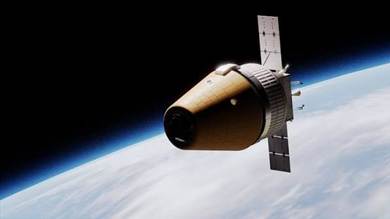
Gaganyaan Space Docking Experiment – SpaDex
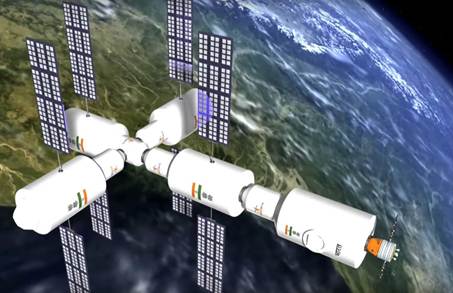
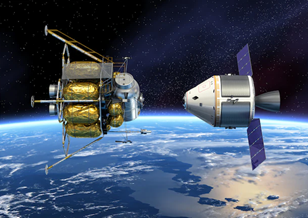
Bharatiya Antariksh Station (BAS)
From Capability to Architecture
Human spaceflight programmes naturally develop through specialised technologies. Launch vehicles, crew modules, life-support systems, docking mechanisms, communications, robotic systems and habitats are each difficult enough to justify dedicated development programmes. The danger appears when successful components are treated as though their existence automatically creates a coherent exploration system.
It does not.
A launch vehicle can deliver mass to orbit without defining what that mass should become after arrival. A docking system can connect two spacecraft without determining the larger logic of an orbital complex. A lunar lander can reach the surface without solving how cargo is unloaded, moved, powered or connected. A habitat can provide pressurised volume without establishing the transportation, logistics, utilities and maintenance network that makes the habitat operational.
This distinction becomes increasingly important as India progresses from short-duration missions toward sustained presence. Space architecture, in this context, should not be understood narrowly as the design of spacecraft interiors. Its larger role is to organise complex mission environments around human purposes while integrating the physical and operational constraints imposed by orbital mechanics, propulsion, mass, energy, radiation, life support, thermal conditions, terrain, robotics, economics and human performance.
The architectural question is therefore not simply, “What vehicle should India build next?” It is: “What must the complete human-spaceflight system eventually be able to do, and how should today’s capabilities connect to that future?
Think From the Destination Back
Traditional mission planning often begins with transportation: how much can a launch vehicle lift, which orbit can it reach, and how much propellant does it require? Those remain fundamental questions. But sustained human presence benefits from reversing the sequence and beginning at the destination.
Consider a future Indian lunar outpost. Before selecting the transportation architecture, planners must ask what needs to be functioning when a crew arrives. At minimum, that may include dependable power, communications, navigation, mobility, cargo handling, habitation, environmental control, science systems, maintenance capability and some degree of logistical redundancy. The location and configuration of those systems affect landing-zone placement, rover routes, cable runs, communication visibility, hazard separation and future expansion. Those surface requirements, in turn, influence the mass, volume and interfaces of the cargo that must be delivered. Only then can transportation be evaluated against what the destination actually requires.
This destination-first logic helps prevent a common architectural trap: asking one vehicle to satisfy fundamentally different environments. A vehicle optimised for launch through Earth’s atmosphere and gravity field is not automatically an ideal long-duration orbital habitat. A vehicle optimised for months of transit in microgravity is not automatically an ideal habitat for the lunar or Martian surface. A lander capable of touching down safely is not automatically a cargo-deployment system.
The objective is not to multiply vehicles unnecessarily. It is to assign clear roles to systems and make those systems interoperable.
Lessons From SICSA: Specialization with Interoperability
Conceptual studies at the University of Houston’s Sasakawa International Center for Space Architecture (SICSA) provide useful examples of this architecture-first method. They are not proposed here as hardware India should adopt, nor are they flight-ready designs. Their value is methodological: they explore how transportation, crew systems, cargo, habitats and surface infrastructure can be considered as connected parts before individual technologies are locked into a mission architecture.
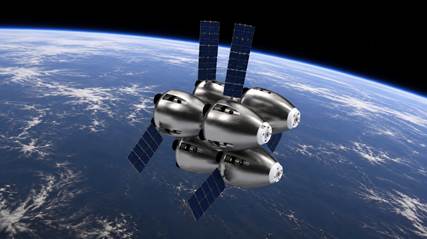
One example is SICSA’s Orbital Propulsion Booster (OPB) concept. Instead of assuming that every payload or crew vehicle must carry a complete interplanetary propulsion system, modular propulsion units can be attached to specialised cargo carriers or crew transit vehicles after Earth launch. The principle is to use heavy-lift launch capability for what it does best—placing mass into orbit—while allowing downstream transportation elements to be optimised for their particular mission roles.
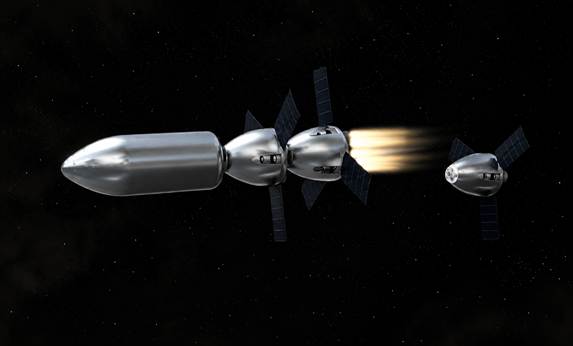
SICSA’s Orbital Propulsion Booster (OPB) Cargo Application
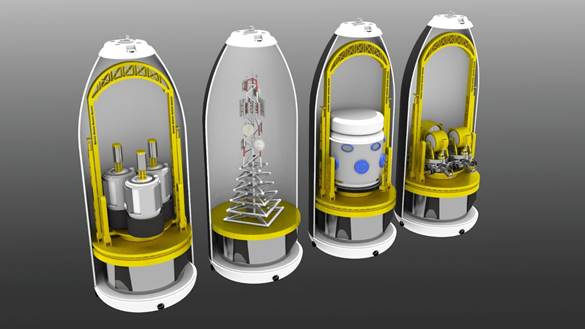
SICSA’s Key Cargo Payloads in Carriers
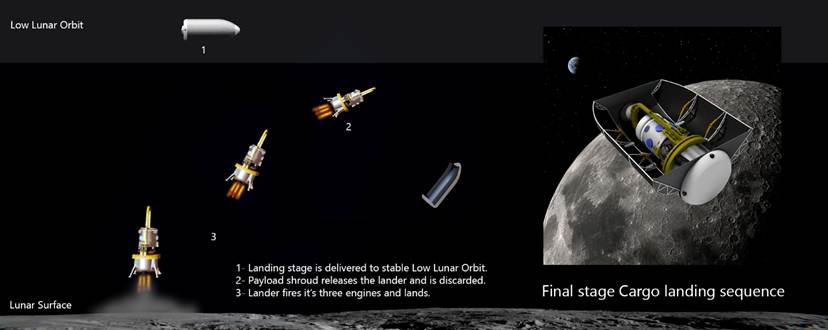
SICSA’s Lunar Cargo Carrier and Lander Concept
A related SICSA Mars concept separates the long-duration crew transit environment from the vehicle used for planetary descent and ascent. A dedicated “Mothership” remains in orbit while a smaller Surface Excursion and Return-to-Orbit Vehicle, or SERTOV, transfers the crew between orbit and the surface. Again, the important lesson is not the specific configuration. It is the architectural principle that interoperability can be more effective than forcing one vehicle to perform launch, transit, landing, surface habitation and return functions simultaneously.
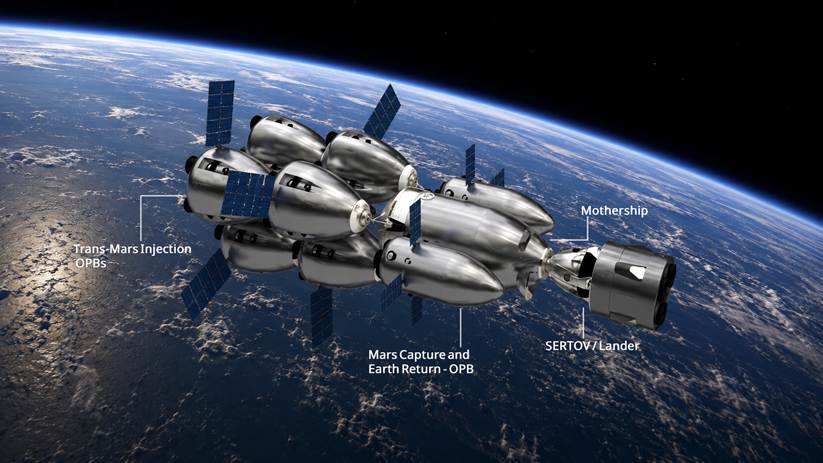
SICSA’s Orbital Propulsion Booster (OPB) Crew-Mothership Application
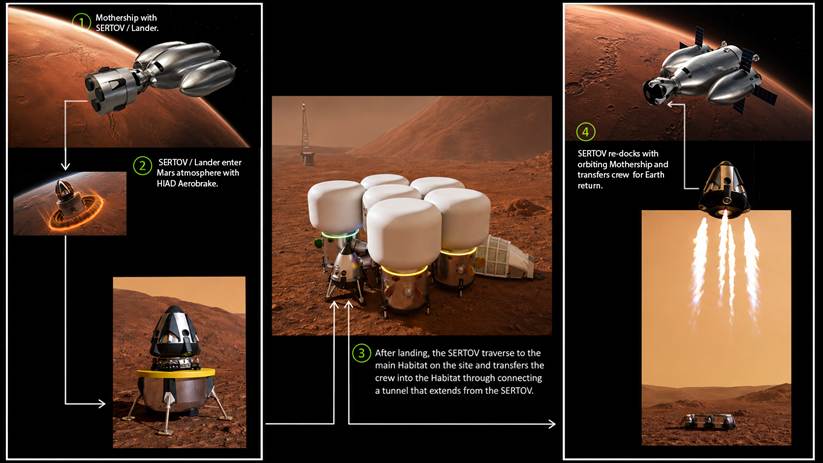
SICSA’s Crew Landing, Surface and Return-to-Orbit Sequence
For India, this principle becomes relevant as the programme moves toward BAS, more complex orbital assembly and eventually lunar operations. The question is not whether India should reproduce any foreign or academic concept. It is whether future Indian systems are being developed with sufficiently clear roles and sufficiently deliberate interfaces that they can become components of a larger architecture.
Docking Is More Than a Demonstration
SpaDeX is particularly important in this context. India’s successful demonstration of rendezvous, docking and undocking is often described as a major technological milestone—and it is. But its architectural significance is larger.
Docking allows a mission to be assembled rather than launched as a single object. That changes the design space. Modules can be launched separately. Vehicles can rendezvous with logistics elements. Propulsion, habitation, laboratories and crew-transfer systems can be distributed among different spacecraft. A station can grow incrementally rather than being fixed at its first launch configuration.
This is directly relevant to BAS. A five-module station is, by definition, not simply a spacecraft but an evolving orbital environment. Its success will depend not only on individual module performance but on interfaces: structural connections, power transfer, data, thermal management, atmosphere, crew circulation, maintenance access, robotic handling and operational compatibility.
The same logic becomes even more consequential for lunar exploration. Once multiple launches contribute to one mission objective, rendezvous and docking become part of a broader logistics architecture. India’s experience with SpaDeX should therefore be viewed not only as acquiring a discrete technology, but as an early building block for modular human-spaceflight systems.
Access Is Not Occupancy
A fundamental distinction exists between reaching a destination and occupying it.
Access means transporting people and cargo to a place. Occupancy means establishing the interconnected capabilities that allow people to live, work, operate, maintain systems, respond to failures, receive logistics and progressively expand their environment.
BAS represents India’s first major transition toward this second problem. A short-duration capsule can rely heavily on consumables and ground support because the crew returns after a limited mission. A station must operate continuously, accommodate visiting vehicles, manage maintenance and failures, support research, control its internal environment and evolve as new modules and systems arrive.
A lunar outpost magnifies the distinction. The surface is not a passive destination. Landing creates plume and ejecta hazards. Equipment must be removed from landers and transported. Power generation must be connected to users. Communications assets need appropriate visibility and redundancy. Habitats require protection, maintenance and logistical access. Mobility systems need routes and interfaces. Future expansion needs space not blocked by the first set of deployments.
Delivered mass is therefore an incomplete measure of success. The more useful measure is operational capability created. A habitat sitting on the lunar surface but unable to be positioned, powered or maintained is not yet a functioning habitat system. A reactor or solar array without distribution is not a power network. A rover without interfaces to cargo and habitation is an isolated vehicle, not a logistics system.
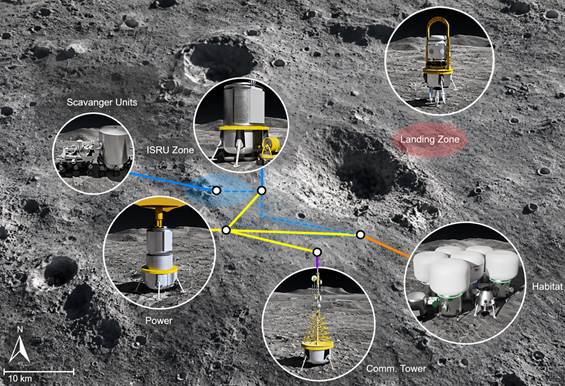
Interconnected Power Systems
Landing Is the Beginning of Surface Architecture
The transition from orbital missions to lunar surface operations requires another conceptual shift: treat landing as the beginning of architecture rather than the end of transportation.
On an airless body such as the Moon, rocket exhaust can accelerate regolith and ejecta across significant distances, creating risks for previously deployed equipment. Terrain, slopes, illumination, line-of-sight communications, mobility corridors and the location of scientific or resource targets can all affect where infrastructure should be placed. As operations grow, landing zones, protected areas, habitats, power systems and rover routes must be planned together.
Cargo deployment is equally important. Large payloads may arrive several metres above the surface on a lander deck. Reaching the Moon does not automatically solve how a habitat, rover, reactor, laboratory or logistics container is lowered, moved to its operating location, levelled, connected and commissioned.
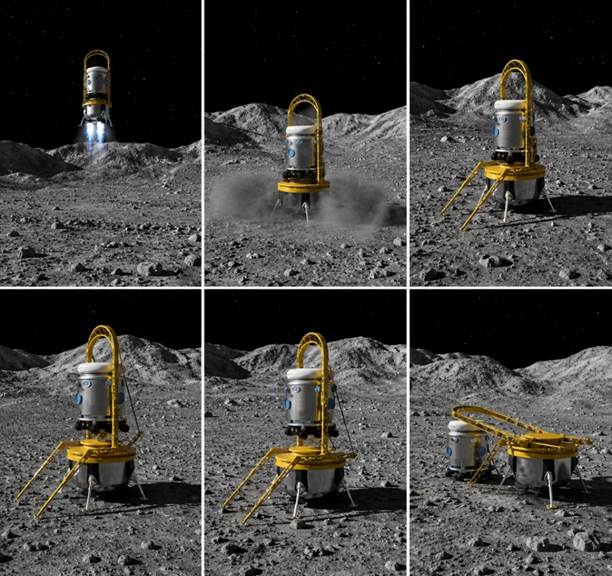
SICSA’s Hooping Crane Surface Offloading System
SICSA studies have explored concepts such as dedicated cargo-handling systems and mobile deployment equipment precisely because “landed” and “operational” are different states. For an Indian lunar architecture, ask the same question early: what is the complete chain from launch integration to final surface emplacement?
That chain may ultimately influence lander geometry, payload packaging, robotics, mobility systems and even settlement layout.
Establish a ‘Lights-On’ Condition Before the Crew Arrives
For increasingly distant destinations, another architectural principle becomes valuable: wherever practical, infrastructure should be functioning before a crew becomes dependent on it.
SICSA Mars studies use the term “lights-on” for a condition in which precursor cargo has already established critical surface capabilities before the first crew arrives. Power is available. Communications are functioning. Essential cargo has been positioned. Habitat systems have been checked. Mobility assets are ready. The crew arrives at an operating system rather than at a collection of unopened payloads.
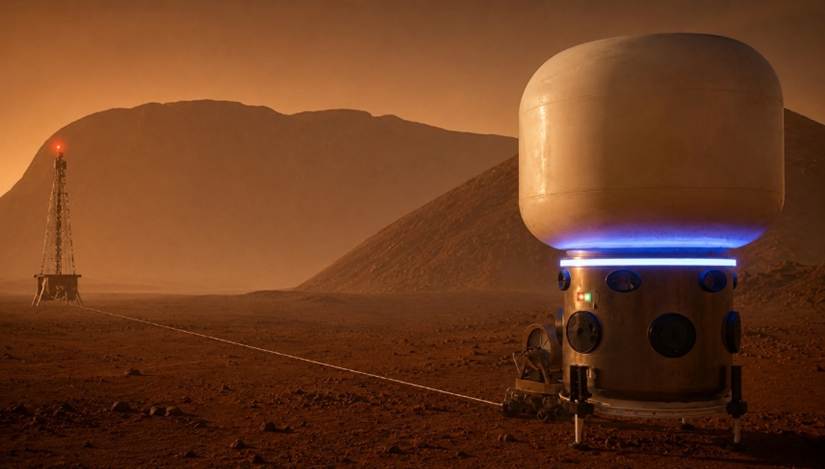
Mars “lights-on” Status, Prior to First Crew Arrival
The principle is especially important for Mars because crews cannot depend on rapid resupply or immediate intervention from Earth. But it also has value for lunar planning. Robotic precursor missions can progressively demonstrate landing accuracy, cargo handling, autonomous deployment, power distribution, communications, surface navigation and habitat commissioning.
India already has deep experience in robotic planetary exploration. As its human programme develops, one of the most powerful architectural opportunities may be to connect robotic exploration more deliberately with the needs of future human occupancy. The robot is then not merely a scientific precursor; it becomes a construction, logistics and commissioning agent for the human system that follows.
Design BAS and Lunar Systems for Growth
An expandable architecture should not require redesign whenever a new capability is introduced.
This is particularly relevant to BAS. The station’s planned progression toward five modules creates an opportunity to establish interface standards, utility strategies and operational practices that support growth from the beginning. Standardised mechanical, electrical, data and robotic interfaces can make later modules easier to integrate and can widen the range of contributions from Indian industry, academia and international partners.
The same principle applies to the lunar surface. Early infrastructure should be located and configured with later expansion in mind. Power systems should allow distribution to new users. Communications networks should accommodate additional nodes. Mobility routes should connect landing, logistics, habitation and resource areas. Habitats should support additional pressurised volumes or specialised modules for science, maintenance, medicine, food systems and fabrication.
SICSA’s conceptual habitat work explores this network logic through combinations of hard utility cores and deployable living volumes, with specialised modules becoming useful through their connection to the larger settlement rather than through complete self-sufficiency.
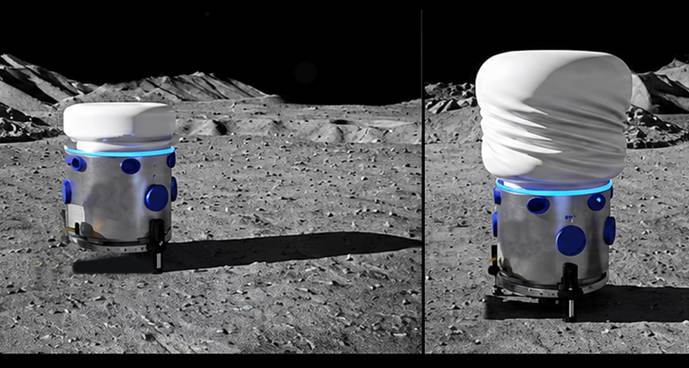
Inflatable Habitat Module Sections Expand Volume
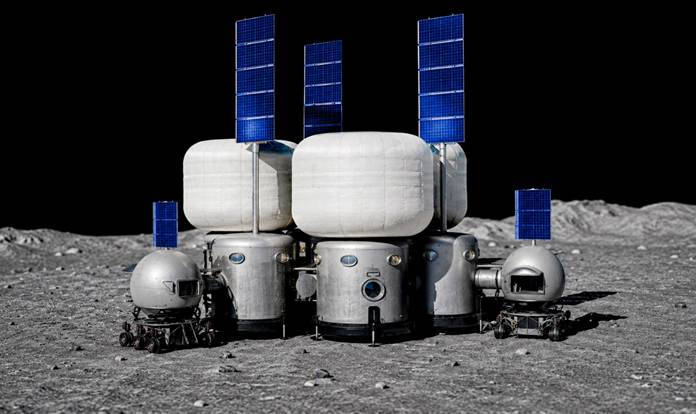
SICSA Lunar Base Concept
For India, the important point is not a particular habitat form. It is to develop an architectural grammar—interfaces, zones, standards and growth rules—that allows a human environment to evolve over decades.
The Moon Should Inform the Architecture for Mars
India’s current Space Vision places BAS and a crewed lunar mission on the national horizon, while the country also continues to pursue broader planetary exploration. This creates an opportunity to avoid treating the Moon as an isolated endpoint.
The Moon can become a proving ground for technologies and operating practices that will matter at greater distances: autonomous cargo deployment, distributed power, surface communications, robotic maintenance, habitat interfaces, dust mitigation, logistics planning and crew operations outside low Earth orbit.
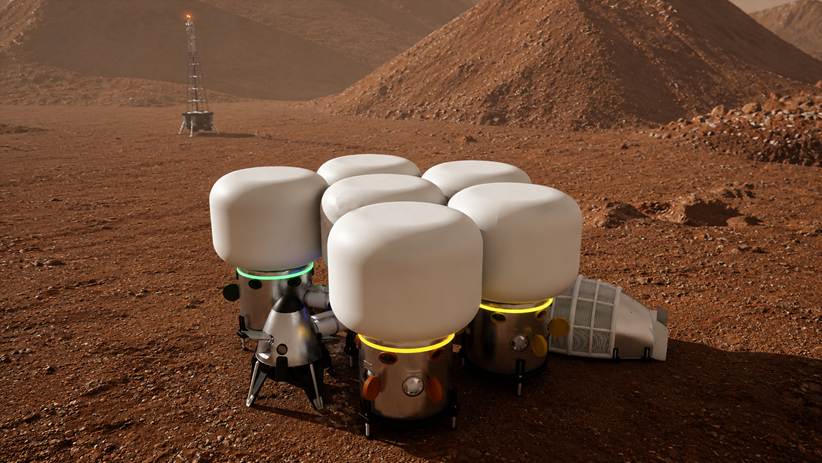
SICSA Mars Base Concept
The environments are not interchangeable. Mars has an atmosphere, different gravity, different thermal conditions, longer travel times and much more severe communication delays. But architectural methods can transfer even when hardware does not. Defining interfaces, assigning specialized roles, pre-deploying infrastructure, and designing for expansion apply across destinations.
This is also where international collaboration can become more productive. A coherent architecture allows partners to contribute specialised capabilities without requiring every participant to build an entire mission stack. Common interfaces can turn separate national contributions into a functioning system.
A Strategic Role for Space Architecture in India
India has already built a powerful ecosystem in launch vehicles, spacecraft engineering, planetary science, remote sensing, navigation and increasingly private-sector space activity. Sustained human spaceflight introduces a complementary need: professionals and institutions that can connect those domains around human occupancy.
That capability should be developed while the programme is still taking shape, not after the major vehicles and interfaces have already been fixed.
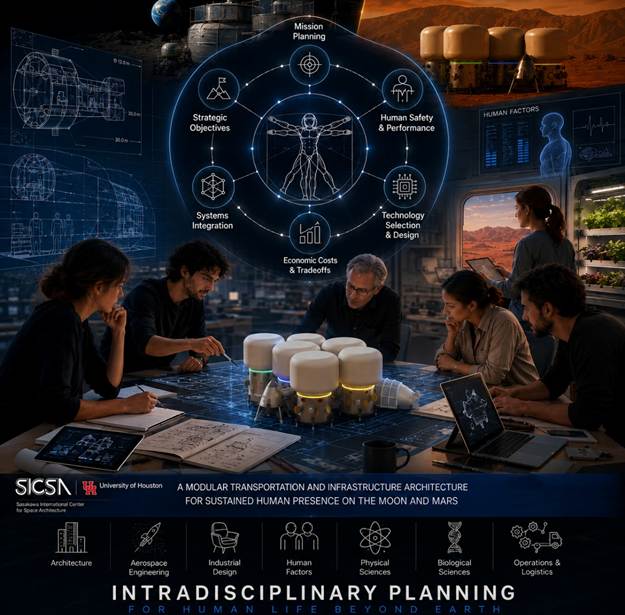
Space architects can work alongside aerospace engineers, planetary scientists, roboticists, physicians, human-factors specialists and mission operators to ask cross-cutting questions early. How will crew movement affect module geometry? How will maintenance access affect packaging? How does a landing-zone decision change cable length and rover operations? How does power architecture affect habitat placement? What does an emergency scenario require from mobility and shelter? Which interfaces should be standardised so future systems can be added without redesigning the whole?
This role does not replace engineering. It gives specialised engineering a common mission environment against which it can evaluate trade-offs.
India’s progression from Gaganyaan to BAS and eventually to the Moon provides a rare opportunity to establish this architectural capability while the physical programme is being built.
Conclusion: Beyond Gaganyaan
Gaganyaan is an essential beginning because independent human access to space is the prerequisite for everything that follows. But India’s own roadmap makes clear that the national objective does not end with access. BAS introduces sustained orbital presence. A crewed lunar mission introduces the challenge of connecting orbit, landing and surface operations. Longer-term exploration will demand systems that can be maintained, expanded and increasingly operated at great distance from Earth.
The central question is therefore changing.
It is no longer only: Can India send humans to space?
It is becoming: What kind of human-spaceflight architecture does India want to build once they are there?
Answering that question requires more than a larger launch vehicle or a more capable habitat. It requires transportation, docking, logistics, robotics, power, communications, mobility, habitation and human operations to be conceived as parts of one progressively evolving system.
India does not need to decide today what every future lunar habitat or Mars vehicle will look like. But decisions being made today about interfaces, modularity, transportation and operations will shape what becomes possible decades from now.
The next great capability after reaching space is not simply staying longer. It is learning how to build there.
Larry Bell is the Founder and Director Emeritus of the Sasakawa International Center for Space Architecture (SICSA) and an Endowed Professor of Space Architecture at the University of Houston, recognized as an AIAA Associate Fellow. Rushabh Mehta and Surabhi Sharma are both Space Architecture Professionals who earned their Master of Science in Space Architecture from SICSA at the University of Houston.