BrahMos, Akashteer & the UAE’s Search for Strategic Optionality
Romiya Das
The reported interest of the United Arab Emirates in India’s BrahMos supersonic cruise missile and Akashteer air-defence command-and-control system represents far more than another defence export headline. If the discussions advance, they will point to a deeper shift in Gulf procurement thinking: the growing willingness of regional states to look beyond their traditional Western suppliers in search of greater strategic flexibility and military autonomy.
At first glance, the reports may appear straightforward. The UAE is reportedly exploring Indian systems as part of its broader effort to deepen defence cooperation with India. But the significance lies less in the hardware itself than in what the hardware represents. BrahMos is among India’s most visible high-end weapons platforms, while Akashteer is a command-and-control layer that speaks to integrated air-defence architecture rather than isolated platform buying. Taken together, they suggest interest not merely in purchasing equipment, but in building a more adaptable and resilient security posture.
That distinction matters because the Gulf’s defence market is changing fundamentally. Procurement is no longer solely about raw performance or brand familiarity. It is increasingly about autonomy, responsiveness, political reliability and the ability to diversify supply chains in an unpredictable security environment. The UAE has long depended on U.S. and European systems, but recent regional shocks have sharpened the value of optionality. In an era of missiles, drones and saturation threats, states are looking for suppliers that can deliver capability without excessive political friction or long delays.
This is where India enters the picture. India is not a traditional Gulf arms supplier. Still, it is increasingly viewed as a credible alternative: strategically independent, militarily capable, and less encumbered by the geopolitical baggage that often accompanies major-power defence deals. For Abu Dhabi, that makes India useful not as a replacement for Western partners, but as a complement to them. The logic is diversification, not abandonment.
For India, the implications are equally important. The confirmation of the purchase would strengthen the argument that India is no longer only a buyer of advanced systems but an exporter of them. More significantly, it would demonstrate that Indian platforms can compete in a market that values not just price but also reliability, combat credibility, and political room to manoeuvre. That is a meaningful threshold for any defence exporter trying to move up the value chain.
The Symbolic Weight of BrahMos
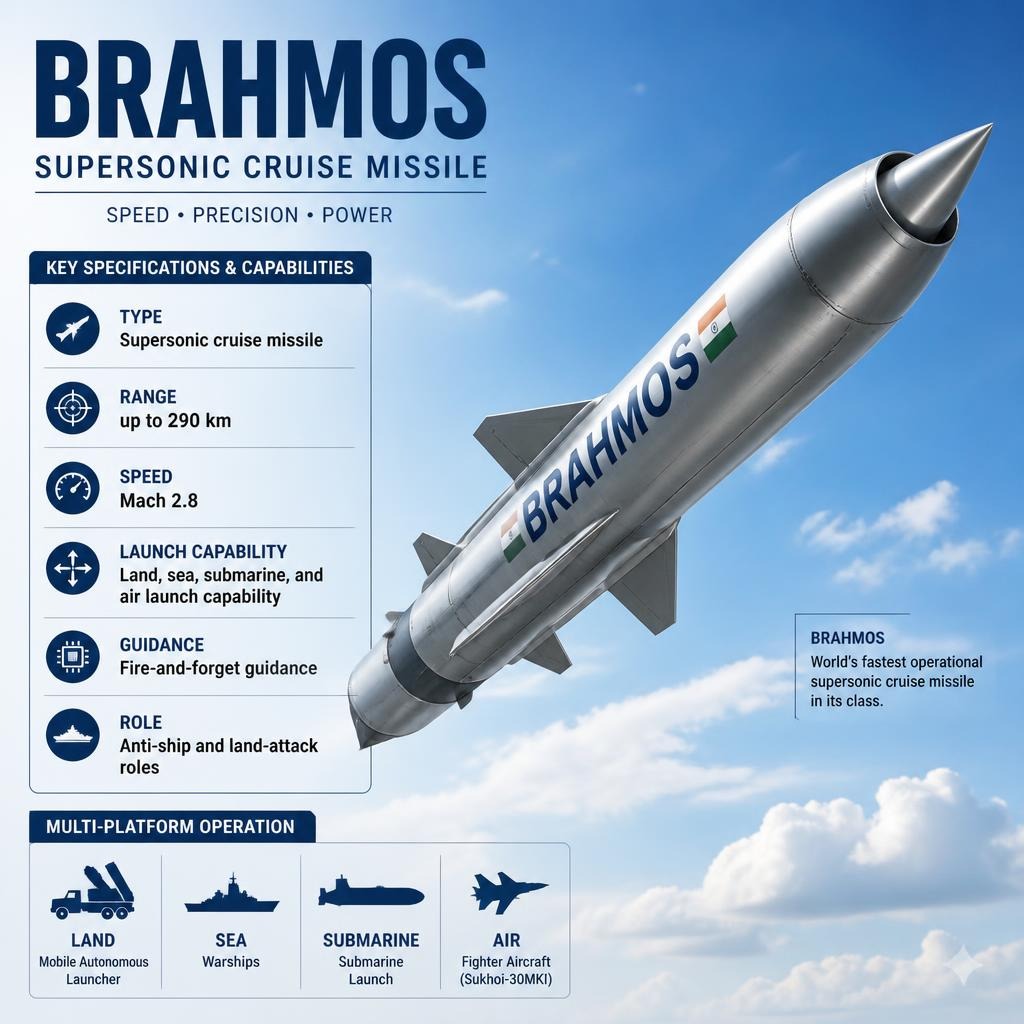
BrahMos, in particular, carries symbolic weight for India’s defence industrial aspirations. It is one of India’s most prominent examples of a high-end indigenous programme that has already earned international validation. Its appeal lies not only in speed—the missile travels at Mach 2.8 throughout its flight envelope—and in a strike range of up to 290 kilometres for the export variant, but also in the message it sends about the maturity of India’s defence industrial base. The weapon has already been operationalized by foreign customers: the Philippines became the first buyer in 2022 with a $375 million contract, followed by confirmed deliveries in 2024 and 2025. More recently, Vietnam signed a substantial agreement valued at approximately $629-700 million in May 2026, with Indonesia’s negotiations in their final stages. These deployments have transformed BrahMos from a development project into an operational military capability with proven international reliability.
Akashteer, by contrast, points to something more systemic. It is not just a weapon, but part of the battle-management architecture that links sensors, decision-making and response. Developed through collaboration between Bharat Electronics Limited (BEL) and the Indian Army, Akashteer is a fully automated system that integrates radar networks, sensors, and communication systems into a unified framework, enabling real-time detection, tracking, and engagement of aircraft, drones, and missiles. For the UAE, the strategic significance extends beyond the missile itself: Akashteer could be integrated with the country’s existing U.S.-provided THAAD and Patriot air-defence batteries, creating a unified layered defence ecosystem capable of handling increasingly complex regional missile environments. That suggests the UAE may be looking beyond individual purchases toward a more integrated air-defence framework—moving from isolated systems to a networked, mutually-supporting defence architecture.
The Russia Question
There is, however, an important caveat. Reports of interest are not the same as a signed deal, and any discussion of BrahMos exports would also need to account for the system’s joint development with Russia through the BrahMos Aerospace joint venture between India’s Defence Research and Development Organisation (DRDO) and Russia’s NPO Mashinostroeyenia. This introduces an additional approval layer that technically requires Russian consent. However, officials in India familiar with the negotiations suggest this is unlikely to prove problematic. Russia’s deepening strategic engagement with Abu Dhabi across energy cooperation, geopolitical alignment, and defence matters has created a permissive diplomatic environment for such approvals. Moscow has shown willingness to accommodate India’s BrahMos exports when the recipient is considered a trusted strategic partner. For now, the story remains one of exploration rather than conclusion. That is why the most careful framing is also the most accurate: this is a serious signal, but not yet a completed transaction.
A Broader Shift in Regional Procurement Strategy
Even so, the direction of travel is hard to miss. The UAE’s reported interest in Indian systems is a reminder that the Gulf’s defence market is diversifying, and that India is becoming part of that conversation in a way it was not a decade ago. The larger story is not about one sale. It is about India’s arrival as a serious defence partner in a region that increasingly values choice and strategic flexibility.
What differentiates the UAE opportunity from India’s Southeast Asian sales is instructive. The Philippines and Vietnam acquired BrahMos primarily for anti-access and area-denial purposes in the South China Sea—to create maritime denial zones against larger naval forces. These are transactional acquisitions of proven capability. The UAE’s interest, however, signals a different ambition: the integration of BrahMos and Akashteer into a comprehensive, layered air-defence system. This represents India moving from the role of “weapons exporter” toward “systems architect”—a higher-order capability that appeals to sophisticated military buyers seeking coherent, integrated defence architecture rather than isolated platforms.
The contrast with other emerging defence exporters is equally revealing. South Korea, for instance, has built its Gulf presence through technology transfer partnerships and joint production arrangements. Saudi Arabia’s Vision 2030 initiative and the UAE’s Tawazun Economic Program both emphasize localization, domestic production capacity, and long-term industrial partnerships. India’s approach differs: it offers strategic autonomy and political independence without the constraints that accompany traditional alliance relationships. For a Gulf state seeking to balance deterrence capabilities with diplomatic flexibility, that proposition carries particular appeal.
Strategic Implications Beyond the Deal
That shift has strategic implications extending far beyond the immediate transaction. If India can supply advanced systems to a Gulf state like the UAE, it strengthens New Delhi’s case as a security partner with reach beyond its immediate neighbourhood. It also suggests that India’s export ambition is beginning to intersect with genuine geopolitical demand, rather than with industrial policy or government subsidies. The defence relationship becomes a tool of strategic influence and diplomatic positioning.
The timing is significant as well. The UAE’s interest emerges during a period of extraordinary expansion in India’s defence export ambitions. India’s defence exports reached ₹38,424 crore (approximately US$4.6 billion) in FY2025–26, reflecting the government’s continued focus on expanding indigenous defence manufacturing and exports. This represents a dramatic increase from minimal export volumes a decade earlier. Industry observers view this growth as evidence of India’s emergence as a credible supplier of advanced military technologies to global markets.
The UAE’s outreach also reflects broader changes in regional security thinking. Recent conflicts and tensions have sharpened Gulf states’ desire for military self-sufficiency and diversified supplier relationships. A broader supplier base provides strategic autonomy without necessarily antagonizing traditional partners like the United States. The logic is one of portfolio diversification: maintain core partnerships with Western powers while expanding options with emerging defence suppliers who operate with fewer political constraints. India fits that profile perfectly.
The Larger Story
In that sense, the UAE’s reported outreach is best understood not as an isolated procurement but as a test of the next phase in India’s defence story. The question is whether India can sustain its role as both a credible defence exporter and a strategically independent actor in a multipolar security environment. Success with the UAE would signal that India can move beyond Southeast Asia into the more complex, strategically significant Gulf region—a market long dominated by Western suppliers and shaped by alliance relationships rather than transactional purchases.
For India, the broader stakes extend beyond commerce. A successful deal validates India’s claims to defence-industrial maturity and export capabilities. It demonstrates to other potential customers—in the Middle East, Africa, and beyond—that Indian platforms can compete on reliability, capability, and political independence. It strengthens the argument that India is no longer primarily a buyer of advanced defence systems, but an exporter of them on terms that appeal to strategically sophisticated buyers.
For the UAE, the stakes are equally significant. A closer defence relationship with India provides not only additional military capability but also diplomatic leverage within an increasingly fragmented Middle Eastern security environment. It signals Abu Dhabi’s determination to build independent strategic partnerships beyond the traditional Western framework. It reflects a new regional reality: the Gulf’s defence market is becoming more decentralized, technologically layered, and strategically autonomous compared with the heavily Western-dependent model that dominated previous decades.
For the broader international system, the significance lies in what the UAE-India discussions reveal about shifting patterns in defence cooperation and great-power competition. It is a reminder that emerging powers are becoming credible alternatives to established suppliers, and that traditional alliance structures are giving way to more flexible, transactional partnerships based on strategic fit rather than ideological alignment.
The story, then, is larger than missiles and air-defence systems. It is about the gradual reordering of the global defence market, the emergence of India as a serious player in that market, and how rising powers are reshaping the security architecture of regions long dominated by the West. The UAE’s preliminary talks with India are one of many indicators that this transformation is already well underway.
Reports of interest may not yet constitute a signed deal. But they point to a future in which Indian defence systems will play a more prominent role in global security competitions, and in which the countries of the Gulf will exercise greater strategic choice in how they build their military capabilities. That shift, more than any single weapons system, is what makes this story worth watching.