
Chaitali Bag
India’s booming skies are calling—and what an exciting challenge it is: the anticipated massive fleet expansion over the coming two decades create an electrifying opportunity—and a clarion call—for building a world-class aviation workforce: an estimated need for roughly 37,000 pilots and 38,000 maintenance technicians highlights the scale and urgency of the task ahead, especially given current shortages of trained pilots compounded by the steep cost of training and the wave of seasoned aviators nearing retirement; these realities make investment in accessible, high-quality training, skill development, and human resource initiatives not just beneficial but indispensable if airlines are to scale operations, meet soaring passenger demand, and sustain safety and reliability as the industry grows. At the same time, India’s progress on diversity is a powerful source of pride and momentum—women comprised 14% of airline pilots in 2023, well above the global average—showing that targeted outreach, supportive corporate policies, family encouragement, employer investment, and government subsidy programs can together open pathways and accelerate inclusion; harnessing this gender-diverse talent pool alongside purposeful training pipelines, apprenticeship programs for technicians, partnerships between industry and academia, and financial support mechanisms will turbocharge capacity-building, drive economic opportunity across regions, and position India to lead in both scale and social progress in aviation.
India’s Aviation Boom Needs People Power
India’s aviation story is taking off with breathtaking speed. Passenger numbers are surging, ambitions are sky-high, and carriers are racing to scale up fleets to meet a future that promises unparalleled connectivity. With projections pointing to 300 million domestic fliers by 2030 and nearly 2,000 aircraft on order for major Indian carriers, the country is positioning itself as one of the world’s most dynamic aviation markets. Iconic homegrown airlines such as IndiGo and Air India are at the forefront of this transformation, committing to add hundreds of planes—including long-range jets that signal India’s intent to become a global aviation hub. The excitement is palpable: airports are being upgraded, routes expanded, and business opportunities multiplying across manufacturing, services, tourism and logistics.
Yet beneath the optimism lies a pressing and complex challenge: demand for trained aviation personnel is exploding far faster than the supply. The statistics are stark. Today, India counts roughly 11,000–12,000 commercial pilots, while government estimates say the country will need some 30,000 pilots over the next 15–20 years. Industry projections are similarly urgent: CAPA India’s estimate that nearly 11,000 additional pilots will be required by 2030 implies that the workforce must roughly double in under a decade. Even with record issuance of commercial pilot licences—1,622 in 2023 compared with 744 in 2019—training pipelines are straining to keep pace. And pilots are only one piece of the puzzle: aircraft maintenance engineers, technicians, and cabin crew are also in short supply, creating bottlenecks that can blunt the fleet expansion ambitions of airlines.

The effects are already visible in day-to-day operations. Airlines report difficulty crewing certain aircraft types and filling seats in the command role, pushing some carriers to hire foreign pilots on temporary permits. More worrying for long-term development is the steady outflow of trained Indian aviation professionals to overseas employers. Middle Eastern and Southeast Asian carriers, in particular, have attracted Indian pilots and technicians with lucrative offers and rapid career progression—often recruiting with little notice. India’s aviation ministry has contested any overall countrywide shortage, but concedes shortfalls of captains on specific aircraft. The reality, however, is that this talent drain creates a vicious cycle: Indian carriers and training institutions invest significant resources to produce skilled personnel, only to see many leave, forcing repeated recruitment and retraining. That churn saps capital and managerial attention, undermining orderly sectoral growth.
Recognizing the systemic nature of the problem, Indian authorities have moved from diagnosis to action. In a bold diplomatic step, India submitted a working paper to the International Civil Aviation Organization calling for a global code of conduct on the hiring of airline staff—an appeal to temper aggressive cross-border recruitment practices that can destabilize national aviation ecosystems. Domestically, the government has pledged an ambitious expansion of training capacity, with plans to open over 50 new training organizations over the next five years to cultivate pilots, engineers, and crew at scale. These measures aim to shore up the talent pipeline, reduce dependence on foreign hiring, and ensure India’s growth trajectory remains on course.
India’s Aviation Boom Soars—Now Let’s Supercharge the Skilled Workforce!
India’s aviation boom is a story of thrilling takeoffs and expanding horizons—but it also reveals a pressing challenge that doesn’t sit in the cockpit: a chronic shortage of engineers, technicians, air traffic controllers and other specialized staff essential to safe, reliable air travel. The excitement of new routes, gleaming fleets and surging passenger numbers must be matched by an equally ambitious investment in the human workforce that keeps aircraft flying, airports running and regulations enforced.
The scale of the problem is staggering. Boeing’s 20-year outlook projects global needs for 710,000 new maintenance technicians, 1,000,000 new cabin crew, and 660,000 pilots by 2044. South Asia — and India in particular — is at the heart of that surge. With over 2,000 new commercial aircraft expected in India’s skies over the next two decades, the country will need tens of thousands of additional aircraft maintenance engineers (AMEs), technicians and ground staff. This isn’t a marginal staffing exercise; it is a foundational requirement for safety and operational resilience.
Today, India’s training ecosystem produces roughly 3,500 maintenance graduates annually from 57 DGCA-approved AME institutes. The Ministry of Civil Aviation views this as adequate, but industry voices tell a different story. Many newly certified engineers lack the type-specific hands-on experience airlines demand. Seasoned AMEs are increasingly mobile, lured by global opportunities and competitive packages, leaving domestic MROs and carriers to compete fiercely to attract and retain talent. This “high mobility” effect amplifies shortages and raises the cost and complexity of maintenance operations.
Air traffic control compounds the concern. India’s airports are processing record flight volumes, yet about 30% of ATC positions were vacant as of 2023—roughly 1,600 controllers short of what’s needed. Such gaps are not just staffing metrics; they can create bottlenecks, increase stress on current controllers and, if unchecked, raise safety risks. The DGCA itself faces nearly half its posts vacant, undermining regulatory oversight at a moment when robust supervision is most critical.
The implications are clear: addressing India’s aviation workforce shortfall requires coordinated, multi-pronged action. Scaling up training capacity is necessary but not sufficient; curricula must emphasize type-rated, hands-on experience and industry-readiness. Apprenticeships, stronger partnerships between airlines, MROs and training institutes, and incentives to retain experienced engineers will be crucial. For ATC and regulator staffing, competitive recruitment, better career progression and investments in technology that reduce human load can help bridge gaps while maintaining safety margins.
There is cause for optimism. India’s aviation ecosystem is dynamic, entrepreneurial and resourceful. Airlines and training institutes are beginning to innovate with simulator-based training, collaborations with foreign MROs, and targeted scholarship programs. Government policy can accelerate progress by incentivizing skill development, streamlining certification pathways, and creating frameworks to keep trained professionals contributing domestically.
Unlocking India’s Hinterland: Boost Regional Air Travel with Local Crews, MROs & Training
As the world’s third-largest domestic aviation market, the nation boasts over 450 airstrips and airports scattered across its length and breadth—yet fewer than 100 host regular scheduled services. This contrast is not merely a statistic; it is a vivid paradox. While metro-to-metro corridors brim with frequent flights and fierce competition, the vast hinterland—Tier-2 and Tier-3 cities where nearly 275 million people live—remains largely disconnected from the speed and opportunity that air connectivity brings. Economic aspirations, business opportunities, tourism potential, and time-sensitive commerce in these regions are waiting to be unlocked.
The UDAN scheme, launched with great fanfare in 2016 to democratize air access, has registered notable successes but has also exposed the practical difficulties of building a sustainable regional aviation sector. By 2024, only about 52.3% of awarded routes were fully operational; many active routes suffer low load factors or intermittent service. Clearly, policy intent alone is not enough. What’s required is a more integrated, pragmatic approach that targets the three pillars underpinning regional aviation: crew availability, technical maintenance capability, and cost-effective infrastructure support.
First, let us address the human capital bottleneck. India needs a steady pipeline of qualified pilots, dispatchers, safety officers, and licensed Aircraft Maintenance Engineers (AMEs). Waiting for licensed crews to trickle into underserved states is inefficient. A proactive strategy would be to establish joint academies pairing state governments, airlines, and Flight Training Organizations (FTOs). These academies should offer DGCA-approved bridge programs tailored to elevate candidates with limited flying hours—such as CPL holders with only 200 hours—through structured training and supervised experience. Similarly, standardized dispatcher and safety officer training programs delivered regionally would create qualified cadres ready to support growing regional operations.
Prem Kumar Garg, CEO of IndiaOne Air, rightly connects the dots as he says, “For airlines such as IndiaOne Air, the challenge is not only to grow operations but to simultaneously build a pipeline of aviation professionals who can safely, efficiently, and sustainably support regional connectivity across India. Retention of such manpower is challenging, but feasible if we have policies for growth and opportunity for these professionals and the right environment to work in. To ensure talent retention, we promote internally. Several of our First Officers have progressed rapidly because they embraced responsibility early. Similarly, technicians have embraced the roles of AME and security staff as screeners.”
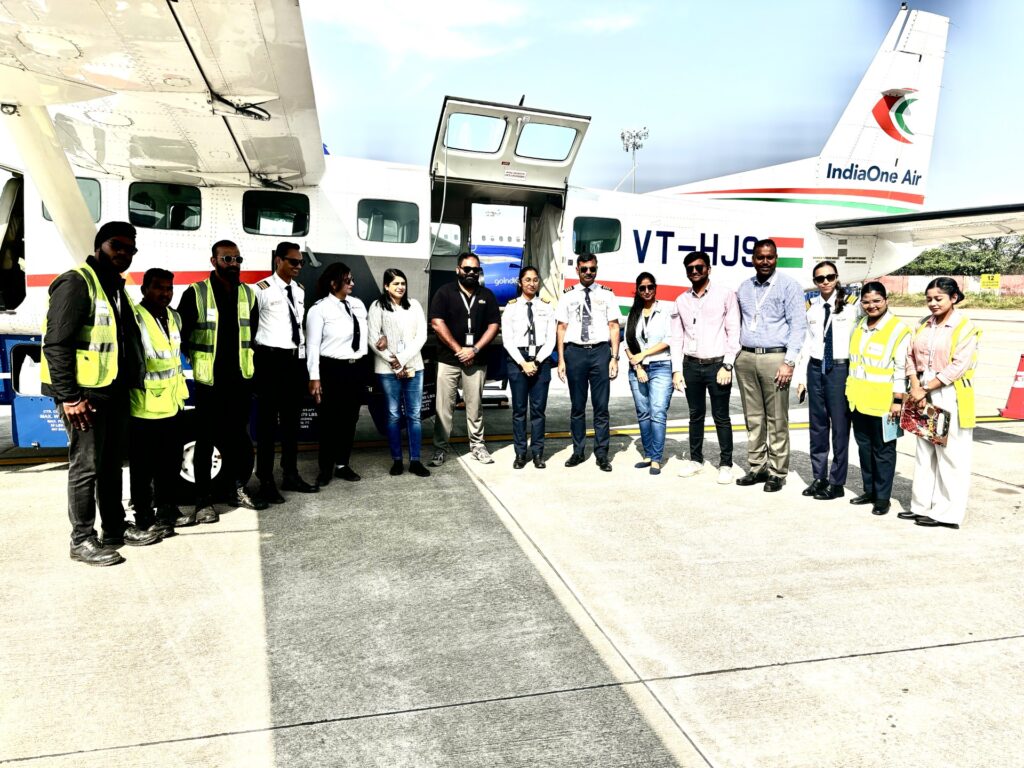
Technical training must be rethought as well. CAR 147 Type Training Organizations should be mandated to integrate On-the-Job Training (OJT) into a single, cohesive package for trainees. This ensures that new licensed AMEs emerge from training fully prepared to enter the workforce, reducing the lag between certification and employability. The current output of technical training institutions does not match the nation’s needs; integrating OJT into classroom curricula and creating local industry tie-ups can rapidly boost the number of competent technicians available to regional carriers and MROs.
Which brings us to maintenance, repair, and overhaul (MRO)—a vital element for regional aviation sustainability. Despite government initiatives, the majority of MRO revenues continue to flow overseas, with roughly 80% leaving the country. This dependence forces operators to incur high ferry costs and long downtimes. To stem this outflow and cultivate homegrown capability, targeted incentives for regional MROs are essential. Policy measures could include a tax holiday for regional MRO investments under a ₹100 crore capex threshold, extending customs duty waivers on spares and tools beyond UDAN beneficiaries to non-scheduled operators (NSOPs) in Tier-3 markets, and offering rent-free gestation periods of 18 to 24 months after land allotment so firms can build infrastructure before operations commence. Such measures would lower entry barriers, accelerate capacity building, and make domestic maintenance competitive.
The impact of localized MRO capacity is not theoretical—it is demonstrable. GMR Aero Technic’s expansion in Hyderabad created a hub that encouraged smaller operators to base aircraft locally, cutting ferry costs by around 28%. This is the kind of domino effect policymakers should seek: a single, well-supported hub catalyzes regional basing, reduces operational costs, increases aircraft utilization, and ultimately makes more routes commercially viable.
Powering India’s Regional Aviation Boom: Build a Future-Ready Talent Pipeline Now
India’s regional aviation sector is on the cusp of a transformative boom, and with this surge comes a thrilling opportunity: to build a deep, diverse, and future-ready aviation talent pipeline. If policymakers, industry leaders, training institutions, and state governments act in concert, India can not only meet the skyrocketing demand for pilots and engineers but also create a broad wave of sustainable employment that uplifts smaller cities and energizes regional economies.
At the heart of this endeavour is a simple truth: people power aviation. Expanding training infrastructure is therefore non-negotiable. More pilot academies, aerospace engineering programs, maintenance and avionics institutes, and aviation management courses across states will be essential to keep pace with fleet expansions and new regional routes. Geographic dispersal of these institutions—beyond metropolitan centers into tier-2 and tier-3 cities—will ensure a geographically representative workforce and reduce barriers for talented youth from smaller towns.

Yet building bricks-and-mortar institutions alone won’t be enough. Deeper, structured industry–academia collaboration is critical. Airlines, MROs, airport operators, and technology providers must partner closely with colleges and training academies to co-design curricula, offer internship pathways, and provide hands-on exposure to contemporary aircraft systems, digital tools, and safety-management practices. Apprenticeship models and industry-led labs will enable trainees to graduate job-ready, reducing onboarding time for employers and ensuring training continually evolves with operational and technological advances—whether in avionics, sustainable aviation fuels, or digital operations.
State-led regional skill development initiatives can accelerate this alignment. By integrating aviation workforce programs into broader regional airport development strategies, state governments can create synergies that boost local employment while supporting infrastructure growth. Policies that incentivize the establishment of training centers near new or upgraded regional airports—through land allotments, tax breaks, or seed funding—can knit together education, operations, and regional connectivity into a coherent growth plan.
Access and affordability are other critical levers. Aviation training is capital-intensive, and without thoughtful financial support mechanisms, many talented aspirants will be shut out. Scholarships targeted at underserved communities, income-contingent loans, subsidized training seats, and employer-sponsored apprenticeships can democratize access. Incentives such as placement guarantees or tax benefits for airlines that sponsor local trainees will further align private incentives with public goals.
Importantly, the ripple effects of regional aviation extend far beyond pilots and engineers. Each new route and operational airport becomes a hub of economic activity: ground handling and cargo operations, airport retail and hospitality, passenger services, logistics, tourism enterprises, and construction and maintenance work. These sectors create diverse employment opportunities that can absorb a wide range of skills and educational backgrounds, empowering local populations with stable, long-term livelihoods. By unlocking connectivity for smaller cities, regional aviation catalyzes supply-chain linkages, stimulates tourism, and attracts business investment—fuelling inclusive regional development.
To realize this vision, coordination is paramount. A national framework that sets competency standards, encourages public–private partnerships, and channels funding into both capital and human resources will provide direction. Simultaneously, flexible state-level strategies can adapt national objectives to local needs—prioritizing specific training specializations linked to nearby airport roles or regional industry clusters. Periodic stakeholder forums, industry advisory boards within academic institutions, and monitoring mechanisms will ensure responsiveness and continuous improvement.