Skyroot’s maiden orbital success has proved that an Indian private company can build a rocket capable of reaching orbit. The major task now is to turn an extraordinary mission into an ordinary, dependable and financeable launch service.
Lt Gen AK Bhatt (r) & Akshat Johri
A successful launch earns applause. A hundred successful launches build a space power.
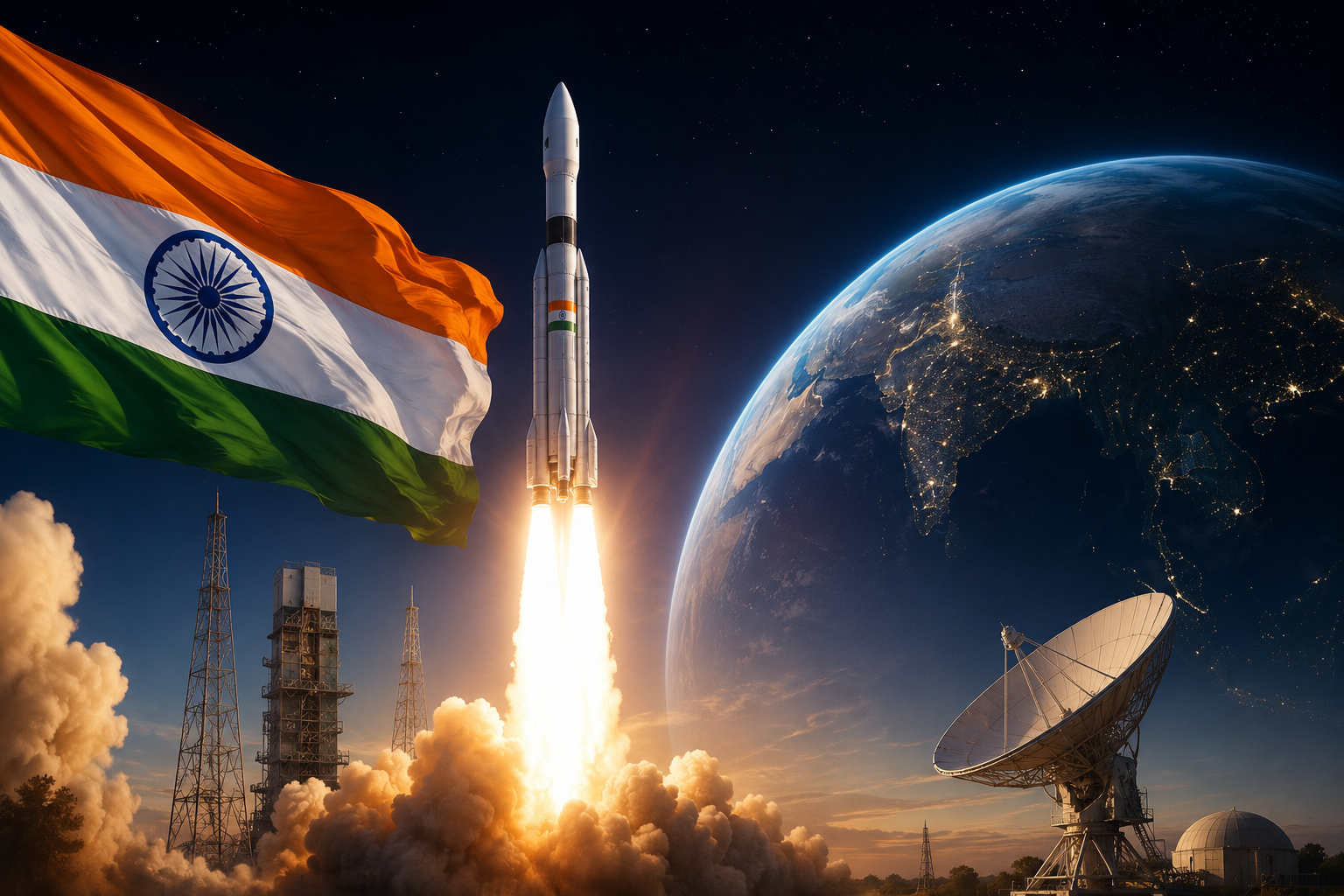
At 12:05:30 pm on July 18, Skyroot Aerospace’s Vikram-1 lifted off from the Satish Dhawan Space Centre at Sriharikota. The four-stage vehicle carried two satellites—SCOPE and Grahaa—into low Earth orbit, while other payloads remained attached to the upper stage for in-orbit experiments. It was the first orbital launch undertaken by an Indian private company from Indian soil—and it succeeded on its maiden attempt. (ISRO)
The achievement deserves to be celebrated without qualification. A privately designed and manufactured Indian rocket, built by a company founded only in 2018, crossed the technological threshold that separates rocket developers from genuine launch providers. Vikram-1 validated its propulsion, guidance, avionics, telemetry and stage-separation systems, placing its payloads into an orbit of roughly 450 kilometres. (Reuters)
It is a victory for Skyroot’s founders, Pawan Kumar Chandana and Naga Bharath Daka, for the hundreds of young engineers who built the vehicle, and for the reforms that opened India’s space sector to private participation after 2020.
But Vikram-1’s greatest significance may not lie in the launch that has just taken place.
The first flight has proved that Skyroot can build a rocket. Cadence will decide whether India can build a private launch economy.
The difference between a rocket and a launch business
Customers do not ultimately buy rockets. They buy reliable access to a particular orbit within a promised window. Satellite operators plan manufacturing, financing, insurance, ground operations and commercial service around a launch date. For them, the worth of a launch provider turns not on whether its vehicle can fly, but on whether it can fly when required.
That is why the transition from Vikram-1’s first flight to its first series of commercial missions will matter far more than it may appear.
Skyroot has said it is analysing extensive flight data and targeting another Vikram-1 mission by the end of 2026, subject to any changes the post-flight review may require. Commercial launches are expected to follow. The company also aims to build the capacity to manufacture one Vikram-1 every month. (The Times of India)
That distinction is fundamental.
One rocket a month is a manufacturing target. One launch a month is an economic system.
Skyroot is selling time, not merely kilograms
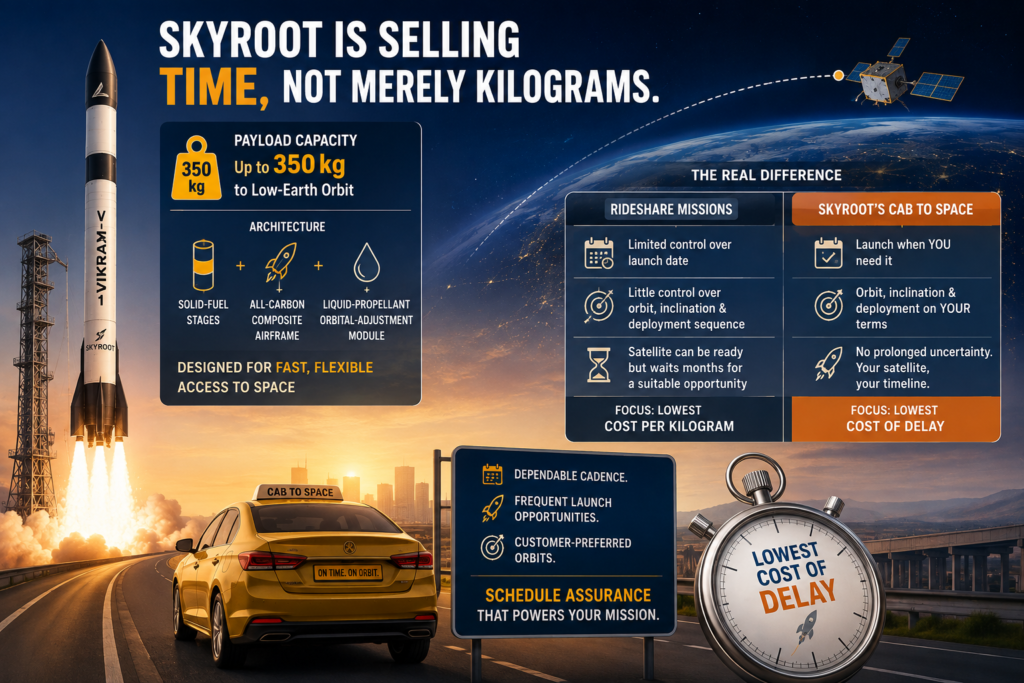
The vehicle can place up to 350 kilograms into low-Earth orbit. It pairs solid-fuel stages with an all-carbon-composite airframe and a liquid-propellant orbital-adjustment module—an architecture designed to provide small-satellite customers with comparatively fast and flexible access to space. (Reuters)
But focusing only on payload capacity or cost per kilogram misreads its commercial proposition.
Small satellites can often ride as secondary payloads aboard larger rockets. Such rideshare missions may offer attractive prices, but the customer usually has little control over the date, target orbit, inclination and deployment sequence. A satellite can be technically ready yet wait months for a suitable opportunity.
For many customers, the decisive figure will not be the lowest cost per kilogram, but the lowest cost of delay.
This is where dependable cadence becomes central to Skyroot’s “cab to space” proposition. A cab is valuable because it leaves when the passenger needs it and travels towards the required destination.
Vikram-1’s long-term advantage must therefore be expressed as schedule assurance: clearly defined integration periods, frequent launch opportunities and the ability to place satellites into customer-preferred orbits without prolonged uncertainty.
Launch India, Build India
The uncomfortable truth of the global small-launch market is that a technically capable rocket does not automatically generate enough demand to fill a frequent launch schedule. A dedicated small launcher must compete through responsiveness, orbital precision, schedule certainty and customer service.
SpaceX’s launch frequency offers a useful—but often misread—comparison. Its cadence has not been built on reusable boosters alone. It has also been sustained by recurring internal demand from the Starlink constellation.
Skyroot has no equivalent captive constellation today. Its cadence will therefore have to be built through a diverse and dependable commercial manifest.
However, the long-term success of Vikram-1 cannot depend solely on attracting overseas customers. India’s own satellite manufacturers and payload developers must become the primary drivers of the launch pipeline. As Indian companies build larger Earth observation, communications, navigation, climate, maritime and defence constellations, they should increasingly look to Indian launch providers as their first choice. A vibrant domestic payload ecosystem will provide the demand certainty that enables regular launches, while regular launches, in turn, will encourage greater investment in indigenous satellite manufacturing. The two sectors must evolve together in a virtuous cycle.
India must also develop mechanisms to aggregate smaller payloads. Many universities, research institutions and early-stage startups possess spacecraft that are too small to justify procuring an entire mission independently.
Ultimately, the most valuable engine for Vikram-1 may not be the one that powers the rocket—it may be the pipeline of Indian satellites waiting to fly. A launch vehicle without payloads is an engineering marvel; a launch vehicle with a sustained domestic manifest becomes a national strategic asset.
Government must evolve from enabler to anchor customer
The success of Vikram-1 is inseparable from India’s institutional reforms.
ISRO and IN-SPACe also played an indispensable role in Mission Aagaman. At Sriharikota, the agency opened its solid-motor casting and static-test infrastructure to the company and supported trajectory analysis, stage handling, integration, testing and the launch campaign itself. (ISRO)
This is an effective model of state capacity enabling private innovation. But the next phase of reform must treat demand as seriously as supply.
Government should not permanently guarantee the revenues of individual companies. It can, however, become a sophisticated anchor customer for capabilities that carry strategic and developmental value.
India could consider multi-year framework agreements under which authorised launch providers compete for a pipeline of government missions. Rather than procure each flight through a wholly separate process, agencies could set block requirements covering technology demonstrations, Earth-observation spacecraft, communications payloads and rapid-replacement satellites.
Policy opened the supply side of private space. Procurement must now help activate the demand side.
From access to infrastructure-as-a-service
Vikram-1 also underscores the importance of public-space infrastructure.
Sriharikota was designed primarily around national missions. Its successful use by Skyroot is an important precedent. But if several Indian companies are to run regular launch programmes, access to integration buildings, test facilities, tracking systems and launch ranges will have to become far more predictable and service-oriented.
In other words, India must move from providing access to facilities to providing launch infrastructure as a service.
The upcoming SSLV launch complex at Kulasekarapattinam, now planned for transfer to the private sector for operations, has been designed in part to accommodate launch activities by non-government entities, with its second launch complex targeted for completion by the end of 2026. (ISRO)
That site could become more than an additional launch location. It could anchor a new operating model in which government-owned ranges support multiple launch providers through transparent service standards and commercially legible interfaces.
As the number of missions grows, spaceport turnaround time may come to matter as much as rocket-production time.
Cadence changes the financing equation
Vikram-1’s first flight has sharply reduced one category of risk: the uncertainty over whether the vehicle can actually reach orbit.
But investors, lenders, insurers and customers will now weigh a different set of risks: manufacturing consistency, schedule performance, repeat reliability, customer concentration, working-capital needs and the ability to convert signed contracts into completed missions.
Cadence is what turns technical credibility into financial credibility.
A regular series of launches produces operational data. It lets insurers assess reliability from demonstrated performance rather than engineering projections alone. It gives suppliers visibility over future orders. It lets customers reserve missions with more confidence. It improves revenue predictability and can eventually let a company finance part of its growth through structured debt rather than relying almost entirely on successive equity rounds.
Predictable demand, milestone-based customer payments, and repeatable schedules can gradually change the character of the enterprise—from an experimental technology venture to a transportation and infrastructure business.
The first successful flight attracts attention and equity. Repeated successful flights create the possibility of financeability.
Cadence is strategic sovereignty
The case for cadence is not only commercial.
Cadence can also become an instrument of foreign policy. India could offer responsive launch opportunities to friendly countries that own small satellites but lack independent access to orbit. Such partnerships could deepen strategic ties while building the international customer base Indian launch companies will need.
Launch capability means India can place payloads into orbit. Launch cadence means India can respond through orbit.
History happens once. Industries happen repeatedly
Vikram-1 has already earned its place in Indian space history. Its all-carbon-composite structure, 3D-printed orbital-stage engine and pneumatic separation system reflect the technological confidence of a new generation of Indian engineers. The mission shows what becomes possible when public institutions supply infrastructure and technical support while entrepreneurs shoulder the commercial and technological risk of building something new. (The Times of India)
But the enduring value of Mission Aagaman will be set by what follows: the second flight, the first routine commercial mission, the first repeat customer, the first multi-launch agreement—and eventually, a calendar measured not in isolated milestones but in months and weeks.
India does not merely need more rockets. It needs a launch calendar that customers can schedule against, investors can finance, insurers can underwrite and strategic users can depend upon.
The first flight made Skyroot historic.
Cadence can make it indispensable.
. Views expressed are personal to the authors.