Staff Correspondent
The contemporary global security environment is characterized by rapid technological evolution, shifting geopolitical alignments, and an expanding market for advanced military capabilities. Within this complex milieu, state actors and defence industries pursue innovations that recalibrate the balance of power, extend operational reach, and provide novel options for deterrence and coercion. The introduction of the Garpia-A1E loitering munition system by JSC Rosoboronexport—developed and manufactured by the Almaz-Antey Air and Space Defence Corporation and marketed within the Rostec State Corporation umbrella—represents a salient development in the proliferation of long-range, precision-strike unmanned systems. This essay evaluates the technical, operational, strategic, and geopolitical implications of the Garpia-A1E’s entry into the international arms market, situating it within broader trends in unmanned aerial systems (UAS), arms export dynamics, and defence-industrial policy.
Technical & Operational Characteristics
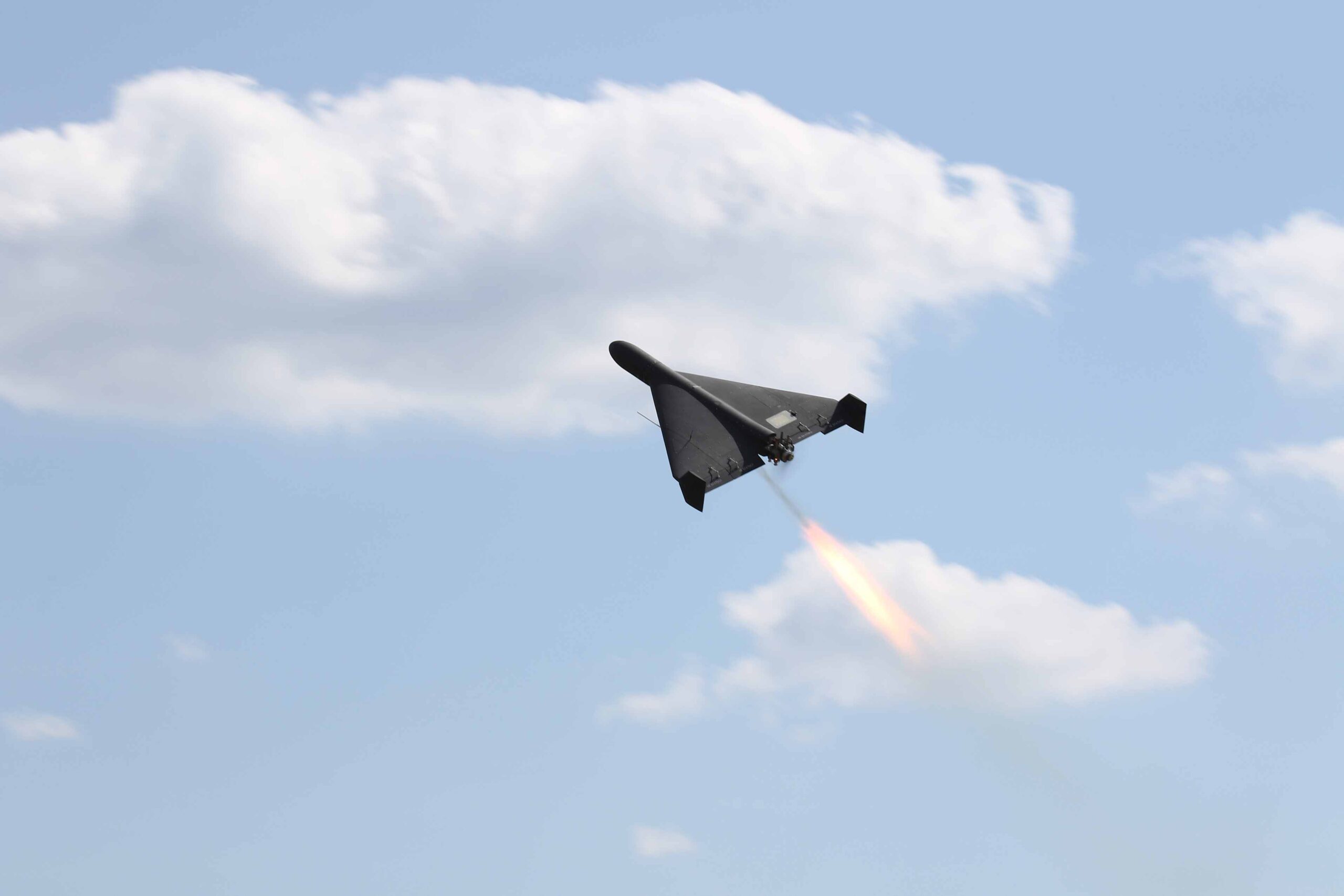
The Garpia-A1E, as presented by Rosoboronexport, is distinguished foremost by its range and payload capabilities. Described as the only loitering munition currently available on the global market with an operational range of up to 1,000 kilometres, the system claims a combination of endurance, precision, and lethality not commonly found in comparable platforms. Key technical attributes include a loitering munition (BLA-D) configured as a flying wing with a pusher-propeller gasoline engine; flight envelope parameters of 50 to 2,500 meters altitude and a maximum speed of at least 170 km/h; an endurance of at least six hours; and an automated flight regime. The munition’s dimensions—3.4 meters in fuselage length, a 3-meter wingspan, and a takeoff weight of 250 kilograms—paired with a warhead capacity exceeding 50 kilograms and a claimed circular error probable (CEP) of no more than four meters, suggest an asset capable of engaging fixed targets with high precision at operationally meaningful distances.
These characteristics converge to yield several operational advantages. Long-range reach expands standoff options, permitting targeting beyond the range of many conventional air-defence envelopes and enabling cross-border missions from dispersed launch sites. Significant endurance and automated flight reduce the burden on command-and-control architectures and increase persistence over target areas, facilitating time-on-station for reconnaissance, target verification, and sequencing of engagement. The substantial warhead mass and tight CEP combine to produce a highly effective effect against fixed infrastructure, hardened point targets, and high-value assets, while reducing collateral damage when employed with accurate geolocation. The flying wing design may offer favourable aerodynamic efficiency, lower radar cross-section, and simplicity of manufacture relative to more complex airframes.
Strategic Implications for Force Projection & Doctrine
The deployment and transfer of long-range loitering munitions such as the Garpia-A1E have implications for doctrine, operational art, and force structure. For exporting states and their partners, acquisition of an extended-range, precision loitering munition provides a relatively low-cost means of augmenting strike capacity without the political and fiscal overhead associated with crewed aircraft or larger missile systems. For military planners, such systems enable distributed lethality concepts: dispersed launch and control nodes can complicate adversary targeting and strengthen resilience. The availability of long-endurance, automated loitering munitions supports counter-stealth, anti-access/area-denial (A2/AD) penetration strategies, and can be integrated into layered strike architectures to complement ballistic and cruise missiles, guided artillery, and manned aviation.
Conversely, the proliferation of such systems can drive changes in adversary defensive postures. Extended-range small–to–medium-sized munitions increase the surface area of potential threat vectors, necessitating enhancements in early warning, integrated air defence systems, electronic warfare, and counter-UAS measures. The operational calculus of deterrence may shift, as states or non-state actors equipped with long-range loitering munitions acquire new capabilities to hold critical infrastructure at risk from greater stand-off distances. These dynamics can catalyze arms competition in both offensive and defensive domains, affecting regional stability.
Arms Export Policy & Industrial Considerations
Rosoboronexport’s role as Russia’s sole state intermediary for defence exports places the Garpia-A1E within a centralized framework of state-managed arms transfer policy. The corporation’s claim to account for over 85% of Russia’s defence exports and its cooperation with more than 700 domestic enterprises underscores the state-directed nature of military-technical cooperation. In this institutional context, the introduction of the Garpia-A1E aligns with several policy objectives: sustaining Russia’s market share in the global arms trade, projecting technological prowess, and cultivating strategic partnerships through military-technical cooperation.
Alexander Mikheev’s statement regarding Almaz-Antey’s readiness to fulfil foreign contracts without compromising Russian defence requirements highlights the balancing act inherent in dual-priority production: meeting domestic security demands while capitalising on export opportunities. Rosoboronexport’s openness to localization of production in friendly states reflects a common export strategy intended to enhance market access, reduce recipient political risk, and deepen bilateral ties. Localization can also transfer production capacity and technical know-how, potentially embedding Russian systems within partner militaries’ logistics and doctrine—an outcome with lasting strategic value.
Geopolitical Context & Export Controls
The marketing of a long-range precision loitering munition intersects with a contentious geopolitical environment. The transfer of advanced strike systems, particularly those that enable long-range precision engagement, is subject to scrutiny under various international frameworks and export control regimes. While no single multilateral treaty exclusively governs the export of loitering munitions, recipient selection, end-use assurances, and compliance with international humanitarian law (IHL) obligations remain salient concerns for exporting states and the international community. The potential for such systems to alter regional power balances may attract countermeasures, sanctions, or diplomatic pressure from third-party states seeking to limit their proliferation.
Rosoboronexport’s targeting of “countries friendly to Russia” as potential partners implicitly maps arms sales onto geopolitical alignments. For clients, procuring the Garpia-A1E can signify deepening strategic ties with Russia, thereby affecting regional alliance structures and defence interoperability. For states opposed to such alignments, the system’s diffusion may prompt recalibration of security cooperation, increased defence assistance, or the pursuit of asymmetric responses. Moreover, the introduction of a system with claimed high precision and long range into contested theatres can influence escalation dynamics and crisis stability, especially where attribution and thresholds for kinetic response are ambiguous.
Operational Risks, Ethical Considerations, & Legal Implications
Beyond technical capability, the employment of loitering munitions raises operational risks and ethical considerations. Autonomous or automated flight does not equate to full autonomy in target selection; ensuring human oversight in the engagement decision-making chain is critical to compliance with IHL principles such as distinction, proportionality, and precaution. Systems with long loiter times and automated modes can present complex command-and-control and human-machine interface challenges that require rigorous doctrine, training, and safeguards to prevent misidentification or unintended engagements.
There is also the risk of diversion, capture, or reverse engineering of exported systems. Once fielded, advanced platforms can be replicated, adapted, or used in ways inconsistent with the supplier’s intent. Such risks underscore the importance of end-use monitoring, export licensing regimes, and potential technological safeguards embedded in supplied systems—though these measures are imperfect.
Market Dynamics & Competitive Positioning
The arms market for unmanned systems is increasingly competitive, with state and non-state producers offering a spectrum of solutions from small tactical loitering munitions to high-end combat UAVs and cruise missiles. The Garpia-A1E differentiates itself by the combination of long range, substantial warhead payload, and claimed precision—attributes that, if corroborated in independent operational assessments, could position it favourably against competitors. Its gasoline-powered propulsion and relatively compact size may reduce acquisition and operating costs compared to larger turbofan-powered systems, thereby broadening its appeal to states seeking cost-effective precision-strike capabilities.
However, market acceptance will depend on demonstrable reliability, logistic support, training, interoperability with customer command-and-control systems, and political considerations. The offer to localize production can be an attractive commercial proposition, offering economic benefits to purchasers and strengthening long-term dependence on Russian maintenance, spare parts, and upgrades. Conversely, customers may weigh the reputational and diplomatic costs of procuring advanced strike systems from a particular supplier against prospective operational gains.
Implications for Regional Security Architectures
The diffusion of long-range loitering munitions has distinct regional implications. In theatres where Russia or its partners have cultivated influence, the Garpia-A1E could enable clients to establish asymmetric deterrent capabilities or expand their reach against adversaries’ critical infrastructure. In multipolar regions, these systems may spur neighbours to seek countermeasures, leading to procurement cascades in air defence, electronic warfare, and cyber capabilities. Such procurement patterns can exacerbate security dilemmas, heighten military expenditures, and complicate conflict management.
Where borders are porous, or disputes are unresolved, the availability of stand-off precision strike systems increases the risk of cross-border incidents and escalation. Conversely, states possessing credible oversight, robust legal frameworks, and responsible doctrine could incorporate such capabilities into defensive postures without destabilizing effects. Ultimately, the regional outcome depends on the interplay of capability diffusion, diplomatic engagement, and confidence-building measures among affected states.
The Garpia-A1E loitering munition system, as marketed by Rosoboronexport and produced by Almaz-Antey, embodies several trends reshaping modern warfare: increased emphasis on unmanned systems, demand for long-range precision effects, and the strategic use of arms exports to cement international partnerships. Its claimed combination of 1,000-kilometre range, a warhead exceeding 50 kilograms, six-hour endurance, and a CEP of no more than four meters presents a compelling operational profile that, if validated, could materially affect both tactical engagements and broader strategic calculations.
The system’s introduction into the global market highlights the dual-use tension inherent in defence exports—the opportunity to generate economic returns, deepen alliances, and project influence, alongside risks to regional stability, escalation dynamics, and legal and ethical constraints. How recipients integrate the Garpia-A1E into their force structures, and how rival states react, will determine whether its proliferation contributes to deterrence stability, arms competition, or a recalibrated security environment.
In navigating these developments, policymakers and defence planners must weigh operational advantages against normative and strategic considerations. Transparent export practices, adherence to international law, rigorous end-use monitoring, and multilateral dialogue about the implications of long-range loitering munitions can help mitigate adverse consequences. At the same time, states seeking to preserve their sovereign security interests will continue to pursue capabilities that offer precision, reach, and affordability—criteria that the Garpia-A1E is expressly designed to meet. The consequent evolution of doctrines, alliances, and defence-industrial linkages will be an important element of twenty-first-century security dynamics.