Dr. Shagun Aggarwal

For much of human history, space has been imagined as an endless frontier — an infinite expanse waiting to be explored. As our space capabilities grew, we pushed beyond Earth, reaching the Moon, exploring Mars, sending spacecraft to the outer planets and venturing into deep space.
But there is a paradox at the heart of the new space age.
Space may be infinite, but the orbits around Earth are not.
Earth orbit should therefore not be thought of as an empty three-dimensional space, but as a collection of increasingly occupied orbital “shells”. Certain combinations of altitude and inclination are particularly valuable for Earth observation, communications, navigation and scientific missions. As more spacecraft are placed into these regimes, the issue is not simply the number of objects in space, but the amount of usable orbital capacity.
Since the dawn of the space age in 1957, humanity has launched over 16,000 objects into orbit. Many have since re-entered the atmosphere and burned up, but the debris left behind in orbit continues to grow. As of 2026, more than 29,187 objects are larger than 10 cm. Only 18,561 of those are active, operational satellites — the rest is debris. But this is only a fraction of the population, which has been actively tracked primarily by the US Space Surveillance Network, along with other sensors, and maintained in their catalogue. Statistical models maintained by ESA and NASA estimate approximately 1.2 million objects between 1 and 10 cm, and more than
140 million fragments smaller than 1 cm. These smaller objects are currently impossible to track individually but are large enough to cause serious damage to spacecraft.
A fragment only a few centimetres across may sound insignificant on Earth. In orbit, however, size can be deceiving. Objects in Low Earth Orbit travel at roughly 7–8 km/s. When two objects collide, their relative velocity can be even higher — in some cases reaching around 10 km/s or more. At these speeds, even a fragment no larger than a screw can behave like a bullet, carrying enough kinetic energy to damage a spacecraft critically. Large objects can be routinely tracked and catalogued, while smaller fragments may be detected only intermittently or statistically characterized through population models. This creates an important asymmetry: the objects capable of causing damage are not necessarily the objects we can reliably track.
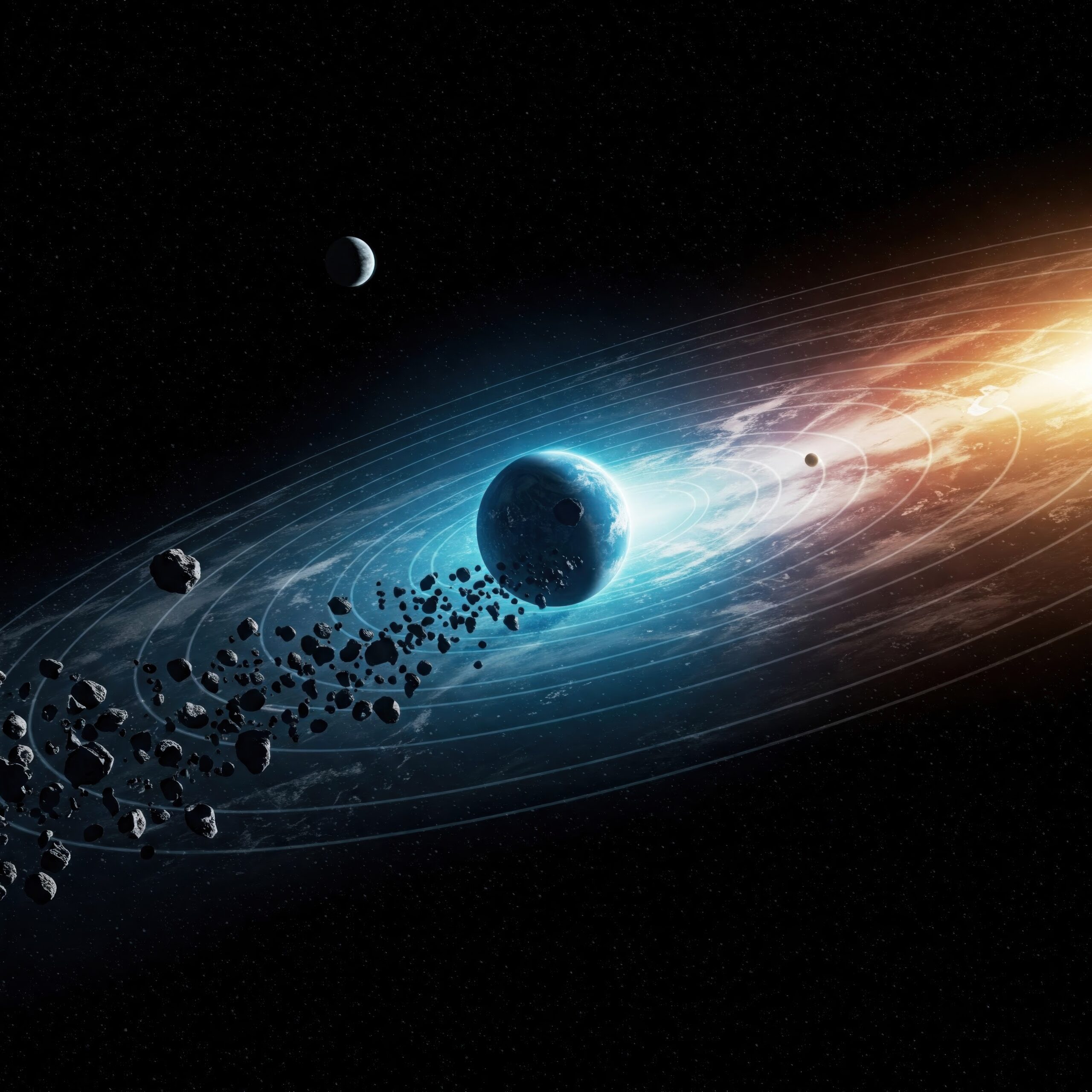
This creates orbital debris, a catastrophic problem which is inevitable with the increasing space traffic. A collision in space can create thousands of additional fragments, each becoming a new potential collision hazard. This creates a dangerous feedback loop: more objects increase the probability of collisions; collisions create more debris; and more debris increases the probability of further collisions. The problem is therefore not linear. Every collision has the potential to amplify the population of objects already present in orbit, creating a cascading effect in which the orbital environment can become progressively more difficult — and eventually more costly — to use. Debris does not originate from collisions alone. It can enter the environment through launch-vehicle stages, mission-related objects, spacecraft failures, fragmentation events, abandoned spacecraft and collisions. The debris problem must therefore be considered across the entire spacecraft lifecycle — from launch and deployment to operations, servicing and eventual disposal.
This evolution has also transformed space debris from being solely an environmental and engineering challenge into an emerging economic opportunity which can simply be described as an orbital lifecycle economy. The commercial opportunity is no longer limited to removing existing objects. An Industry is developing around space sustainability — from debris removal and end-of-life services to collision avoidance, traffic coordination, monitoring, mitigation technologies and spacecraft designed to operate safely in increasingly congested orbital regimes.
Space Situational Awareness (SSA) and Space Domain Awareness (SDA) technologies have evolved considerably, with many systems now reaching high Technology Readiness Levels (TRLs). Improved tracking networks, radar and optical sensors, onboard navigation, conjunction assessment, data fusion and increasingly sophisticated modelling capabilities are giving a much clearer picture of what is happening around Earth. SSA and SDA can help us identify objects, estimate their trajectories and assess potential conjunctions. They can enable spacecraft operators to manoeuvre, avoid collisions and make better-informed decisions. Mission designers can increasingly incorporate debris and traffic considerations from the beginning of a mission rather than treating them as an operational problem after launch. But prediction is never perfect. Technologies such as electrodynamic tethers, drag sails, plasma brakes, deployable drag devices, and electric propulsion systems enable controlled end-of-life disposal and orbital lifetime reduction. Over the past decade, significant research and several in-orbit demonstrations have been explored.
Yet, despite this technological progress, one fundamental challenge remains: the unpredictable nature of the space environment.
Orbital objects are continuously influenced by atmospheric drag, solar activity, gravitational perturbations, spacecraft manoeuvres and interactions with an environment that we cannot completely control or measure. The smaller the object, the more difficult it becomes to track, characterize and predict its trajectory accurately. This is why space traffic is no longer a distant or hypothetical concern. The emergence of Very Low Earth Orbit (VLEO) missions is one indication of how rapidly the orbital environment is evolving. As we move into lower altitudes to exploit advantages such as reduced latency, improved imaging resolution and new commercial applications, we are also entering an orbital regime where atmospheric variability and spacecraft–environment interactions become increasingly important.
The challenge, therefore, is not simply to know where objects are. It is to understand where they will be, how confidently the systems can predict their position, how the environment will change their trajectories, and what decisions should be made before uncertainty becomes a collision.
In 2024, ISRO announced its Debris Free Space Mission (DFSM) initiative, intending to achieve debris-free space missions by Indian governmental and non-governmental space actors by 2030. The approach goes beyond tracking existing debris. It calls for debris considerations to be incorporated into mission design, including orbital selection, fuel budgeting for post-mission disposal, trajectory planning, controlled re-entry and spacecraft reliability. India has also been building the operational infrastructure required to support this philosophy through ISRO’s System for Safe and Sustainable Space Operations Management (IS4OM) and the Network for Space Objects Tracking and Analysis (NETRA). The 2025 Indian Space Situational Awareness Report describes continuing development of optical and radar tracking capabilities, conjunction assessment and debris mitigation activities.

ESA’s ClearSpace-1 is an important mission being developed to rendezvous with, capture, and remove ESA’s 95 kg PROBA-1 satellite from low Earth orbit, demonstrating the technologies required for active debris removal and potentially helping to establish a future commercial debris-removal sector. Its planned launch is currently 2029. Japan has pursued a similar direction through ADRAS-J, a mission designed to demonstrate
rendezvous and proximity operations around a large piece of orbital debris. These missions demonstrate something important: removing debris is not simply a matter of reaching an object and pushing it down. The target may be uncontrolled, rotating, poorly characterized and never designed to be captured. Navigation, attitude determination, proximity operations and capture therefore become major technological challenges.
Missions such as SpaDeX and the POEM-4 platform have demonstrated capabilities relevant to future in-orbit servicing and debris removal, including autonomous rendezvous, docking and robotic debris-capture experiments. POEM-4 was also deliberately lowered from approximately 475 km to 350 km after completing its experiments, enabling its eventual atmospheric re-entry rather than leaving another long-lived object in orbit. Alongside these government initiatives, emerging commercial efforts such as CosmoServe point towards a future Indian ecosystem for in-orbit servicing and space sustainability. Together, these efforts reflect a broader shift in India’s approach: from simply tracking orbital debris to preventing its creation, extending spacecraft lifetimes and developing the technologies needed to remove existing debris.
The next phase of space operations will not be defined only by how many satellites can be launched, how quickly they can reach orbit, or how many missions can be operated simultaneously. It will increasingly be defined by how responsibly we can use the orbital environment. Tracking and Space Domain Awareness will help us understand tractable orbital activities. Collision avoidance will help navigate an increasingly congested environment. Servicing and debris-removal technologies can address existing objects, while improved mission design and end-of-life disposal can prevent future spacecraft from becoming part of the problem.
But no single technology will solve the orbital debris problem.
What is needed is an ecosystem in which spacecraft are designed for their entire lifecycle, operators share information, governments establish effective rules, and commercial markets make sustainable behaviour economically viable.
For India, and the wider global space sector, this is both a challenge and an opportunity. The countries and companies that develop the ability to operate safely and sustainably in congested orbits will not simply be protecting the space environment — they will be building the infrastructure required for the next generation of the space economy.
Dr. Shagun Aggarwal is a space researcher specializing in space debris mitigation, with applications in spacecraft deorbiting and orbital sustainability. Her work combines experimental plasma research, geospatial analytics, and space systems design to address challenges in low Earth orbit operations.