Chaitali Bag
As the Indian Air Force (IAF) commemorates its 94th Air Force Day, it stands at a defining juncture in its evolution—from a formidable combat force to a technologically advanced, network-centric aerospace power equipped to meet the challenges of an increasingly complex and contested battlespace. As air warfare undergoes a profound transformation driven by artificial intelligence, autonomous systems, advanced sensors, precision weapons, and multi-domain integration, the IAF’s future will be shaped as much by technological superiority and operational resilience as by combat strength.
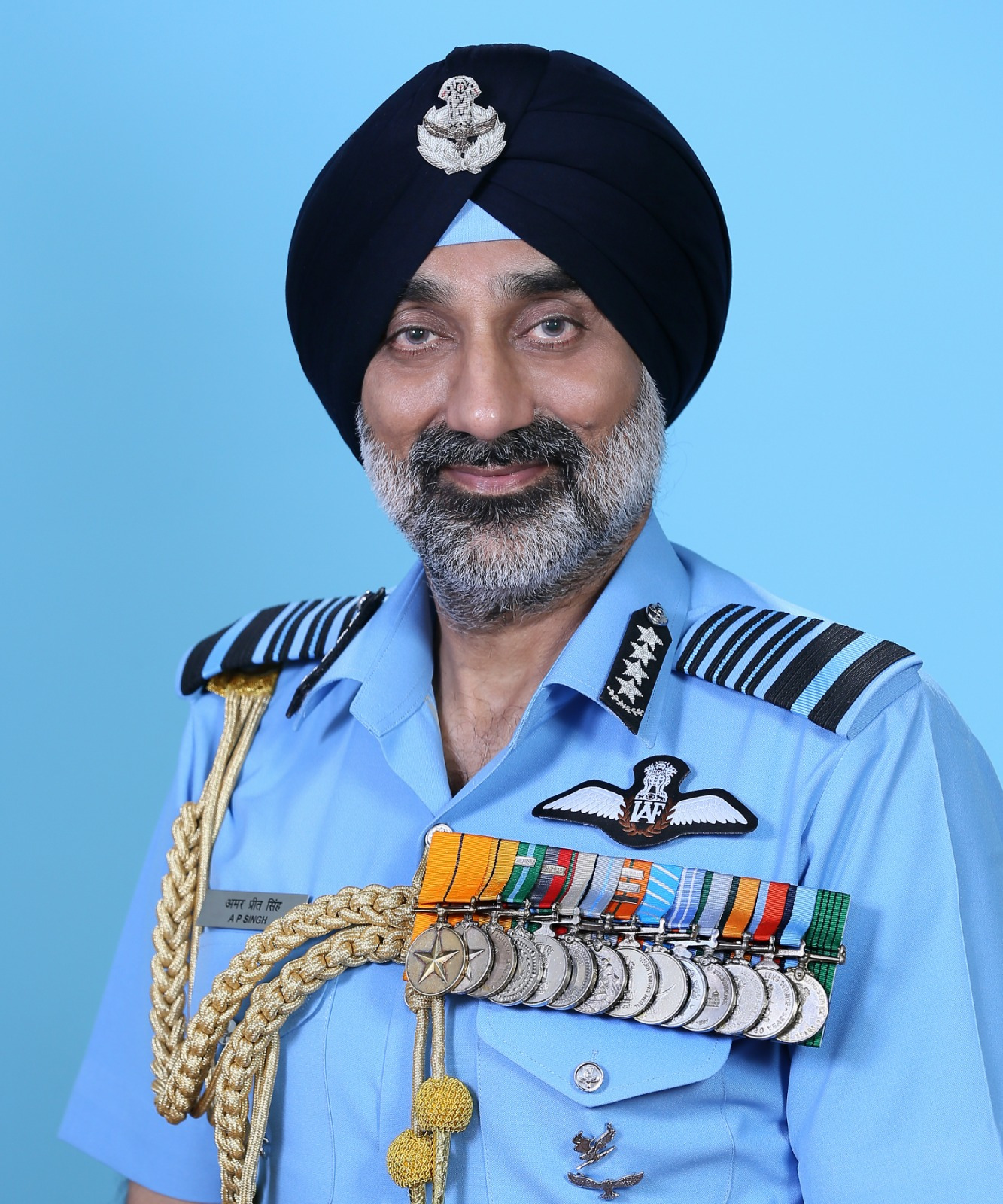
In an exclusive interaction with Indian Aerospace & Defence Magazine (IA&D), Air Chief Marshal Amar Preet Singh, PVSM, AVSM, Chief of the Air Staff, offers a compelling perspective on the IAF’s strategic priorities, capability development and long-term vision. From rebuilding fighter squadron strength and advancing indigenous combat aircraft programmes to strengthening air defence against emerging drone threats, the Chief outlines the imperatives that will define India’s air power in the decade ahead.
The conversation explores the critical importance of technological sovereignty, particularly in aero-engines, advanced sensors, electronic warfare, avionics and precision weapons, while underscoring the need for deeper collaboration between the IAF, DRDO, public and private industry, start-ups, MSMEs and academia. The interview also examines the lessons of contemporary conflicts, the evolution of counter-unmanned aircraft systems, and the Advanced Medium Combat Aircraft (AMCA) as a cornerstone of India’s future combat-air ecosystem.
Looking further ahead, Air Chief Marshal Singh articulates a vision of an Indian Air Force that is increasingly indigenous, digitally integrated, autonomous where appropriate, and capable of generating combat power across air, space, cyber and the electromagnetic spectrum. His perspective reinforces a central strategic message: India’s future air power will depend not merely on the platforms it fields, but on the technologies it owns, the networks it commands and the industrial capabilities it can sustain independently.
As India advances towards Viksit Bharat@2047, this exclusive Air Force Day interaction reflects the ambition to build an aerospace force that is operationally decisive, technologically self-reliant and prepared for the demands of tomorrow’s warfare.
Q. The IAF continues to face the long-standing challenge of maintaining adequate fighter squadron strength while simultaneously transitioning to next-generation platforms. With the 97 LCA Mk1A contract signed and the AMCA programme moving towards its next phase, what is your assessment of the IAF’s fighter fleet over the next decade?
- A. My assessment of the IAF’s fighter fleet over the next decade is one of confident transition. Our direction of travel is clear. Over the coming decade, the fleet will grow in numbers, improve in quality, and become increasingly Indian in design and manufacture.
I see the decade unfolding in two broad phases. In the first, the emphasis will be on consolidating and rebuilding strength. The Su-30MKI will remain the backbone of our combat force. Its upgrade, a design and development project with significant indigenous equipment, is progressing, and the fleet is being reinforced by 12 additional aircraft under a contract signed in December 2024. The Rafale adds a potent, contemporary capability. The LCA Mk-1A will be central to rebuilding squadron strength. With two contracts signed for 83 and 97 aircraft, the indigenous LCA family is set to grow substantially. Deliveries are yet to commence, and we are working closely with all stakeholders to ensure they proceed expeditiously. The industrial groundwork is also being laid. In November 2025, HAL concluded an agreement to supply engines and a support package for the 97-aircraft programme. Alongside this, the Multi-Role Fighter Aircraft will bring a contemporary fighter into service in the near term. The Defence Acquisition Council accorded Acceptance of Necessity for it in February 2026. Most aircraft will be manufactured in India, with maximum emphasis on technology transfer and integrating indigenously developed weapons.
The second phase, in the latter part of the decade and into the 2030s, will mark a generational shift. DRDO is developing the LCA Mk-II and the Advanced Medium Combat Aircraft, our fifth-generation fighter, with the IAF actively involved, and they will significantly boost our capability in the 2030s. As the AMCA programme moves into its next phase, its timely progress is essential, particularly since some global players, including our adversaries, have already advanced in fifth-generation programmes. We are also preparing for what lies beyond. The IAF is closely monitoring the emergence and evolution of sixth-generation combat aircraft technologies worldwide, to assess their operational relevance and potential integration into its future capability development roadmap.
By the end of the decade, therefore, the LCA, the Su-30MKI, the MRFA and the AMCA will form the core of the IAF’s combat potential. Most of these aircraft will be of indigenous design, and the rest will have significant indigenous content and be made in India. Equally important, this fleet will not operate as a collection of individual platforms. It will function as part of a networked combat system, supported by airborne early warning, aerial refuelling, electronic warfare, precision weapons and unmanned teammates, so that the whole is far greater than the sum of its parts.
The road ahead demands sustained effort, but the foundations are firmly in place. The IAF will continue to build squadron strength progressively, ensuring that over the next decade our fighter fleet is not only adequate in number but superior in capability, and increasingly built in India.
Q. What is the most urgent capability gap that must be addressed to ensure that the IAF can effectively manage a two-front or multi-domain contingency?
A. Any single platform or system cannot meet a multi-domain contingency, so I would not reduce the answer to one item on a wish list. Such a contingency demands the right combination of combat platforms, weapons, air defence, intelligence, electronic warfare, surveillance, logistics, and resilient command and control. It also demands the ability to shift these capabilities rapidly as the situation evolves. If I had to name the most urgent requirement, it would be to strengthen three things together: capability, capacity and sustenance. That is what will let us generate and sustain combat power across multiple fronts at the same time.
Capability comes first. As I have often said, the IAF has moved from a platform-centric approach to a capability-centric one, and the networked combat system I described a moment ago is its practical expression. It is what allows us to meet a two-front challenge without dividing the force rigidly between sectors. With networked sensors, aerial refuelling, long-range weapons and appropriate basing, air power can be concentrated from considerable distances and shifted rapidly to wherever the threat is greatest. That depends on resilient networks that keep situational awareness and command and control intact even under sustained attack.
Capacity is the second element. We need adequate combat mass, deeper stocks of precision and stand-off weapons, robust air and missile defence, unmanned and autonomous systems, and strong electronic warfare capabilities. Squadron strength is being rebuilt progressively along the lines outlined above. Inventory depth is being strengthened through diversified sourcing, accelerated indigenous production and assured weapons stocking. Multi-layered, mobile air defence with gap-free surveillance has emerged as a critical priority in its own right.
Sustenance is the third. In a high-intensity conflict, the first few days matter, but so does the ability to sustain operations over a prolonged period. That places a premium on logistics, maintenance, infrastructure, ammunition reserves and the resilience of our operating bases, all of which an adversary will try to disrupt from the outset. We are therefore investing in dispersal, redundancy and hardened infrastructure. We are also building a domestic industrial base capable of meeting surge requirements, because the most secure supply line begins in India.
Running through all three is an important multi-domain dimension. Air operations will increasingly depend on what happens in the space, cyber and electromagnetic domains. We must integrate these domains rather than treat them as separate capabilities, protect the space-enabled networks we rely on, and prepare to operate even when they are degraded.
None of these requirements is beyond our reach, and work on each is already well underway. The IAF is committed to building a force with the capability to fight as one, the capacity to prevail and the sustenance to endure, however many fronts the nation may have to face.
Q. India has made significant strides in indigenous defence manufacturing. What critical aerospace and defence technologies—particularly aero-engines, AESA radars, electronic warfare, advanced sensors, propulsion, avionics, and precision weapons—does the IAF believe India must urgently develop and own end-to-end to achieve true technological sovereignty?
A. India’s defence industry has made impressive progress in recent years, and the IAF is proud to be part of that journey. But true technological sovereignty will come only when we stop depending on foreign sources for the technologies that decide the outcome of an air war. Sovereignty does not mean manufacturing every component in India. It means end-to-end ownership of the technologies critical to combat effectiveness, survivability, and strategic freedom of action.
Those technologies span the full breadth of modern air power. They include aero-engines and propulsion, AESA radars, advanced seekers and sensors, electronic warfare, secure avionics and mission systems, and precision weapons with their critical electronics and software. Advanced metallurgy, manufacturing technologies and stealth materials underpin all of them. Equally important are data fusion and net-centric capability, AI-enabled and autonomous systems, Manned–Unmanned Teaming, swarm and counter-swarm capability, persistent ISR, hypersonic weapons and quantum communication.
Technological sovereignty is an ecosystem, not a single product. Industry must own the complete chain of design, manufacture, integration, testing, maintenance and upgrade, not merely assemble platforms. The IAF is deeply involved in this effort alongside DRDO, the DPSUs and private industry. DRDO-led programmes now include Development-cum-Production Partners supported by tier-2 sub-vendors, and MSMEs and start-ups are taking up a growing number of projects. DPSUs and large private players must also expand production capacity, especially for weapon systems, to meet surge requirements in a contingency.
Maintenance tests sovereignty every day. An aircraft or system that cannot be sustained, repaired and upgraded in India remains dependent on its foreign manufacturer. For the IAF, owning a technology therefore means owning its entire life cycle for aero-engines, including indigenous overhaul and repair down to hot-section components. For radars and sensors, it means in-country repair down to the module level. For precision weapons, it means the ability to test, refurbish, re-certify and extend shelf life in India.
Digital twins can transform this effort. A digital twin of each aircraft, engine, and critical sub-system is continuously fed by health-monitoring, flight, and maintenance data and analysed with AI. It lets us forecast failures before they occur and move from calendar-based to condition-based, predictive maintenance. The result is fewer unscheduled groundings, better spares planning, faster depot turnaround and higher serviceability, especially during surge. The same data can flow back to DRDO and industry to improve reliability and shape the next upgrade.
For this to work, we need indigenous test benches, diagnostic tools, maintenance-analytics software, common data standards, secure data-sharing, and active management of obsolescence. Contracts must also include technology transfer and repair rights from day one. Maintenance sovereignty must be treated as a core part of technological sovereignty, not as an afterthought.
Unless India controls the technologies at the heart of its combat systems, operational independence will remain incomplete. With them, India will have an air power that is truly its own. The IAF is committed to working with Indian industry, research institutions, and academia to make that a reality, so the capabilities that decide tomorrow’s air battles are designed, built, sustained, and controlled in India.
Q. What role can the Indian Air Force play in creating a stronger partnership with Indian industry, MSMEs, start-ups and academia to accelerate indigenous R&D? Going forward, how can the IAF become not merely a customer of domestically developed technologies, but an active catalyst and early adopter of disruptive technologies that can give India a decisive operational advantage?
A. The relationship between the Defence Forces and Indian industry has to evolve from a traditional customer–supplier arrangement into a genuine partnership in capability development. For the IAF, this means moving from being a buyer at the end of the process to a stakeholder from day one. Indian industry, MSMEs, start-ups and academia have enormous technological talent. Our task is to channel it toward the operational problems that matter most and help turn the resulting solutions into battlefield advantage.
We have built strong foundations for this partnership. The Directorate of Aerospace Design at Air Headquarters is the nodal directorate for Make, iDEX and DRDO’s Technology Development Fund projects. It conveys our requirements to industry, assesses industry potential and hand-holds participating firms. We have commissioned two units of the Regional Aerospace and Innovation Division, at Gandhinagar and Bengaluru. At the Tri-Services Academia Technology Symposium in 2025, held on the sidelines of Aero India, the IAF released a compendium of “Technological Challenges and Opportunities” and signed nine MoUs with academic institutions.
Through the Directorate of Indigenisation, the IAF formulates clear, long-term self-reliance policies, maintains a database of capability gaps, and provides early-stage, operationally relevant specifications, while the BRDs translate feasibility studies into field-ready solutions, creating a seamless flow from research to development. By co‑funding R&D, offering joint test‑bed facilities, granting fast‑track access to operational data and conducting early adopter trials, the IAF can de‑risk disruptive innovations, accelerate technology maturation, and ensure that home‑grown systems are shaped to deliver decisive operational advantage.
The results are tangible. More than 175 projects under Make, iDEX and TDF are in progress, creating business opportunities worth more than ₹30,000 crore for Indian private industry. Several Make and iDEX projects, including those under ADITI, have prototypes ready for bulk production. The domestic share of the IAF’s capital expenditure in FY 2024-25 and FY 2025-26 was approximately 90 per cent, well above the Ministry of Defence guideline of 70 per cent. As this is the first tranche of such projects, we are also refining processes with the Department of Defence Production to enable faster processing without compromising quality or oversight.
The next step is a systematic, continuous innovation pipeline, and that is where the IAF can act as a true catalyst. It begins with clearly articulating the operational problem through structured channels and challenge-based innovation that defines the problem rather than prescribing the equipment. Our domain experts and operational users will take part in development from the outset, as technology champions. As an informed early adopter, the IAF will open its test facilities and data to trusted partners, fund milestone-based prototypes, and rapidly and iteratively evaluate early versions, wherever operational security and safety permit. Every successful prototype must then have a clear pathway to scale, through limited “test and buy” inductions, spiral upgrades, predictable contracts and assured orders.
Maintenance is one of the richest areas for such partnerships, because it is where operational problems are felt every day on the flight line. Our Base Repair Depots and units deal with ageing fleets, component obsolescence, spares shortages and long turnaround times, while needing to sustain high serviceability in a contingency. We intend to put these challenges before industry and academia in the same challenge-based manner. They include:
- predictive maintenance built on digital twins
- AI-based fault diagnosis
- reverse-engineering of obsolete components
- additive manufacturing of spares
- advanced non-destructive testing
- automated test equipment
Academia can contribute to fatigue analysis, materials and prognostics. Start-ups and MSMEs can grow into reliable Tier-2 sustainment partners. The IAF will share curated maintenance data with trusted partners and evaluate prototypes in live maintenance conditions, within the bounds of flight safety and airworthiness.
The larger objective is an environment in which an Indian innovator can approach the IAF not merely with a product, but with a solution to an operational problem, and find a partner ready to test, refine and field it. In this way, the IAF can turn India’s innovation ecosystem into battlefield advantage, while retaining the design authority, intellectual property and freedom to upgrade that lasting technological sovereignty requires. That is how the IAF will become not just a customer of Indian technology, but a catalyst for it.
Q. The proliferation of drones, loitering munitions and low-cost unmanned platforms is fundamentally changing the character of air warfare. What key lessons has the Indian Air Force drawn from the operational experience of the past year, and how is it strengthening and redesigning its Counter-UAS architecture to address increasingly sophisticated and massed drone threats?
A. The experience of recent conflicts has made one thing unmistakably clear: the drone is no longer a niche capability. It is now an integral part of the modern battlespace. The threat is also evolving rapidly, from individual drones to coordinated, networked and potentially massed attacks involving many different types of unmanned systems, including swarms and loitering munitions.
Operation Sindoor offered the most important of these lessons. It demonstrated the value of an integrated, layered air defence architecture in which counter-UAS systems, conventional air defence, electronic warfare, sensors and command-and-control structures operate as a single network rather than as isolated capabilities. The adversary launched a large number of drones and stand-off weapons against us. Our home-grown, networked air defence, with IAF surface-to-air missile and counter-UAS units supported by the Indian Army’s air defence units, all operating under the control of IACCS nodes, safeguarded our critical assets.
Three further lessons now guide our approach. The first is that an effective counter-UAS architecture must combine detection, identification, tracking and engagement, using both kinetic and non-kinetic means in layers. If one method fails against a particular threat, another must be ready to take over. This places a premium on resilient command and control and on the ability to integrate multiple sensors and effectors. The second is economics. It is not sustainable to answer every inexpensive unmanned platform with a disproportionately expensive interceptor, so we are diversifying our effector portfolio. That portfolio spans soft-kill electronic warfare, hard-kill options such as anti-drone guns and interceptor drones, missiles, directed-energy systems and counter-swarm capabilities able to defeat a massed attack. The diversity also gives us redundancy. The third lesson is that counter-UAS can never be a system we procure once and consider complete. It must be continuously upgraded through software, sensors, electronic warfare techniques and new effectors.
We have translated these lessons into concrete measures. Drone Coordination Centres have been established at IACCS nodes as nodal centres for all drone and counter-UAS matters, equipped to enable friendly drone operations and counter hostile ones. The IAF has inducted equipment developed specifically to counter low-cost threats such as drones and loitering munitions. A Joint Counter-UAS Standard Operating Procedure is being finalised by Headquarters Integrated Defence Staff together with all the Services. It aims to improve interoperability, ensure economy of effort, and inflict maximum attrition on hostile drones, while preserving freedom of operation for all legitimate users. Our indigenous system, Vayu UTtaM, is designed to integrate drone and counter-UAS operations across military, paramilitary and civil agencies. Once operational at our Drone Coordination Centres, it will provide comprehensive airspace management for drone and counter-UAS operations across India. At Dronathon-2026, it demonstrated its ability to detect and track both military and civil unmanned aircraft in real time. All relevant stakeholders are being integrated into a pan-India grid to counter such threats, and our Standard Operating Procedures are kept under continuous review.
Ultimately, the drone threat is not confined to the battlefield. It has dual-use, commercial and asymmetric dimensions, and it demands a Whole-of-Nation response involving the Armed Forces, state agencies, industry, academia and the public. The IAF is coordinating with all these stakeholders. Our aim is twofold: to preserve the maximum possible freedom for the peaceful use of drones, and to defeat threats from low-cost unmanned platforms and loitering munitions effectively and efficiently. Whatever form the drone threat takes, and in whatever numbers it comes, the IAF is determined that India’s skies and critical assets remain protected.
Q. The Advanced Medium Combat Aircraft is expected to become the centrepiece of India’s future combat-aircraft ecosystem. What key milestones would you like to see achieved in the AMCA programme over the next five years, and how important is it that AMCA be conceived not merely as a fifth-generation fighter but as a networked combat system integrating unmanned wingmen, long-range weapons, electronic warfare, artificial intelligence, and space-based intelligence?
A. The Advanced Medium Combat Aircraft will be the centrepiece of India’s future combat-aircraft ecosystem, and its success is essential. Its importance goes beyond giving the IAF a fifth-generation fighter. The programme will develop next-generation technological capabilities across the entire Indian defence ecosystem, including the private sector, and those capabilities will shape our aerospace industry for decades.
The programme’s foundations are firmly in place. The Cabinet Committee on Security sanctioned the milestones and timelines DRDO proposed in April 2024. In May 2025, the Hon’ble Raksha Mantri approved the AMCA Programme Execution Model, moving the project to an industry-driven model. Under this model, the Aeronautical Development Agency executes the programme through industry partnership. Private and public sector companies compete on an equal footing, either independently, as joint ventures or as consortia. For the first time, the private sector can participate alongside public sector companies in a defence project of this scale. The plan is to develop five prototypes, to be followed by series production. As designer, ADA drives the consortium with active involvement from the IAF. The IAF conducts periodic reviews in coordination with all agencies and the Programme Management Team, and the most recent review took place in July 2026.
Over the next five years, I would like to see the milestones form a clear sequence. First, the industry partner must be firmly on board, and prototype development must proceed at pace. The first flight of AMCA must be followed by a robust and rigorous flight-test programme across the prototypes, maturing the aircraft’s systems and building confidence in its performance. Alongside this, the indigenous technologies at the heart of the programme must mature steadily, so the path to series production and induction in the next decade is well prepared. The IAF will remain closely involved at every stage, because achieving these milestones on time will keep the technologies on board contemporary when the aircraft enters service.
On the second part of your question, I agree that the AMCA must be conceived not merely as a fifth-generation fighter, but as the heart of a networked combat system. This is the capability-centric approach I spoke of earlier, applied to our most important future platform. In future air combat, an aircraft’s value will depend as much on the network around it as on its own performance. A low-observable platform with advanced sensors is ideally suited to serve as the sensing, fusing, and commanding node in such a system. It can act as the manned element in Manned–Unmanned Teaming, directing unmanned wingmen and collaborative combat aircraft, and employ long-range weapons from a survivable position. It must draw on electronic warfare, AI-enabled decision support, and space-based intelligence, and it must be fully integrated with our wider command-and-control network. The AMCA pilot will increasingly be a mission commander, orchestrating a team of manned and unmanned assets rather than flying a single platform.
Developing the aircraft indigenously gives us the freedom to design it around our own doctrine, networks and weapons, and to upgrade it throughout its service life on our own terms. Any collaboration on a future sixth-generation programme will build on these indigenisation efforts and strengthen them, not substitute for them. The IAF is fully committed to the AMCA, and we will keep working hand in hand with ADA, DRDO, and Indian industry. Hence, it will take to the skies as planned and enter service as the cornerstone of a networked, future-ready, and self-reliant Indian Air Force.
Q. As India moves towards its Viksit Bharat@2047 vision, what should the Indian Air Force look like by 2040–47? Beyond the number of fighters and helicopters, what capabilities—space, cyber, AI, autonomous systems, long-range precision strike, air mobility, surveillance and reconnaissance, hypersonic weapons, and unmanned combat systems—will determine whether India becomes a leading aerospace power?
A. As India moves towards its vision of Viksit Bharat@2047, the Indian Air Force must grow into an aerospace power that matches the nation’s ambitions. The number of fighters and helicopters alone will not define that future. It will be defined by the ability to generate combat power through networks, software, autonomous systems, space-enabled capabilities, cyber resilience and long-range precision effects. By 2047, our ambition is an aerospace force that is technologically advanced, networked, resilient, autonomous where appropriate, and predominantly indigenous.
That vision rests on a structured, long-term framework. The IAF has formulated a Capability Perspective Plan-2047, which sets out long-term priorities based on emerging technologies. It feeds into ten-year plans that are updated periodically. Every step we take today is a deliberate step towards the force of 2047. Those steps range from inducting contemporary fighters and long-range precision weapons to airborne early warning, in-flight refuelling, and multi-layered air defence with gap-free surveillance.
I see five broad pillars defining that future aerospace force. The first is a truly networked force: the capability-centric approach I have described, carried to full maturity. Every platform, manned or unmanned, will be part of a resilient network connecting sensors, shooters, command systems and decision-makers. The second is AI-enabled and autonomous combat capability. By 2040–47, the distinction between manned and unmanned systems will matter far less. The manned–unmanned teaming I described in the context of the AMCA will have matured into a force-wide capability, with swarms and unmanned combat systems operating alongside manned aircraft and AI-enabled battle management at the heart of air operations. The third pillar is long-range precision effects: the ability to hold targets at risk at considerable range, supported by accurate intelligence and resilient targeting networks, including hypersonic capabilities as they mature. The fourth is survivability and resilience. The dispersal, redundancy, and hardening I spoke of earlier must, by 2047, be matched by cyber protection, integrated air and missile defence, and the ability to regenerate combat power, so the force can fight through any disruption. The fifth is strategic mobility and persistent situational awareness. A major aerospace power must be able to move forces rapidly, sustain them at range, and maintain persistent surveillance from the stratosphere to space across India’s strategic neighbourhood.
Self-reliance must run through all five pillars. Software, data and algorithms will increasingly determine operational advantage, so indigenous development must sit at the centre of this journey. The technological sovereignty and the innovation pipeline I have already described are how we will get there.
That, ultimately, is our ambition for the IAF and for India by 2047: one of the world’s most capable, innovative and technologically self-reliant aerospace forces. It should be ready to defend the nation’s interests across every domain and to stand as a worthy pillar of a developed India.