Vijay Grover

At the centre of India’s presence at Farnborough is a story written by decades of effort from many visionary industry leaders. These icons with a long-term vision have showcased India at this year’s Farnborough Airshow as to why the world needs to tie up with India.
The success of state-owned aerospace giant Hindustan Aeronautics Limited (HAL). Functioning as the nodal agency for the India Pavilion, HAL is demonstrating that the nation’s defence and aerospace capabilities have reached a crucial strategic point.
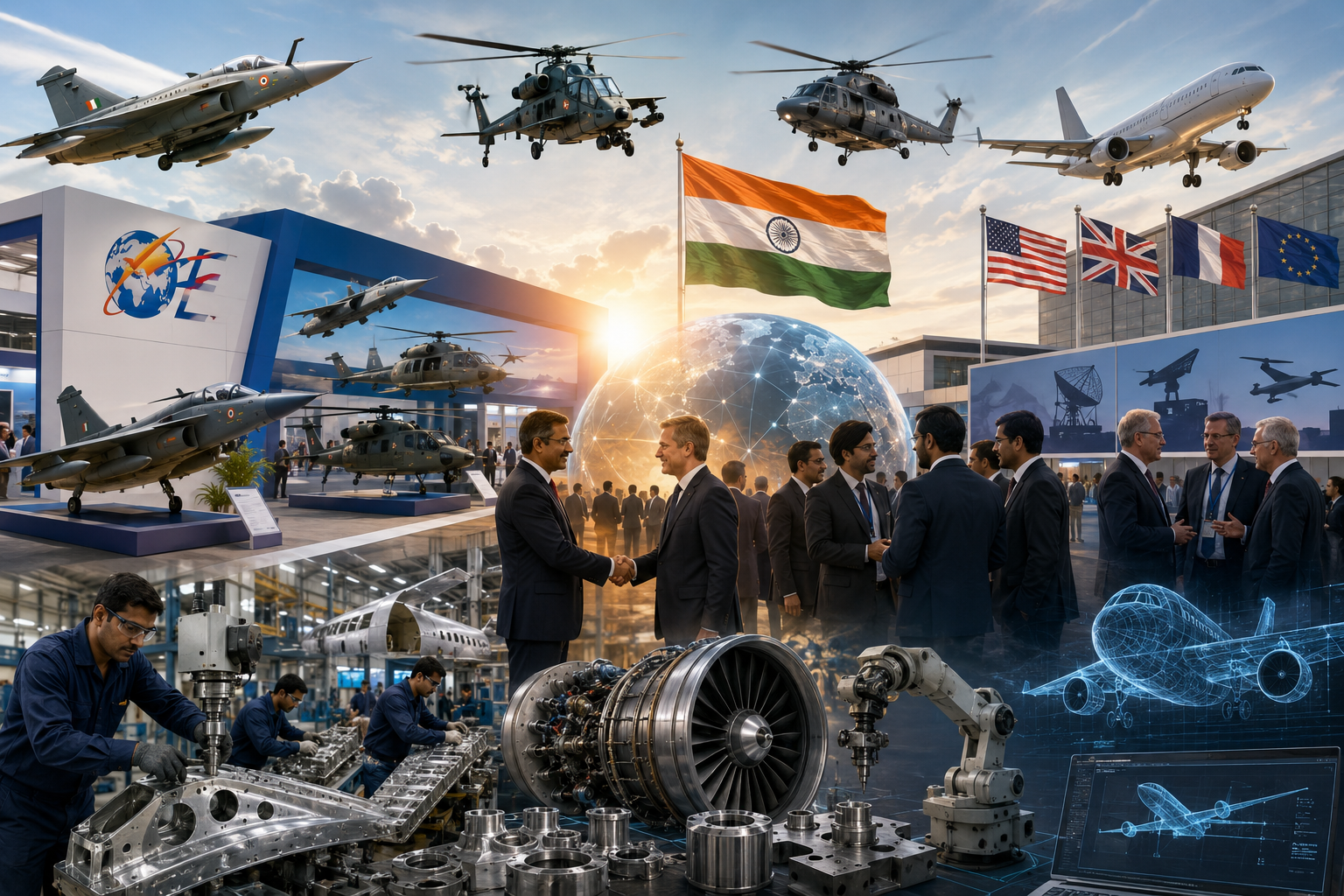
HAL is exhibiting its high-fidelity platforms, including the Light Combat Aircraft (LCA) Tejas, the Prachand Light Combat Helicopter, Rudra, and the Advanced Light Helicopter Dhruv. What is important is that having proven the versatility of their products in Indian defence forces, HAL is now making an aggressive push toward global defence export markets.
”We are showcasing Indian expertise and our willingness to collaborate on co-development,” stated Ravi K, Chairman and Managing Director of HAL, ahead of the trade discussions. “We aim to play a key role in addressing critical supply-chain challenges while advancing India’s defence export ambitions and strengthening the country’s position as a trusted global defence manufacturing hub.”
Beyond showcasing indigenous platforms, HAL’s contribution as a pioneer in ecosystem development can’t be forgotten. By mentoring and integrating hundreds of domestic Tier-2 and Tier-3 suppliers, MSMEs, and tech startups into its supply lines, HAL has, over the decades, facilitated a robust component manufacturing network capable of meeting exacting international standards.
At Farnborough, HAL’s leadership isn’t just exhibiting; they are conducting high-level engagements with global aerospace heavyweights including GE Aerospace, Honeywell, Safran, and Martin-Baker to co-develop technologies, secure joint intellectual property, and address worldwide supply chain bottlenecks.
In the last few years, HAL is not walking the runway alone. HAL has helped develop high-precision engineering and strategic global partnerships under the “Make in India” initiative, the most recent being the tie-up to develop the SJ 100 passenger aircraft for regional routes. India’s aerospace manufacturing sector has grown into a vital hardware supply chain partner for aviation giants like Boeing, Airbus, Lockheed Martin, and Bombardier. Moving well beyond software and IT services, Indian precision engineering firms manufacture critical aerostructures, composite flight controls, structural fuselages, metallic airframe parts, and engine sub-assemblies that actively fly on major commercial and military aircraft around the world.
Key indigenous component suppliers include Tata Advanced Systems Limited (TASL), which is producing AH-64 Apache fuselages, Boeing 737 vertical fins, and Airbus A320 family cargo doors. Dynamatic Technologies has emerged as a primary supplier of flap track beams for the Airbus A320 series and aerostructures for the Boeing P-8 Poseidon; Aequs Aerospace, which is operating a specialized aerospace hub in Belagavi, manufactures thousands of machined metallic components.
Mahindra Aerostructures, which is now supplying structural airframe parts across Airbus commercial lines, is planning expansion.
Also specialized hardware makers like Godrej Aerospace today boast of precision engineering skills to manufacture frames for the Kaveri Engine, clearly representing the depth of India’s evolving industrial base.
A delegation of over 25 premier companies, defence establishments, and high-tech MSMEs coordinated alongside key industry bodies like SIDM and FICCI have converged at Farnborough.
Why are these 25-plus Indian entities pursuing expansion and collaboration at the world’s premier airshow? The answer lies in structural shifts within the global market. As global prime contractors struggle with supply bottlenecks and escalating production costs, Indian enterprises offer precision engineering, cost-effective manufacturing capabilities, advanced defence electronics, and digital engineering solutions.
These establishments are actively pursuing long-term joint ventures, technology transfers, and direct supplier insertion into global OEM value chains. From complex aerostructures and radar sub-systems to autonomous platforms and AI-driven predictive maintenance tools, these firms are proving that Indian manufacturing is ready for primary global deployment.
The takeaway from Farnborough is clear. India’s transition from a consumer market to a global manufacturing heavyweight is no longer just an ambitious policy goal; it is an active operational reality.
By coupling record commercial demand with indigenous engineering, defence production, and a vast component manufacturing network, India is establishing itself as an essential architect of 21st-century aviation. As Farnborough unfolds, the international aerospace industry is no longer just selling aircraft to India; it is building the future of aviation with India.
Vijay Grover is the Editor of Indian Aerospace & Defence. He is a veteran Indian journalist whose work has significantly influenced television newsrooms at outlets such as Zee News, NewsX, and TRT World. Renowned for shaping newsroom practices and ethical standards, he has critiqued the decline of field reporting and the rise of desk-driven propaganda.