Air Marshal Anil Chopra (r)
The recent conflicts in Ukraine, Iran, and closer home, “Op Sindoor,” have highlighted the importance of missiles with longer ranges, larger warheads, and greater precision in a high-electronic-countermeasures environment. Amid India’s growing success in defence production and exports, the missile program is a shining star. For long driven by India’s Defence Research and Development Organisation (DRDO), the missile manufacturing sector is shifting from state monopolies to a competitive, export-driven industrial base. The rising global demand is boosting exports, especially of the supersonic BrahMos missiles and the Akash surface-to-air missile (SAM) systems. These have significantly contributed to national defence exports reaching ₹38,424 crore in FY26, a 60 per cent year-on-year growth.
The missile manufacturing ecosystem is thus emerging as a pillar of India’s security and Atmanirbhar Bharat, transforming the country from a major importer of defence systems into an increasingly capable designer, developer and exporter of advanced missile technologies, and building a globally competitive missile supply chain. Meanwhile, the Astra air-to-air missile (AAM) program is developing world-class variants. In addition to Akash, various specialized short-range, quick-reaction AD systems are undergoing advanced testing.
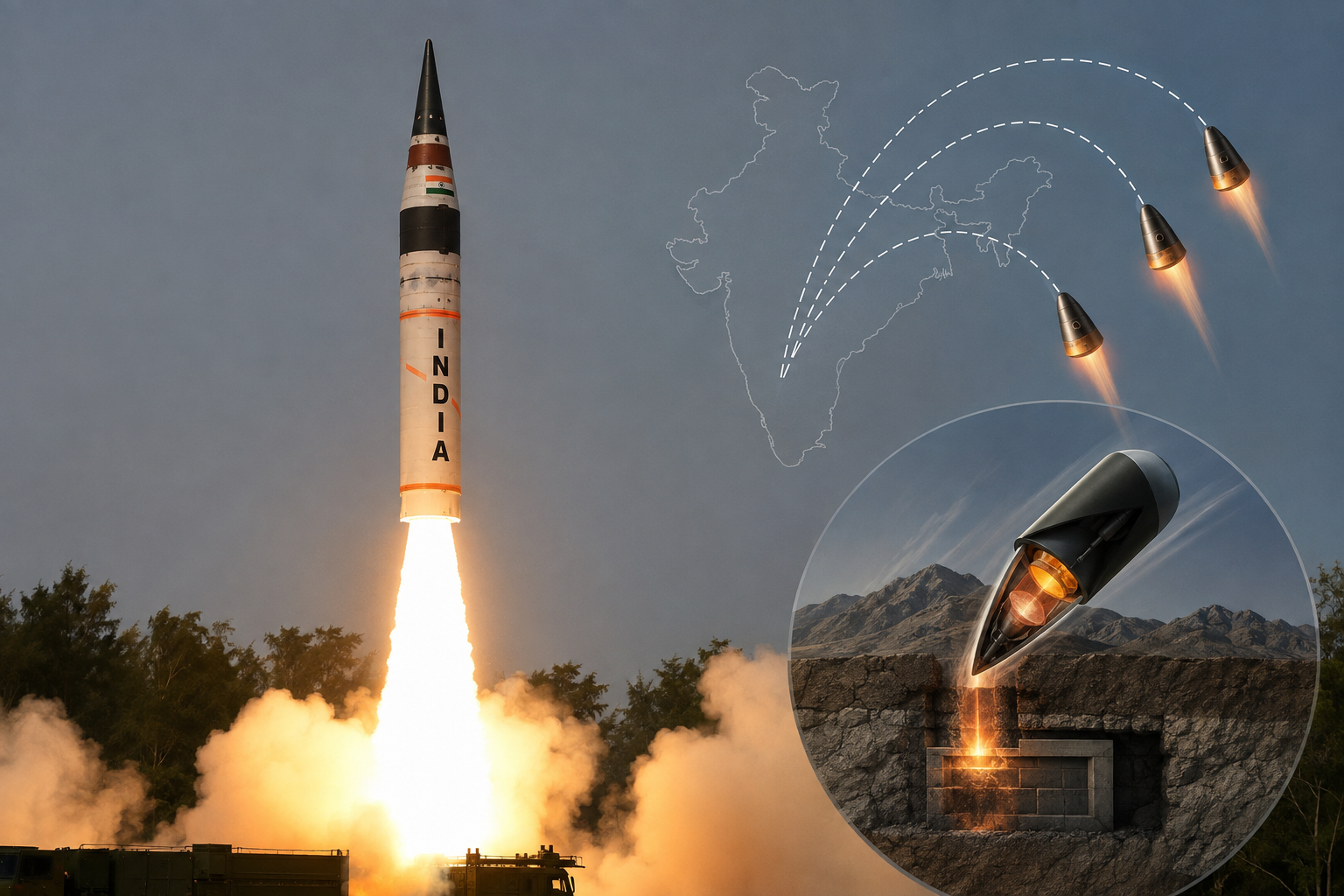
India successfully conducted a user trial of the nuclear-capable Agni-4 medium-range ballistic missile on August 6, 2026, from the Integrated Test Range at Chandipur, Odisha. Carried out by the Strategic Forces Command (SFC), the test validated all operational and technical parameters, reinforcing the credibility of the nation’s strategic deterrence. Earlier, on May 8, 2026, India successfully flight-tested an advanced Agni-5 missile equipped with Multiple Independently Targeted Re-entry Vehicle (MIRV) technology. This test (Mission Divyastra sequel) enables a single missile to deliver multiple nuclear warheads to different targets, significantly enhancing India’s strategic deterrence. The DRDO had earlier given the Agni-V ballistic missile a devastating upgrade with bunker-buster capability, enabling it to penetrate targets through a combination of high mass, hardened casings, and advanced guidance systems. It will reportedly carry a massive 7,500-kilogram conventional warhead, at hypersonic speeds (Mach 8–20), and is designed to penetrate 80–100 meters of reinforced concrete or rock.
Integrated Guided Missile Development Program
The IGMDP was India’s ambitious, indigenous effort starting in the 1980s, led by Dr. A.P.J. Abdul Kalam, “Missile Man of India”, to achieve self-reliance in missile technology. Managed by DRDO, it successfully developed strategic missiles and significantly advanced India’s defence capabilities, despite facing challenges such as technical complexities and cost overruns.
The objective was to develop a comprehensive range of missiles to meet India’s defence needs, reducing reliance on foreign technology and enhancing national security and deterrence. The program focused on five core systems: the “Prithvi” surface-to-surface tactical missile (SSM); the Agni surface-to-surface strategic missile (longer-range); the Trishul short-range SAM; the Akash medium-range SAM; and the Nag anti-tank guided missile (ATGM). The program conferred significant capabilities and technological prowess, making India a major missile power and culminating in the development of advanced missiles such as Agni-V and BrahMos.
With its objectives largely met, the IGMDP was wound down in 2008, and India transitioned into further advanced missile programs.
Agni Missile Program
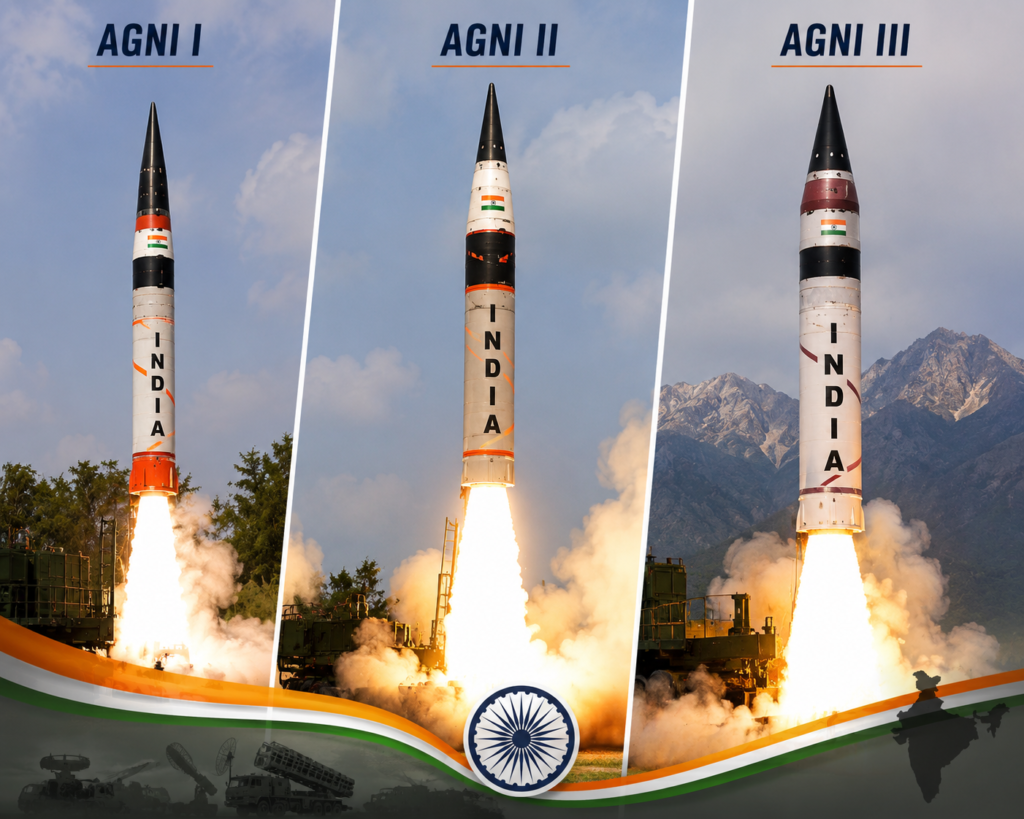
The Agni missile program is India’s premier long-range, nuclear-capable surface-to-surface ballistic missile series. It provides a critical deterrent with missiles ranging from 700 km to over 5,000 km. The missiles are solid-fuelled, road-mobile, and designed for high precision, with later versions featuring canisterisation for faster launch capabilities. The Agni-V and later variants provide ICBM capabilities, with the ability to carry MIRV.
The Agni missile variants are Agni-I (700-800 km, short-range, single-stage missile); Agni-II (2,000+ km medium-range, two-stage missile); Agni-III (3,000+ km intermediate-range, heavier payloads); Agni-IV (4,000 km, modern avionics, road-mobile); Agni-V (5,000+ km ICBM, three-stage solid propellant); Agni-P (Prime) (1,000-2,000 km, advanced next-gen, canister-based) are all operational. Agni-VI is under development and will have a near-12,000 km range and an enhanced payload. The program has put India in an elite group with advanced, long-range, and MIRV-capable strike capabilities.
Countries with operational ICBMs (range 5,500+) include the United States, Russia, China, India, France, the United Kingdom, and North Korea. Some sources also mention Israel, while other nations like Iran possess long-range missiles but don’t have nuclear warheads.
K4 and K-15 Missiles
The K-4 (Kalam-4) and K-15 (Sagarika) are nuclear-capable, submarine-launched ballistic missiles (SLBMs) developed by DRDO to establish a credible, sea-based second-strike capability for India’s nuclear triad. K-15 (Medium-range SLBM) has a range of 750 km. It is India’s first operational underwater-launched nuclear deterrent, compact enough to fit multiple tubes in the initial Arihant-class submarines. The SIPRI Yearbook 2026 notes for the first time that India may have deployed 12 nuclear warheads operationally on a single ballistic missile submarine (SSBN) during occasional peacetime deterrence patrols.
K-4 has a range of 3,500 km (Intermediate-range SLBM) and is intended as a strategic upgrade to extend deep-strike reach. It is operational/deployed on newer platforms like INS Arighaat. It uses a gas booster to eject the missile from the submerged submarine silo before the rocket motor ignites safely above the water’s surface. The longer reach of the K-4 reduces the vulnerability of Indian strategic submarines (SSBNs) by allowing them to patrol closer to home waters while still holding distant strategic targets at risk.
India’s Indigenous Tactical SSM
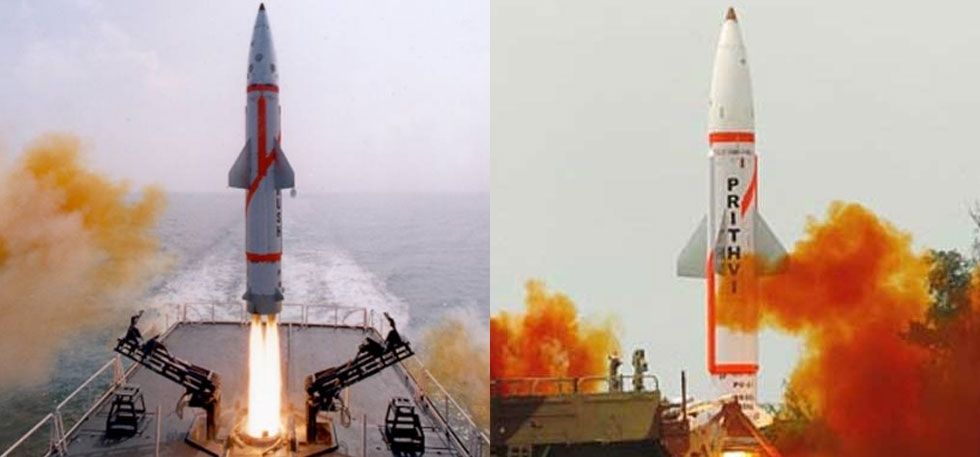
India has developed a robust arsenal of indigenous tactical Surface-to-Surface Missiles (SSM) to ensure battlefield dominance and credible deterrence. These systems focus on high precision, quick reaction times, and the ability to carry conventional or tactical nuclear warheads. The “Prithvi” series includes Prithvi-I (150 km for Army) and Prithvi-II (350 km), a single-stage liquid-fuelled missile used primarily by the Indian Air Force (IAF). “Dhanush” (1,000Kg, 750 km) is a ship-launched, sea-worthy version of the Prithvi missile. Shaurya is a canister-launched hypersonic surface-to-surface missile capable of manoeuvring at speeds above Mach 5, offering a rapid strike capability.
“Pralay” (150–500 km) is a canisterised, solid-fuel, battlefield missile developed to replace older tactical systems like the Prithvi. “Prahaar” (150 km) is a quick-reaction, all-weather, high-precision missile to fill the gap between multi-barrel rocket systems and long-range ballistic missiles.
The operational focus is on “cold start” capabilities, rapid, high-accuracy strikes in low-intensity conflicts. Transitioning from liquid to solid fuel for faster deployment and enhanced stealth in cruise missiles.
BrahMos Variants
The BrahMos is a long-range, ramjet-powered supersonic cruise missile that can be launched from ground, ships, submarines, and fighter aircraft. It is among the world’s fastest cruise missiles, operating at Mach 2.8. The missiles emerged from a joint venture between India’s DRDO and the Russian Federation’s NPO Mashinostroyeniya, who together have formed BrahMos Aerospace. The missile is based on P-800 Oniks. Appropriate versions have been inducted across the Indian Armed Forces. BrahMos Aerospace has developed the missile’s guidance system. In 2016, after India joined the Missile Technology Control Regime (MTCR), the missile’s range was gradually increased. The future hypersonic missile (Mach 8), designated as the BrahMos-II, is based on the Russian 3M22 Zircon. Ship- or Land-based missiles have a range of 800–900 km, air-launched missiles have 450–500 km, and the export variant has 290 km. Accuracy is less than 1 m CEP. 1500 km-plus range missiles are evolving.
BrahMos-NG (Next Generation) is a shortened version. It will have a range of 290 km, a speed of Mach 3.5, and weigh around 1.5 tons. The Su-30 MKI will carry three of these. The Mikoyan MiG-29K, HAL Tejas Mk1A (later Mk2), and Dassault Rafale will each carry one. The submarine-launched variant will be capable of being fired from the new P75I-class submarines.
Anti-Tank Guided Missile (ATGM)
HELINA (Dhruvastra) is an abbreviation for Helicopter-launched NAG. It is a third-generation fire-and-forget anti-tank guided missile (ATGM) for helicopters such as the HAL Rudra, which are equipped with two Twin launchers, one on each side, carrying a total of 8 missiles. HELINA is equipped with a High Resolution Imaging Infrared Seeker (IIR) capable of automatic target detection and tracking in adverse weather conditions. Manufactured by BDL, it has a max range of 7,000 m. The attack modes are top and direct.
The SANT (Stand-off Anti-Tank) missile is an advanced, 4th-generation, indigenous air-to-surface weapon developed by DRDO’s RCI for the IAF. It is an upgraded, helicopter-launched version of the HELINA weapon system. It features a millimetre-wave (MMW) seeker, allowing for high-precision strikes against armoured targets from a safe stand-off distance of up to 10 km. It features both lock-on before launch and lock-on after launch capabilities.
Indian World Class AAMs
India’s primary indigenous AAM is the Astra, a family of Beyond Visual Range (BVR) missiles with variants including the Mk-1 (110 km range), the upcoming longer-range Mk-2 (initially 160 km, upgradable to 240 km), and the Mk-3 “Gandiva” (350 km). These are being integrated on most Indian fighters and have already been cleared on the Su-30MKI, MiG-29, and Tejas Mk.1/1A. DRDO scientists have also reportedly assessed technology from the Chinese-origin PL-15E missile that was recovered intact by India during Op Sindoor, as it lacked self-destruct technology. Astra Mk3 uses Solid Fuel Ducted Ramjet (SFDR), and utilises a two-way data link for mid-course guidance from the launch aircraft or friendly AEW&C aircraft and also employs electronic counter-countermeasures.
Top global AAMs are MBDA Meteor (200+ km), AIM-120D AMRAAM (160+ km), French MICA (80 km), Russian R-77-1/R-77M (110-150 km), and Chinese PL-15 (180-200 km). The Russian hypersonic R-37M (300-400 km) and the American AIM-174B (400 km) are the longest-range AAMs. India is reportedly acquiring the R-37M missile from Russia, with a make-in-India option.
Surface to Air Missiles (SAM)
India utilizes various indigenous and jointly developed SAMs, such as the Akash (medium-range) and Barak-8/MRSAM (jointly with Israel), and is developing Project Kusha (long-range). These complement the Russian S-400, Pechora (S-125) and SAM-8 in the Indian inventory. India is also developing mobile quick reaction QRSAM (Anant Shastra) for moving forces and upgrades to existing fleets, showcasing a mix of short, medium, and future long-range capabilities.
The Akash SAM developed by India’s DRDO and produced by BDL/BEL for the IAF and Indian Army can take on fighter jets, UAVs, and missiles, and has a range of up to 30-45 km, a speed up to Mach 2.5-3.5, and uses a 60 kg high-explosive pre-fragmented warhead. Akash-NG (New Generation) range would be 30-80 km.
India and Israel jointly develop the Barak 8 LR-SAM and MR-SAM, a SAM designed to defend against airborne threats, including aircraft, helicopters, anti-ship missiles, UAVs, ballistic missiles, and cruise missiles. It is produced by Israel’s Directorate of Research and Development (DDR&D), Elta Systems, Rafael Advanced Defence Systems and India’s Bharat Dynamics Limited (BDL), Kalyani Rafael Advanced Systems (KRAS) and Tata Advanced Systems (TASL). There is an extended range variant, Barak-ER. The maximum range is 150 km.
Anant Shastra is an indigenous, highly mobile QRSAM system developed by DRDO, with production fast-tracked for the Indian Army to defend against aerial threats (drones, jets, missiles) in motion. Mounted on 8×8 trucks, it features 360-degree radar coverage, a 30 km range, and is intended to protect armoured columns, particularly along northern/western borders.
Project Kusha is a DRDO-led initiative to develop India’s indigenous, long-range air defence system, designed to create a multi-layered shield against stealth aircraft, drones, and cruise/ballistic missiles. Aiming for induction by 2028-2029, this system features three interceptor missile variants (M1, M2, M3) with ranges up to 350+ km, rivalling the Russian S-400.
The SAMAR (Surface-to-Air Missile for Assured Retaliation) is an indigenous short-range air defence system developed by the Indian Air Force (IAF) to counter low-flying aerial targets, including UAVs, helicopters, and fighter aircraft. It repurposes older Russian-origin Vympel R-73E and R-27 missiles with a 12-km range.
The top global SAM systems are led by Russia’s S-500 Prometheus (600 km) and S-400 Triumf (400 km), alongside the US Patriot PAC-3 and THAAD (200 km). Other elite systems include the Franco-Italian SAMP/T (100 km), Israel’s Iron Dome (70 km) and David’s Sling (300 km), the Indo-Israeli Barak-8, and China’s HQ-9/FD-2000 series (125 km). HQ-9B reportedly has a range of 250 km.
India is likely to procure 5 more S-400 units and may even consider the S-500 system.
India’s Ballistic Missile Defence (BMD)
India’s BMD program was initiated in 2000, post-Kargil. The DRDO-developed two-tiered, multi-layered shield is designed to intercept incoming missiles. The Long-Range Tracking Radar (LRTR) “Swordfish” is based on Israeli EL/M-2080 Green Pine radar technology and built under license in India. This AESA radar can simultaneously track 200 targets at a range of 1,500 km and relay crucial early-warning and target-acquisition data to interceptor missiles. The BMD system utilizing Prithvi Air Defence (PAD) for 50-80 km high-altitude (exo-atmospheric) and Advanced Air Defence (AAD) for low-altitude (endo-atmospheric) interception, the system is evolving into a more robust three-layer defence via Phase-II AD-1/AD-2 missiles to counter advanced threats such as long-range interception of IRBMs and ICBMs. The network provides data to IAF’s Integrated Command and Control System (IACCS). India is developing sea-based BMD, deploying AD-1 and AD-2 interceptors on frontline warships to provide a mobile, tri-domain defence.
Mission Sudarshan Chakra
Mission Sudarshan Chakra is an Indian defence initiative to develop an interlocked, multi-layered, all-encompassing, AI-enabled networked architecture that combines enhanced monitoring, cyber protection, and physical defence to protect the Indian population and infrastructure against terrorist attacks, military strikes, and other high-value threats. The idea behind the defence barrier is similar to that of Israel’s Iron Dome and the United States’ Golden Dome.
Announced by Prime Minister Narendra Modi on August 15, 2025, DRDO recently completed its feasibility report, and Defence Minister Rajnath Singh confirmed its roadmap to build a comprehensive multi-layered indigenous air and missile shield by 2035.
Rudram Anti-Radiation Missile (ARM)
The Rudram missile series (I, II, III), developed by DRDO for the IAF, is evolving rapidly. Rudram-I is in production. Rudram-II was flight-tested in May 2024 and was recently fired from a Su-30MKI fighter under extreme release conditions off the Odisha coast. The trials validated all critical subsystems and trajectory controls, bringing this 300 km-range hypersonic anti-radiation missile closer to operational deployment.
The long-range Rudram-III (550-600 km) has also completed successful tests in 2025. DRDO has also involved Adani Defence & Aerospace under Development cum Production Partner programme for mass production. Launch platforms are MiG-29UPG, Dassault Mirage 2000, Su-30MKI, Tejas Mk.1/1A, and Tejas Mk2 (Planned). These missiles are vital for Suppression of Enemy Air Defences (SEAD) missions, utilizing passive homing heads to identify, classify, and engage targets.
Hypersonic Technology Demonstrator Vehicle (HSTDV)
The HSTDV is an unmanned scramjet demonstration aircraft developed by the DRDO to achieve hypersonic speeds of around Mach 6.5. Successfully tested, it uses a solid-rocket motor to reach high altitudes and speeds, validating technologies such as scramjet ignition, air-breathing propulsion, and high-temperature material resistance. The HSTDV has demonstrated Mach 6 speeds and can reach altitudes of 30–32 km, which are crucial for high-speed cruise. The vehicle uses an indigenous air-breathing scramjet engine, which compresses air before combustion, making it more efficient and cost-effective than conventional rockets.
The technology is intended for the development of long-range cruise missiles (such as Brahmos II) and low-cost, reusable satellite launch vehicles. With its successful test, India became the fourth country (after the USA, Russia, and China) to demonstrate this technology, enhancing capabilities against missile defence systems. The vehicle utilizes advanced materials and thermal barrier coatings to withstand temperatures exceeding 2500 degrees Celsius. The HSTDV program marks a significant leap in India’s defence, surveillance, and space launch capabilities.
To Summarize
DRDO follows the principle “Balasya Mulam Vigyanam” that is “the source of strength is science”, on the premise that scientific development is fundamental to national security. India has a great and growing package of indigenous missiles. India is using leading-edge technologies and employs a blend of indigenous missiles (Astra, Rudram) and imported systems (such as Russian & Israeli missiles) for comprehensive air defence and offensive capabilities.
India continues to develop advanced AAMs, focusing on longer ranges (BVRAAMs), faster engagement, and specialized roles such as anti-radiation, ensuring its air combat capabilities remain potent. The range and accuracy are catching up with the best in the world.
Indian missiles can operate in a dense EW environment, and their no-escape zones are increasing. It is a matter of time before India reduces dependence on foreign weapons. Israel and Russia have been particularly supportive and have shared technologies through joint-venture routes (BrahMos, MRSAM).
India is gradually shifting from being a large arms importer to an inspiring defence manufacturer and exporter. India is rapidly expanding its defence footprint, driven by exports of indigenously developed, high-tech systems such as the supersonic BrahMos cruise missile ($375M deal with the Philippines) and the Akash air defence system to Southeast Asian and African nations. Other nations interested in BrahMos include Malaysia, UAE, Chile, and South Africa.
The Akash missile system is actively being exported, with Armenia as the first confirmed buyer in a major 2022 deal, and significant interest from countries such as the Philippines, Brazil, Egypt, and Vietnam. Atmanirbharta is most important in defence technologies. Indigenization prevents supply chain vulnerabilities. While India has some distance to cover in aircraft, stealth, and aero-engines, it has done well in missiles. It is hoped that missiles will soon be added to the Positive Indigenisation List (PIL).
India’s private sector is expanding rapidly into aerial weapons and missile manufacturing, a sector historically dominated by state-run entities such as DRDO and Bharat Dynamics Limited (BDL). Major Indian conglomerates such as Adani Defence & Aerospace (building a ₹2,500-crore missile complex in Madhya Pradesh), Tata Advanced Systems, Bharat Forge, and Mahindra are stepping up efforts to manufacture precision-guided munitions, tactical drones, and air-to-air missiles.
As of 2026, the Indian Military is transitioning from the “Cold Start” doctrine to the “Cold Strike” doctrine, focusing on proactive, multi-domain operations and rapid, precise punitive strikes rather than just seizing shallow territory. India’s missile program supports such actions.
Air Marshal Anil Chopra (r) PVSM AVSM VM VSM is an Indian Air Force veteran, fighter test pilot, and former Director-General of the Center for Air Power Studies in New Delhi. He has been decorated with gallantry and distinguished service medals during his 40 years of service in the IAF.