Lt Col Narendra Tripathi (r)

The Silent Engine of Aviation
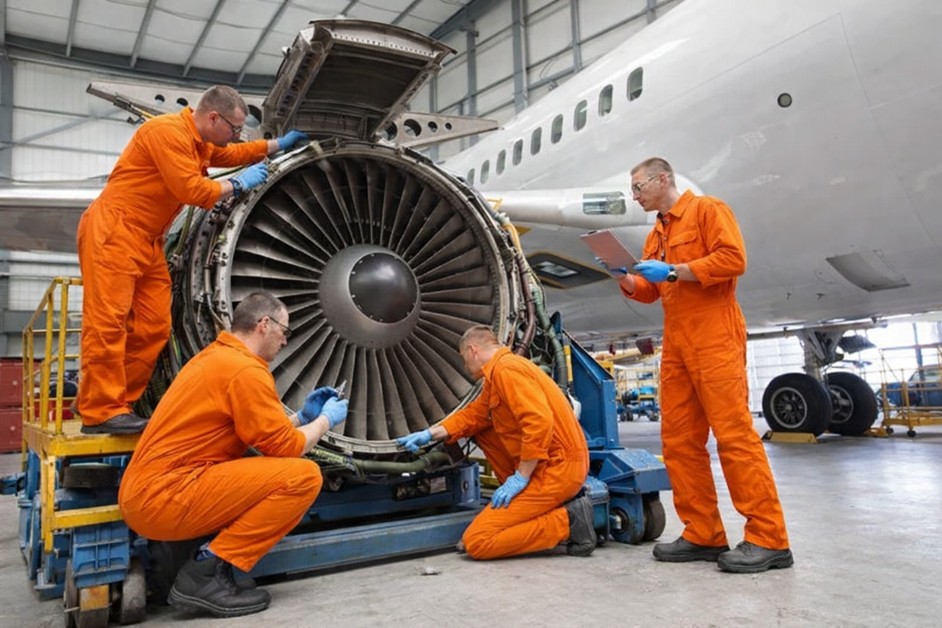
Before the first passengers board a flight each morning, a different world of activity is already underway inside aircraft maintenance hangars. Engineers move around aircraft under bright inspection lights, running diagnostics, checking avionics systems, inspecting engines, and analysing streams of data from thousands of sensors embedded across modern aircraft. Behind every safe landing and every on-time departure lies a vast ecosystem of maintenance facilities, skilled technicians, supply chains, and digital monitoring systems that quietly sustain global aviation. The MRO industry forms one of the most critical pillars of the aviation value chain. As aircraft fleets expand and technology becomes increasingly sophisticated, the role of maintenance has become central to ensuring operational safety, reliability, and economic efficiency.
For many years, however, a large share of India’s aircraft maintenance, particularly heavy checks and engine overhauls, was conducted at overseas hubs. This dependence increased operational costs and extended aircraft downtime. Today, that landscape is gradually evolving. Policy reforms, expanding maintenance infrastructure, growing industry investment, and emerging technologies such as artificial intelligence, predictive analytics, and digital twins are reshaping India’s aviation sustainment ecosystem. With the domestic MRO market projected to reach nearly $4 billion by 2030, India now has the opportunity to transform aviation maintenance into a major strategic and economic capability.
Global Aerospace MRO Framework
The global civil aviation MRO ecosystem operates within a highly structured regulatory environment designed to ensure aircraft safety and airworthiness. At the international level, the International Civil Aviation Organization establishes global safety standards through its Standards and Recommended Practices (SARPs), which guide aircraft maintenance procedures, inspection protocols, and continuing airworthiness requirements. Maintenance organisations operate under strict certification frameworks issued by national regulators. In the United States, maintenance providers are certified under FAA Part 145, administered by the Federal Aviation Administration. In Europe, similar approvals are issued under EASA Part 145 by the European Union Aviation Safety Agency.
These frameworks mandate stringent compliance requirements, including certified maintenance procedures, qualified personnel, strict quality control systems, and full traceability of parts and maintenance activities. Global MRO hubs have emerged where regulatory oversight is supported by strong industrial infrastructure and skilled engineering workforces.
Aerospace MRO activities can be broadly categorised according to the depth and complexity of maintenance tasks.
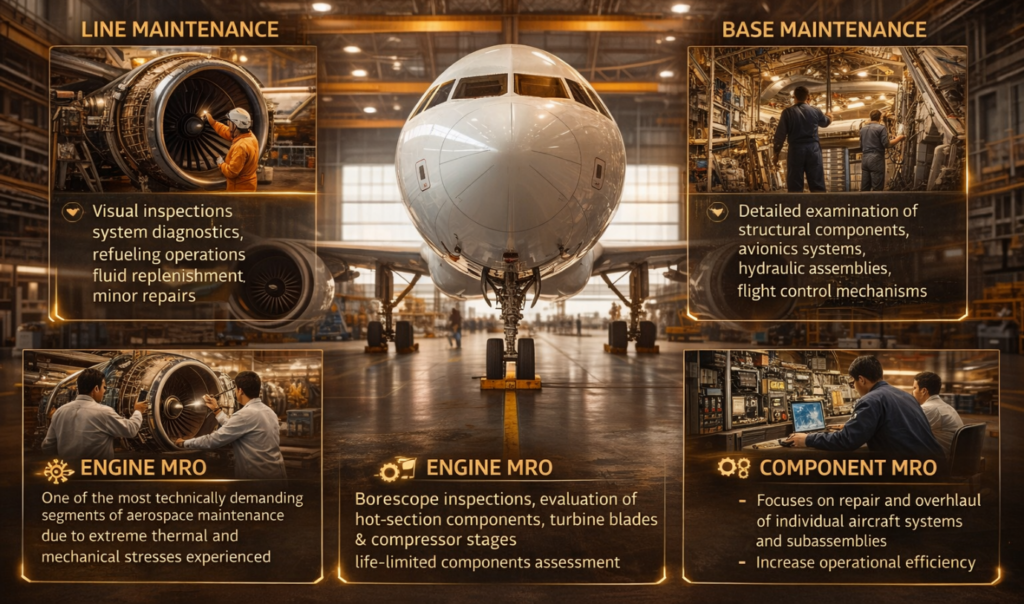
| MRO Category | Description | Typical Activities / Scope |
| Line Maintenance | Represents the first level of aircraft maintenance conducted between flight operations to ensure immediate operational readiness. | Visual inspection of airframes, system diagnostics, refuelling operations, fluid replenishment, and minor repairs. |
| Base Maintenance | Involves deeper periodic inspections conducted after defined flight hours or operational cycles, often requiring partial disassembly of aircraft structures. | Detailed examination of structural components, avionics systems, hydraulic assemblies, and flight control mechanisms. |
| Engine MRO | One of the most technically demanding segments of aerospace maintenance is due to the extreme thermal and mechanical stresses experienced by jet engines. | Borescope inspections, evaluation of hot-section components, inspection of turbine blades and compressor stages, and assessment of life-limited components. |
| Component MRO | Focuses on the repair and overhaul of individual aircraft systems and subassemblies. | Maintenance of avionics systems, landing gear assemblies, electronic modules, hydraulic systems, and flight control actuators. |
A Growing Aviation Market Driving MRO Demand
India stands at the centre of one of the world’s fastest-growing civil aviation markets, driven by rising passenger demand, expanding airline networks, and ambitious fleet expansion plans. Indian carriers have placed record aircraft orders to meet this demand, while government initiatives to strengthen regional connectivity are bringing air travel to new destinations across the country. As fleets grow, the demand for maintenance services rises proportionately. Every aircraft must undergo routine inspections, component replacements, engine checks, and periodic heavy maintenance throughout its operational lifecycle. These activities form the backbone of the Maintenance, Repair and Overhaul (MRO) ecosystem, encompassing line maintenance at airports, heavy airframe checks, engine overhauls, component repair and testing, as well as avionics and software upgrades.
Despite this rapid expansion, India’s domestic MRO infrastructure historically lagged behind fleet growth. High taxation and regulatory complexities often made it more cost-effective for airlines to send aircraft overseas for major maintenance, resulting in higher costs and significant foreign exchange outflows. Recognising these challenges, the Government of India introduced several reforms to improve the competitiveness of domestic MRO providers, including reducing GST on MRO services to 5 percent, introducing a uniform 5 percent IGST on aircraft parts, enabling long-term airport land leasing for MRO facilities, granting export status to maintenance services for foreign airlines, and allowing 100 percent foreign direct investment in the sector.
With these policy barriers easing, investment in aviation maintenance infrastructure is accelerating. Companies such as Air Works have developed strong capabilities in aircraft maintenance, avionics upgrades, and component repair through partnerships with global OEMs. GMR Aero Technic near Hyderabad and Air India Engineering Services Limited (AIESL) also play major roles in supporting domestic and international airline fleets. However, India’s MRO sector still remains modest compared with global leaders like Lufthansa Technik, underscoring the need for further infrastructure development, technology adoption, and deeper integration with global aviation maintenance networks.
Technology Reshaping the Future of Aviation Maintenance
The aviation maintenance sector is undergoing a profound digital transformation driven by the increasing availability of operational data from modern aircraft. Today’s aircraft function as sophisticated flying data platforms equipped with thousands of sensors that continuously monitor engine performance, avionics systems, structural health, and environmental conditions. These data streams generate vast volumes of information during every flight, enabling maintenance teams to gain real-time insights into aircraft performance. Together, these technologies are transforming aircraft maintenance from a reactive activity into a predictive, data-driven discipline that can anticipate failures and optimize maintenance planning.
Predictive maintenance represents one of the most significant developments in this transformation. With continuous operational data now available, early signs of system degradation can be detected before failures. Machine learning algorithms analyse parameters such as vibration patterns, temperature fluctuations, pressure levels, and fuel efficiency to identify anomalies indicating potential component deterioration. Major aerospace companies are already deploying such systems. GE Aviation’s FlightPulse platform analyses engine performance data in real time to detect irregularities, while Airbus’ Skywise platform uses large-scale data analytics to optimise fleet maintenance planning. Similarly, Rolls-Royce’s TotalCare programme aggregates engine performance data from aircraft to predict maintenance requirements and prevent unscheduled failures.
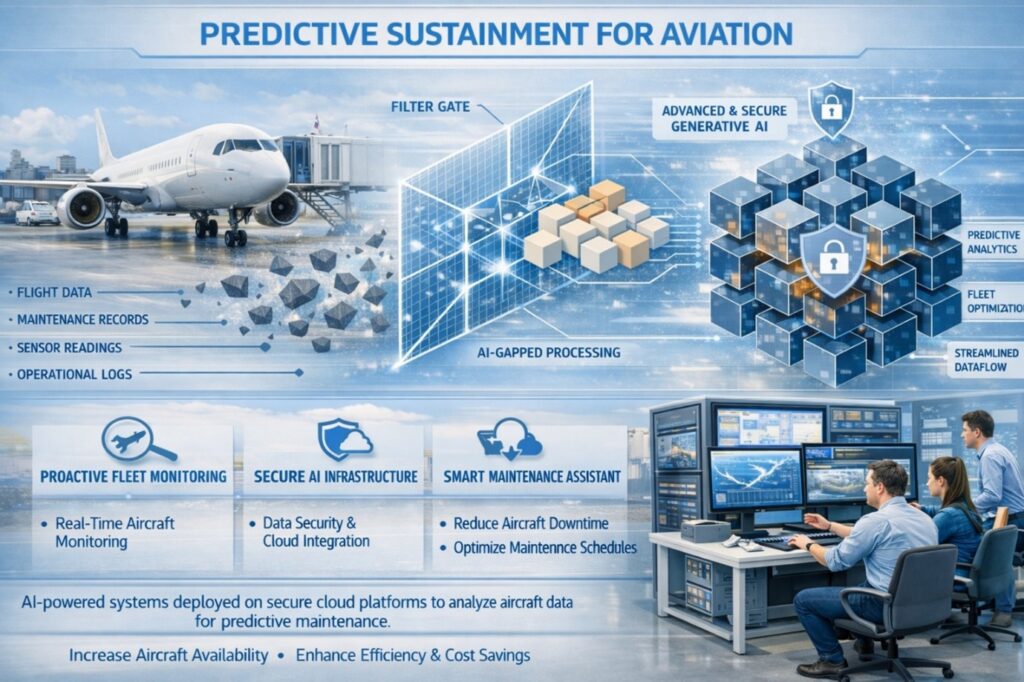
A digital twin is a virtual representation of a physical asset, such as an aircraft engine or airframe, that continuously receives real-time sensor data. By combining operational data with simulation models, engineers can analyse system behaviour under various operating conditions. Engine manufacturers such as Rolls-Royce use digital twin technology to model engine performance under extreme conditions and anticipate potential failures. Continuous analysis of real-time and simulated data enables maintenance teams to detect early component fatigue, optimise maintenance schedules, extend component lifecycles, and improve asset management.
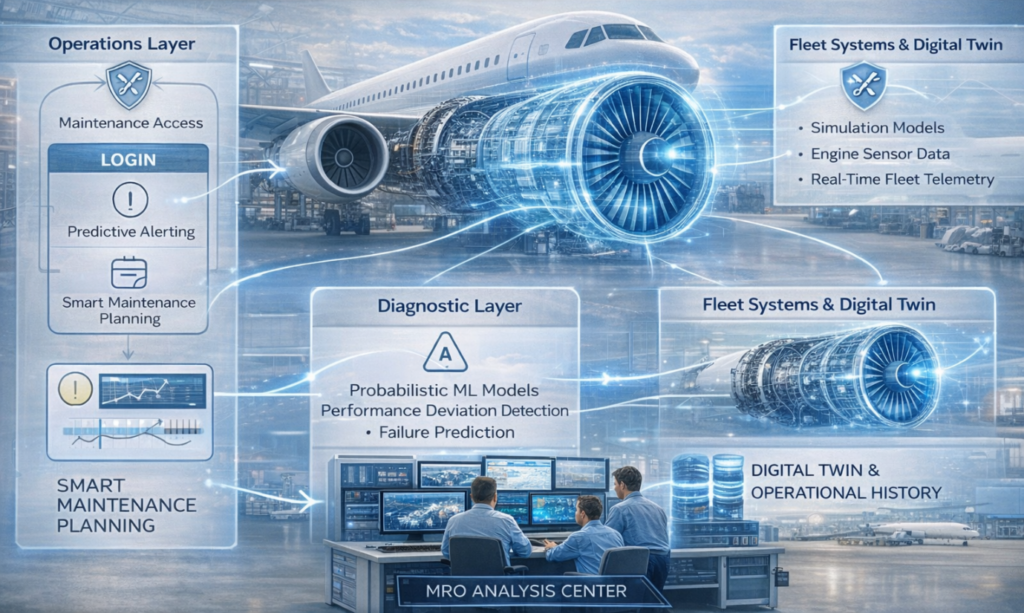
Lifecycle management of aircraft components is closely linked to predictive maintenance and digital twin technologies. Modern digital platforms track every component, from engines and landing gear to avionics systems, throughout their lifecycle, recording installation history, inspection schedules, maintenance records, and regulatory compliance. By analysing this data, airlines and MRO providers can anticipate repair needs, optimise spare-parts inventories, and reduce aircraft turnaround time through efficient, just-in-time supply chains. At the same time, sustainability is becoming central to aviation maintenance. MRO facilities are adopting practices such as component refurbishment, composite repair, energy-efficient hangars with solar and LED systems, and circular supply chains that reuse serviceable parts, reducing waste, lowering costs, and supporting environmental commitments.
Generative AI is poised to play a transformative role in the future of aerospace sustainment. AI-driven systems analyse data generated by onboard aircraft sensors to detect early signs of component degradation, enabling predictive maintenance and improving fleet availability. Generative AI further enhances these capabilities by functioning as an intelligent knowledge assistant. Analyzing engineering manuals, maintenance documentation, and operational records can provide technicians with rapid troubleshooting insights and decision support during complex repair operations.
Engineering major Larsen & Toubro has partnered with NVIDIA to develop sovereign gigawatt-scale AI infrastructure under the India AI Mission. At the same time, Indian deep-tech startups are emerging as key contributors. The iDEX-winning startup Zenerative Minds from IIIT Hyderabad has developed agentic Generative AI frameworks designed for secure on-premise deployment in environments where sensitive enterprise data must remain within controlled networks, signalling a shift toward a digitally enabled aviation maintenance ecosystem.
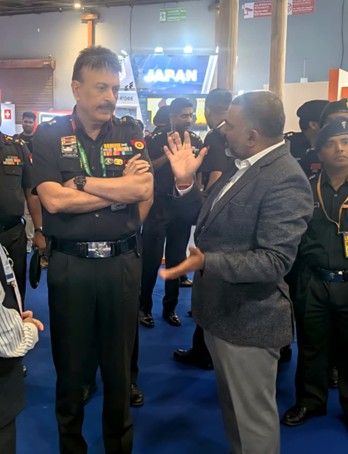
The Sovereign Agentic Gen AI architecture developed by Zenerative Minds briefed to Lt Gen R K Sahani, Director General EME, Indian Army, for MRO analytics at the AI Impact Summit, New Delhi.
MRO in Defence
Parallel developments in India’s defence aviation sector highlight the growing strategic importance of a strong domestic MRO ecosystem in sustaining national air power. While aircraft acquisitions remain a visible component of defence planning, greater emphasis is now being placed on long-term sustainment, modernisation, and the development of indigenous capabilities. The Indian Air Force’s proposed acquisition of around sixty multi-role transport aircraft, drawing interest from Embraer, Lockheed Martin, and Ilyushin, reflects this shift. The programme is expected to prioritise domestic manufacturing through partnerships between global OEMs and the Indian industry, linking aircraft induction with long-term maintenance and sustainment capability.
At the same time, efforts to localise advanced engine maintenance are underway through collaboration between Safran Aircraft Engines and HAL for the M88 engine powering the Rafale fighter aircraft. Expanding domestic assembly and maintenance capability will reduce dependence on overseas overhaul facilities and improve operational availability. Initiatives such as the Super-30 upgrade of the Su-30MKI fleet and the integration of Spike NLOS missiles on Mi-17V5 helicopters further illustrate how evolving operational roles are increasing the complexity of aerospace sustainment. Looking ahead, the induction of next-generation platforms such as the Tejas Mk-2 and the Advanced Medium Combat Aircraft (AMCA) will significantly expand sustainment requirements, reinforcing the need for a resilient, technologically capable domestic military MRO ecosystem.
Challenges, Opportunities & the Road Ahead
Despite notable progress in recent years, several structural challenges continue to influence the growth of India’s Maintenance, Repair and Overhaul (MRO) ecosystem. While policy reforms and infrastructure investments have improved the competitiveness of domestic maintenance providers, key capability gaps must still be addressed if India is to emerge as a global aviation maintenance hub.
One of the most significant limitations is the country’s relatively limited capability in large-scale engine overhaul. Aircraft engines account for the largest share of maintenance expenditure in commercial aviation, yet India still lacks sufficient infrastructure to support comprehensive engine MRO operations for modern aircraft platforms. As a result, many airlines continue to send engines overseas for major overhaul and repair. Establishing advanced engine maintenance facilities requires substantial capital investment, specialised tooling, testing infrastructure, and highly skilled technical expertise.
Another major challenge is the availability of a skilled workforce. Aviation maintenance requires engineers and technicians to be trained and certified under stringent regulatory standards. As aircraft technologies become increasingly sophisticated, with advanced avionics, composite materials, and digital diagnostics, the demand for highly specialised technical personnel is rising rapidly. Expanding aviation training capacity will therefore be essential to meet the sector’s future manpower needs.
Supply chain dependence also remains a concern. Many specialised aircraft components, spare parts, and maintenance tools are still imported from global suppliers, making the ecosystem vulnerable to supply disruptions and logistical delays. In addition, access to proprietary repair technologies and technical documentation is often controlled by original equipment manufacturers (OEMs), making strong partnerships with global aircraft and engine manufacturers essential for developing deeper technical capabilities within India.
Despite these challenges, India’s long-term potential in the MRO sector remains substantial. The country benefits from several strategic advantages, including one of the fastest-growing aviation markets, a large engineering workforce, competitive operating costs, and a supportive policy environment. Infrastructure investments are already expanding maintenance capacity nationwide. Companies such as Air Works have developed strong expertise in aircraft maintenance and component repair. At the same time, GMR Aero Technic in Hyderabad has emerged as one of South Asia’s largest private MRO facilities. Air India Engineering Services Limited (AIESL) also operates some of the country’s largest maintenance hangars with extensive experience in heavy aircraft maintenance.
As the global aviation community gathers for MRO Expo 2026, the message across the industry is clear: maintenance is no longer merely a support function but a strategic enabler of aviation growth. If India can successfully address its structural challenges and continue to expand infrastructure and technological capabilities, it has the potential to build a globally competitive MRO ecosystem that supports both domestic and international aviation markets.
Lt Col Narendra Tripathi (r) is an alumnus of the National Defence Academy, Pune, IIT Kanpur, and IIM Indore. He is the co-founder of a deep-tech company, an iDEX awardee, and a defence technology consultant collaborating with multiple industries. The views expressed are based on open-source information and the author’s professional understanding.