Chaitali Bag
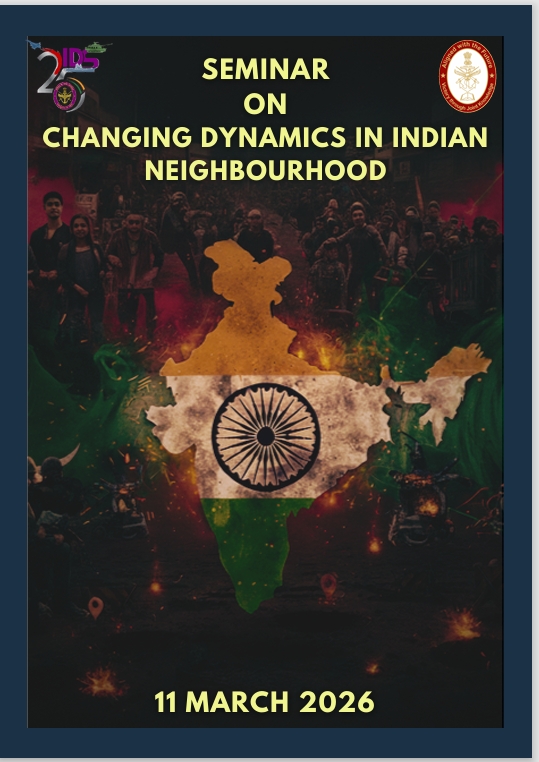
The Centre for Joint Warfare Studies (CENJOWS) marks a quarter century of sustained contribution to India’s strategic discourse in 2026. Established on 27 August 2007 under the aegis of the Ministry of Defence and registered under The Societies Registration Act, 1860, CENJOWS was conceived to transcend parochial departmental perspectives and to foster integrated thinking across the tri‑services, government, industry, academia and civil society. Its founding intent—to promote jointness, integration and transformation in the Indian Armed Forces—remains the lodestar of its research, advocacy and convening activities. The 25th anniversary seminar, “Changing Dynamics in the Indian Neighbourhood,” to be inaugurated by Raksha Rajya Mantri Shri Sanjay Seth at the Manekshaw Centre on 11 March 2026, is an occasion to appraise past achievements, evaluate present challenges and chart future imperatives for India’s strategic posture in a rapidly evolving regional environment.
CENJOWS: Mandate & Institutional Role
CENJOWS was established to provide free and unfettered analysis of joint warfare issues and to offer independent policy options to decision makers in the Government of India and the Defence Headquarters. Its charter emphasises open dialogue, robust scholarship and an engagement-oriented approach—linking government, the public and private sectors, academic institutions, non‑governmental organisations and civil society. By prioritising jointness as a strategic enabler, CENJOWS seeks to influence doctrine, capability development and institutional reform that are essential to harnessing Comprehensive National Power.
The Centre’s vision to attain premier think‑tank status and its mission to promote jointness as a synergistic enabler reflect a recognition that modern conflict is multidomain and multidimensional. CENJOWS’ work spans doctrinal research, wargaming, scenario analysis, outreach, and capacity‑building. Its agenda includes fostering the transformation of the armed forces into a technology‑savvy institution by providing research inputs on emerging technologies, while also pursuing bilateral and multilateral academic exchanges to strengthen understanding across the neighbourhood and beyond.
The Seminar: Objectives & Thematic Focus
The seminar “Changing Dynamics in the Indian Neighbourhood” convenes senior military leaders, diplomats, policy practitioners and strategic experts to undertake a comprehensive assessment of geopolitical developments in India’s periphery. Its primary objectives are to:
– Examine evolving security, political and economic trends in neighbouring states and subregions.
– Analyse implications of these trends for India’s strategic posture, defence planning and regional diplomacy.
– Explore the role of emerging technologies—including artificial intelligence (AI)—in shaping military operations, deterrence and crisis management; and
– Promote policy options for enhancing cooperation, resilience and stability in the neighbourhood through diplomatic, military, economic and people‑to‑people measures.
The programme’s focused sessions will unpack country‑specific developments while situating them in the broader regional context: great‑power competition, maritime security, transnational threats, infrastructure connectivity, economic interdependence and the diffusion of disruptive technologies. By integrating perspectives from defence, diplomacy and academia, the seminar intends to generate holistic recommendations for policy and practice.
Defence technology, professional military education & the role of innovation
A notable feature of the inaugural session is the launch of key initiatives in defence technology and professional military education by Raksha Rajya Mantri Shri Sanjay Seth. These include the unveiling of the Samvad Application—developed collaboratively by the Centre for Artificial Intelligence Research (CAIR), the Defence Research and Development Organisation (DRDO), and other stakeholders—and the Integrated Online Training and Evaluation Programme (IOTEP), developed by the Indian Defence University (IDU) Directorate. Both initiatives exemplify the imperative to harness digital tools and AI to augment operational readiness, decision‑making and institutional learning.
The Samvad Application, in its conception, promises to enhance information synthesis, situational awareness and decision support—capabilities that are increasingly decisive in the contemporary operational environment. IOTEP reflects a broader reform agenda in professional military education, enabling standardized, scalable and competency‑based training across the services. Together, these instruments exemplify how technology and pedagogy can converge to facilitate the transformation of the armed forces into a more integrated, agile and knowledge‑driven institution.
Regional Dynamics: Contours & Implications for India
The security environment in India’s neighbourhood is shaped by a confluence of complex and interrelated factors. Persistent interstate tensions, internal political flux in neighbouring states, the strategic interests of extra‑regional powers, economic interdependence and climate‑induced vulnerabilities combine to create an intricate risk landscape. Key contours that merit close attention include:
– Geopolitical competition: The intensification of strategic competition—maritime and continental—between major powers has direct bearings on India’s options. Rivalry in the Indian Ocean Region, infrastructure diplomacy, and alignments among neighbouring states affect access, basing dynamics and maritime domain awareness.
– Cross‑border insurgency and terrorism: Non‑state actors exploiting porous borders and hybrid conflict techniques continue to pose threats to internal stability and complicate bilateral relations. Counterterrorism cooperation, intelligence sharing and border management remain critical priorities.
– Economic linkages and coercive diplomacy: Investments, connectivity projects and trade interdependencies can be instruments of influence. India must navigate economic engagement while guarding against debt‑trap diplomacy, strategic vulnerabilities in critical infrastructure and supply‑chain risks.
– Climate and resource stresses: Environmental change and resource scarcity can exacerbate migration, communal tensions and governance challenges, thereby having security implications across the neighbourhood.
– Technological diffusion and cyber vulnerabilities: The proliferation of advanced technologies—including AI, drones, cyber tools and maritime surveillance systems—lowers thresholds for coercion and complicates deterrence calculus. Protecting critical infrastructure and ensuring resilient command‑and‑control are imperative.
For India, these dynamics necessitate calibrated responses that combine hard-power preparedness with nuanced diplomacy, developmental engagement, and regional institution‑building. A key policy challenge lies in balancing deterrence and cooperative initiatives—strengthening defence capabilities while deepening connectivity, trade and people‑to‑people ties.
Policy recommendations & strategic imperatives
Drawing from the seminar’s intended deliberations and CENJOWS’ institutional mandate, several strategic imperatives emerge:
– Institutionalise jointness: Accelerate doctrinal and organisational reforms that operationalise tri‑service integration—shared doctrine, joint logistics, unified command arrangements for critical theatres and interoperable C4ISR (Command, Control, Communications, Computers, Intelligence, Surveillance and Reconnaissance) architectures.
– Embed emerging technologies responsibly: Develop a national strategy for military AI and dual‑use technologies, emphasising ethics, human‑in‑the‑loop decision frameworks, secure data governance and indigenous R&D to reduce strategic dependence.
– Strengthen neighbourhood diplomacy: Pursue calibrations of engagement—combining high‑level strategic partnerships with grassroots connectivity projects—to address governance deficits, infrastructure gaps and humanitarian challenges that drive insecurity.
– Enhance regional security architectures: Promote cooperative mechanisms—information sharing, maritime domain cooperation, disaster response frameworks and counterterrorism platforms—that create mutual stakes in stability and reduce scope for escalation.
– Resilience and supply‑chain security: Secure critical supply chains for defence and dual‑use technologies through diversified sourcing, indigenous manufacturing and strategic reserves.
– Invest in professional military education: Expand initiatives like IOTEP to create common curricula, war gaming and scenario planning that cultivate a shared operational culture and strategic literacy across services and with partner nations.
CENJOWS’ contribution & the road ahead
Over twenty‑five years, CENJOWS has sought to shape India’s security discourse by offering independent analysis, convening policy debates and promoting institutional reform. The 25th anniversary seminar is both a celebration and a call to action. It underscores the continuing need for think‑tanks that can pierce bureaucratic silos, foster cross‑sectoral dialogue and translate complex strategic challenges into practicable policy options.
As the geopolitical environment grows more fluid and technology‑driven, CENJOWS’ remit—to nurture scholarship, influence the national security elite, and pursue the transformation of the armed forces—remains imperative. Its ambition to be recognised as a think‑tank of global repute will be realised through sustained excellence in research, credible engagement with stakeholders and a demonstrable impact on doctrine and policy.
The seminar “Changing Dynamics in the Indian Neighbourhood,” inaugurated by Raksha Rajya Mantri Shri Sanjay Seth on the occasion of CENJOWS’ 25th anniversary, provides a timely forum to examine the multifaceted challenges and opportunities that define India’s strategic environment. By integrating insights into geopolitical shifts, technological innovation and institutional reform, the discussions promise to yield actionable recommendations to strengthen India’s defence posture and diplomatic outreach. As India navigates an era of strategic transition, the continued vitality of institutions like CENJOWS—committed to jointness, rigorous research and open dialogue—will be central to forging a secure and prosperous future in the neighbourhood and beyond.