
Kamal Shah
“Our Aerospace & Defence Cooperation Has Never Been Stronger”
H E Lindy Cameron CB OBE on the UK–India Strategic Partnership
The UK–India aerospace and defence partnership is at a high point, characterized by growing military interoperability, industrial alignment, and strategic convergence. Recent milestones, including the first-ever joint Carrier Strike Group maritime exercise, expanded joint training and officer exchanges and heightened bilateral exercises, have deepened trust and operational integration. Defence and security are core priorities of the bilateral agenda, and the UK–India Free Trade Agreement (effective 15 July) is expected to accelerate sectoral cooperation by removing tariffs (e.g., on aircraft spares) and streamlining trade in machinery and precision instruments.
In an exclusive interview with Indian Aerospace & Defence Magazine, Ms Lindy Cameron CB OBE, British High Commissioner to the Republic of India, stresses how both countries are moving from buyer–seller relationships toward co-development and co-production. British strengths in design, systems integration, and advanced engineering are combining with India’s manufacturing scale, digital talent, and sovereign development aims (Make in India, Atmanirbhar Bharat). Concrete collaborations span missile systems (e.g., STARStreak-related work), electric propulsion for amphibious platforms, jet-engine core technology projects, and proposed Rolls-Royce involvement in AMCA engine development—emphasizing technology transfer, speed to flight and reduced third-party constraints.

Strategically, India is central to the UK’s Indo-Pacific vision: a democratic maritime power whose security and economic interests align with the UK’s focus on secure sea lanes, resilient supply chains and respect for international law. Aerospace and defence collaboration strengthens interoperability, capability development, and regional influence—particularly in maritime security and integrated multi-domain operations.
Looking ahead, international cooperation will be driven by speed, software and scale: autonomous systems, precision strike, integrated air and missile defence, AI, cyber resilience and drone/electronic-warfare countermeasures. Success hinges on trusted frameworks that address technology security, IP, export controls, and industrial resilience. Space cooperation is poised to grow across Earth observation, secure communications and space-domain awareness.
Skills and workforce development are also advancing: the FTA facilitates mobility for specialists, UK universities are expanding their presence in India, and industrial projects (e.g., Rolls-Royce and GTRE) are creating talent pipelines. Overall, the defining shift is toward durable industry-to-industry partnerships and co-developed capabilities, which are seen as the most consequential foundation for a resilient, long-term UK–India strategic partnership.
Q. The India-UK relationship has evolved significantly in recent years. How do you assess the current state of aerospace and defence cooperation between the two countries?
A. Our aerospace and defence cooperation has never been stronger and now has real momentum. Our militaries share a unique bond which is only growing through training, education and joint exercises. When the UK Carrier Strike arrived off Indian shores last year, it marked the first time in history that a British and Indian Carrier Strike Group conducted a maritime exercise together. In doing so, we entered a new era of defence cooperation between the UK and India, defined by trust, technology and a shared view of security. It’s no surprise, therefore, that defence and security is one of five shared priorities in the UK-India partnership.
Another priority, growth, has the potential to benefit UK-India cooperation in aerospace and defence further. And with the UK-India Free Trade Agreement now in force, having come into effect on 15 July, I can see it’s only going to get better.
What has the trade deal got to do with our defence cooperation? Well, aerospace is one of the sectors that should benefit most quickly: easier processes for producing and exporting aircraft spares, machinery, and precision instruments, which can make collaboration faster and more competitive. For instance, UK exports of aircraft spares are currently subject to tariffs of up to 11%. These will be tariff-free under the FTA.
In fact, beyond defence cooperation, this can also signal an era of defence co-production, with mutual benefits to both countries. UK and Indian companies are increasingly moving as one ecosystem: British design, systems integration and high-end engineering combining with India’s manufacturing depth, digital talent and scale. You can see it in partnerships such as Dynamatic’s work on the Airbus A320 flap-track beams across Swindon and Bengaluru, and in Rolls-Royce’s long-standing industrial footprint with Hindustan Aeronautics Limited. The opportunity now is to take that model further: from components to engines, avionics, software, lifecycle support and next-generation combat air. The FTA can open the door to this and more.
Q. How central is India to the United Kingdom’s Indo-Pacific strategy, and to what extent does this partnership, especially in aerospace and defence collaboration, shape the UK’s strategic objectives, capability development, and regional influence?
A. India is central. The UK’s vision is for a free, open and prosperous Indo-Pacific, and India is indispensable to that vision: a major democracy, a maritime power, a fast-growing economy and an increasingly important security partner.
The need for cooperation is getting stronger. The UK and India both rely on secure sea lanes, resilient supply chains and respect for international law. That is why maritime security matters so much, from the Indian Ocean to critical chokepoints such as the Strait of Hormuz and Bab-el-Mandeb. Recent work to launch a Regional Maritime Security Centre of Excellence is exactly the kind of practical cooperation the region needs, boosting capability, resilience and shared awareness.
Aerospace and defence collaboration gives this wider strategy a harder edge. It builds interoperability between our forces, connects our industries, and helps both countries keep pace in a region where technology, deterrence, and industrial capacity increasingly define influence.
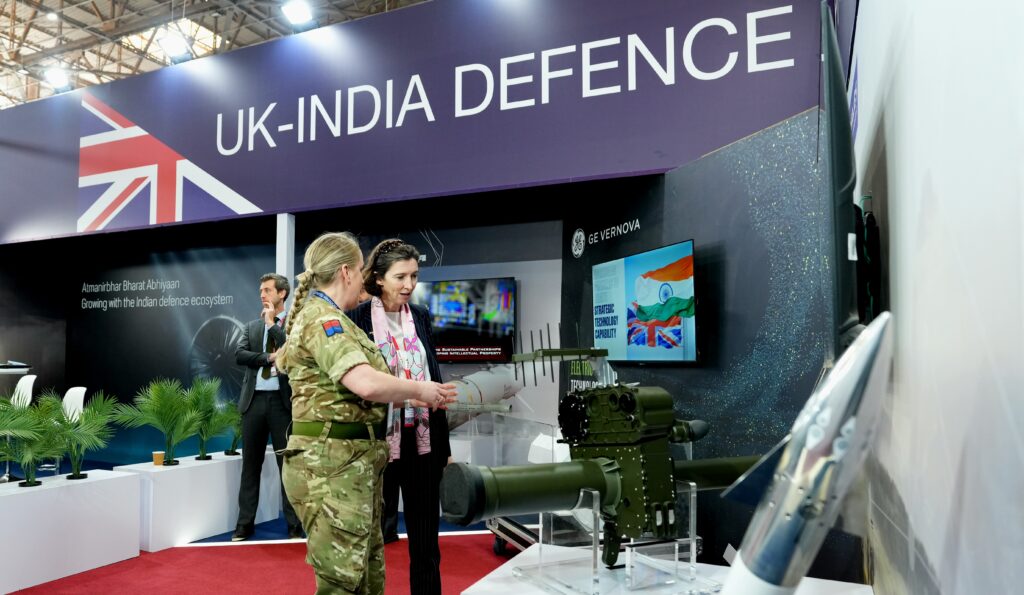
Growing collaboration between our armed forces, defence industries and technology sectors reflects the deep trust that underpins the broader UK-India relationship. Put simply, India is not only a key Indo-Pacific partner for the UK but also one of our most important strategic partners globally.
Q. How is the UK government and its defence and aerospace sector (including firms such as BAE Systems, Rolls‑Royce, Leonardo UK, MBDA, Thales UK) facilitating long‑term partnerships with Indian industry — specifically which models of collaboration are being promoted to ensure sustained UK‑India defence and aerospace ties, and how are UK companies adapting their commercial and technical strategies to align with India’s “Make in India” and indigenous defence‑manufacturing priorities?
A. The most exciting shift is the move to co-development, co-production and shared industrial advantage. That reflects India’s ‘Make in India’ and ‘Atmanirbhar Bharat’ ambitions, and UK companies are increasingly adapting their approaches accordingly. Defence Partnership-India, the Defence Industrial Roadmap and our shared Vision 2035 agenda all point in the same direction: deeper industry-to-industry links, more resilient supply chains and more ambitious technology partnerships.
There are already concrete examples. Cooperation on Laser Beam Riding Missile Systems, including STARStreak High Velocity Missiles and Lightweight Multirole Missiles, demonstrates how advanced capabilities can be developed to meet mutual security needs. Integrated Full Electric Propulsion for India’s next-generation amphibious platforms is another high-value area. So too is combat air. The UK Government and Rolls-Royce’s proposal on India’s future Advanced Medium Combat Aircraft (AMCA) engine development offers a serious route to bring world-class propulsion expertise together with India’s ambitions for sovereign capability. This Rolls-Royce proposal is groundbreaking: it offers the fastest time-to-flight, extensive technology transfer, and a level of freedom from third-party constraints that is particularly attractive to countries pursuing greater sovereign capability. Backed by the British Government, it provides India with access to some of the world’s most advanced propulsion expertise while supporting its long-term ambitions in combat air. Increasingly, the emphasis is not simply on exporting capability to India, but on collaborating with Indian partners to develop, manufacture and sustain capability in support of India’s long-term industrial and strategic objectives.
The direction of travel also aligns with India’s broader defence transformation. The commissioning of INS Mahendragiri, Rs 52,000 crore of new defence acquisitions, and the move towards integrated theatre commands all point to the same trend: a military becoming more joint, more networked and more capable. The UK wants to be part of that story—not simply as a supplier, but as a long-term partner in capability development, industrial collaboration and operational integration. That is entirely consistent with India’s ambition to build greater sovereign capability through Make in India and Atmanirbhar Bharat.
Q. How do you foresee international and industry collaboration evolving over the next decade in areas such as advanced propulsion systems, combat air technologies, avionics, unmanned systems, and aerospace engines, and what technical, regulatory, and organizational challenges will most influence the pace and nature of that cooperation?
A. The next decade will be shaped by three things: speed, software and scale. Ukraine has reminded every serious military that mass, resilience and adaptability matter. Drones are transforming the battlefield; electronic warfare is jamming communications; precision fires reach deep; and information operations can shape the battlespace before the first round is fired. India’s Army Chief has described Ukraine as a “living lab” for future conflict; that is the right lens.
The UK Defence Investment Plan reflects many of the same lessons emerging from modern conflict. Backed by £298 billion of investment over the next four years, it focuses on autonomous systems, precision strike, integrated air and missile defence, cyber resilience, and digitally connected military capabilities. At its heart is a recognition that future military advantage will come from integrating sensors, decision-makers, and effectors more effectively across all domains. Combined with investment in advanced air power, AI and defence innovation, the aim is to deliver armed forces that are more integrated, more resilient and faster to adapt in an increasingly contested world.
That convergence creates real opportunities for international collaboration. Countries and companies are increasingly focused on many of the same capability challenges, whether in propulsion, combat air, avionics, autonomous systems or digital integration. As those priorities align, the opportunity is not simply to buy equipment from one another, but to develop, build and innovate together. Success will depend on creating trusted frameworks that enable collaboration while providing confidence on issues such as technology security, intellectual property, export controls and industrial resilience.
Q. Space has become an increasingly important strategic domain. Do you foresee greater UK–India cooperation in defence-related space technologies and satellite systems?
A. Yes. Space is now both critical national infrastructure and a contested operational domain. The UK and India bring highly complementary strengths. India’s growing role as a space power and the rapid expansion of its commercial space sector sit naturally alongside the UK’s strengths in advanced research, satellite technologies and commercial space services. Together, that creates significant opportunities for collaboration across both the civil and defence space sectors.
The opportunity is not only in defence satellites. It spans areas such as Earth observation, secure communications, and space-domain awareness — capabilities that are becoming increasingly important for both security and economic resilience. Both countries are investing in these areas and share an interest in ensuring that space remains secure, sustainable and accessible.
Bringing together our respective space communities to explore collaboration in research, innovation and commercial opportunity is an important part of the UK-India partnership under Vision 2035.
Q. Joint military exercises and operational engagements between the Indian and British armed forces have increased in recent years. How do these engagements contribute to interoperability and strategic trust?
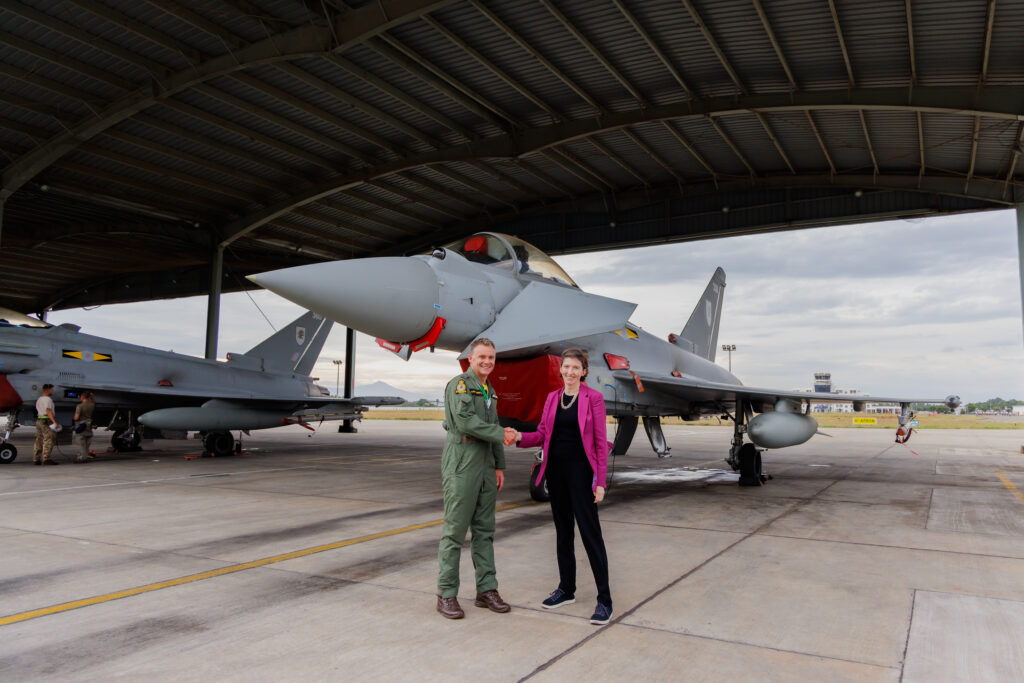
A. Last year our navies conducted their largest-ever maritime exercise, bringing both nations’ Carrier Strike Groups together in the Indian Ocean, including air-defence activity involving fast jets from the Royal Navy, Royal Air Force, Indian Navy and Indian Air Force. On land, Exercise Ajeya Warrior in Rajasthan saw the Royal Gurkha Rifles train alongside the Indian Army’s Sikh Regiment.
Those engagements matter because interoperability is built before a crisis, not during one. Common procedures, shared understanding, officer exchanges and senior-level engagement all build trust. Indian officers are now integrated as instructors in UK officer training establishments, and Indian Qualified Flying Instructors will deploy to RAF Valley later this year to help train future RAF and Royal Navy fast-jet pilots. That is a strong signal of confidence between professional militaries and, as I said, a new era of defence cooperation.

Q. Aerospace and defence increasingly depend on highly skilled talent. Are there initiatives underway to enhance UK–India cooperation in aerospace education, skilling, and workforce development?
A. The FTA will make mobility easier for engineers, consultants and professional services teams working on complex projects. The education relationship is also expanding at pace: Indian students remain among the largest groups choosing the UK and nine UK universities have permission to open campuses in India. That’s really exciting, as it makes the UK the country with the largest higher-education footprint in India.
For defence and aerospace, this matters because it’s a powerful example of what the UK-India partnership can achieve, creating new opportunities for students, researchers, and the next generation of innovators, including in these sectors.
The Rolls-Royce and GTRE work in Bengaluru on Jet Engine Advanced Core Technology is a good example of how industrial collaboration can become a skills pipeline, exposing engineers and technicians to the demands of next-generation military aviation propulsion.
Q. From your perspective, what concrete milestones have already been achieved in UK–India defence and aerospace cooperation under the Roadmap 2030, such as joint programmes, technology transfers, defence trade agreements, co-development projects, or major exercises, and which of these do you view as most significant for a long-term strategic partnership?
A. The most significant milestone is the shift to delivery. The Free Trade Agreement, Vision 2035, and the Defence Industrial Roadmap have created the framework, but what matters is that we are now seeing tangible cooperation emerging in areas such as missile systems, electric propulsion, combat air, and maritime security. Just as importantly, cooperation is increasingly focused on co-development, industrial collaboration and long-term capability partnerships.

If I had to pick one development that matters most for the long-term partnership, it would be the growing alignment between our defence industries. Exercises are important, but industrial partnerships create enduring relationships, shared expertise and mutual strategic interests. As India strengthens its indigenous capabilities and the UK invests in advanced and dual-use technologies—from autonomous systems to AI and digitised warfare—there is an opportunity to build, innovate, and solve problems together. That is ultimately what will make this partnership more resilient, more ambitious and more consequential in the years ahead.
All responses are attributed to the British High Commission, New Delhi.