
By Gurmukh Singh Bawa
On September 17, 2025, the Airports Authority of India (AAI) observed Yatri Sewa Diwas (Passenger Service Day) across all airports in the country. This initiative was created to highlight AAI’s commitment to improving passenger experiences and enhancing travel comfort. It was not merely an announcement; instead to celebrate the first-ever Yatri Sewa Diwas, various airports conducted a wide range of passenger-centric initiatives; including, Passengers were welcomed with gestures like flower showers and traditional “tilak” markings, Events such as cultural programs, quiz competitions, and painting contests were organized, Free health and eye check-up camps were set up for both passengers and airport staff, Tree plantation drives were conducted to promote environmental awareness, Student groups were given airport tours and briefed on career opportunities in aviation.
I am not aware; will this be a one-time affair or an annual affair? But it was a grand gesture by the Airports Authority of India towards Air Travellers. But, I must convey to AAI that it was a great welcome by the passenger fraternity; it shall be celebrated every year. Before coming to the main issue, in the same breath, let me also appreciate the ‘Udan Yatri Café’ scheme that speaks volumes of the intent of the people at the top to address the affordability concerns of Air Travellers, under Ude Desh Ka Aam Admi.
Further, earlier, AERA had issued a consultation paper on the 18th of August 2025, outlining a proposed framework for the formulation and monitoring of performance standards at major airports in the country. AERA’s consultation meeting marks a significant step forward in collective efforts to strengthen the regulatory framework governing aviation operations in India. It was timely, crucial, and essential, but not easy, because global air passenger tariffs are influenced by rising operational costs, inflation, and fuel prices, as well as by strong travel demand and expanded capacity in many regions, leading to generally elevated fares despite regional variations in load factors and competition.
As the aviation sector continues to evolve rapidly, India’s regulatory framework must keep pace with passengers’ growing expectations and the increasing size and complexity of the airport ecosystem. This AERA initiative focused on performance standards for service delivery, while enabling a more structured and enforceable approach to monitoring them.
It is felt that AERA has issued this consultation paper to establish uniform performance standards across all major airports in the country. I think this is the right opportunity for this action. I, too, attended this public meeting. During AERA’s detailed presentation, it was stated that AERA wishes to adopt uniform performance standards across all airports in the country, linked to tariffs. It is imperative that overall efficiency and accountability be linked to drive India’s global competitiveness, thereby enhancing the passenger experience, which is a worldwide project steered by ACI, IATA, and ICAO.
At the local level, it will enhance the value for each stakeholder and be a win-win for all involved in the process. However, utmost Transparency and least human interaction (Full Automation) is a must in this process. As we know, passenger Expectations are very dynamic and subjective; the role of passenger associations becomes crucial in monitoring the shift and advising the concerned authorities on a time-to-time basis; as such, public bodies involved in the air traveller’s welfare shall be consistently roped in.

During the two-hour-long, detailed and elaborate presentation, there was a spellbound silence that clearly demonstrated that the content delivery was worth it. In summing –
“AERA stated that, as per the act, they have been mandated to monitor the set performance standards. So, to have uniform performance standards, AERA has taken this initiative, which we should, because at present, you all know that we have so many concession agreements. Some concession agreements have certain provisions; others have different provisions. So, it is important that we have a uniform performance standard that is easily evaluated, can be monitored, and can be monitored in an efficient manner. With the passage of time, earlier concession agreements have many things that are not being used nowadays. And many new technologies have also come. As we have seen, DIGI-YATRA, CUTE, CUSP, and other technological advancements have taken place. So, the measurement of those needs to be incorporated in the present system. So, over time, baggage is now sent directly rather than only given at the counter; i.e., there is a baggage drop facility at the airport. So, this technological advancement has given us an opportunity, and the ministry has mandated a uniform performance standard for all major airports. These major airports, you know, will serve at least 90 to 92 percent of the total passengers of India. So, our efforts are to make all parameters uniform, measure them, and enforce them in a way that is also practical to enforce.”
It is strongly felt that Reliability of the services at the airports are important, and for that there must be a system with some benchmarks as per international best practices, so that we compare the performance against those benchmarks and then this entire framework would set in motion a complete exercise of not only the passengers coming to know how the airport is making available the facilities for which they themselves are paying.
It was made clear that “all the airport infrastructure is getting funded by the air travellers (passengers), as such, the focus shall be on passenger facilitation, and this is dynamic in nature”.
Point of discussion cropped out from the Existing Provisions in different OMDAs, SSAs, and concession agreements, which are not only valid and effective, but also have legal ramifications. As such, how the integrations take place was a significant concern.
It was presented that historically, Airport Operators came into being as government entities. Later, the Airports Authority of India, erstwhile IAAI, became a commercial organization, and the government sought to develop more international airports in the country. It was envisioned that airlines would fund airport infrastructure investments, as they were the direct beneficiaries, and this was a global practice at the time. As such, it was decided that it was okay to approach airlines to fund investments, but airlines and their associations had a different opinion. Subsequently, it was proposed to tax the passengers, and a system was developed for passengers to pay the UDF, etc. Since Passengers have no voice, it continues to date.

A key point to keep in mind is that, however long the money remains with the government, it has different connotations. Still, when it goes into private hands — i.e., private operators — the situation changes. Now, all those collections from the passengers are going into private hands; naturally, there is an issue. And this can be addressed by an able body, such as AERA.
Also, it was opined that, until recent developments, there was no concept of passenger service, particularly when AERA came into being. It is opined that AERA is required to monitor the standards; if the operators fail to comply, the power to act lies with OMDA. The penalty is laid down in OMDA as follows: 4% of airport revenue constitutes the damages to the airport, to be paid to the airport authority.
Under this scenario, the money collected from the passenger is paid to the government for the damages, but there is no provision to return it to the passenger. There should be a provision stating that if any airport form does not meet those standards, passenger development fees should be refunded to passengers.
Unfortunately, there is no law in it; there is nothing written anywhere. OMDA is written because it is still a government. These airports are only on lease, so we must investigate whether these standards are being enforced. These standards are good; these standards can be monitored digitally or otherwise. And if the operator does not follow, then what happens? Like, if an aircraft is delayed, airlines compensate; in a similar scenario, would the airport authority or the airport operator compensate? The Airport Authority may not give compensation, because it is a government agency. On the other hand, private airports may resort to courts. Take the example of the recent Air India crash, where the compensation value is in debate, despite clear law. Thus, the only loser will be the passenger. The meeting was a perfect example of adequate due diligence in this matter.
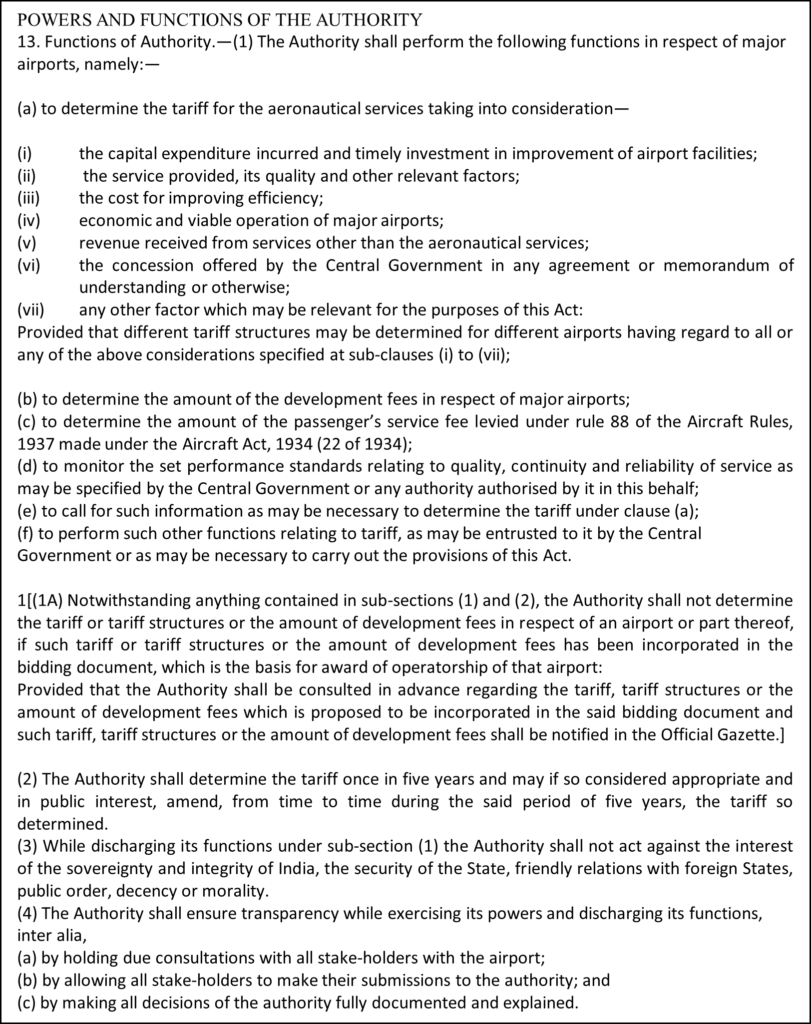
Further, it was discussed and decided that implementing such a monitoring task shall not result in any additional financial burden on passengers. In sum, it was made clear that, under AERA ACT, Section 13-1-a, AERA has the mandate… to determine tariffs… subject to the following: service provider shall have quality and other relevant factors… And AERA shall take power from this paragraph. As such, it shall be added as an addendum to the Tarif guidelines.
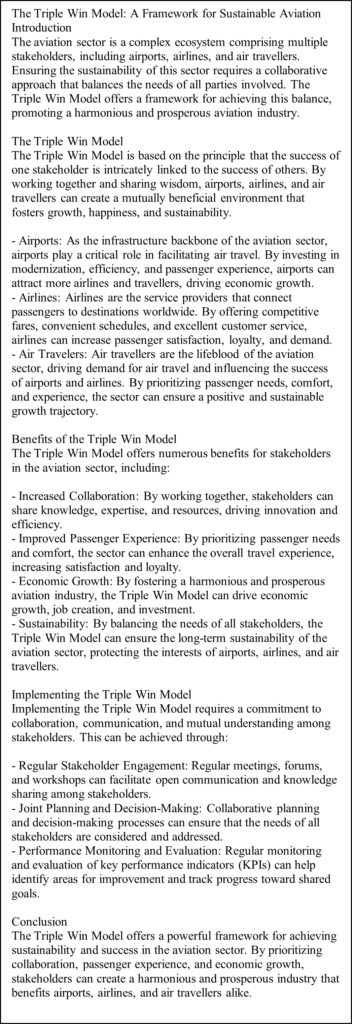
It was the general demand that the time given to file written submissions is too little and the same shall be extended. It was assured. And I observed that it has been done so until 20th Oct. 2025. As I always say, every one of us is a passenger first; as such, we must take cognizance of such developments and share the wisdom to ensure the sustainability of the aviation sector by protecting the survival of Airports, Airlines, and Air Travellers. The Triple Win Model, whereby all the stakeholders are happy, and happiness makes the merry-go-round.
G.S. Bawa is a Senior Aviation Consultant & Advisor. A Former General Manager, Airports Authority of India, he is a highly accomplished aviation professional with decades of experience in airport management, economic planning, corporate planning, public relations, and general administration. Through his expertise in domains such as Airport Planning & Development, Economic Planning, Statistical Analysis & Traffic Forecasting, Public Relations, International Cooperation, and Training & Development, as a seasoned aviation professional, G.S. Bawa offers strategic guidance and expertise to aviation organizations, leveraging his vast experience is his forte.