By Chaitali Bag
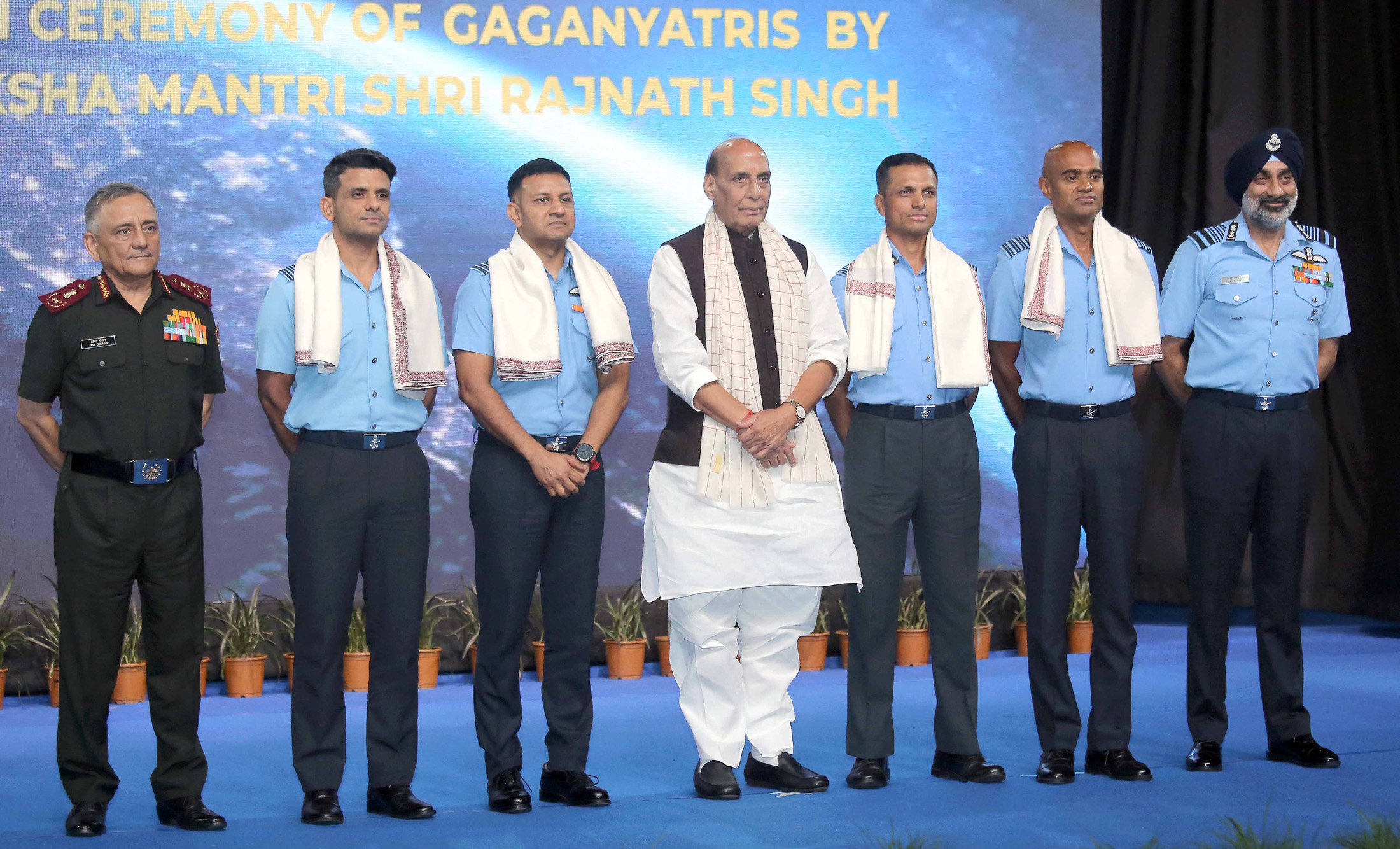
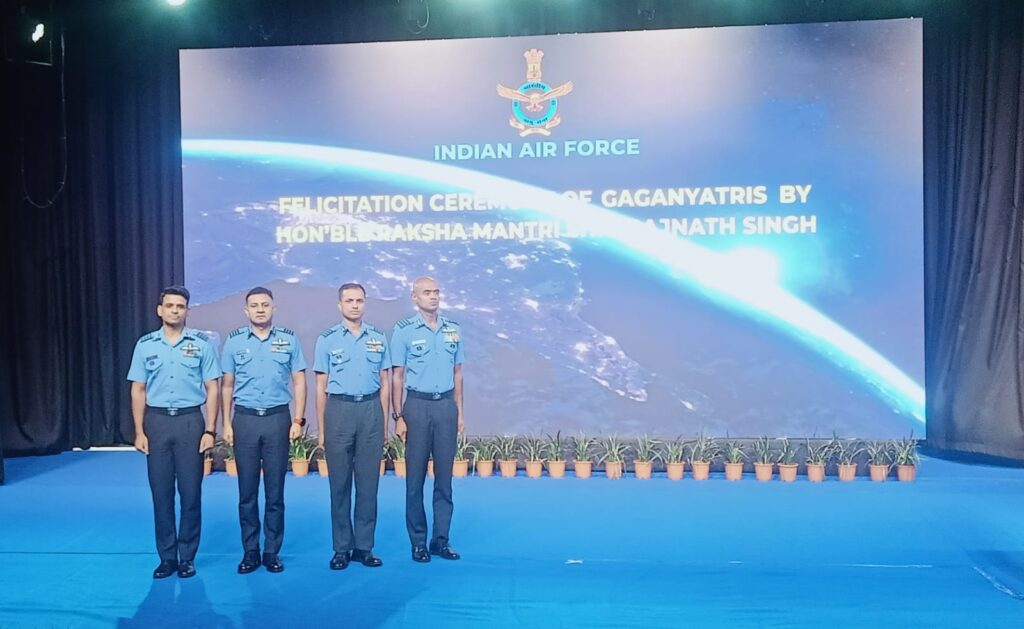
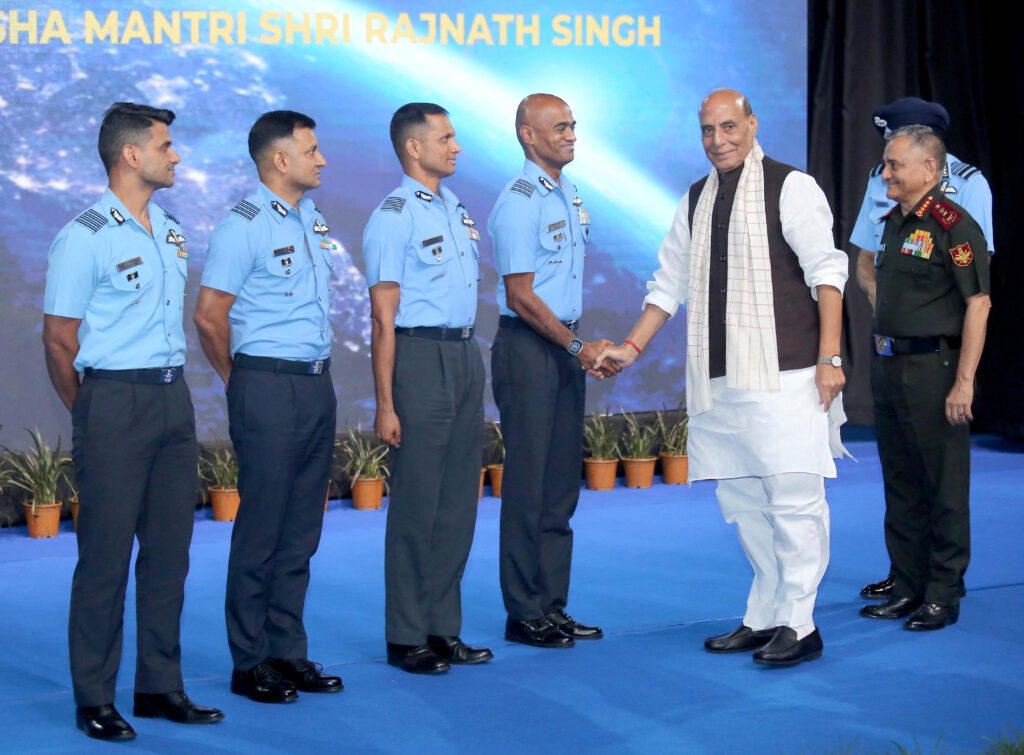
India’s tryst with the stars reached a stirring crescendo in New Delhi on August 24, 2025, as Raksha Mantri Shri Rajnath Singh felicitated the four extraordinary Gaganyatris of ISRO’s maiden human spaceflight mission—Group Captain Shubhanshu Shukla, Group Captain PB Nair, Group Captain Ajit Krishnan, and Group Captain Angad Pratap. In a ceremony brimming with pride and purpose, these astronauts were hailed not just as pilots of a spacecraft but as pilots of a nation’s dreams.
In a stirring celebration in Delhi, Raksha Mantri congratulated India’s Gaganyatris with a blend of pride, purpose, and palpable excitement, honouring not just their personal milestones but the nation’s soaring aspirations in space exploration. The event was more than a ceremony; it was a snapshot of India’s evolving scientific spirit, a reminder of our rich celestial heritage, and a clarion call to push further into the unknown with courage and curiosity.
Pride in a National Horizon
The address opened with heartfelt congratulations to Dr. Anupam Agarwal and a salute to the selected Group Captains moving toward the Axiom Mission 4. This recognition did not rest merely on titles and ranks; it spotlighted the rigor of their training and the vast horizon of opportunities before them.
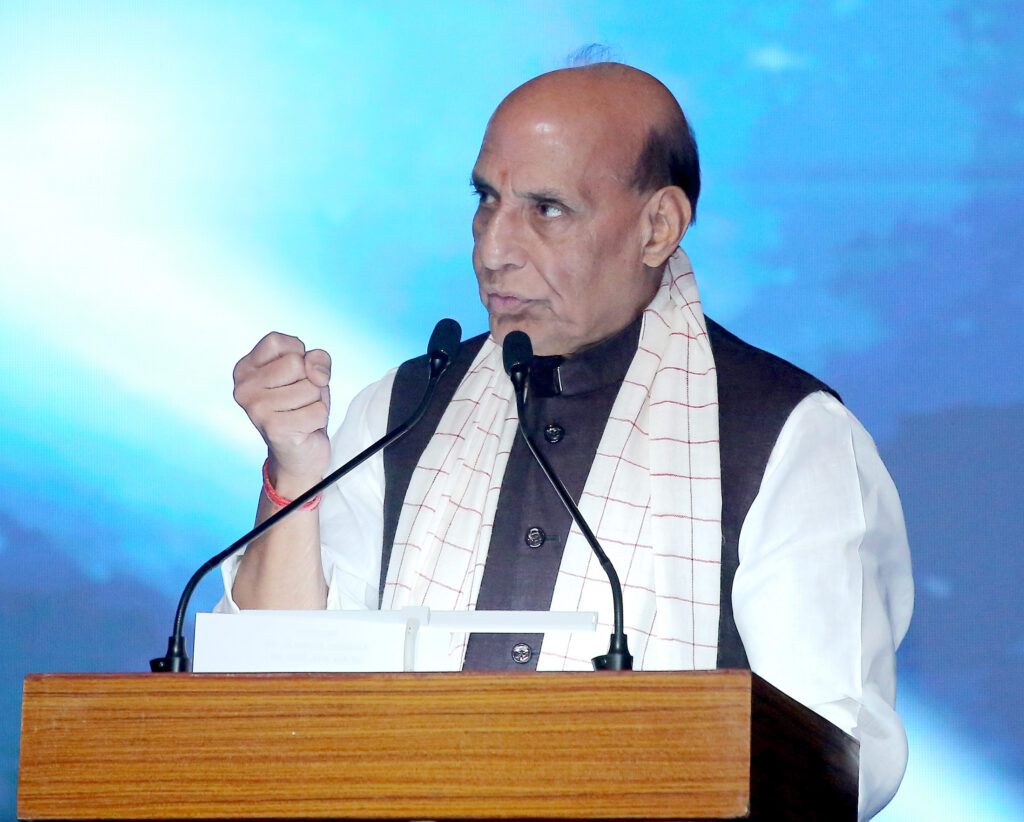
– Challenge and Curiosity: The realities of space—gravitational extremes, oxygen scarcity, carbon dioxide regulation—were framed not as deterrents but as catalysts for curiosity. RM emphasized that these very difficulties spark the questions that drive science forward.
– Destiny and Determination: There was a decisive nod to destiny—the idea that selection for such training was, in some sense, preordained. Yet this notion is intertwined with diligence and devotion, suggesting that destiny favours those who prepare.
– Family and Community: The speech graciously acknowledged the families and communities behind the astronauts, affirming that every launch is a team effort and every milestone a shared triumph.
The Astronauts as Aspirations
“Our astronauts are pioneers of India’s aspirations,” declared Shri Rajnath Singh, capturing the essence of this moment. These four officers, he said, are the living symbols of a confident, self-reliant India—an India that embraces the enormity of the cosmos with the same grit with which it tackles challenges on Earth.
The Gaganyatris embody a continuum of national resolve—from Chandrayaan’s moonlit footprints to Mangalyaan’s triumphant Martian orbit. They represent the power of mind and machine, of engineering precision fused with human courage. And in honouring them, India honoured its own spirit: indomitable, inventive, and inclusive.
RM turned to the human element: the extraordinary demands placed on astronauts over long missions.
– Holistic Readiness: Astronauts must endure physiological and psychological trials—sleep cycles, bone density changes, isolation, and high-stakes decision-making. Preparedness spans physical fitness, mental resilience, and emotional steadiness.
– Institute of Aerospace Medicine: Training at this institute stands at the core of readiness, refining focus, stamina, and adaptability for the harsh confines of space.
– Civil–Military Fusion: The speech underlined how dual-use technologies advance both defence and civilian sectors. Contributions from individuals like Shukla radiate across industries and, ultimately, serve humanity.
Space: India’s Next Frontier of Nation-Building
“We do not see space only as a field of research,” the Raksha Mantri said, “but as the future of tomorrow’s economy, security, energy, and humanity.”
This vision transforms space from a distant wonder into a strategic canvas. Communication satellites that link remote schools, weather constellations that safeguard crops, and disaster-monitoring systems that save lives—these are not abstractions; they are daily dividends of India’s space enterprise reaching every village and every farm.
Beyond today lies an even more audacious horizon:
– Space mining and planetary resources that may unlock new energy paradigms.
– Deep space exploration that challenges human endurance and ingenuity.
– A thriving space economy that seeds jobs, startups, and sovereign capabilities.
RM’s message crystallized around India’s growing stature in the global space community.
– Self-Reliance and Innovation: Our progress is not accidental; it is the result of determined innovation and a spirit of atmanirbharta across sectors.
– Beyond Satellites: From Chandrayaan to Mangalyaan, India’s missions have spoken with a quiet confidence on the international stage, broadening the nation’s profile from satellite deployment to deep-space exploration.
– National Vision, Global Collaboration: India’s space program reflects a dual mandate: fulfill national aspirations and deepen international cooperation. It is part of a strategy to meet future needs in the economy, security, and humanitarian response.
– Technology for the People: Space-derived technologies—telemedicine, precision agriculture, climate and disaster management—are improving life in rural and urban India alike, proving that the benefits of space touch everyday lives.
This is space as infrastructure. Space as opportunity. Space is the next great chapter in Aatmanirbhar Bharat.
A Message for Humanity
Shri Rajnath Singh’s words resonated with the timeless Indian ethos of Vasudhaiva Kutumbakam—the world as one family. He reminded the audience that space is no longer a mere theatre of competition; it is a common of collaboration and a stage for our collective future. India’s journey from the Moon to Mars, and now to Gaganyaan, showcases that when resources are limited. Still, willpower is limitless; history bows to perseverance.
The Shubhanshu Shukla Milestone
– A shining exemplar: Group Captain Shubhanshu Shukla was singled out for special praise after his successful sojourn to the International Space Station as part of Axiom Mission 4.
– A feat of grit: Completing “two-and-a-half years of training in just two-and-a-half months,” as the Minister noted, is not merely a statistic—it is a story of human resolve, of mind over matter, of a nation’s determination distilled into a single individual.
Shukla’s journey is also a testament to civil–military fusion at its finest. Wearing the Indian Air Force uniform yet representing the hopes of citizens and the ambitions of scientists, he bridges the defence, civil, and commercial dimensions of space in one seamless arc. His achievement underlines the nurturing role of the Institute of Aerospace Medicine, which prepares astronauts not just physically, but mentally, emotionally, and psychologically for the rigors of space.
From Laboratories to Lives
India’s space program has always been more than rockets and research facilities. It is a living organism that pulses through the economy and society: empowering fishermen with ocean data, guiding disaster response with rapid imaging, enabling digital inclusion through satellite connectivity, and inspiring classrooms with the poetry of planets. This is why Gaganyaan matters—it brings every Indian closer to the cosmos and brings the cosmos closer to every Indian.
Forward to the Future
RM’s felicitation was not a destination but a departure point. His words to the Gaganyatris were also a rallying cry to students, scientists, entrepreneurs, and citizens:
– Stay Curious: Let questions lead. Curiosity is the engine that turns hardship into discovery.
– Build Boldly: Strengthen laboratories, startups, and collaborations that push the limits of propulsion, life support, materials, AI, and quantum technologies.
– Serve the Nation, Help the World: Ensure that the benefits of space missions—data, tools, and techniques—lift communities, protect environments, and save lives.
A Nation Ready for Liftoff
With Chief of Defence Staff General Anil Chauhan and Chief of the Air Staff Air Chief Marshal AP Singh present at the ceremony, the message was unmistakable: Gaganyaan is a national mission, powered by inter-agency synergy, scientific excellence, and steadfast leadership.
With decades of ingenuity converging into this moment, India now stands fully prepared for human spaceflight, poised to ignite the launchpad of aspiration and confidence across the nation. This is more than a mission to reach orbit; it is a mission to expand the orbit of opportunity for a billion-plus citizens, catalyzing new industries, inspiring classrooms, and accelerating breakthroughs in science, healthcare, and sustainability. Each component tested, each blueprint refined, reflects a larger pledge: that space is not a distant frontier but a shared platform for progress. As Indian astronauts rise skyward, so too will the horizons of innovation, inclusion, and possibility—turning a technological milestone into a people’s movement that propels the country toward a brighter, bolder future.
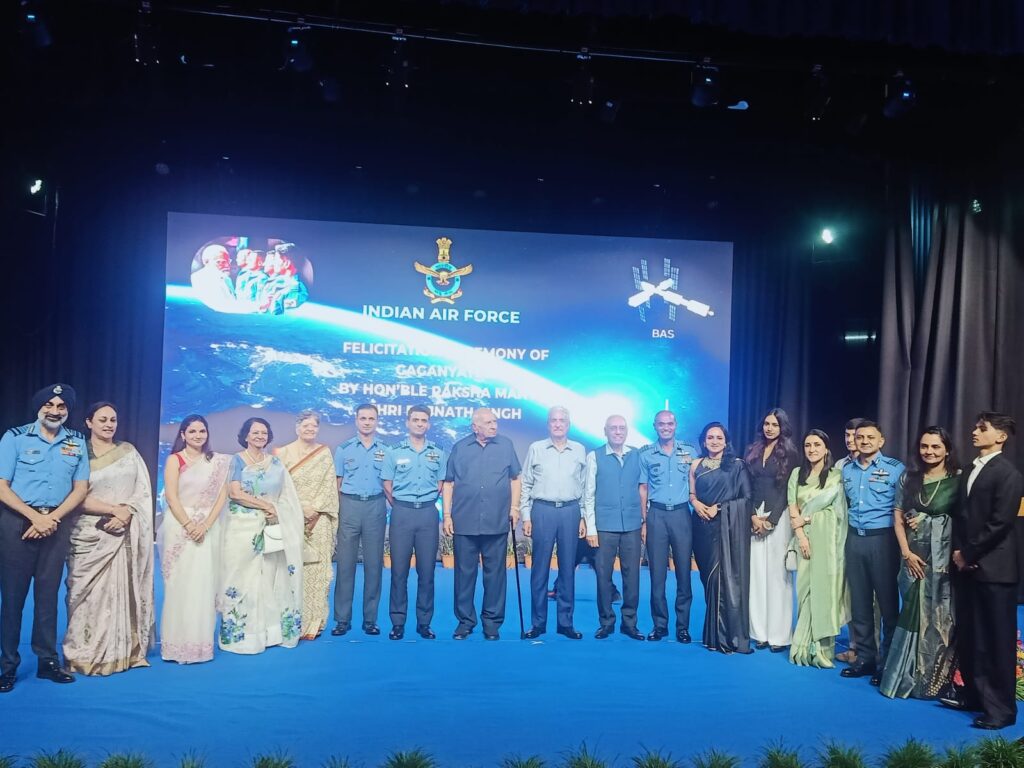
In celebrating the Gaganyatris—Gp Capt Shubhanshu Shukla, Gp Capt PB Nair, Gp Capt Ajit Krishnan, and Gp Capt Angad Pratap—India celebrates its future. Their courage lights the launchpad; their discipline steadies the trajectory. As the countdown to Gaganyaan gathers momentum, one truth shines brighter than any star: this mission carries the aspirations of a nation and the hopes of humanity.
In Delhi, under the gaze of a nation that has always loved the sky, RM’s message rang clear: India’s space journey is not merely about reaching orbits; it is about uplifting spirits, expanding possibilities, and writing a chapter of human progress with Indian ink. To the Gaganyatris—congratulations. To the next generation—prepare. The stars are calling, and India is ready to answer with courage, curiosity, and unstoppable conviction.