By Cdr Rahul Verma (r)

The 55th edition of the Paris Air Show opened with remarkable energy and a clear signal: the aerospace sector is no longer just flying, it’s thinking and evolving.
Day 1 saw a striking shift in focus toward autonomous systems, eVTOL platforms, and AI-enabled drones, as global OEMs, startups, and military delegations converged at Le Bourget. In a show historically dominated by fighter jets and turbofans, software-defined airpower, electric propulsion, and intelligent systems are now firmly at the forefront.
eVTOLs: Ready for Deployment, Not Just Display
The era of vertical mobility has officially arrived. EVTOLs flew in front of the crowd, no longer limited to concept art, with aircraft from Wisk, Beta Technologies’ Alia CX300, Joby, and Archer demonstrating autonomous flight stability, high redundancy, and regulatory maturity.
Wisk’s Generation 6 aircraft, a four-seater, fully autonomous, all-electric air vehicle, impressed with its FAA-aligned safety stack, quiet operation, and clear military dual-use relevance. Defence observers noted its suitability for last-mile logistics, ISR missions, and medevac operations, particularly in urban or mountainous terrain.
Drones: From Theatre Support to Strategic Platforms
Unmanned systems came into their own on Day 1. The drones on display weren’t just tactical add-ons; they’re core to modern battle networks and logistical chains. France’s Turgis & Gaillard unveiled a full-scale model of the AAROK, a sovereign MALE UAV designed to deliver strategic autonomy for France and Europe. With its rugged design, modular payload capability, and ambitions to replace non-EU systems, the AAROK represents France’s clearest signal yet of UAV industrial self-reliance.
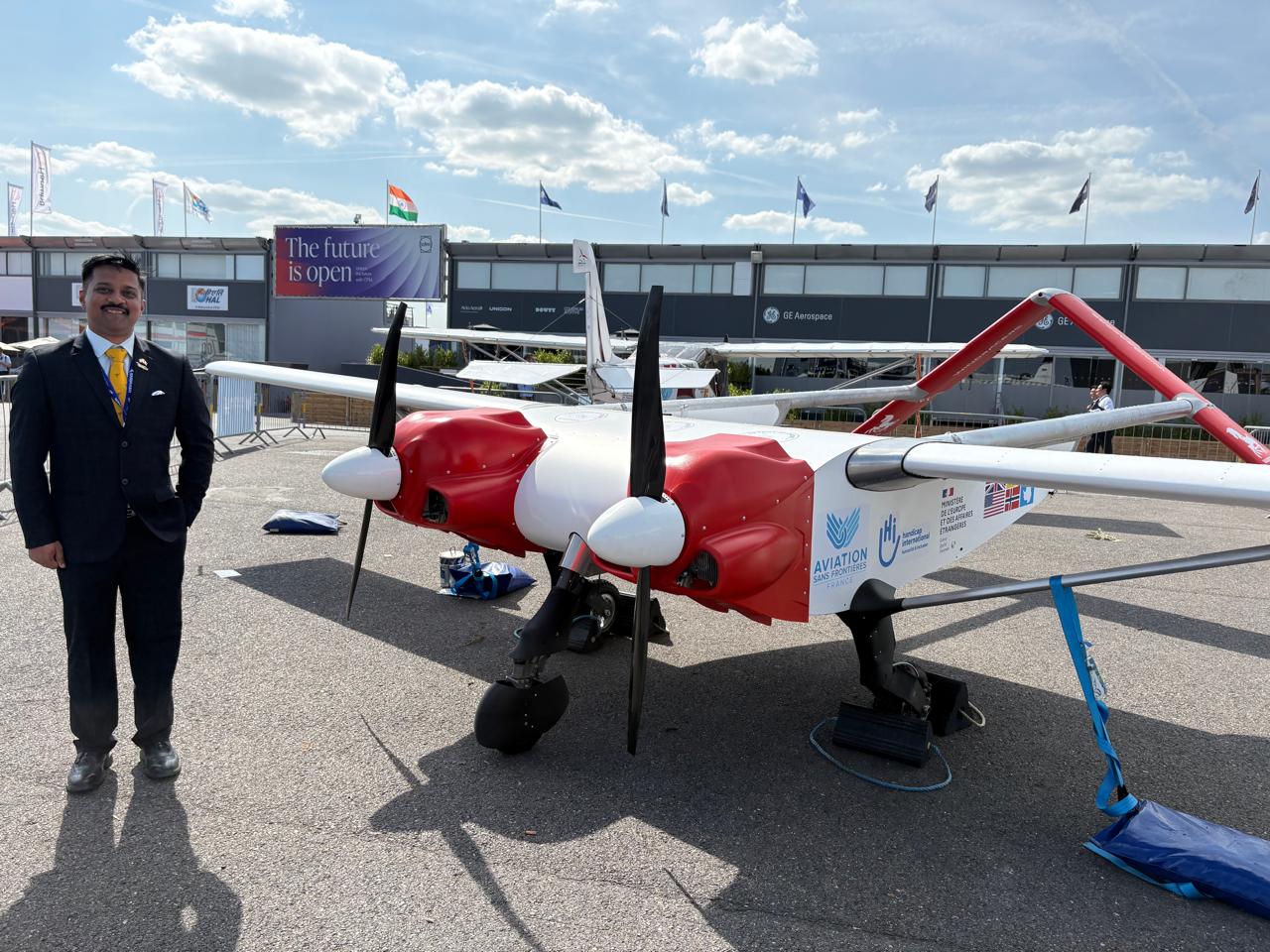
Across the Channel, Windracers showcased its ULTRA autonomous cargo UAV, built for long-range, cost-effective logistics. With a twin-engine layout and GNSS-denied navigation capability, the aircraft is gaining traction among humanitarian agencies and military logistics planners. Interest from Indo-Pacific buyers in the only proven unmanned and autonomous carrier-onboard delivery platform reflects a broader trend: supply chain autonomy now flies on electric wings.
Global drone majors from Israel were missed, whether it was IAI, Elbit or Uvision. The US and India also featured systems ranging from loitering munitions to AI-controlled ISR drones capable of operating in denied environments. India’s iDEX startups and HAL showcased export-ready, agile UAVs with modular sensors and swarm capabilities.

The Autonomy Layer: Code is the Combat Multiplier
What tied everything together today was not just the aircraft, but the autonomy stack beneath them. The show floor buzzed with announcements of AI-powered mission planning systems, onboard edge computing, and ML-based threat classification modules.
AI firms highlighted intelligent flight control suites capable of enabling real-time sensor fusion, cooperative UAS swarming, and onboard decision-making even in GPS and comms-denied zones.
Autonomy isn’t an add-on anymore. It’s the engine.
From Alouette to Autonomy: Replacing Legacy with Electric Intelligence
India’s iconic Chetak and Cheetah helicopters, based on the French Alouette III, have long been the backbone of high-altitude and naval utility operations. But as these legacy platforms approach the end of their service lives, the future is arriving in the form of autonomous, electric vertical lift systems.
For high-altitude logistics and medical evacuation, Wisk’s Generation 6 autonomous eVTOL, with its advanced fault-tolerant systems and quiet electric propulsion, presents a compelling alternative. Its pilot-optional configuration and zero-emission profile could significantly reduce crew risk in the Himalayas while enhancing operational efficiency.
Meanwhile, for carrier-onboard delivery (COD) and ship-to-shore logistics, the Windracers ULTRA UAV stands out. Its twin-engine autonomous design, heavy payload capacity, and proven GNSS-denied navigation make it an ideal solution for deck landings, spare parts transport, and emergency replenishment, all without risking pilots or tying up helicopter hours.
Together, platforms like Wisk and Windracers offer India a chance to leapfrog from legacy to leadership in the autonomous aviation age.
Global Vibes and Strategic Trends
From NATO’s autonomy trust framework to emerging Indo-Pacific interest in sovereign drone fleets, the message is consistent from my perspective: control of the skies now begins with control of code. For militaries, autonomy offers resilience; for industry, it offers scalability; and for regulators, it offers a challenge worth embracing.
The 55th Paris Air Show is proving that the future of flight is electrified, autonomous, and increasingly, unpiloted. As legacy aerospace giants and insurgent innovators share the tarmac, one thing is clear: the sky is no longer the limit — it’s becoming self-aware.
Stay tuned for Day 2 as we bring updates on combat air teaming, AI–human interface systems, and new propulsion technologies shaping the next aerospace decade.
Cdr Rahul Verma (r), former Cdr (TDAC) at the Indian Navy, boasts 21 years as a Naval Aviator with diverse aircraft experience. Seaking Pilot, RPAS Flying Instructor, and more, his core competencies span Product and Innovation Management, Aerospace Law, UAS, and Flight Safety. The author is an Emerging Technology and Prioritization Scout for a leading Indian Multi-National Corporation, focusing on advancing force modernization through innovative technological applications and operational concepts. Holding an MBA and Professional certificates from institutions like Olin Business School, NALSAR, Axelos and IIFT, he’s passionate about contributing to aviation, unmanned technology, and policy discussions. Through writing for various platforms, he aims to leverage his domain knowledge to propel unmanned and autonomous systems and create value for Aatmannirbhar Bharat and the Indian Aviation industry.