
Staff Correspondent
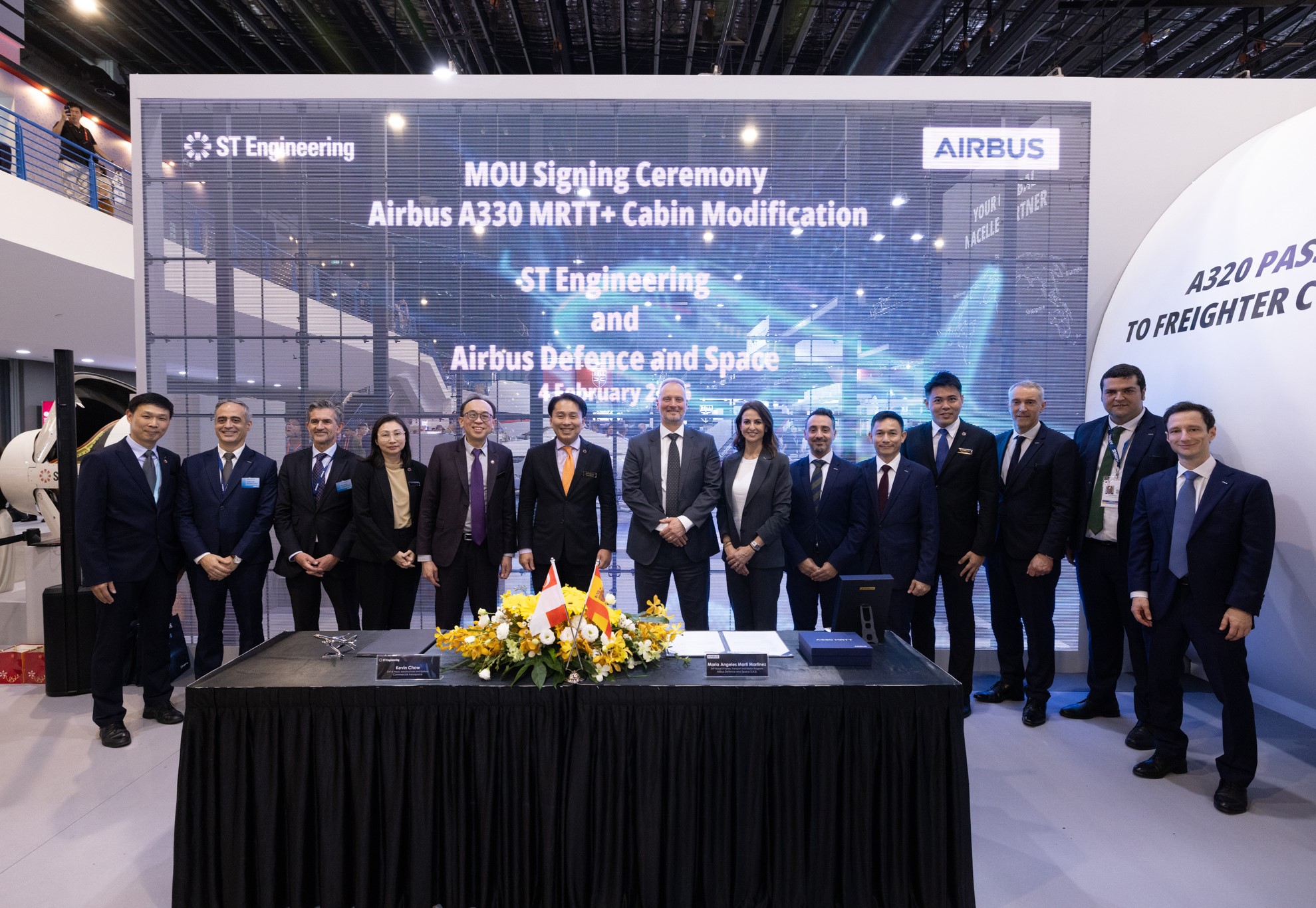
ST Engineering’s recent memorandum of understanding with Airbus Defence and Space to undertake a cabin modification programme for an Airbus A330 Multi Role Tanker Transport Plus (A330 MRTT+) represents a significant development in contemporary aerospace engineering, commercial collaboration, and capability integration. This agreement, which formalizes a preliminary understanding for the provision of engineering design, certification and aircraft modification services, highlights not only the technical demands of modern military transport and refuelling platforms but also the evolving role of specialised aerospace systems integrators in delivering mission-tailored solutions to operators.
The A330 MRTT+ itself embodies both continuity and evolution in aerial refuelling and transport capability. Derived from the A330neo family, the platform builds on the combat-proven legacy of the A330 MRTT while incorporating advances in airframe efficiency, systems architecture and operational flexibility. Such platforms are required to perform multiple roles—tanker, troop and cargo transport, aeromedical evacuation, and command-and-control—often within a single airframe. Consequently, cabin modification programmes for such aircraft are complex undertakings that demand multidisciplinary design skills, rigorous certification pathways, and meticulous systems integration to reconcile operational requirements with safety, regulatory, and logistical constraints.
The MoU between ST Engineering’s Commercial Aerospace business and Airbus Defence and Space foregrounds several facets of contemporary aerospace collaboration. First, it underscores the importance of specialised third-party engineering partners in translating high-level operational requirements into certifiable cabin architectures. Modern cabin modifications—especially those for multi-role military platforms—extend beyond simple interior refurbishment. They encompass structural assessments; environmental control and pressurisation interfaces; electrical and avionics integration; cargo and restraint systems; berthing and medical module installations; and the routing and support of mission systems. Each change must be assessed for structural integrity, electromagnetic compatibility, weight and balance implications, and maintainability, then validated through testing and regulatory engagement. By positioning itself to deliver engineering design, certification support and modification services, ST Engineering signals its capability to manage these interconnected dimensions.
Second, the agreement highlights the strategic value of experience in passenger-to-freighter conversion and cabin reconfiguration. ST Engineering’s established work in freighter conversions—particularly through joint ventures and partnerships—provides a foundation in structural modification, cargo-handling system integration and certification processes that are highly relevant to military cabin remits. Although military cabin requirements often entail additional systems and bespoke mission equipment, the core competencies of bespoke structural modification, systems integration and supply-chain coordination are transferable and essential. The MoU thus exemplifies how commercial aerospace expertise can be leveraged to meet defence-oriented mission specifications while ensuring compliance with civil and military airworthiness standards.
Third, the collaboration points to the increasingly global and networked posture of contemporary maintenance, repair, and overhaul (MRO) ecosystems. ST Engineering’s assertion of a global network of MRO facilities and partners reflects industry realities: large-scale modification programmes often require distributed capabilities—design hubs, certified production facilities, specialist tooling and local regulatory interfaces—coordinated across jurisdictions. Effective execution, therefore, depends on robust program management, supply-chain resilience, and the ability to deliver after-sales support and lifecycle sustainment. The capacity to move from bespoke engineering design through certification and on to delivery and through-life support addresses an operator’s need for predictability, performance and long-term operability.
Beyond the technical and logistical aspects, this MoU also demonstrates the commercial and strategic calculus at play in modern aerospace partnerships. For Airbus Defence and Space, collaborating with an experienced third-party modifier amplifies the value proposition of the A330 MRTT+ by offering a credible route to customised mission fit-outs for specific customers without diverting core manufacturing resources. For ST Engineering, the engagement extends its portfolio into a high-profile military platform, enabling the company to showcase its engineering depth and to consolidate its reputation in both commercial and defence markets. Such partnerships can create competitive differentiation by marrying platform pedigree with bespoke missionization capabilities, thereby addressing the varied procurement preferences of military operators who demand tailored capability within fixed acquisition timelines and budgets.
The successful implementation of such cabin modification programmes depends on strict adherence to certification requirements and standards. Whether modifications proceed under civil certification frameworks, military airworthiness authorities, or hybrid arrangements, the certification pathway requires comprehensive documentation, analysis, ground and flight testing, and clear evidence that modifications do not diminish the aircraft’s safety or performance envelope. The experience and processes that ST Engineering brings—spanning design substantiation, testing protocols and regulatory engagement—are therefore central to converting MoU intentions into fielded capability.
Equally important is the human and organizational dimension: collaborative programmes require seamless interfaces between original equipment manufacturers, modification teams, regulatory authorities and the end customer. Alignment on requirements, change control, knowledge transfer and sustainment planning is vital. This is especially true for multi-role platforms that must retain operational flexibility while integrating specialised mission systems. The MoU framework provides an early governance architecture for such alignment, establishing the basis for subsequent contractual arrangements, program milestones and responsibility matrices.
The announcement also situates ST Engineering within a wider narrative of technological leadership and multidisciplinary capability development. The company’s exhibition of capabilities at forums such as the Singapore Airshow signals its intention to engage with global markets and stakeholders, demonstrate engineering excellence across air, land, sea, digital, and emerging domains, and attract further collaborative opportunities. Public-facing engagements serve both commercial and reputational functions, reinforcing trust among potential customers and partners that the company can manage complex, high-consequence modifications.

