
By Vijay Grover
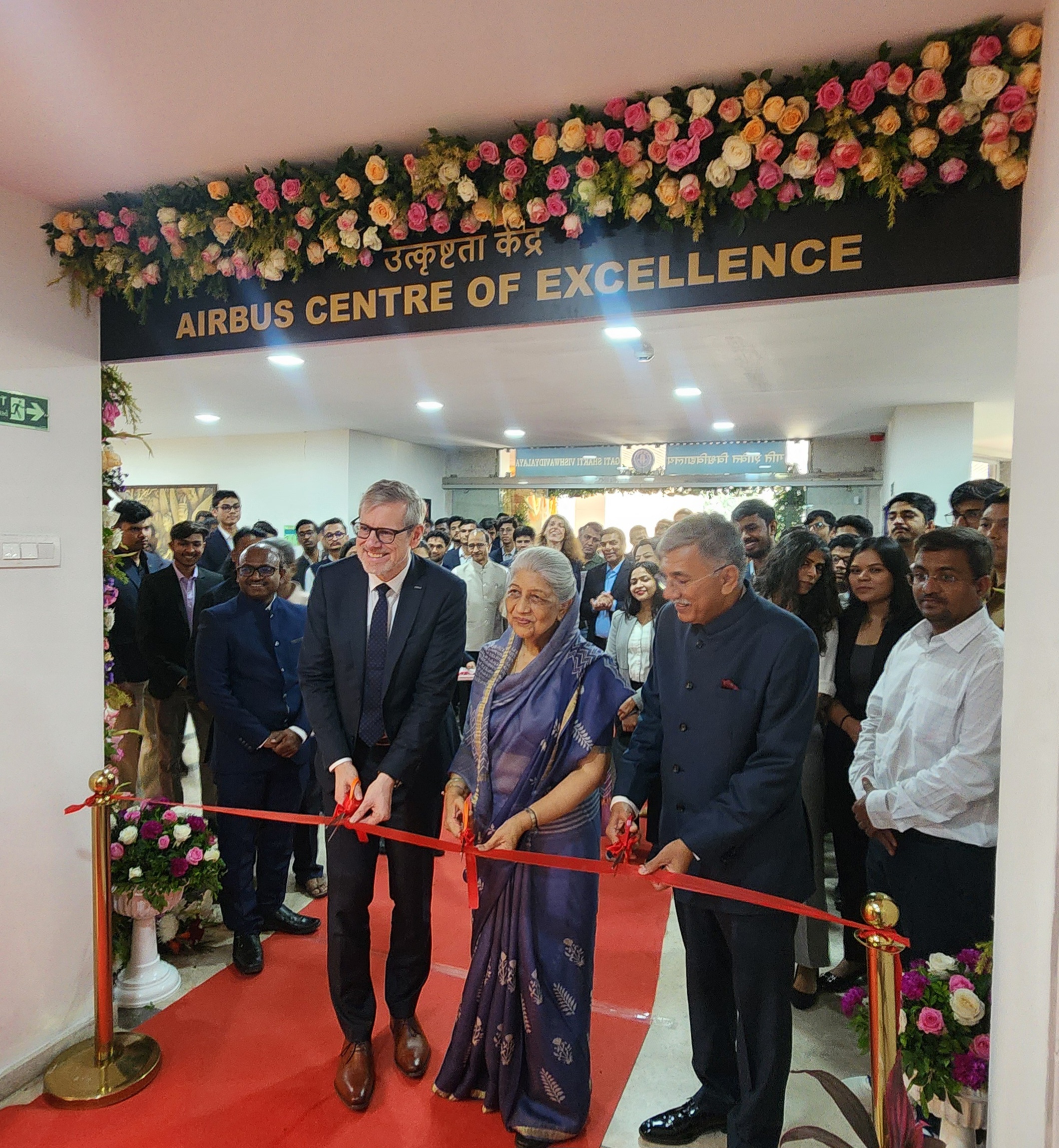
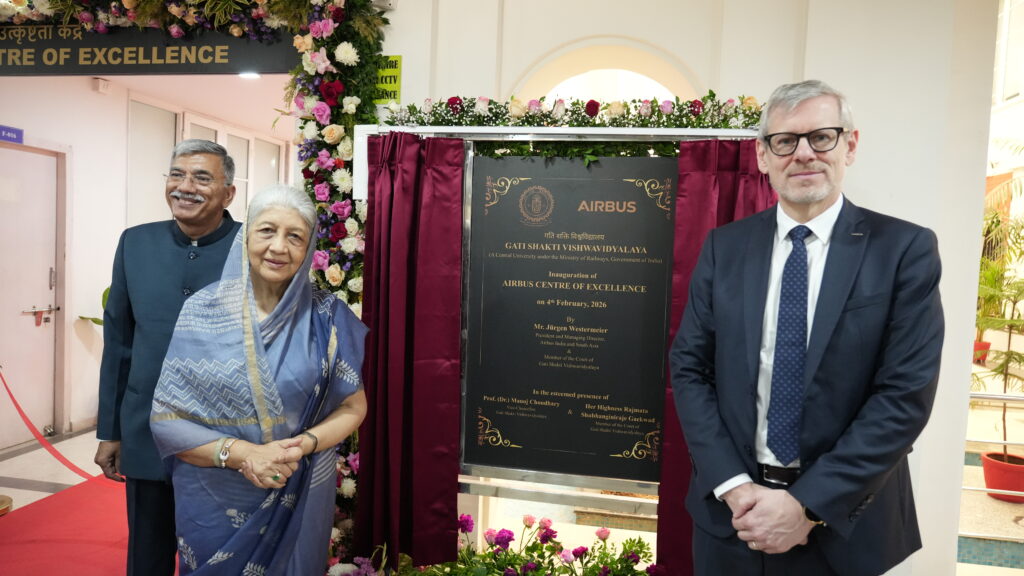
Airbus’s inauguration of a Centre of Excellence (CoE) for aerospace studies at Gati Shakti Vishwavidyalaya (GSV) in Vadodara represents a consequential development for India’s nascent yet rapidly maturing aerospace ecosystem. The CoE embodies a strategic confluence of industry capability, academic inquiry, and national policy intent, aiming to accelerate research, cultivate talent, and foster innovation that together can underpin both technological progress and sustainable growth within the nation’s transportation and logistics sectors.
Contextually, GSV occupies a distinctive position in India’s higher education landscape. Founded by an Act of Parliament in 2022 as a central university devoted to transportation and logistics, GSV is expressly mandated to address the full spectrum of mobility modalities—railways, aviation, highways, ports, maritime, inland waterways, urban transport—and the integrated supply chains that connect them. The university offers a purpose-built institutional platform for industry–academia collaboration in areas where coordinated systems thinking and cross-modal engineering are essential. The establishment of an Airbus CoE at GSV therefore leverages this unique institutional mandate and aligns with broader governmental priorities, including Aatmanirbhar Bharat and long-term objectives for national infrastructure and technological self-reliance.
The CoE advances three interrelated objectives: strengthening research and development, nurturing human capital, and enabling industry-relevant innovation. On the research front, the CoE’s explicit focus on Sustainable Aviation Fuel (SAF), including R&D into converting municipal solid waste (MSW) into SAF, addresses an urgent global and national imperative. Aviation’s decarbonization is a central technical and policy challenge: alternative fuels, efficiency improvements and novel propulsion technologies are all essential to reducing lifecycle greenhouse gas emissions from air transport. Locally produced SAF made from waste feedstocks offers multiple advantages—reduced carbon intensity relative to fossil jet fuel, the creation of circular-economy pathways that valorize municipal waste, the potential for regional energy-security benefits, and the stimulation of new industrial activities. Airbus’s industrial expertise, combined with GSV’s research capabilities, can accelerate proof-of-concept work, pilot projects, and scalable processes adapted to India’s specific feedstock profile, regulatory environment, and logistics constraints.
Human capital development constitutes the second critical pillar of the partnership. Airbus and GSV’s scholarship programme—supporting 45 meritorious and underprivileged students, with a deliberate reservation of one-third of scholarships for women—addresses both equity and capacity-building objectives. The aerospace sector’s long-term competitiveness depends on a steady supply of deep technical talent, multidisciplinary engineers, applied researchers and managerial professionals conversant in aviation systems, regulatory frameworks and sustainability imperatives. Complemented by the establishment of an Airbus Chair Professor for Aerospace Studies and curriculum initiatives spanning undergraduate, postgraduate and executive education, the CoE will help create pathways for students to transition from academic study to industrial and research careers. This capacity-building is particularly consequential for regional development: by nurturing local talent in Gujarat and across India, the partnership lays the foundation for human resources that support indigenous design, manufacturing, and services in aviation.
The CoE also exemplifies a replicable model of industry–academia collaboration. Airbus’s investment in scholarships, faculty support and joint research accords demonstrates a long-term commitment that extends beyond episodic outreach. The joint study agreement to develop sustainable aviation solutions further institutionalizes collaboration through grants and shared research agendas. Such holistic engagement—combining funding, expertise, curriculum development and targeted R&D—creates an environment where academic inquiry is directly informed by industrial needs and where industry benefits from an academic pipeline of ideas and trained personnel. Prof. Manoj Choudhary’s framing of the Airbus–GSV partnership as a template for the country underscores the potential for scaling similar centers across other institutions and mobility sectors, thereby amplifying the partnership’s national impact.
Several broader implications merit emphasis. First, the CoE’s focus on converting MSW to SAF aligns technical innovation with pressing societal challenges—urban waste management and environmental sustainability. India’s urban centers generate substantial amounts of municipal waste, and technologies that convert suitable organic and combustible fractions into usable aviation fuel could simultaneously reduce landfilling and supply low-carbon feedstocks to the aviation sector. Second, the partnership supports the government’s strategic priorities—evident in references to Aatmanirbhar Bharat and the Viksit Bharat vision for 2047—by fostering domestic capabilities rather than relying solely on external technology imports. Third, the gender-inclusive scholarship design addresses systemic barriers to participation in STEM fields and signals a commitment to widening access to high-value careers in aerospace.
Operationalizing these ambitions will require sustained attention to several challenges. Converting MSW into sustainable aviation-grade fuel presents challenges related to feedstock heterogeneity, preprocessing, contamination control, and lifecycle emissions assessment. Effective collaboration will demand robust pilot plants, interdisciplinary teams spanning chemical engineering, environmental science and systems analysis, and clear regulatory pathways for fuel certification and commercialization. On the education front, curricula must balance foundational theory with hands-on, industry-relevant experience; internships, co‑operative education models and project-driven learning will be important. Finally, scaling from pilot demonstrations to industrial deployments will require coordination among municipal authorities, waste-collection systems, fuel-offtakers and investors—areas where GSV’s cross-modal remit and industry relationships can be consequential.
Vijay Grover is the Editor of Indian Aerospace & Defence. He is a veteran Indian journalist whose work has significantly influenced television newsrooms at outlets such as Zee News, NewsX, and TRT World. Renowned for shaping newsroom practices and ethical standards, he has critiqued the decline of field reporting and the rise of desk-driven propaganda.

