
Chaitali Bag
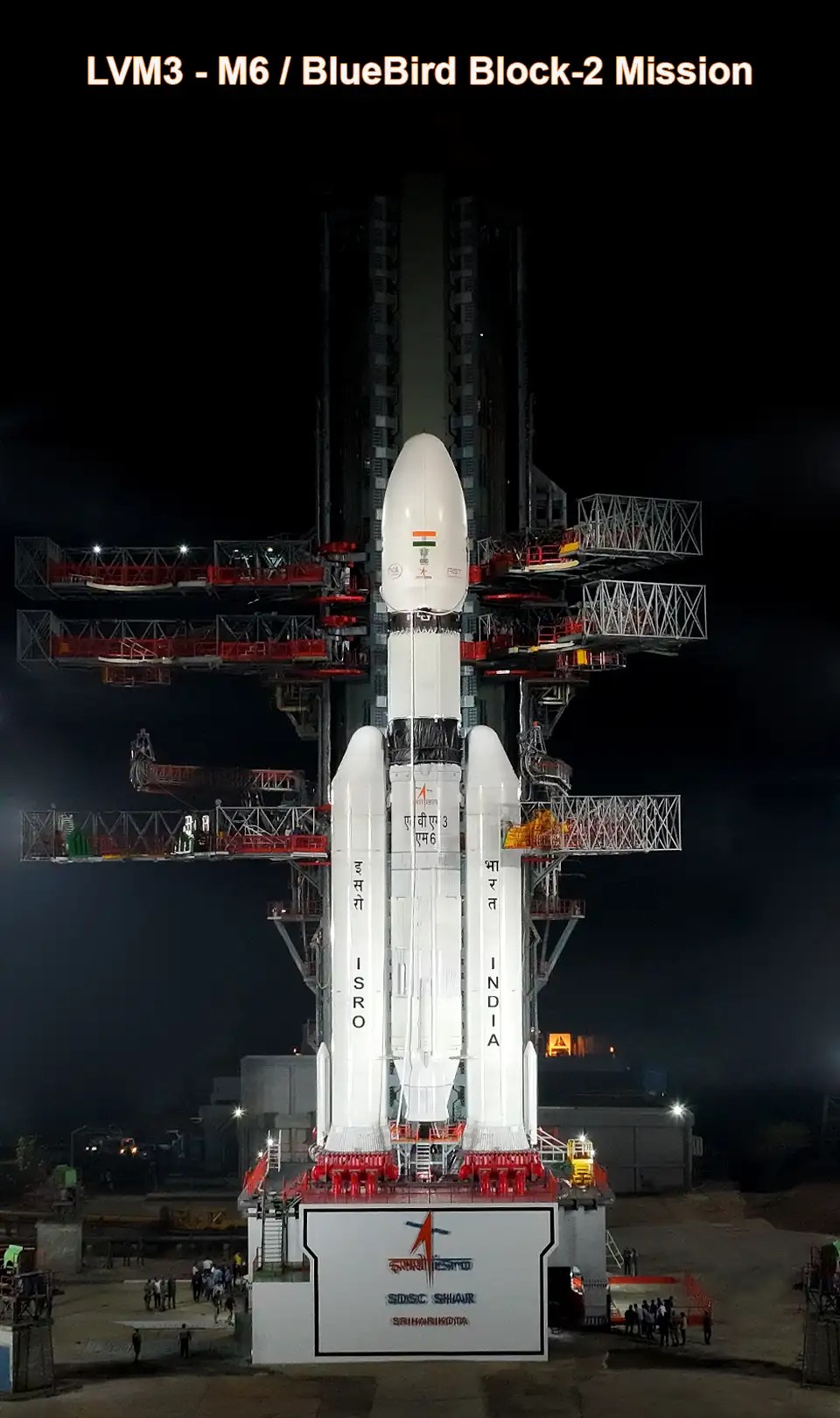
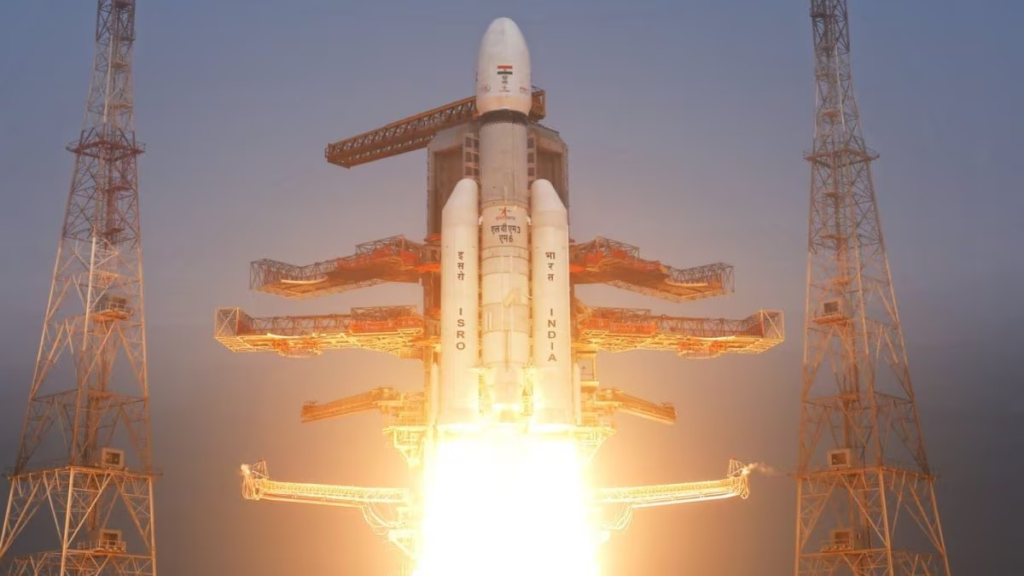
The Indian Space Research Organisation (ISRO) has once again shown the world the power of persistence, engineering excellence and bold innovation. With the successful launch of the LVM3-M6 mission carrying the BlueBird Block-2 satellite and its precise insertion into the targeted low Earth orbit, ISRO not only celebrated a milestone mission but also announced a remarkable achievement: the completion of 100 orbital launches. This landmark underscores India’s steady ascent as a dependable and competitive player in the global space services sector.
LVM3—the heavy-lift workhorse of ISRO—stood at the center of this triumph. Built to carry substantial payloads into space, LVM3’s three-stage architecture of solid boosters, a liquid core stage and a cryogenic upper stage has powered some of India’s most significant missions, from Chandrayaan lunar ventures to commercial OneWeb deployments. The LVM3-M6 mission was notable for setting a new payload record for launches from Indian soil: it carried the heaviest payload ever flown by an LVM3, demonstrating both the vehicle’s mature capability and ISRO’s commitment to expanding its commercial reach.
BlueBird Block-2, developed by US-based AST SpaceMobile, represents an exciting leap in space-enabled communications. Unlike conventional satellite systems that require specialised ground equipment, this satellite is designed to communicate directly with standard smartphones. As part of a global low-Earth-orbit constellation, BlueBird Block-2 aims to deliver 4G and 5G voice and video calling, messaging, streaming, and mobile data even in areas without terrestrial network coverage. With a massive antenna roughly the size of a tennis court—the largest commercial communications antenna ever placed in LEO—the satellite signals a future in which connectivity is truly global and ubiquitous.
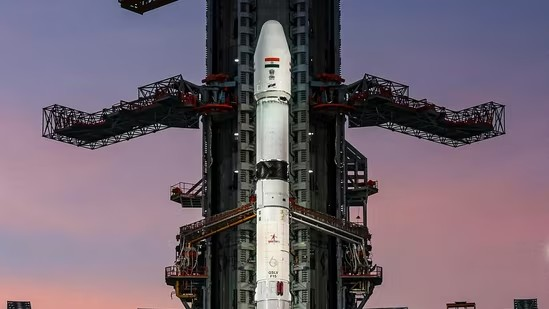
Technically, the mission was also a milestone in systems innovation. For the first time on an LVM3 flight, ISRO employed electro-mechanical actuators (EMA) to gimbal and control the S200 solid booster nozzles, replacing the traditional hydraulic systems. This transition to EMAs is more than a detail: the new actuators are lighter and simpler, freeing up mass for additional payload capacity, improving reliability, and easing ground support and maintenance. It exemplifies ISRO’s pragmatic upgrades—small but impactful optimizations that add up to meaningful performance gains for launch vehicles.
The commercial nature of the flight further highlights India’s growing role in the international space market. LVM3-M6 was a dedicated commercial mission for AST SpaceMobile, reflecting ISRO’s ability to attract and serve global customers with precision and consistency. ISRO Chairman V. Narayanan lauded the mission’s success, pointing out the flawless injection of the satellite and noting this flight as ISRO’s 104th launch from Sriharikota and the ninth successful LVM3 mission—an impressive record of operational reliability.
Beyond numbers and hardware, this mission resonates with a larger vision: democratizing access to space-enabled services. By enabling direct-to-handset satellite connectivity, BlueBird Block-2 could transform emergency response, bridge digital divides in remote regions, and extend high-quality communications to oceans, deserts and mountains where building terrestrial networks is impractical. ISRO’s role in making such services more attainable—by offering cost-effective, reliable launches—helps catalyze a new era of global connectivity and technological entrepreneurship.
The triumphant launch of LVM3-M6 is more than a single mission milestone — it is a clarion call announcing India’s arrival as a heavyweight contender in the global commercial launch market. When AST SpaceMobile entrusted NewSpace India Limited and the Indian Space Research Organisation’s LVM3 with the BlueBird Block-2 satellite — the largest commercial communications spacecraft ever lofted into Low Earth Orbit and the heaviest payload launched from Indian soil at 6,100 kg — it signalled a structural shift in how satellite operators weigh where to buy rides to orbit. That a U.S. operator chose India’s LVM3 over familiar Western alternatives underscores a new reality: for a substantial and growing segment of the market, India now offers a package of capability, cost-effectiveness and commercial maturity that makes it a genuinely competitive alternative to the United States and Europe.
At the heart of this development is the LVM3 itself. Designed to address the mid- to heavy-class segment of the market, LVM3 delivers a balance of lift capacity and operational flexibility that meets the needs of many modern communications satellites. With the ability to lift several tonnes into Low Earth Orbit and meaningful payloads to Geosynchronous Transfer Orbit, LVM3 occupies a market sweet spot: it can serve single, large payloads that are too heavy for small launchers but do not require the full power — and price tag — of the most powerful Western rockets. For operators like AST SpaceMobile, which must match satellite mass and orbit targets to launcher performance while keeping program economics viable, the LVM3 proposition becomes very attractive.
Equally important is the commercial interface NewSpace India Limited provides. NSIL’s role as a single-window commercial gateway for ISRO’s launch fleet provides foreign customers with the predictability and contractual clarity essential to multi-million- and multi-hundred-million-dollar satellite programs. Consistent pricing structures, well-defined contracting processes and an increasingly experienced mission-management capability lower transaction friction and perceived commercial risk. NSIL’s commercial expansion — evidenced by strong revenue growth and a mandate that now spans launches, satellite manufacturing, leasing and technology transfer — further signals that India is not merely offering one-off launches but is building the institutional scaffolding of a mature launch services industry.
Operational experience amplifies commercial credibility. ISRO and NSIL have demonstrated their ability to manage complex, high-stakes campaigns. The deployment of 72 OneWeb satellites across two LVM3 missions taught operational lessons that scale beyond constellation rides; those missions demonstrated that India can handle the precise integration complexities, tight schedules, and logistics demands of international customers. The LVM3 has also carried national flagship missions such as Chandrayaan-2 and Chandrayaan-3, proof points that the vehicle can support delicate, high-profile missions under intense scrutiny. BlueBird Block-2’s successful insertion into LEO is the latest in a string of missions that collectively build a persuasive reliability narrative — and reliability is the currency that buys confidence for costly, one-off commercial payloads.
Cost competitiveness, however, is what makes India’s emergence structurally significant rather than merely symbolic. Launch economics are a calculus of payload mass, target orbit, vehicle capability and price. For many satellites—particularly large LEO communications platforms like BlueBird Block-2—operators can now evaluate India’s LVM3 as a lower-cost route to orbit without sacrificing performance or reliability. When the pricing advantage is paired with transparent commercial processes and a growing catalog of successful flights, the decision to select India becomes more than a budget concession; it becomes a rational procurement choice. In short, India is no longer competing only on price — it is competing on value.
This convergence of capability, cost and commercial maturity is transforming market dynamics. Historically, U.S. and European rockets have dominated global heavy-launch demand, aided by deep industrial networks, financing, and long-established commercial relationships. India’s rise does not instantly displace these incumbents; rather, it adds a robust alternative that recalibrates bargaining power. For satellite operators, having another reliable, cost-effective option creates leverage in contract negotiations and greater resilience in planning: launch manifest congestion, geopolitically driven export controls, or narrow capacity windows are less likely to derail programs when a proven Indian alternative is on the table.
The LVM3-M6 mission also carries geopolitical and industrial implications. Prime Minister Narendra Modi’s praise of the launch as a “significant stride in India’s space sector” is not mere rhetoric — it reflects the strategic intent to build an indigenous space ecosystem that serves both national and commercial objectives. NSIL’s expanding role in manufacturing, leasing, and technology transfer suggests an ambition to move up the value chain: India can provide not only launch services but also broader satellite solutions and partnerships. That expansion could attract more foreign customers seeking integrated services and local production options, further deepening India’s foothold in the global supply chain.
Moreover, India’s growing cadence and reliability matter for the era of mega-constellations and connectivity-focused missions. As constellations proliferate and operators plan multi-hundred- or multi-thousand-satellite deployments, launch cadence becomes a critical bottleneck. LVM3’s scaling, coupled with India’s efforts to commercialize additional vehicles and ground services, can help alleviate global capacity constraints. Successful heavy-lift missions like LVM3-M6 send a message: India can be a dependable contributor to the global launch manifest, smoothing the path for ambitious constellations and large spacecraft alike.
Of course, challenges remain. To sustain and amplify this competitive position, India must continue improving launch cadence, streamline regulatory and export control frameworks, and expand its industrial base to support even larger or more frequent missions. Investment in ground infrastructure, range capacity and faster integration pipelines will be necessary to meet the tempo demanded by commercial customers. NSIL will need to deepen partnerships with private industry to scale manufacturing and services, and India must maintain rigorous quality assurance and mission-safety protocols to preserve its reliability record. But the trajectory is already clear: the foundational achievements are in place, and the incentives — both commercial and geopolitical — align strongly with continued growth.
The LVM3-M6 mission is therefore emblematic of a new chapter in space commerce: India has moved beyond being an emerging option to being a structurally viable alternative for heavy satellite launches. It offers a compelling blend of lift capacity suited to mid-heavy satellites, a maturing and predictable commercial interface through NSIL, and an established reliability record that builds operator confidence. For customers evaluating their next-generation communications infrastructure — whether single large satellites or elements of expansive constellations — India now figures into the shortlist not as a low-cost outlier but as a mainstream competitor.

