
A Milestone Moment in Visakhapatnam
Staff Correspondent
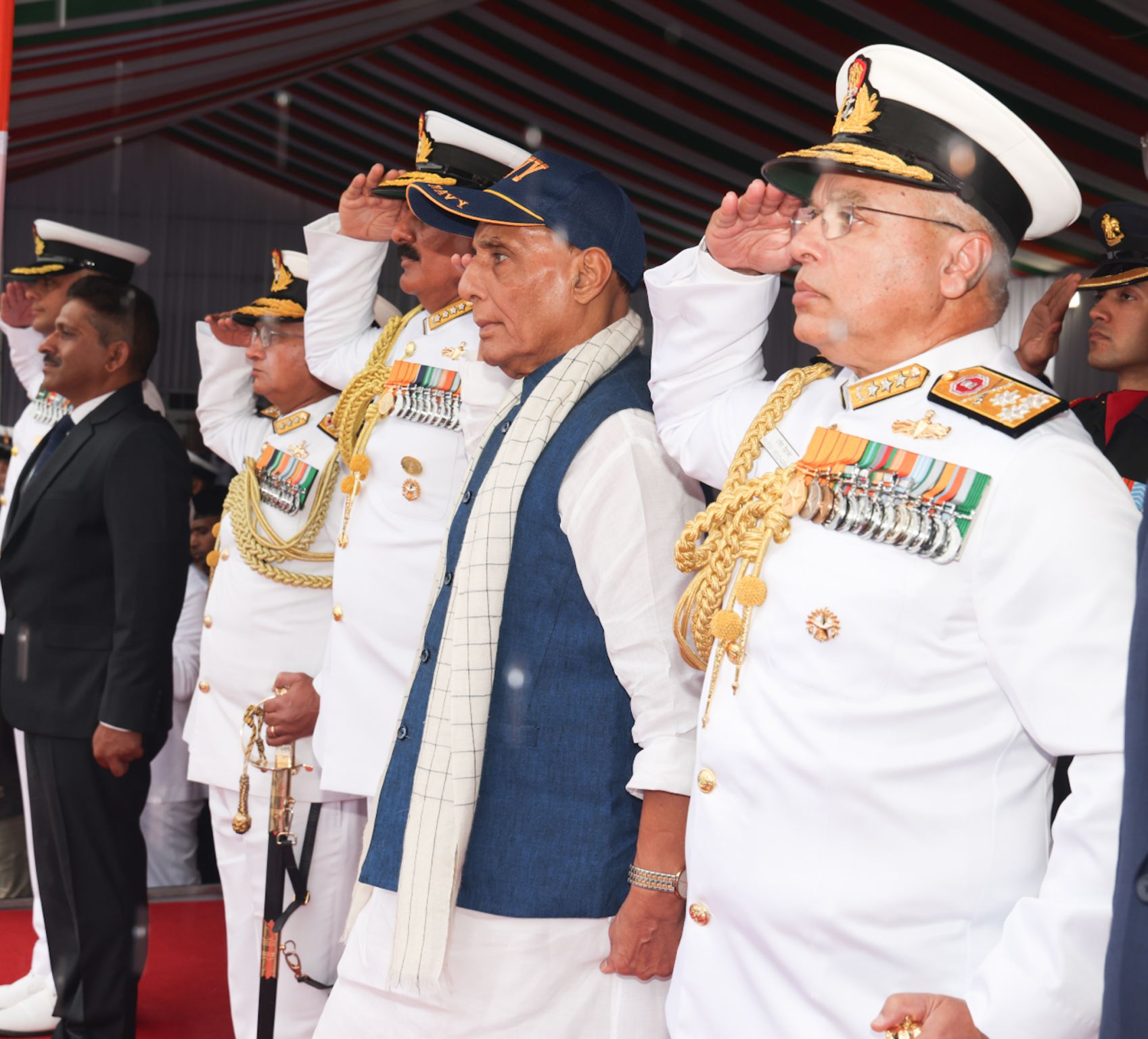
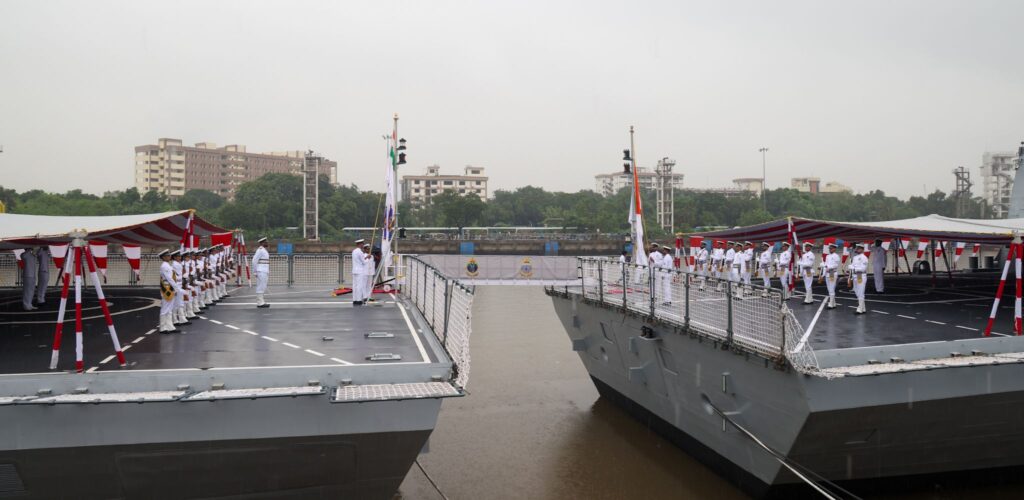
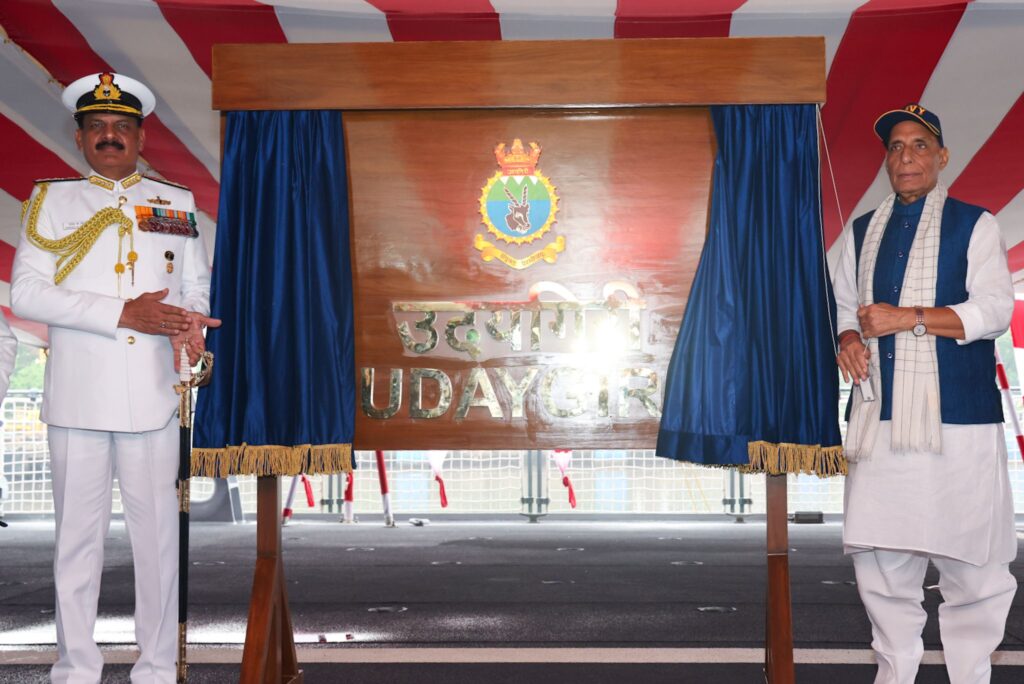
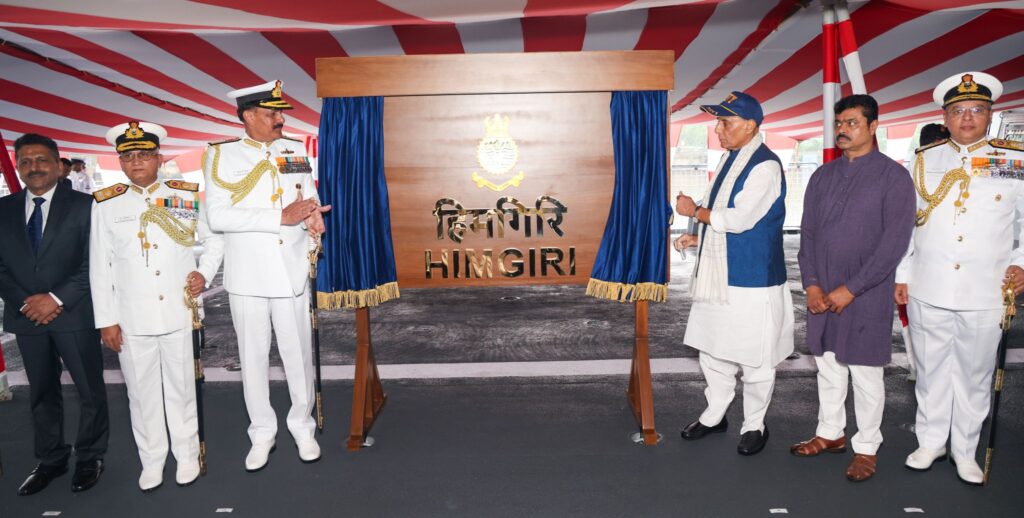
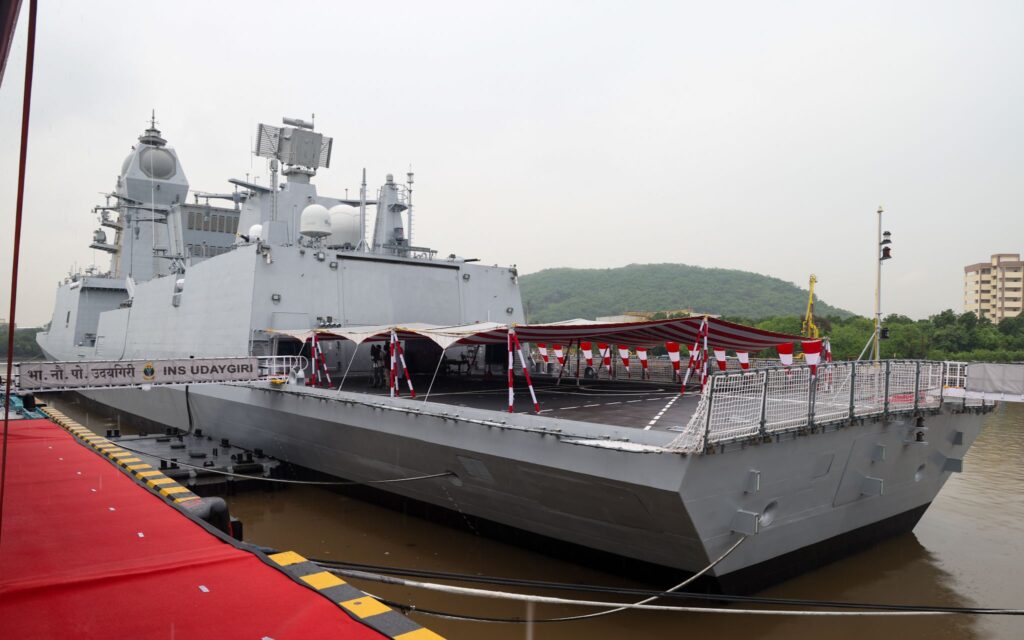
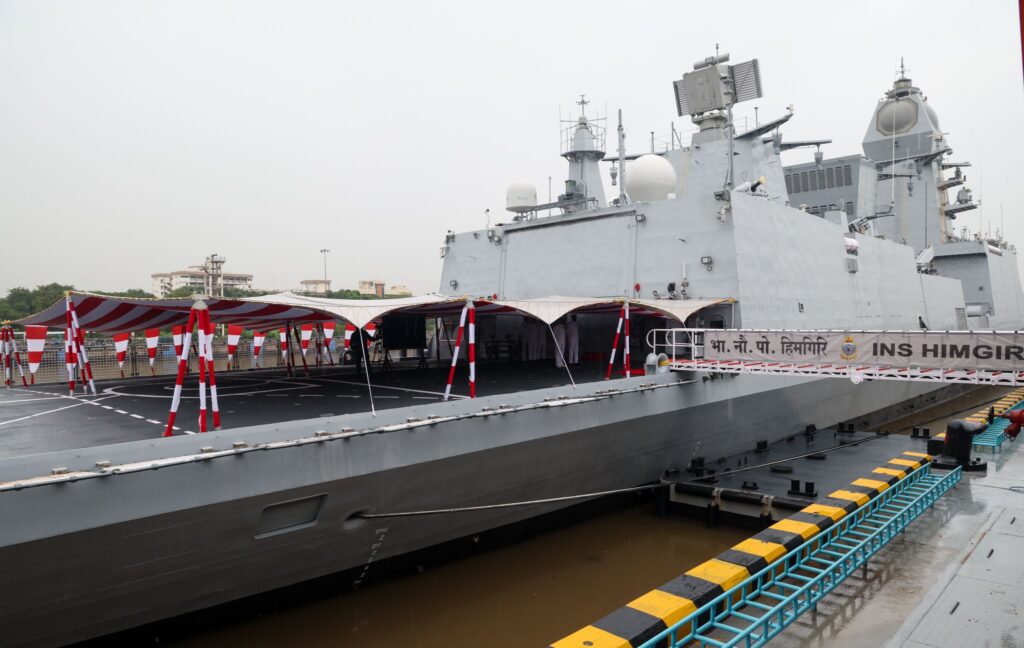
In a landmark ceremony that underscored India’s accelerating march towards maritime self-reliance, two multi-mission stealth frigates of Project 17A — INS Udaygiri and INS Himgiri — were commissioned into the Indian Navy in the presence of Raksha Mantri Shri Rajnath Singh at the Naval Base, Visakhapatnam, on August 26, 2025. The event marked the first simultaneous commissioning of two frontline surface combatants, each indigenously built by different shipyards: Mazagon Dock Shipbuilders Limited (MDL), Mumbai, and Garden Reach Shipbuilders & Engineers Limited (GRSE), Kolkata.
With this allied achievement, India reaffirmed its position as a rising maritime power — technologically adept, operationally agile, and strategically clear-eyed.
“Aatmanirbharta Is Ground Reality”
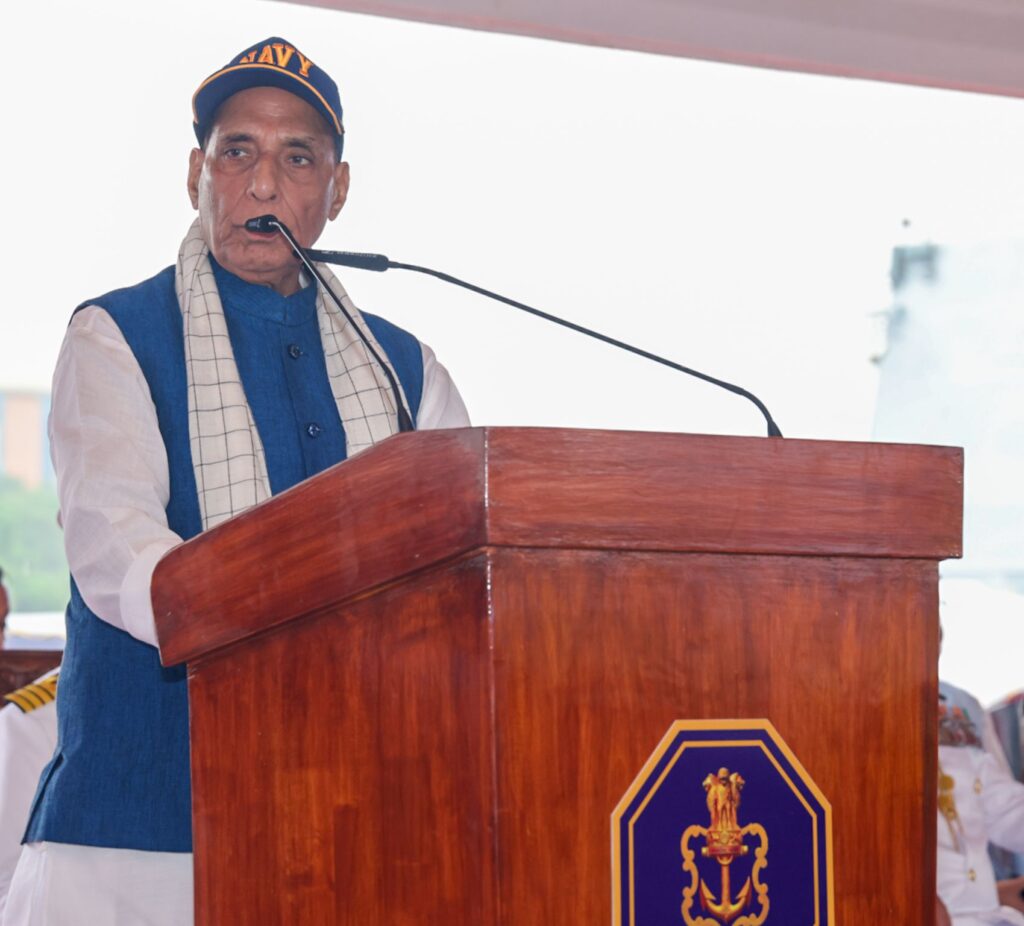
Addressing the gathering, Raksha Mantri Shri Rajnath Singh framed the commissioning as a decisive step in India’s journey towards defence self-reliance, aligning it with the vision of Aatmanirbhar Bharat. He emphasized that INS Udaygiri and INS Himgiri are “shining examples of the Government’s firm resolve towards self-reliance,” reflecting a tangible shift from aspiration to implementation.
– Indigenous Content: Exceeding 75%, enabled by Indian OEMs and a vibrant MSME ecosystem
– Design Pedigree: Successor class to Project 17 (Shivalik), with enhanced stealth, survivability, and mission flexibility
– Propulsion and Automation: Combined Diesel or Gas (CODOG) plants paired with an Integrated Platform Management System for higher speed, efficiency, and reliability.
The Defence Minister reiterated a dual commitment: India does not believe in aggressive expansionism, but it will never bow to those seeking harm. The commissioning, he added, tangibly advances the Nation’s “Neighbourhood First” and MAHASAGAR (Mutual and Holistic Advancement for Security & Growth for All in the Region) policies.
Project 17A: Designing for the Full Spectrum
The Project 17A frigates are purpose-built for the diverse and demanding realities of 21st-century maritime operations. They are among the most sophisticated surface combatants in the Indian Navy’s inventory, engineered for stealth, flexibility, and sustained presence.
Stealth and Survivability
– Reduced radar cross-section signatures through advanced shaping and materials
– Acoustic and infrared signature management for anti-submarine and anti-air survivability
– Layered electronic warfare suites for detection, deception, and defence
Sensors and Combat Systems
– Next-generation surveillance and multifunction radars for long-range situational awareness
– Integrated Combat Management Systems enabling real-time data fusion and fire control
– Indigenous surface-to-surface and surface-to-air missiles for offensive and area air defence roles
– Rapid-fire gun systems for close-in engagements and asymmetric threats
Propulsion and Platform Management
– CODOG architecture offering a balance of speed, range, and fuel economy
– State-of-the-art Integrated Platform Management System for predictive maintenance and reduced crew load
– Aviation facilities to embark and sustain naval helicopters and UAVs for extended ISR and ASW reach
By design, these frigates are multi-mission workhorses, optimized for anti-air, anti-surface, and anti-submarine warfare, as well as sea control, maritime security, and humanitarian operations. Their entry into service elevates the Indian Navy’s capacity to protect sea lanes, deter coercion, and respond swiftly across the Indian Ocean Region (IOR).
Blue-Water Assurance: First Responder and Preferred Partner
The commissioning of INS Udaygiri and INS Himgiri reinforces India’s blue-water capability and its posture as a “First Responder” and “Preferred Security Partner” in the IOR. From counter-piracy and anti-trafficking operations to disaster relief and non-combatant evacuation, the platforms broaden the Navy’s toolkit for crisis response and regional cooperation.
Operational Roles
– Maritime domain awareness and sea-lane security
– ASW picket and convoy escort in contested environments
– Maritime interdiction, counter-terrorism, and anti-smuggling tasks
– HADR (Humanitarian Assistance and Disaster Relief) missions with scalable logistics support
The Raksha Mantri highlighted the Navy’s central role in safeguarding national economic security, pointing to the strategic maritime arc from the Arabian Sea to the Middle East and the eastern African seaboard — a region critical to India’s energy flows and trade lifelines.
Lessons from Operations: Deterrence, Readiness, Resolve
Citing the Navy’s prompt planning and execution during Operation Sindoor, Shri Rajnath Singh affirmed that India’s maritime forces project credible deterrence and decisive capability. He underscored a national stance rooted in restraint yet firm resolve: India does not provoke, but when threatened, it responds effectively, precisely, and proportionately.
– Jointness in Action: Seamless tri-service and inter-agency synergy demonstrated
– Strategic Signaling: Swift deployment and assertive posture constrained adversarial action
– Continuity of Purpose: “Not over — merely a pause,” emphasizing vigilance and national unity against terrorism
Chief of the Naval Staff Admiral Dinesh K Tripathi echoed this theme, noting the Navy’s ability to deliver overwhelming force from the sea. He connected the efficacy of sea control to broader national deterrence, crediting indigenous capability — as embodied by INS Udaygiri and INS Himgiri — for enabling rapid, calibrated responses.
Industrial Momentum: From Design Halls to the High Seas
The frigates symbolize a mature, networked ecosystem of design, manufacturing, and integration:
– Warship Design Bureau: These are the 100th and 101st in-house designed warships, a testament to institutional depth
– Supply Chain: Robust participation from MSMEs and Indian OEMs in sensors, weapons, and platform systems
– Dual-Yard Delivery: MDL and GRSE’s synchronized execution demonstrates scalability and risk dispersion in complex shipbuilding programs
Key milestones illustrate disciplined program management:
– INS Udaygiri: Keel laid May 7, 2019; launched May 17, 2022; delivered July 1, 2025
– INS Himgiri: Keel laid November 10, 2018; launched December 14, 2020; delivered July 31, 2025
Four additional ships of the class are being advanced at MDL and GRSE, with deliveries slated for mid-2026 — an indicator of industrial rhythm and learning-curve efficiencies.
Eastern Seaboard Focus: Speed, Reach, Relevance
Both ships will join the Eastern Fleet under the Eastern Naval Command, augmenting India’s readiness and resilience in the Bay of Bengal and adjoining sea spaces. The dual induction strengthens rapid-reaction capacity for contingencies from the Malacca approaches to the wider IOR littorals, while reinforcing maritime partnerships and coordinated security architectures.
Operational Payoff
– Faster surge capacity and persistent presence missions
– Enhanced multi-domain ISR and anti-submarine coverage
– Greater flexibility for task group composition and rotational deployments
Heritage and Continuity: Names That Endure
The Navy’s tradition of rechristening preserves institutional memory and honours legacy:
– INS Udaygiri pays tribute to its predecessor in service from 1976 to 2007
– INS Himgiri honors the namesake that served from 1974 to 2005
The new hulls embody a continuum — a bridge between a storied past and a technologically advanced future.
Future-Ready by Design: Innovation as Doctrine
Warfare is evolving across domains — sea, air, undersea, space, cyber, economic, and social. The Government’s focus on defence R&D aligns with the Navy’s emphasis on modularity, digital integration, and interoperability. Project 17A ports these imperatives into steel:
– Digital Backbone: Integrated data environments for faster decision loops
– Open Architectures: Pathways for spiral upgrades and indigenous tech insertion
– Mission Modularity: Rapid reconfiguration for role-specific deployments
– Sustainment: Predictive maintenance and lifecycle optimization via advanced diagnostics
As Admiral Tripathi noted, indigenous design and high local content introduce uniqueness and operational surprise — critical attributes in a competitive maritime theatre.
The Strategic Arc Ahead
With INS Udaygiri and INS Himgiri entering service, India consolidates three converging vectors:
– Capability: Stealthy, versatile combatants that extend reach and lethality
– Credibility: Demonstrated readiness and calibrated deterrence in real-world operations
– Confidence: A shipbuilding ecosystem that can design, build, and integrate complex platforms at pace
These frigates are more than platforms; they are policy in motion — supporting Neighbourhood First, MAHASAGAR, and India’s role as a stabilizing maritime power. In their wake is a broader narrative of national capacity: scientists, engineers, sailors, and industry partners bringing “Aatmanirbharta” from slogan to sea-state reality.
At a Glance: INS Udaygiri and INS Himgiri
– Class: Project 17A multi-mission stealth frigates (successors to Shivalik class)
– Builders: MDL (Udaygiri), GRSE (Himgiri)
– Core Capabilities:
– Anti-air, anti-surface, and anti-submarine warfare
– Advanced stealth shaping and EW suites
– Integrated sensors and combat management systems
– Supersonic SSMs, SAMs, rapid-fire naval guns
– Aviation facilities for helicopters/UAVs
– Propulsion: CODOG with Integrated Platform Management System
– Indigenous Content: >75% (weapons, sensors, systems from Indian OEMs and MSMEs)
– Fleet Assignment: Eastern Fleet, Eastern Naval Command
– Program Trajectory: Four additional ships due by mid-2026
Steel, Seamanship, and Self-Reliance
The commissioning of INS Udaygiri and INS Himgiri is a defining waypoint in India’s maritime journey — a confluence of industrial maturity, strategic foresight, and operational excellence. As the flags were hoisted in Vizag, the message was unambiguous: India seeks peace without passivity, partnerships without dependency, and power without provocation. But when called upon, it stands ready — with ships that can sail fast, strike hard, and endure.

