

Kamal Shah
The Raksha Mantri’s ‘Ran Samwad’ message crystallizes a doctrine for our time:
– Keep dialogue open, structured, and insulated from provocation.
– Build credible, indigenous capability across technological stacks.
– Adopt a national, whole-of-society approach to security.
– Fuse ethical responsibility with operational necessity.
In every age, the tension between the instinct to fight and the impulse to converse has shaped the destinies of nations. The Indian civilizational lexicon offers a succinct expression for this duality: ‘Ran’ (battle) and ‘Samwad’ (dialogue). Far from being mutually exclusive, they are complementary instruments for stewardship of power, order, and justice. Today, as the nature of war evolves through cyber domains, artificial intelligence, precision-strike networks, and autonomous systems, the imperative to maintain open dialogue—even amid contestation—has never been more urgent.
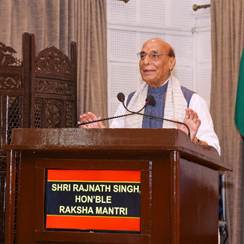
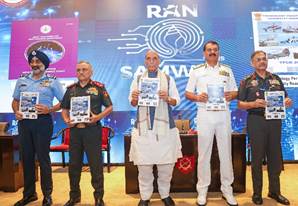
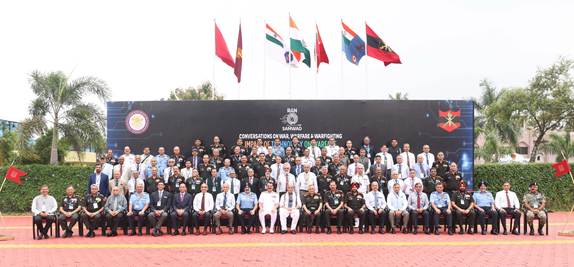
Reflecting this ethos at the ‘Ran Samwad’ forum, organised by Headquarters Integrated Defence Staff and the Centre for Joint Warfare Studies, in close coordination with Army Training Command India’s Raksha Mantri Shri Rajnath Singh emphasized dialogue as a cornerstone of conflict resolution while underscoring hard-power credibility, techno-military transformation, and the necessity of self-reliance. He called for a national approach to security, urging collaboration across government, industry, academia, and the armed forces to enhance India’s defence capabilities. This article situates that message within India’s historical arc, surveys the technological shifts redefining conflict, and assesses the strategic logic of atmanirbharta (self-reliance) in defence as a whole-of-nation endeavour.
“The very title of the program, Ran Samwad, strikes me as quite interesting. The name itself is a subject worth thinking about and reflecting on. On one hand, ‘Ran’ evokes the imagery of battle and conflict, and on the other hand, ‘Samwad’ points towards dialogue, discussion, and reconciliation,” he said.
The Civilizational Ethos: Dialogue Alongside Deterrence
Ran and Samwad as twin pillars: The Raksha Mantri explained in Indian strategic culture that the readiness to defend sovereignty coexists with the willingness to accommodate through dialogue. This is not a paradox but a pragmatic ethic: dialogue is strongest when backed by credible capability, and deterrence is most stabilizing when coupled with communication channels.
The Mahabharata chronicles persistent attempts to avert catastrophe—entreaties for prudence, equitable settlements, and counsel from sages embodying statecraft and ethics. When war arrived, it was framed not as a repudiation of dialogue but as the consequence of its failure. Two lessons stand out: seek a just compromise where possible; prepare for a just defense when necessary.
Contemporary crises—great-power frictions, regional flashpoints, and sub-conventional proxy wars—often metastasize when communication is severed. Even adversaries with clashing aims can reduce the risk of miscalculation by maintaining backchannels, hotlines, and diplomatic forums. In an age of compressed decision times, this is strategic prudence, not idealism.
War’s Persistent Shadow and Historical Shaping Power
RM described war as a historical constant with variable character, from agrarian empires to industrial nation-states. War has reordered borders, drained treasuries, accelerated technologies, and reshaped societies. Few polities seek war; prudent ones prepare to deter, defend, and de-escalate. The costs—human, economic, environmental—are consistently devastating.
From land and sea to air and beyond: Strategic power migrated from cavalry and sail to steel and steam, then to airpower and amphibious reach. The 20th century introduced nuclear deterrence and space-based reconnaissance. The 21st century introduces cyber, cognitive, and autonomous overlays that blur the lines and dissolve the distinction between the home front and the battlefront.
The Technological Recomposition of Warfare
RM proclaimed that over the last two decades, the tempo of innovation has fractured predictability. Advantage decays quickly; learning cycles and adaptability become doctrine. The half-life of any single military edge is shrinking. Drones, loitering munitions, and networked sensors compress the find, fix, and finish cycle. Precision fires attrit high-value assets without massed formations, while persistent ISR (intelligence, surveillance, reconnaissance) erodes sanctuary. Code now shapes targeting, logistics, deception, and morale. Electronic warfare, cyber operations, and data poisoning can paralyze without a shot. The kill chain is increasingly a data chain: to sense, decide, and strike is to compute.
AI-enabled C2 and autonomy: Machine learning augments command-and-control, fusing multi-domain inputs into actionable options. Swarms, collaborative independence, and human–machine teaming redefine mass and manoeuvre. Yet AI introduces new failure modes—bias, brittleness, and adversarial manipulation—requiring robust testing and human oversight.
Semiconductors, rare earths, propulsion, and secure communications are now strategic substrates. Industrial capacity and technological sovereignty have a significant influence on resilience in prolonged conflicts. Innovation migrates from defence labs to dual-use startups and back. The civilian sectors, including cloud computing, satellite constellations, and telecommunications, have become strategic enablers.
India’s Strategic Response: Dialogue Anchored in Credible Power
RM maintained that diplomacy was a deterrence partner. India’s approach prioritizes peaceful resolution while sustaining deterrence through readiness across land, sea, air, cyber, and space. Dialogue reduces miscalculation; capacity builds leverage at the table.
Atmanirbhar Defence & Doctrinal Agility: From Vision to Execution
India’s strategic discourse, as articulated in the RM’s message at Ran Samwad, underscores a cohesive agenda that marries principled diplomacy with technological ascendancy and industrial self-reliance, while driving doctrinal agility across the armed forces; it emphasizes that dialogue remains a force multiplier in conflict resolution—keeping channels open with neighbours and partners and leveraging multilateral platforms to shape norms—even as the character of warfare shifts toward AI-enabled, quantum-empowered, hypersonic, and space-driven paradigms that must be integrated into doctrine, training, and force design. Delivering on this vision requires an Atmanirbhar Bharat architecture that moves beyond aspiration to a programmatic scaffold: phased positive indigenization lists to nudge demand, Make categories and iDEX to de-risk early-stage R&D and pull MSMEs and startups into the procurement mainstream, defence corridors in Uttar Pradesh and Tamil Nadu that knit OEM anchors with testing facilities and academia, and export facilitation that couples streamlined licensing with offsets and financing to scale Indian platforms globally. Capability priorities must be sequenced around sensors and shooters—AESA radars, EO payloads, precision munitions, long-range artillery, A2/AD systems—while closing propulsion and platform gaps across fighters, UAV/UCAV families, armoured vehicles, naval combatants, and marine/jet engines; simultaneously, a sovereign digital backbone is essential, encompassing secure tactical datalinks, EW suites, cyber defence, cloud-to-edge architectures, digital twins for lifecycle management, and resilient space and PNT layers integrated with NavIC to ensure assured communications and navigation under contestation, alongside munitions resilience via scalable energetics, seekers, and guidance kits for surge capacity. Industrial strategy must harden the design-to-manufacture pipeline by funding TRL 3–7 transitions, expanding test ranges, EMI/EMC labs, wind tunnels, and anechoic chambers, and institutionalizing model-based systems engineering; it should tighten standards and certification through AS9100 and MIL-STD compliance with accelerated yet uncompromised QA/QC, localize supply chains for composites, alloys, microelectronics, and optronics with built-in redundancy, and sharpen export competitiveness through reliability, cost discipline, lifecycle support, and training ecosystems for partner forces. Underpinning all of this is human capital: deepening STEM in avionics, propulsion, materials, AI, and EW with scholarships and joint labs; scaling apprenticeships and certifications in precision manufacturing and maintenance across MSMEs; and enabling civil–military mobility via lateral entries and secondments that cross-pollinate operational insight with industrial innovation. Finally, doctrinal evolution must codify lessons from global conflicts while adapting to subcontinental realities, privileging mission command, distributed operations, jointness, and rapid learning in a transition from jointness to proper integration through interoperable C4ISR, common data standards, and unified theatre doctrines that align force packages to mission-oriented, cross-service capabilities; this is anchored by a digital backbone—sovereign clouds feeding latency-sensitive edge nodes, a zero-trust data fabric with standard schemas and metadata for cross-domain fusion, and robust AI pipelines with MLOps, validation, and adversarial red-teaming—that compresses the OODA loop: observing via ISR satellite constellations, HALE/MALE drones, and ground sensors; orienting with AI-assisted, context-rich analytics; deciding through mission-level optimization and commander’s intent propagated across echelons; and acting with synchronized, distributed effects across land, sea, air, cyber, and space, thereby ensuring that India’s security is prosecuted as a whole-of-nation enterprise—policy, services, academia, startups, MSMEs, and industry moving in concert to deliver deterrence by denial, punishment, and resilience.
In the RM’s message at ‘Ran Samwad,’ dialogue is framed as a strategic technology—an architecture as vital as any platform—where robust communication infrastructure, including hotlines, deconfliction mechanisms, maritime incident protocols, and crisis playbooks, lowers escalation risks while digital resilience—encryption, EMP hardening, and satellite redundancy—ensures continuity under stress; alongside these mechanics, India should lead the shaping of norms and regimes for cyber conduct, space debris mitigation, and the responsible use of AI in warfare, turning rule-making into a projection of responsible power that protects national interests in contested commons, even as backchannels and track‑2/1.5 engagements with neighbours and major powers widen option sets, clarify red lines, and create off‑ramps when formal diplomacy stalls; in the cognitive battlespace, information integrity must be treated as deterrence in its own right, coupling fused intelligence with credible, transparent public communication to outpace disinformation; sustaining power also demands an economics of security in which defence outlays are fiscally sustainable and deliberately converted into industrial depth, innovation spillovers, and skilled employment—leveraging dual‑use investments in microelectronics, advanced materials, and space services to strengthen smart manufacturing, resilient logistics, and disaster response—while lifecycle economics, from through‑life support and modular upgrades to condition‑based maintenance, keeps fleets current at lower total ownership cost, measured by hard resilience metrics such as supply continuity under stress, mean time to restore critical networks, inventory depth for high‑burn munitions, and domestic content ratios in key platforms; regionally, a “neighbourhood first, globally networked” posture should anchor stability and connectivity across the subcontinent and Indian Ocean even as India deepens technology partnerships for co‑development and co‑production, practicing interoperability without dependency by standardizing with partners yet retaining sovereign control over critical nodes, data, and source code, and using exports as strategy to build trust, align standards, and establish maintainable spheres of interoperability that convert commerce into durable security relationships; governance must match ambition, with procurement agility that treats time as capability—streamlined RFPs, spiral development, prototype funding with clear exit criteria, and disciplined avoidance of requirements creep—backed by transparent prioritization through capability‑based planning, red‑teamed threat scenarios, and unclassified industrial roadmaps that mobilize private capital, plus rigorous testing and evaluation via independent verification, cyber test ranges, and live–virtual–constructive environments to validate readiness against realistic adversaries, and a true audit‑and‑learning culture where after‑action reviews shape doctrine, acquisition, and training, and where whistleblowers are protected and candor incentivized; finally, recognizing security as a public good, citizens should cultivate a resilience mindset—cyber hygiene, emergency preparedness, and critical media literacy—while the state expands talent pipelines through hackathons, DRDO/ISRO internships, and NCC technology tracks, and energizes the industry–academia–forces triangle with capstone projects aligned to operational needs and challenge grants that pull research toward real‑world problem‑solving, thereby fusing dialogue, technology, and society into a coherent strategy for enduring security and credible power.
The RM spoke at length on Technological Recomposition of Warfare. Warfare is undergoing a technological recomposition marked by acceleration without a stable pattern. Over the last two decades, the tempo of innovation has shortened the half-life of military advantage: capabilities diffuse quickly, countermeasures arrive faster, and what works today may be obsolete tomorrow. In this landscape, adaptability is not a desirable trait—it is doctrine. Forces that embed rapid learning loops, modular architectures, and flexible command structures will outpace those anchored to static concepts of operation.
Precision and Persistence: A New Operational Ethos
With unmistakable energy and clarity, the Raksha Mantri championed a future of warfare defined by precision and persistence, where momentum is won not by mass alone but by mastery of tempo, signatures, and systems: the compression of the kill chain through drones, loitering munitions, and dense sensor webs now lets small, agile teams—plugged into distributed ISR—find, fix, and finish with breathtaking speed, generating effects once reserved for massed formations; precision fires bring attrition without mass, surgically degrading high-value nodes—air defences, logistics hubs, and C2—with fewer sorties and smaller signatures, turning every strike into a lever that tilts the battlespace; survivability is boldly reimagined for a world of persistent surveillance, hinging on dispersion, deception in both physical and digital realms, robust electronic protection, and resilient, redundant logistics, where camouflage becomes as much cognitive as material and signatures across RF, thermal, and digital spectra are managed like precious currency; persistent ISR itself emerges as a deterrent, its watchful, correlatable gaze across unclassified and classified feeds raising the cost of aggression and rewarding operational discipline; in the cyber and cognitive domains, systemic targets take center stage as cyber operations routinely contest infrastructure, industrial control systems, and command networks to produce effects spanning tactical disruption to strategic coercion, while perception warfare stretches the battlespace into public opinion, financial systems, and the data exhaust of civilian life, shaping decision tempos and morale amid the fog of narrative; the ambiguity of thresholds in blended cyber–information campaigns complicates attribution and escalation, demanding legal agility, diplomatic poise, and technical readiness to respond decisively below the kinetic line; AI-enabled C2 surges ahead with momentum through augmentation—accelerating targeting, optimizing logistics, and driving predictive maintenance to raise sortie rates and platform availability while lifting cognitive burdens—yet insists on guardrails for reliability, acknowledging algorithmic opacity, data drift, adversarial perturbations, and data poisoning as risks to be tamed through rigorous testing, red-teaming, dataset provenance, secure MLOps, and steadfast human-over-the-loop oversight for any lethal decision; interoperability by design becomes a force multiplier, with open, secure interfaces and modular data standards empowering coalition operations and dissolving vendor lock-in to keep adaptability alive under contested conditions; and above it all, space stands as critical scaffolding, delivering foundational PNT, secure communications, and ISR, while protection and reconstitution strategies—proliferated LEO constellations, sovereign capabilities, rapid launch, allied interoperability, space domain awareness, hardening, and terrestrial backups—embed resilience into deterrence itself; together, these pillars form a cohesive, future-ready doctrine that prizes speed with judgment, stealth with stamina, and technological edge with ethical control, ensuring that precision and persistence are not mere slogans but the decisive cadence of modern power.
With heartfelt pride and invigorating clarity, the RM congratulated the Indian Tri-Services for absorbing the hard-won lessons of contemporary theatres and translating them into action, noting how the Russia–Ukraine conflict has spotlighted an era of attrition-by-precision where commercial satellites, open-source intelligence, tactical drones, and electronic warfare dissolve old asymmetries; where static defences are mapped and struck, logistics are harassed at depth, and morale is contested digitally; and where victory now favours those who adapt fastest—through training, tactics, industrial mobilization, and supply-chain agility—while Operation Sindoor epitomizes the techno-operational fusion. India is championing the integration of sensors, counter-UAS, integrated air defence, secure communications, and EW into a coherent doctrine, so that technology becomes a repeatable capability rather than mere gadgetry, powered by disciplined maintenance, data architectures, and mission-ready crews. Looking ahead to the future battlespace, the RM celebrated India’s sharpened focus on system-versus-system confrontation—where supply chains, finance, data, energy, and alliances dynamically interact—and emphasized that intelligence as arbitrage will determine tempo, pre-emption, and deception detection, just as diplomacy as a force multiplier will bend cost curves, expand logistics access, deepen technology partnerships, and preserve off-ramps even as deterrence strengthens. In this strategic shift, India’s turn to self-reliance gleams with confidence: from importer to reliable exporter of platforms like `LCA Tejas`, `Akash`, advanced artillery, and a growing fleet of naval vessels, propelled by policy reforms that unleash private industry, mobilize MSMEs, accelerate acquisitions, spur startups, and ease exports—while pursuing true sovereignty through mastery of propulsion, seekers, radars, EW suites, advanced materials, and secure software stacks, backed by sovereign test infrastructure, robust IP frameworks, and sustained R&D that vaults the nation from assembly to innovation. The RM lauded the training-to-sustainment pipeline—test ranges, digital twins, secure DevSecOps, lifecycle support, and realistic training that blends cyber, EW, and counter-UAS—turning platforms into operational advantage and ensuring readiness is lived, not claimed. Finally, he underscored the strategic imperatives with contagious optimism: design for adaptability via modular, upgradeable, open architectures; harden the information backbone with zero-trust networks, resilient PNT, and spectrum-aware operations; close the OODA loop through AI-augmented C2, fused ISR, and mission command that compress decision cycles without sacrificing judgment; build industrial stamina through secure supply chains, dual-use innovation, and surge manufacturing; and leverage alliances so interoperability and shared situational awareness transform partnerships into credible deterrence and operational depth—together forging a future in which India senses, decides, acts, and recovers faster than any adversary, with confidence, coherence, and courage.
In outlining a maritime and aerial posture to secure the global commons, the Raksha Mantri underscored that India’s security and prosperity hinge on the freedom, stability, and predictability of the sea and air domains, where deterrence by presence, integrated awareness, and interoperable partnerships form the bedrock of credibility and restraint; this requires defending trade arteries in the Indian Ocean Region through blue-water naval reach backed by forward logistics, while scaling persistent ISR—satellites, coastal radars, underwater sensors, and manned/unmanned platforms—to build a recognized maritime picture that constrains grey-zone tactics and supports networked ASW across multistatic sonar, maritime patrol aircraft, and autonomous undersea vehicles; simultaneously, maritime partnerships—ranging from exercises and information fusion centers to coordinated patrols with regional and extra-regional navies—must align operating pictures, rules of behaviour, and signalling so that malign actions are visible, attributable, and therefore costly; in the air domain, a resilient umbrella rests on layered IAMD with high-coverage sensors, ground-based interceptors, point-defence systems, and AEW&C for real-time cueing, all fused through network-centric operations that tie multirole fighters, UAVs, long-range fires, and joint C2 via secure data links, while tanker support extends time-on-station for rapid swing-role responses across dispersed theatres; this integrated posture is complemented by a sober accounting of the total cost of conflict—beyond the battlefield—where supply chain rewiring, commodity shocks, and inflationary spillovers reshape growth trajectories, and dual-use technologies such as semiconductors, quantum communications, advanced materials, and resilient software stacks become strategic levers that shape both deterrence and development; at home, societal resilience is a strategic asset: civil preparedness through robust public health, civil defence drills, and critical-infrastructure cyber hygiene reduces systemic vulnerabilities, while psychological resilience—anchored in media literacy, rumour-control protocols, and transparent communication—blunts disinformation and sustains cohesion under stress; ultimately, national security is a collective responsibility demanding whole-of-society preparedness in which industry delivers secure-by-design products, diversified and hardened supply chains, and surge capacity for critical goods; academia advances open innovation with secure research protocols, ethical frameworks for dual-use research, and talent pipelines in STEM and strategic studies; citizens practice disaster readiness, strong cyber hygiene, and informed media consumption; and government orchestrates inter-agency coordination, transparent risk communication, and sustained investment in foundational science and test infrastructure; finally, bridging innovation to capability requires disciplined pathways from lab to field through testbeds, regulatory sandboxes, and mission-oriented public–private collaboration that compresses timelines, derisks adoption, and ensures that deterrence by presence—at sea and in the air—is matched by deterrence by performance, readiness, and resilience.
The Enduring Relevance of Ran & Samwad
India’s strategic synthesis of Ran (force) and Samwad (dialogue) remains a durable guide for an era defined by dispersed, data-driven, and often silent contests. The task is not to choose between deterrence and diplomacy, but to integrate them: to field capable maritime and aerial shields, invest in the technologies that shape tomorrow’s battlespace, and cultivate societal resilience that denies adversaries’ easy leverage.
As first shots may be digital and decisive manoeuvres may unfold in boardrooms and laboratories, the sovereign edge will accrue to those who fuse capability with conversation, deterrence with diplomacy, and speed with judgment. India’s drive toward self-reliance in defence, coupled with open channels for crisis management and norm-setting, exemplifies this equilibrium. That is the timeless counsel of the Mahabharata—strength guided by wisdom—and the timely mandate for modern statecraft.
Keeping the Conversation and the Capability
India’s strategic inheritance affirms that Ran and Samwad are not alternatives but complements. Dialogue—rooted in civilizational confidence and diplomatic dexterity—reduces the risk of miscalculation and creates avenues for just peace. Deterrence—grounded in readiness, technology, and self-reliance—gives that dialogue weight and credibility.
The RM’s call at ‘Ran Samwad’ is therefore both timely and timeless: invest in the tools of modern warfare—AI-enabled C2, resilient networks, precision effects, and secure supply chains—while institutionalizing dialogue across borders and within our own national ecosystem. Self-reliance is not autarky; it is strategic autonomy built on competitive capability and trusted partnerships. National security is not the sole remit of the armed forces; it is a whole-of-society enterprise, where citizens, industry, academia, and government share reciprocal responsibilities.


